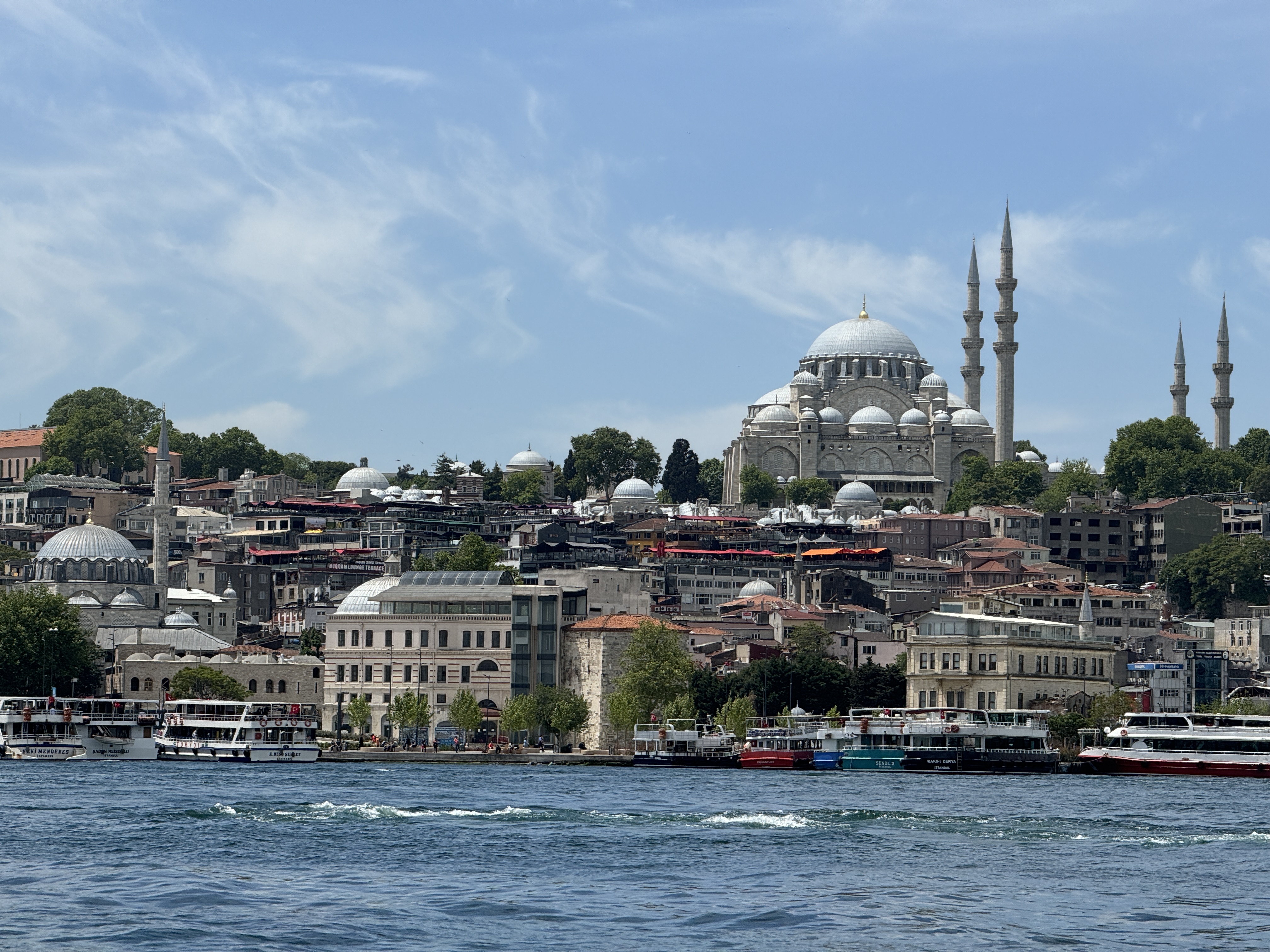
October, 2024
Incredible Istanbul
Here we are, 30 years after we switched our honeymoon destination from Turkey to Portugal after some terrorist activity made us nervous. Despite the rampant inflation (our taxi driver told us how the price of milk went up tenfold over the past three years), there’s a lot of action and a positive vibe here. Street vendors and restaurant staff stand outside their shops trying to entice us in. They are funny (“hi, can I take your money?”), persistent, but not in an annoying way and when you turn them down they laugh and say “ok, maybe later?” There are so many shops and restaurants in this city, one has to wonder how they make any money. The history is long and rich and full of intrigue. So much to share that I will divide it up into a few posts.
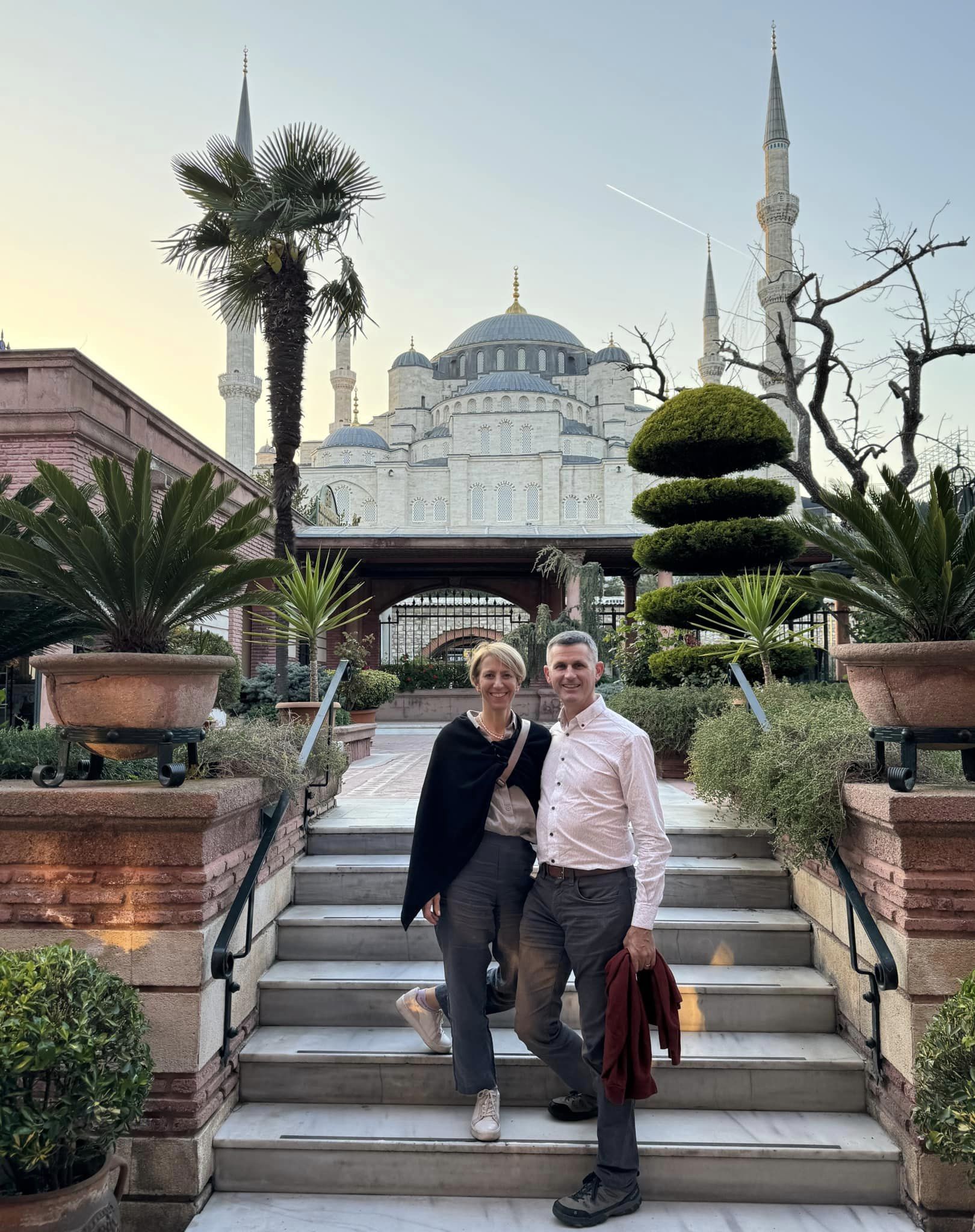
Who knew our hotel faced the Blue Mosque?! Spectacular location!
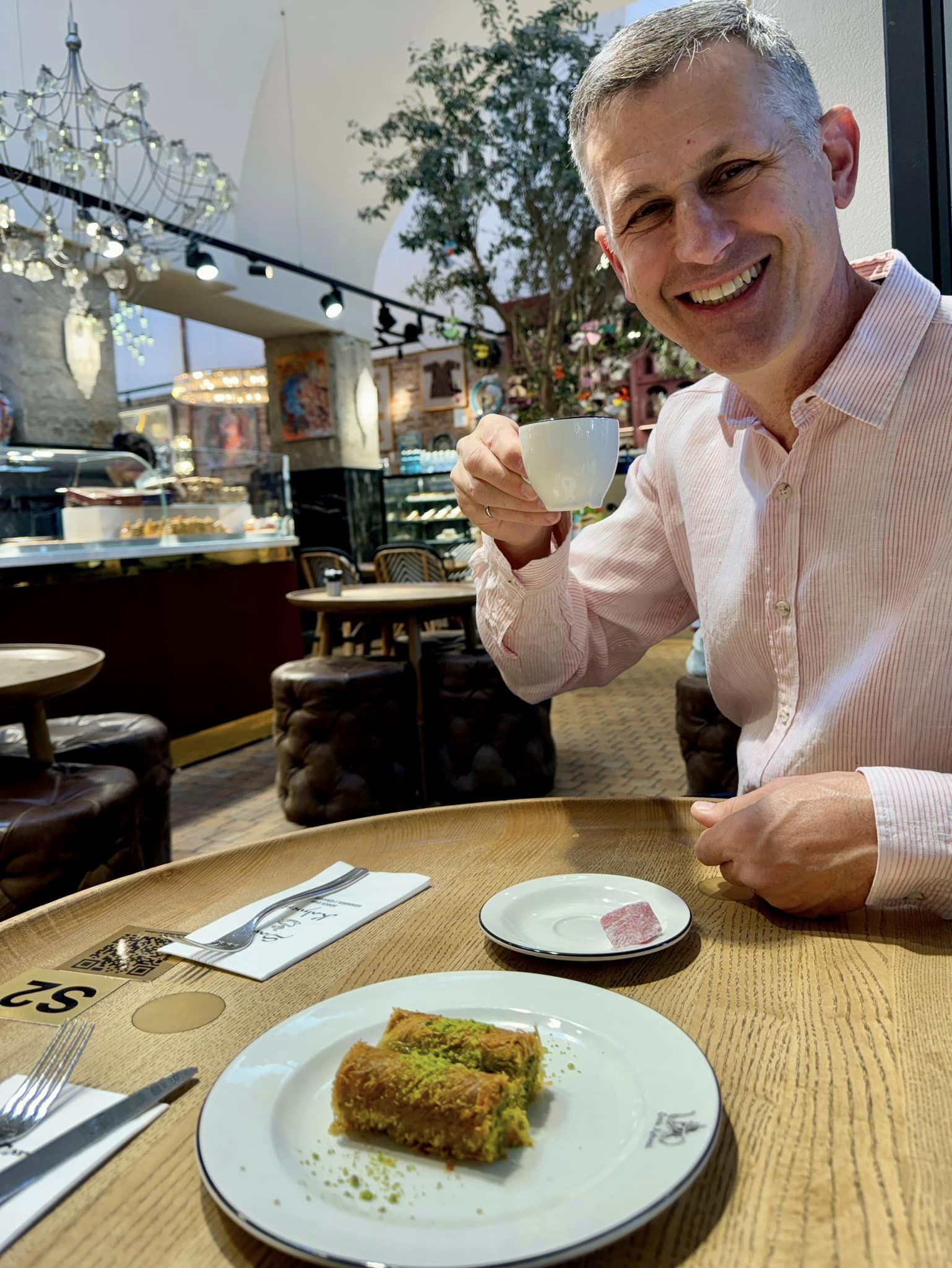
First morning, Adam dove right into a Turkish coffee. The bottom third of the cup was coffee grinds. Nobody official was around to tell his future but I could tell part of it with confidence; that there would be no more Turkish coffee in his future. He’ll stick to his regular doppio espresso!
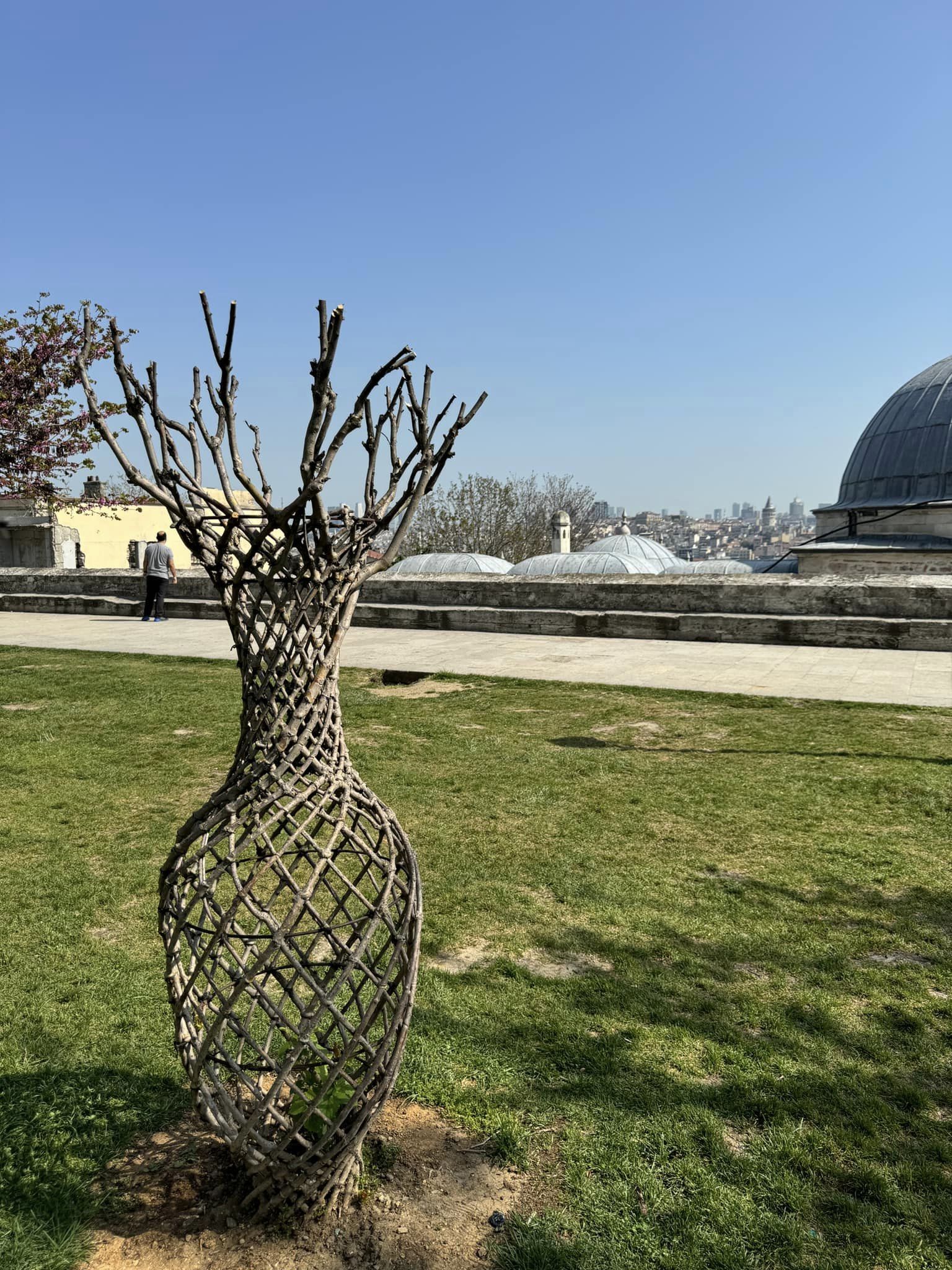
This is a real level up for topiaries. Step aside braided Benjamin Figs and make room for this Crape Myrtle. How amazing would this be in bloom!
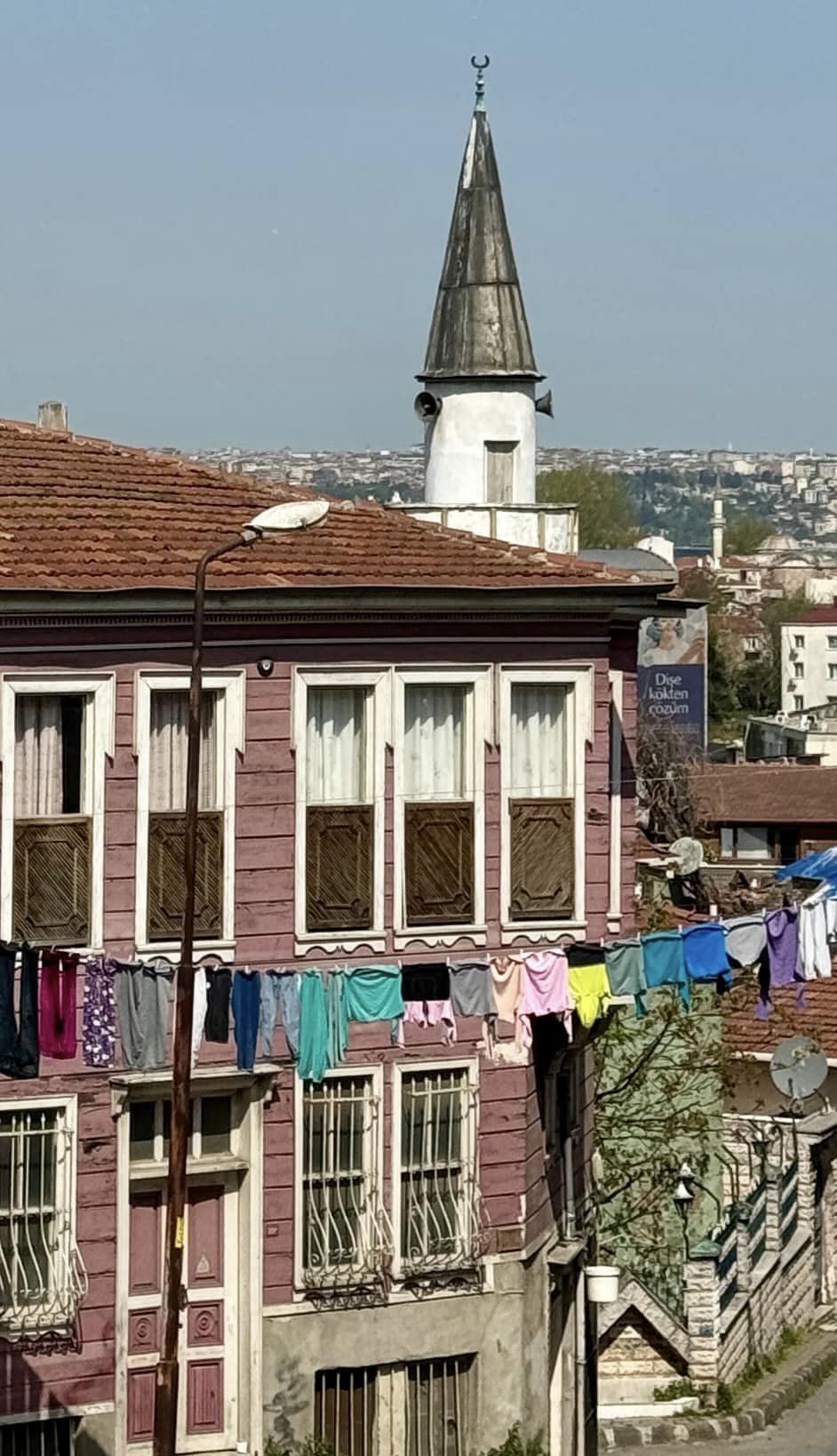
Wandering the streets outside the tourist areas takes us to the most beautiful places where real people live.
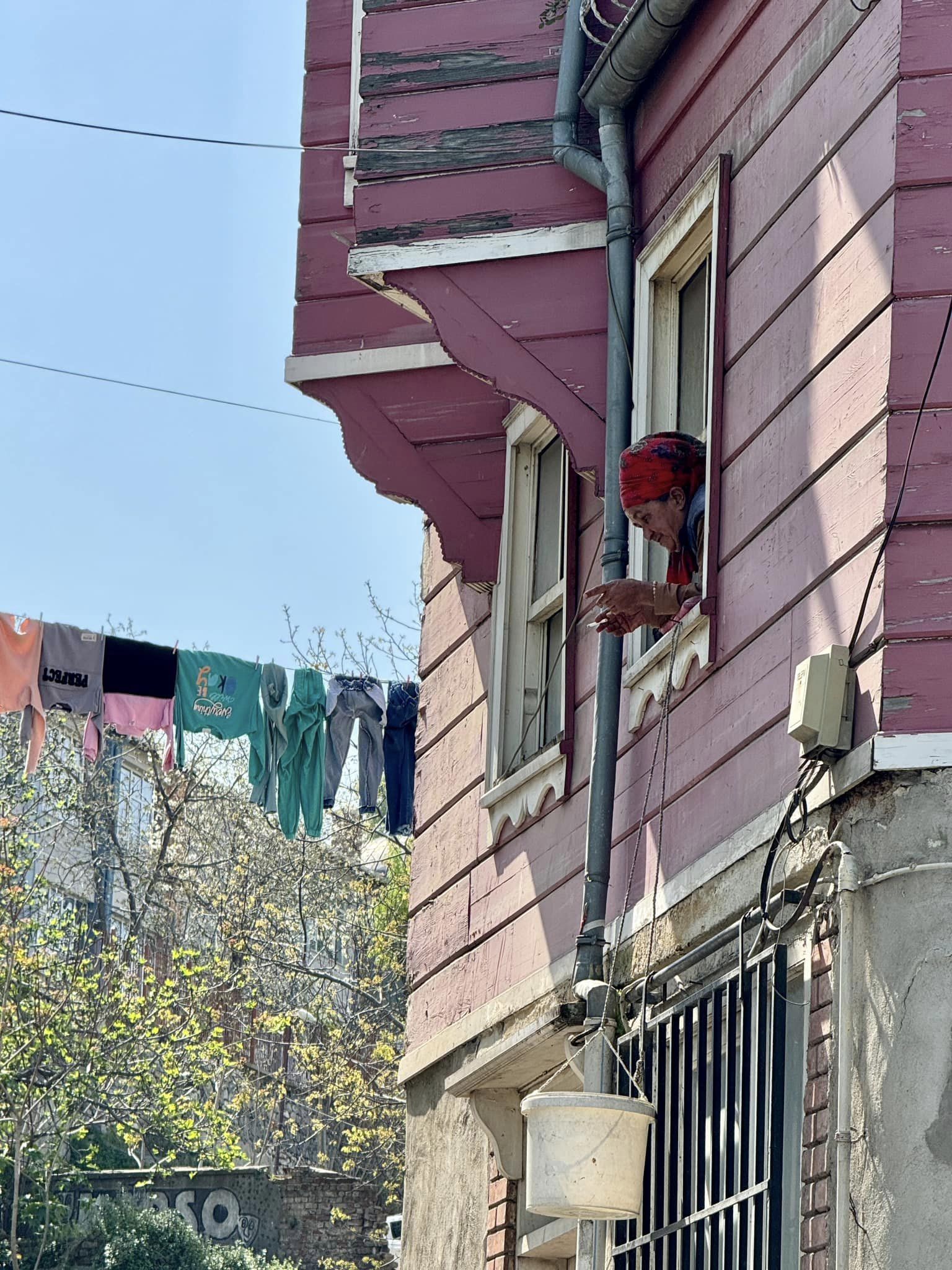
Chatting with the neighbours.
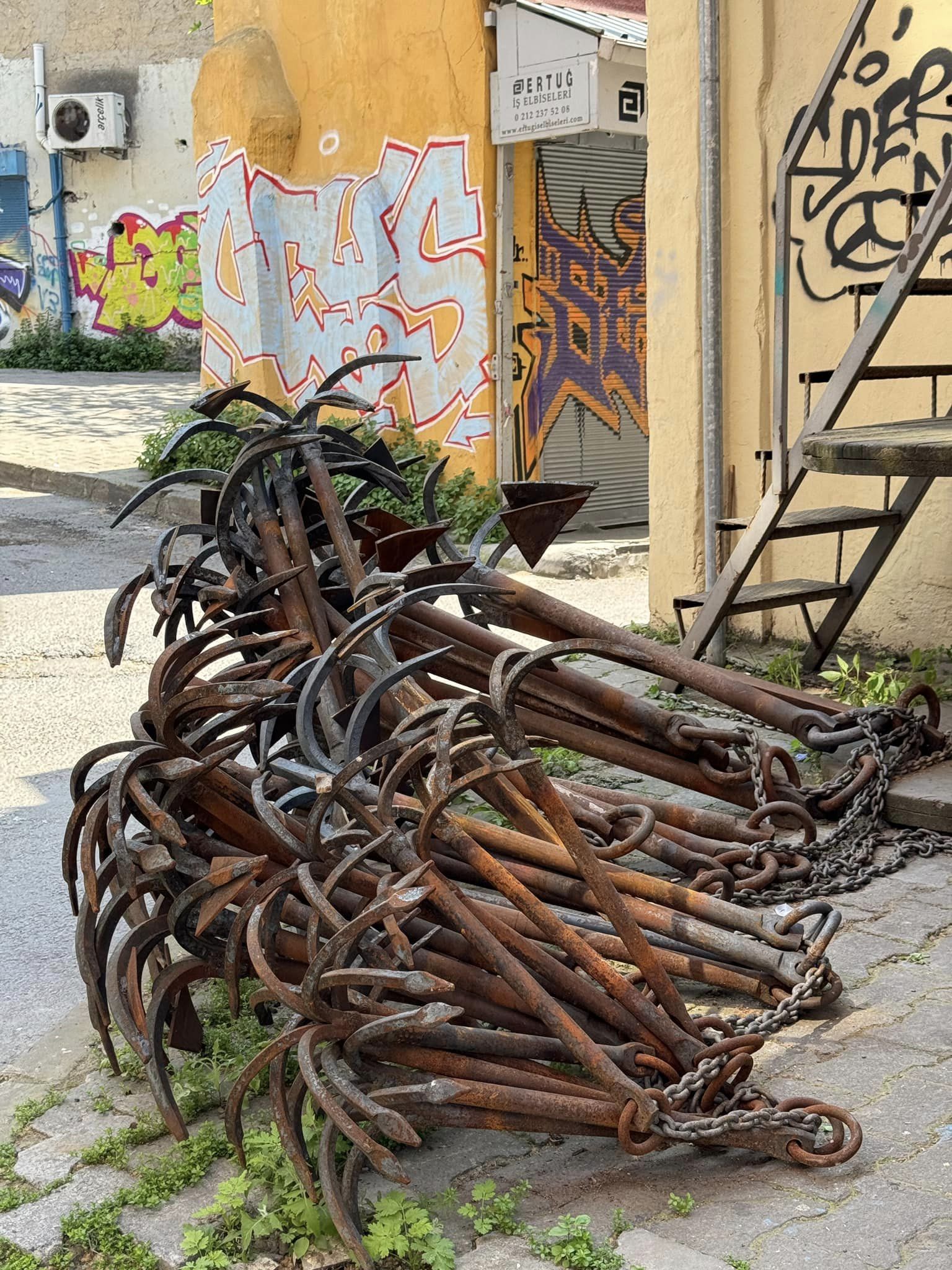
Anyone need an anchor? Good luck getting one out of this stack unscathed. This takes pick-up-sticks to a whole new level!
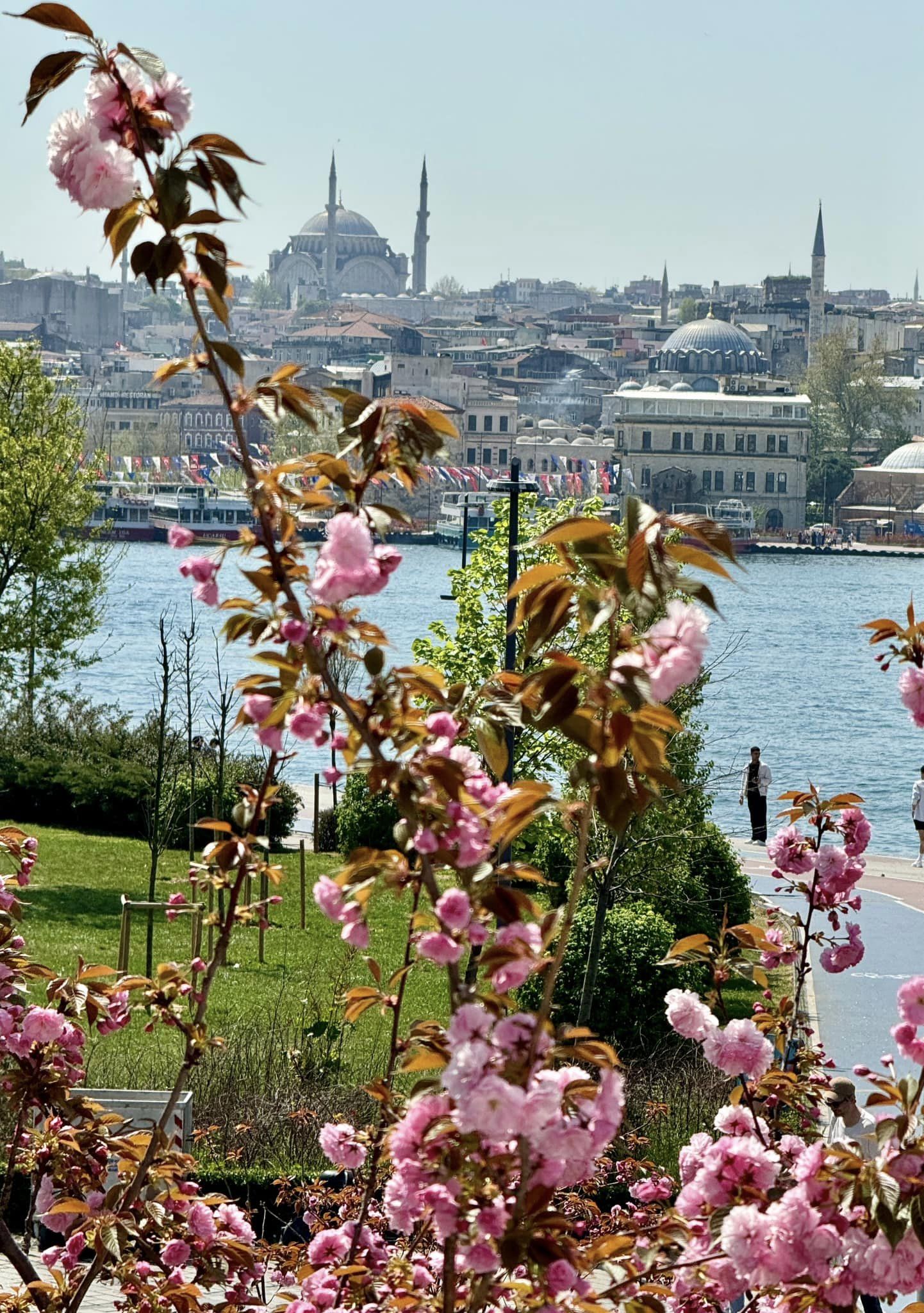
It’s cherry blossom season in Istanbul too!
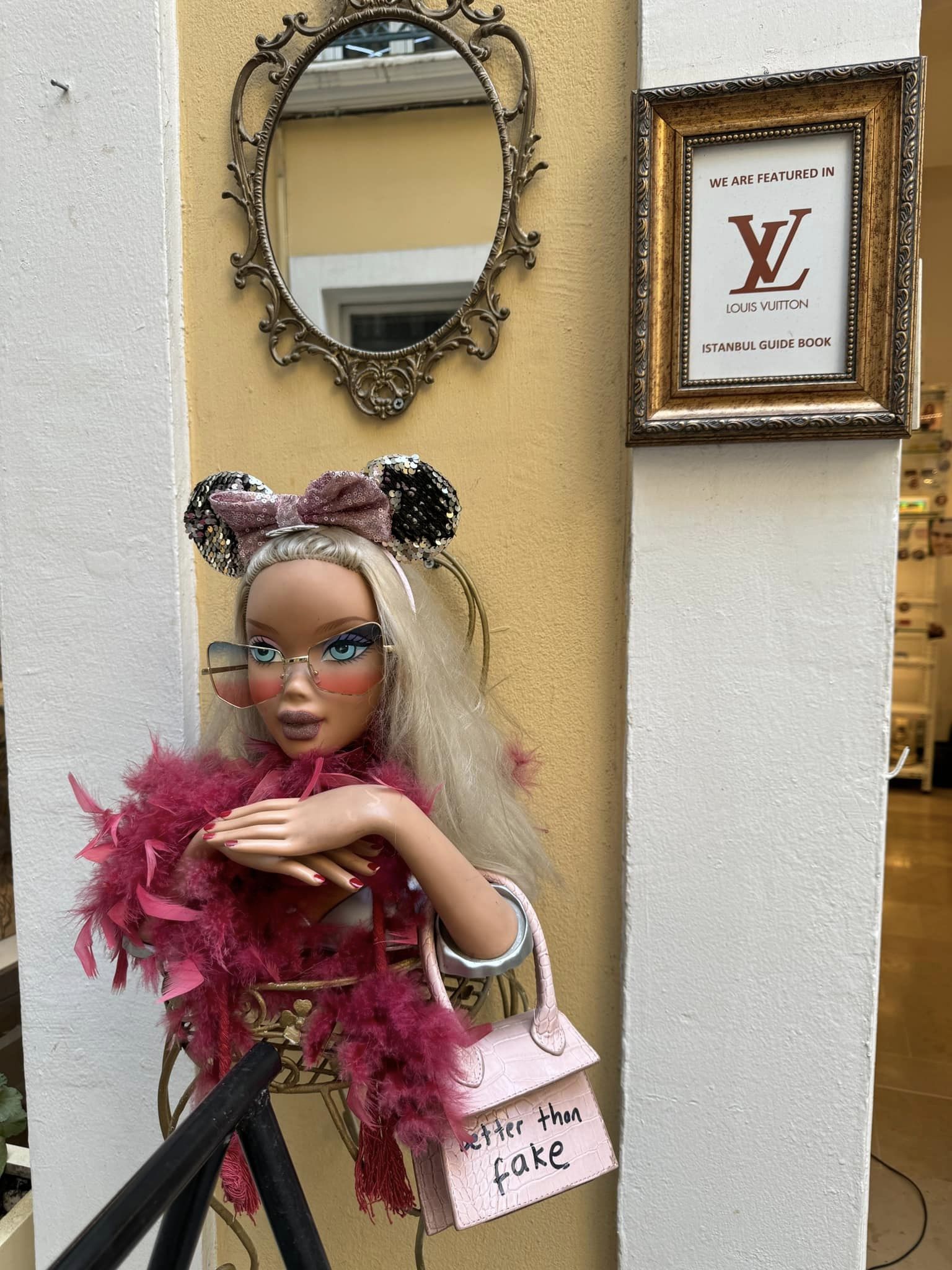
Ah, the land of fakes. The markets are full of fake everything from shoes to handbags to jewellery to watches. The funny thing is they are all the same pieces from shop to shop…and there are hundreds of shops. So if you want Chanel shoes, or an Hermes bag, or a Rolex watch, or a Tiffany bracelet, there is actually a very limited selection.
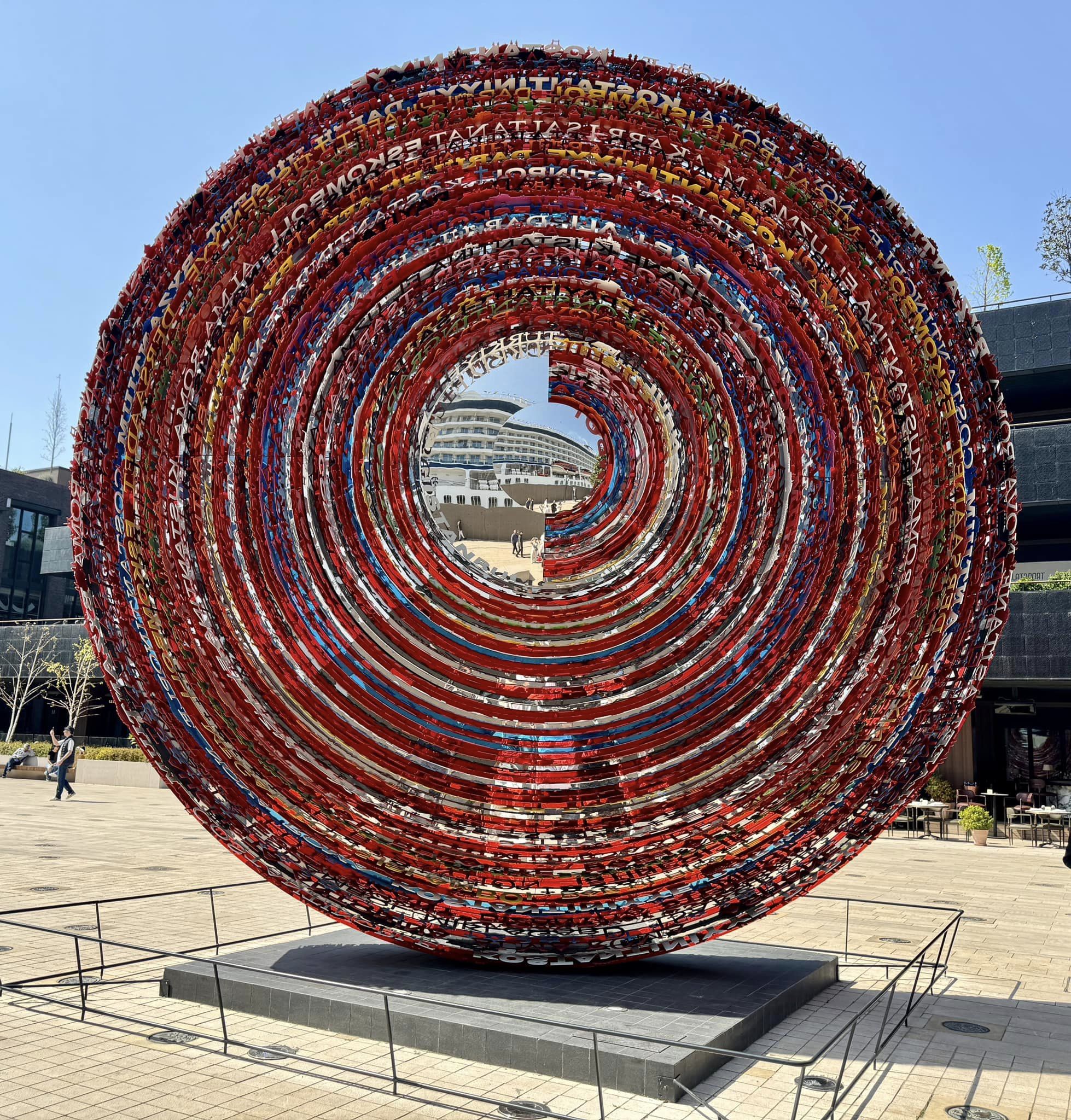
İsimlerin Şehri İstanbul (Istanbul City of Names) is a 2022 sculpture by Kurdish artist Ahmet Güneştekin at the Galataport’s waterfront. The many names of Istanbul through the ages make up this giant ring attesting to the long, vibrant and ever-changing history of this magical city.
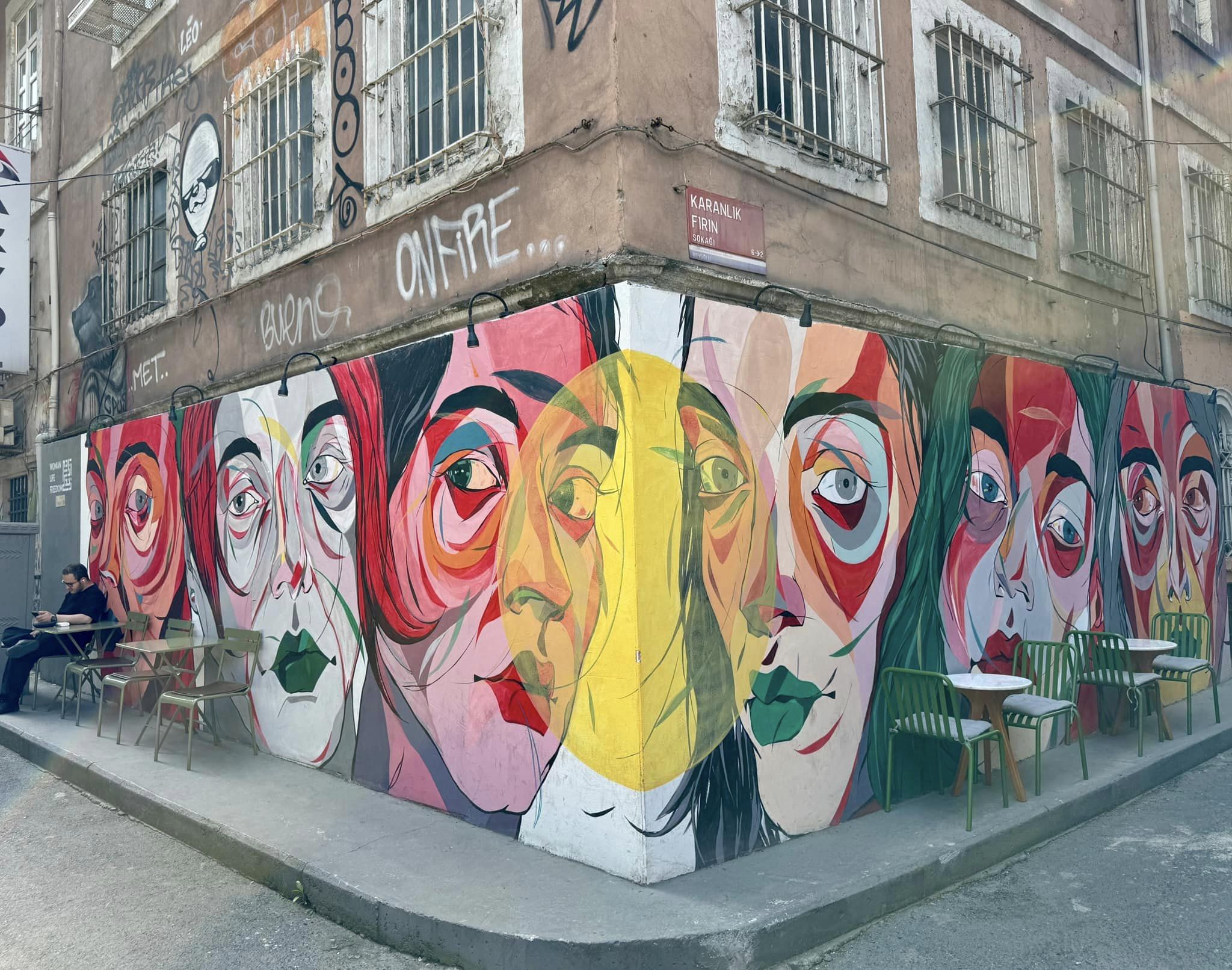
Woman Life Freedom, by artist Mohammad Javad Moradi was commissioned by Parsa Coffee Roasters and Ropi Karaköy Coffee in Istanbul in 2023. MJ Moradi is an Iranian artist who expresses his ideas through portraits with an emphasis, as you can see here, on eyes and lips. The slogan "Women, Life, Freedom" was started by the women-led Kurdish Freedom Movement in the early 2000s in response to persecution from the governments of Iran, Iraq, Turkey and Syria. It exploded as an international slogan with the protests following the 2022 death of Masha Amini at the hands of the Iranian police for refusing to wear a hijab.
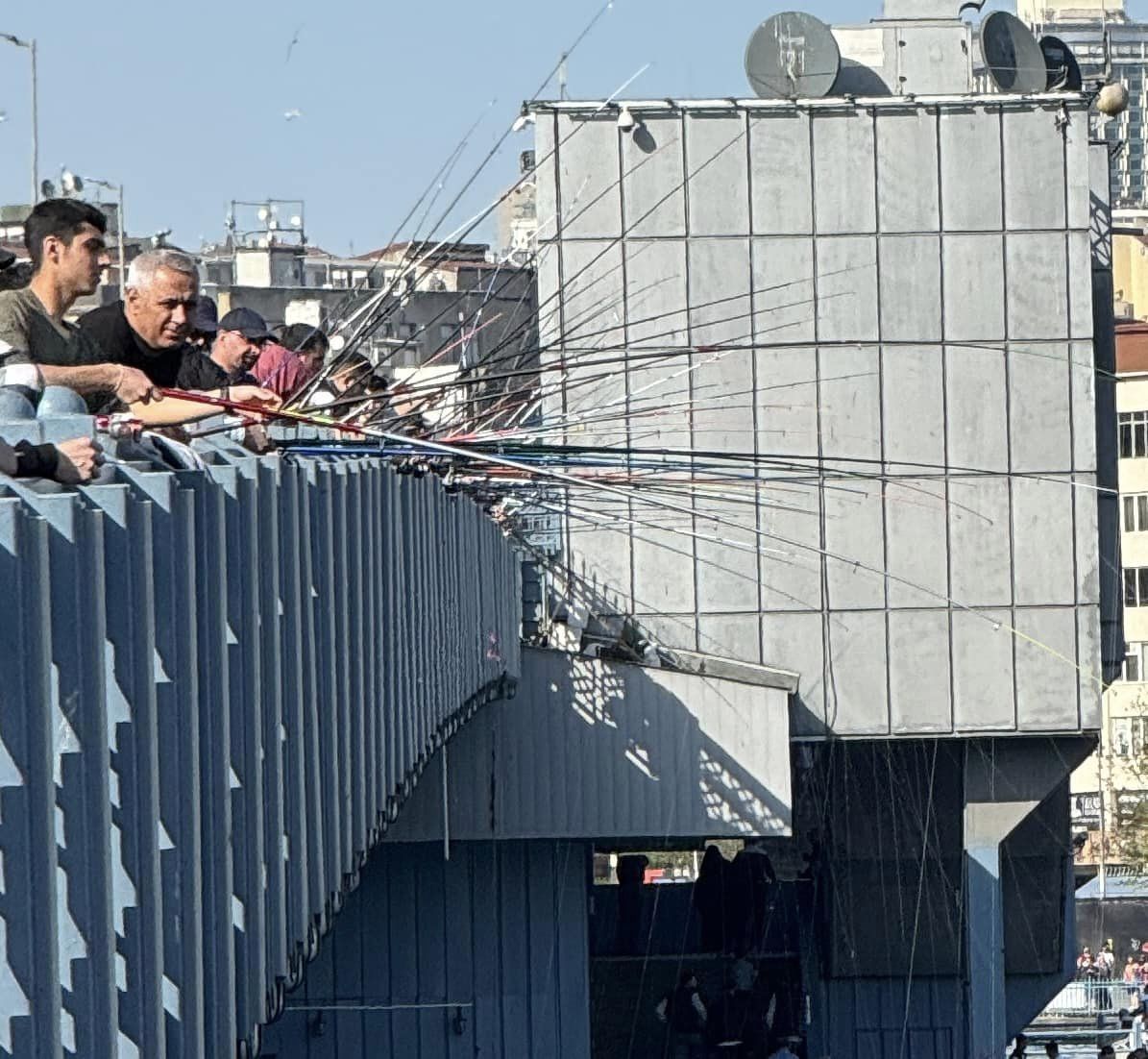
Fishing off the Galata Bridge. Hundreds of fishermen (and some women) are here from morning until late at night catching buckets of sardines, bluefish, horse mackerel and Atlantic bonito. Once the city cleaned up the toxic waters of Golden Horn about 15 years ago, the fish returned and the stench disappeared making it a haven for local fishers.
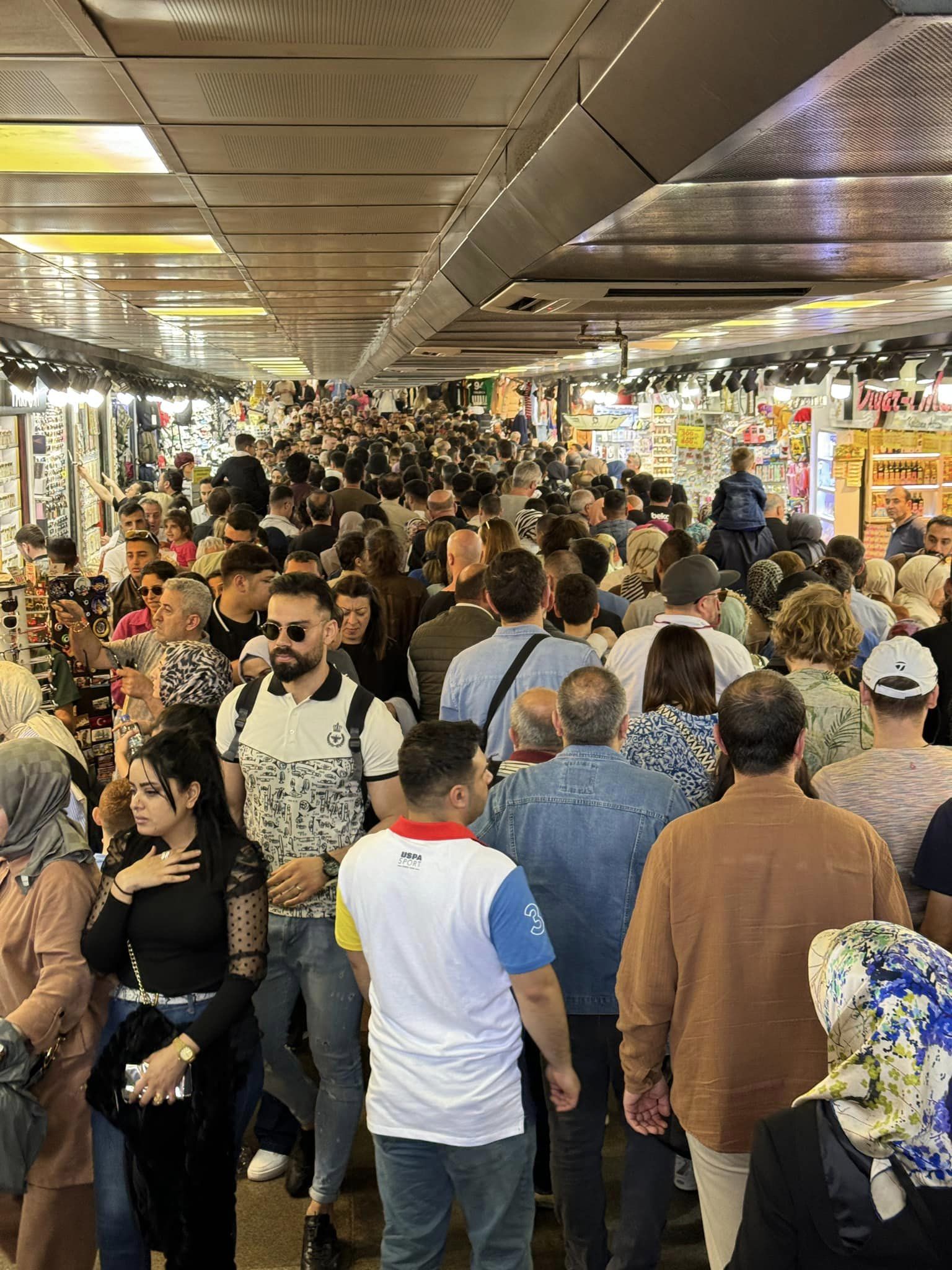
Traffic was insane when we arrived on the Friday after Ramadan ended. We realized it was the end of Eid and everyone was out to enjoy what they’d been missing for the past month. Traffic in the old city was at a patient standstill. No honking, no squeezing past cars (single lane after all), just waiting. And nobody seemed fussed that a taxi or a bus just stopped to wait for passengers and completely blocked everything. People on their feet are another story. Pushing and shoving to get through a tunnel lined with shopping stalls. Jam-packed with everyone swapping the crush of quiet cars on the street above for the crush of impatient people below.
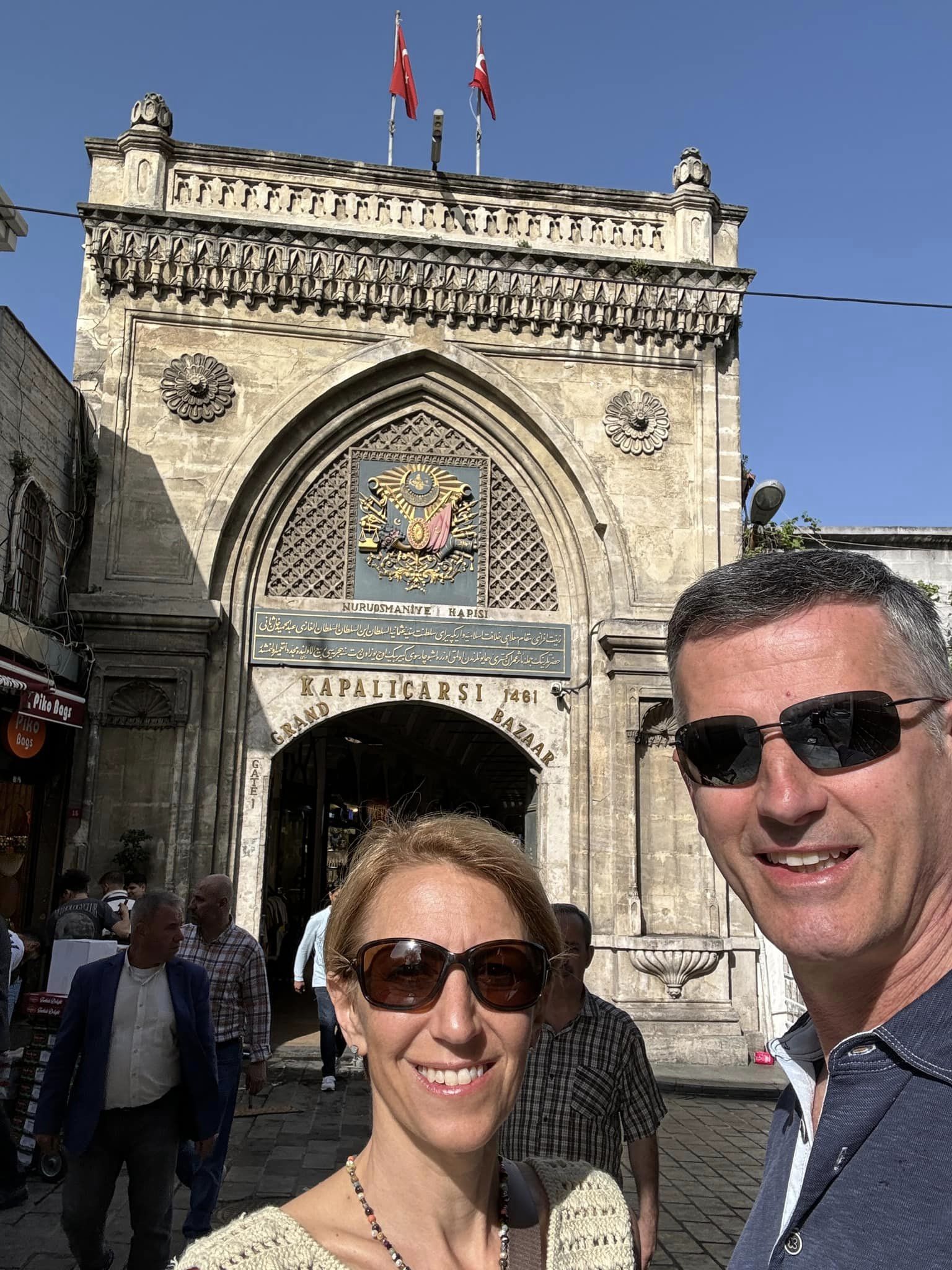
Grand Bazaar…on your mark, get set, go!
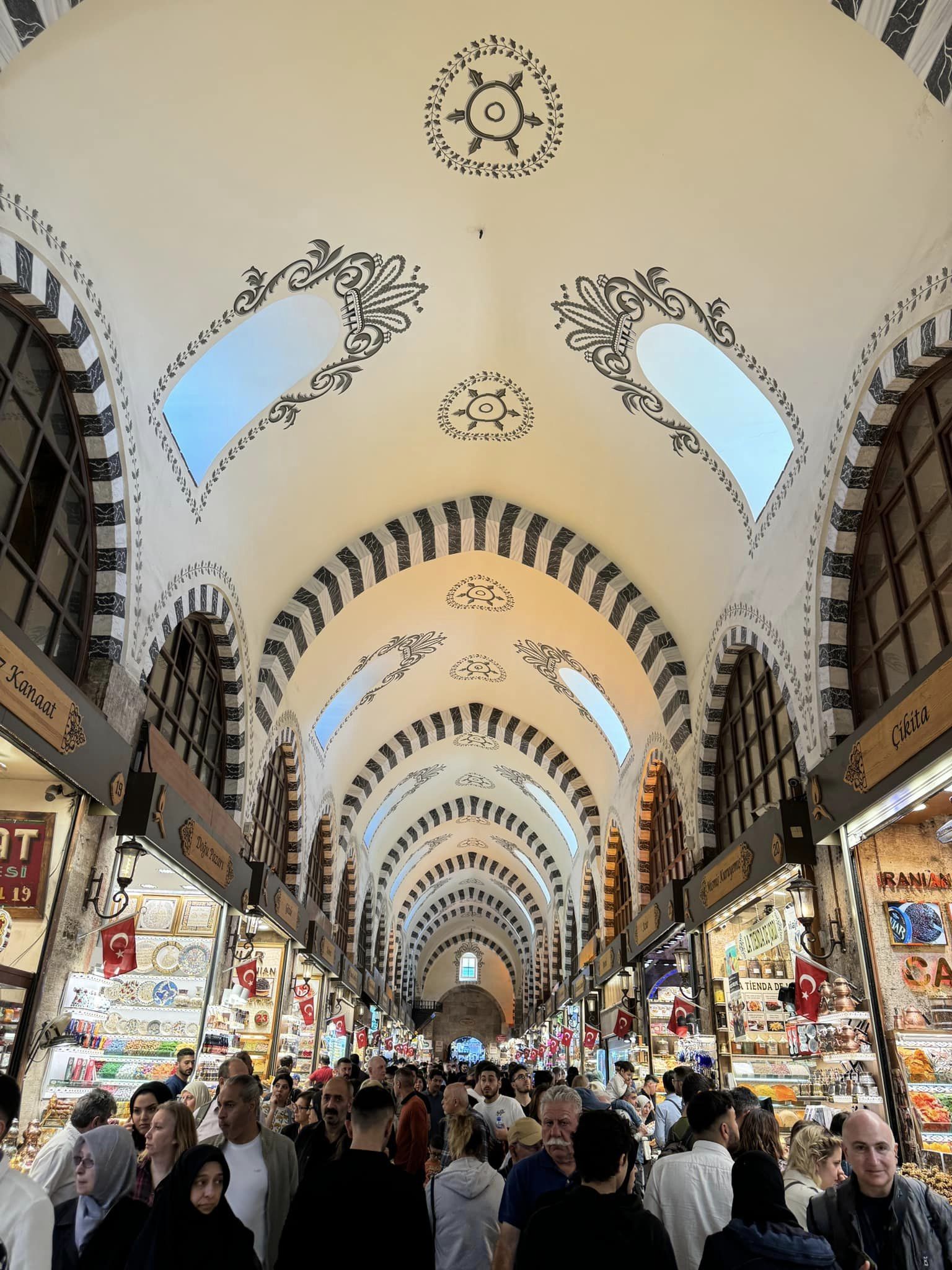
The Grand Bazaar is the world’s oldest and largest covered market. Since 1461, shoppers and merchants have met along these halls which now are a maze of 56 interconnected passages covering nearly 56,000 square metres and housing 4,000 shops. The passages making up the Grand Bazaar started out covered overhead with tent canvas. The canvas gave way to wooden planks and now we walk beneath stone and brick vaulted ceilings. Not as crowded in the Grand Bazaar as it would be during full on tourist season but lots of shoppers and observers nonetheless.
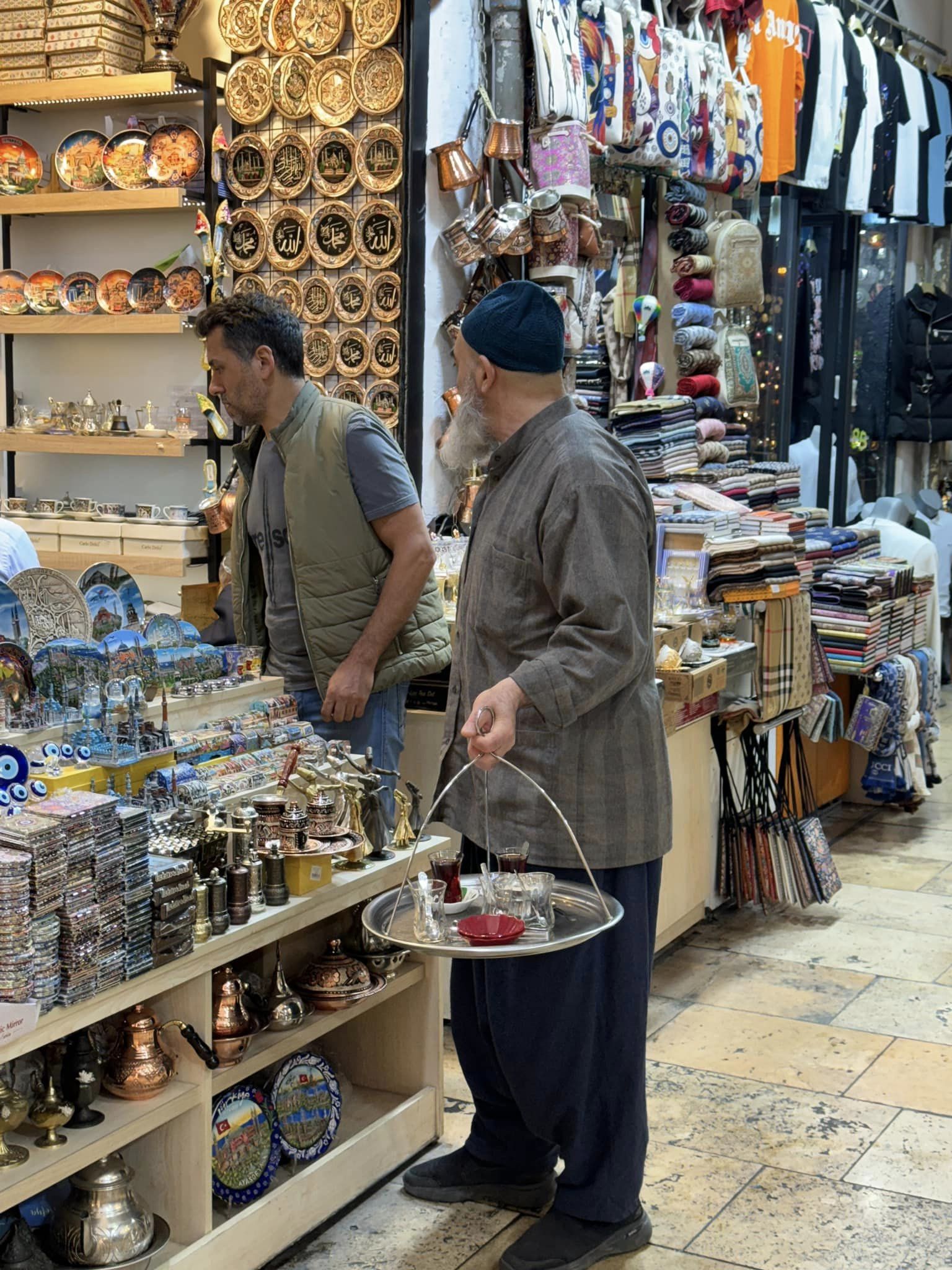
These gentlemen deliver tea all day long to the shopkeepers. They rush around the bazaar with these trays carrying tea with sugar and spoons. When empty, they return to tiny little tea service stations between the stalls where fresh tea and clean cups are at the ready.
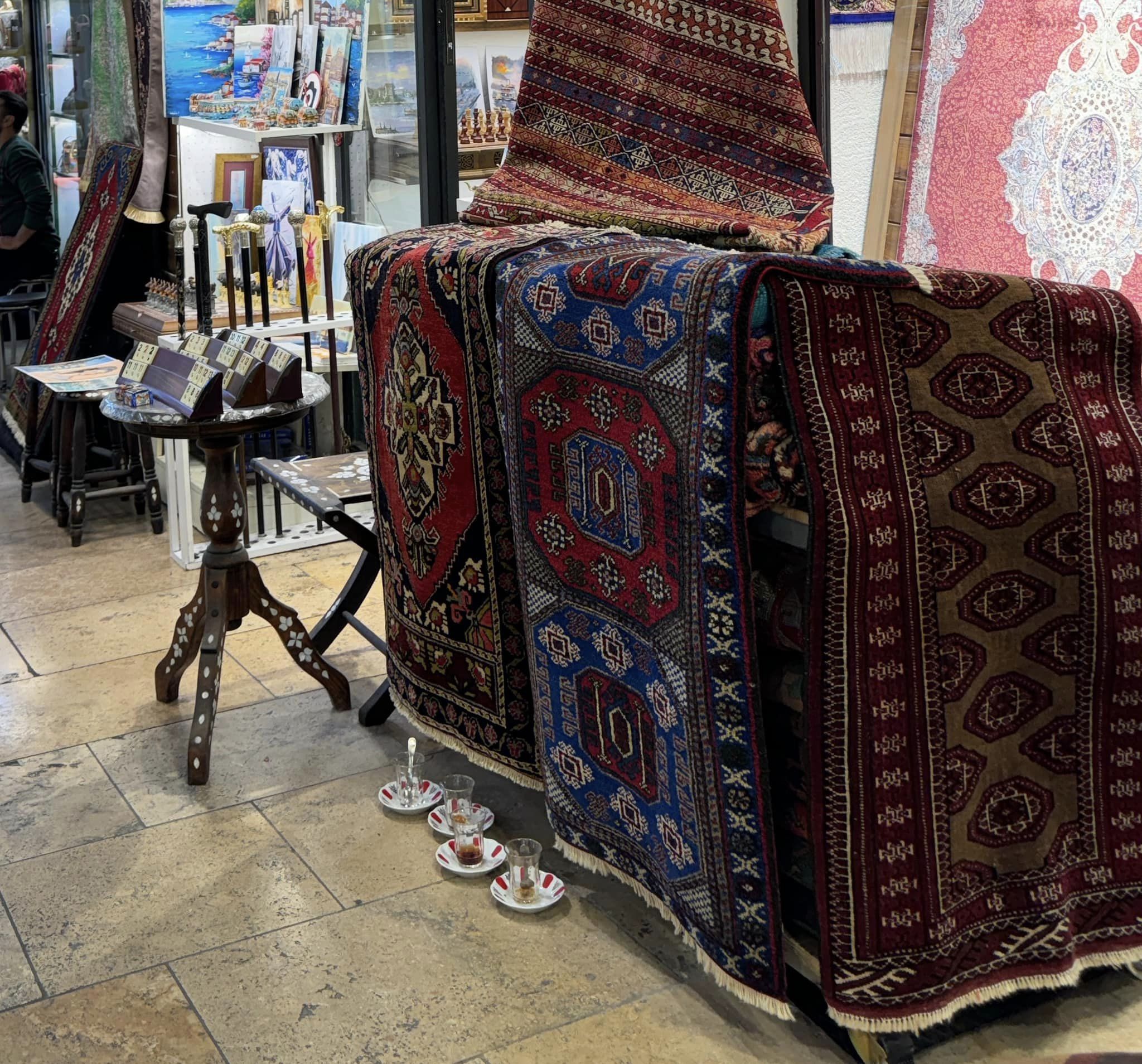
Shop owners drink tons of tea thanks to the guys that deliver it throughout the day. Empty cups and plates sit on the floor by the shops, ready for pick up.
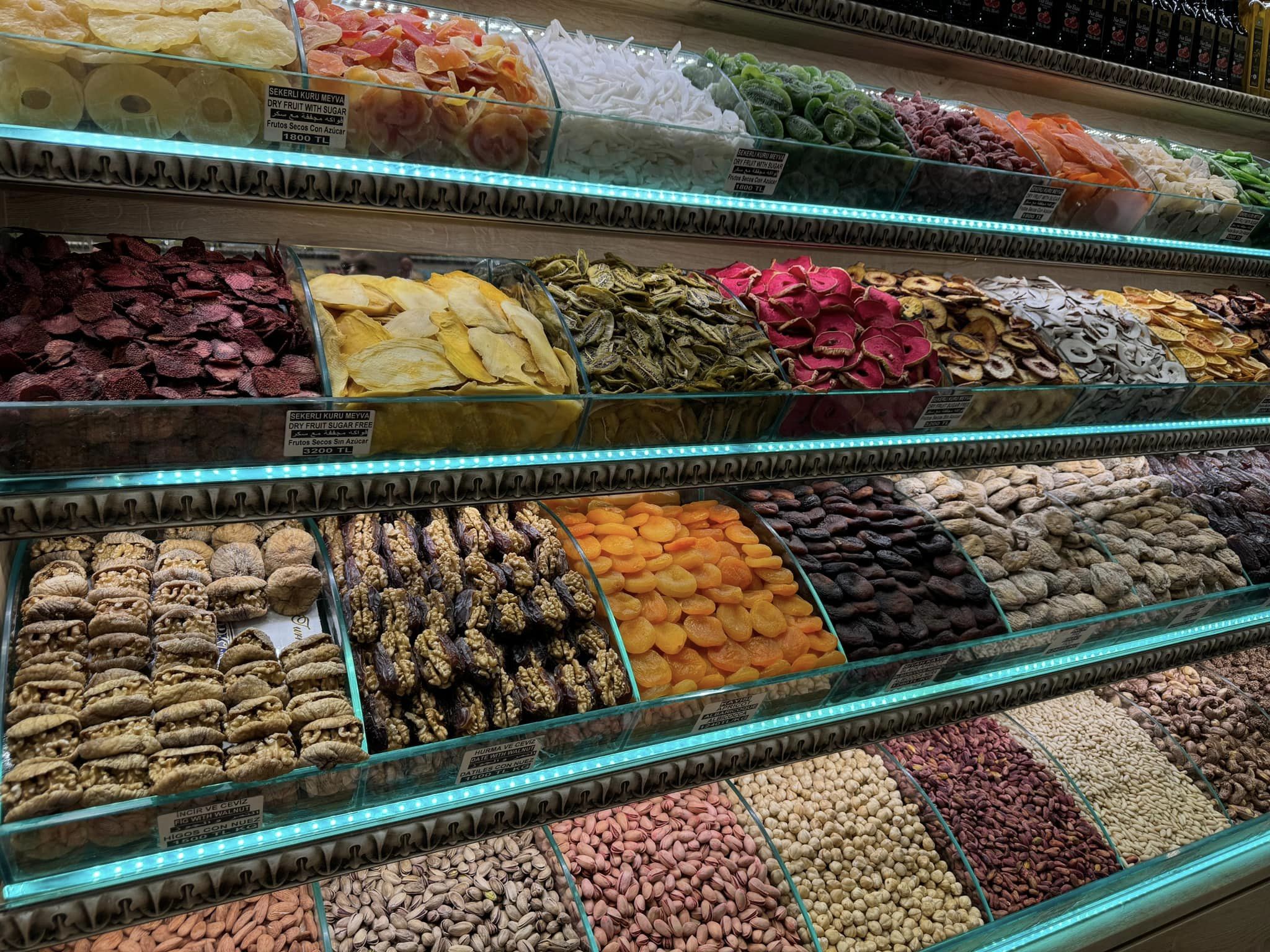
The Spice Bazaar section has the most incredible array of tastes and smells. Colourful and tasty dried fruit and nuts.
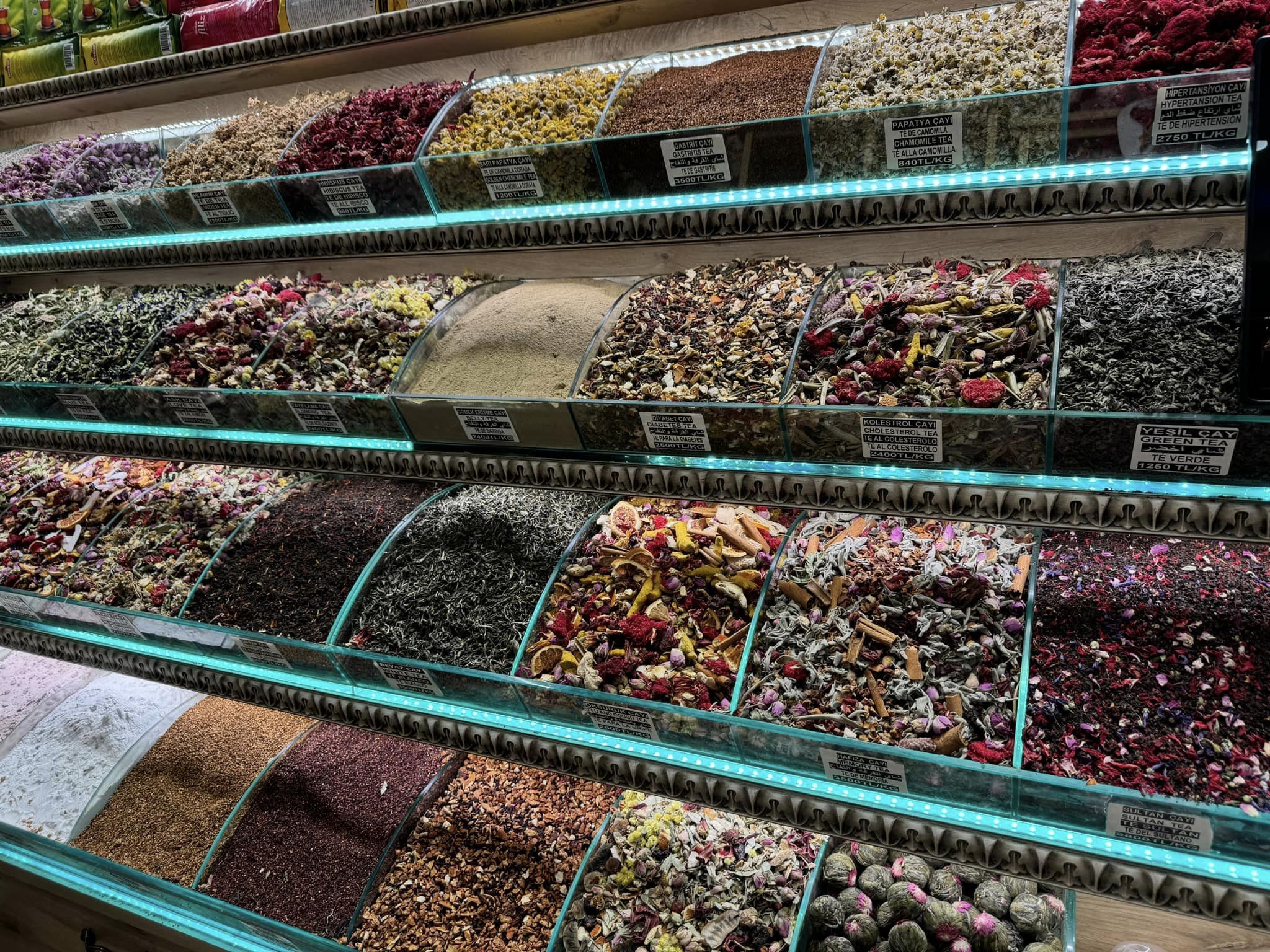
Tea like I’ve never seen before with the names describing the multitude of ailments and problems they solve. Everything from diabetes, flu and coughs, belly aches, cholesterol, hypertension and gastritis to helping with love, relaxation, slimming and detox. I guess the Brits have it right, when they say all is well after a cuppa...
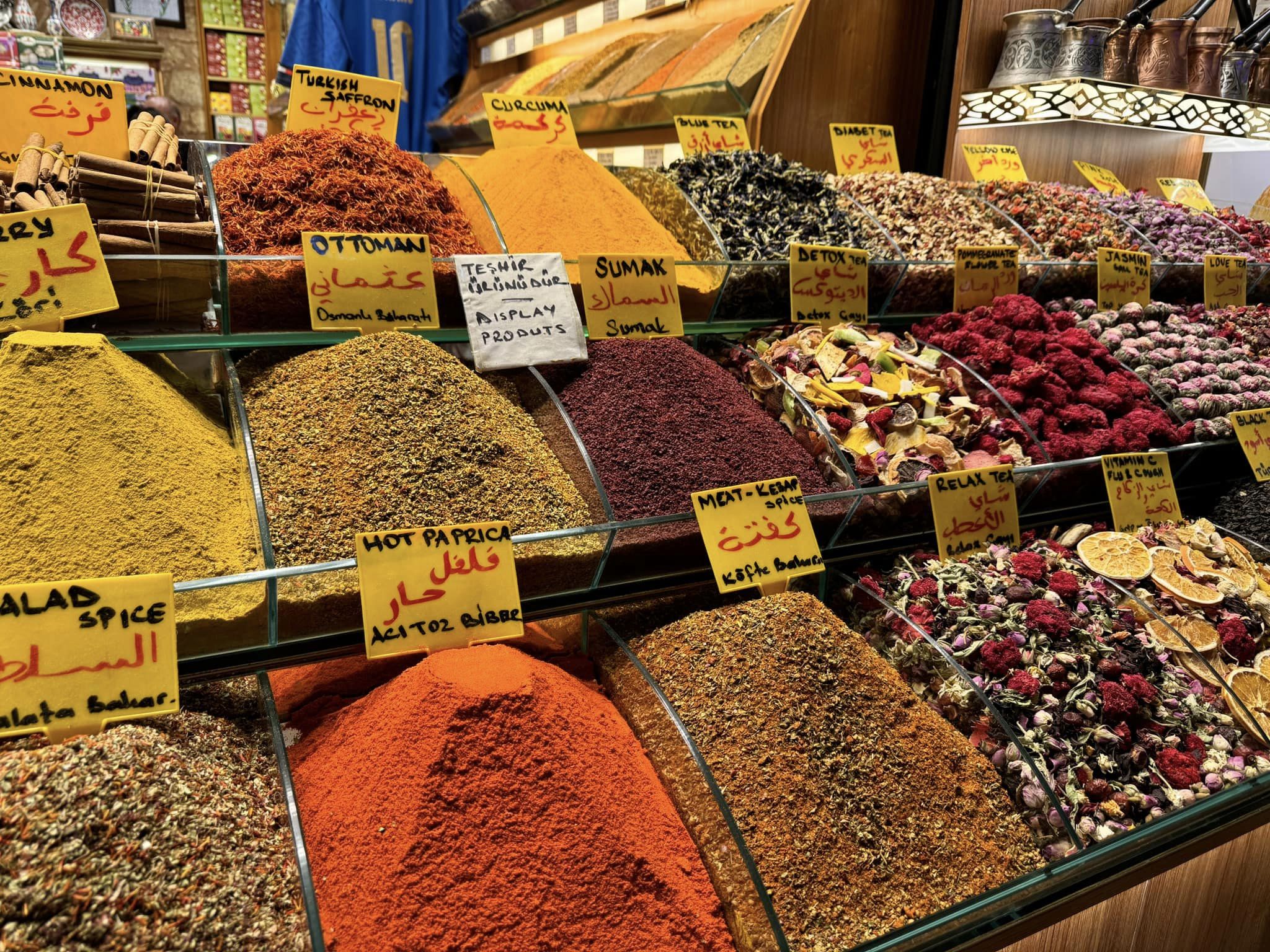
And the spices! Can I bring this home?!
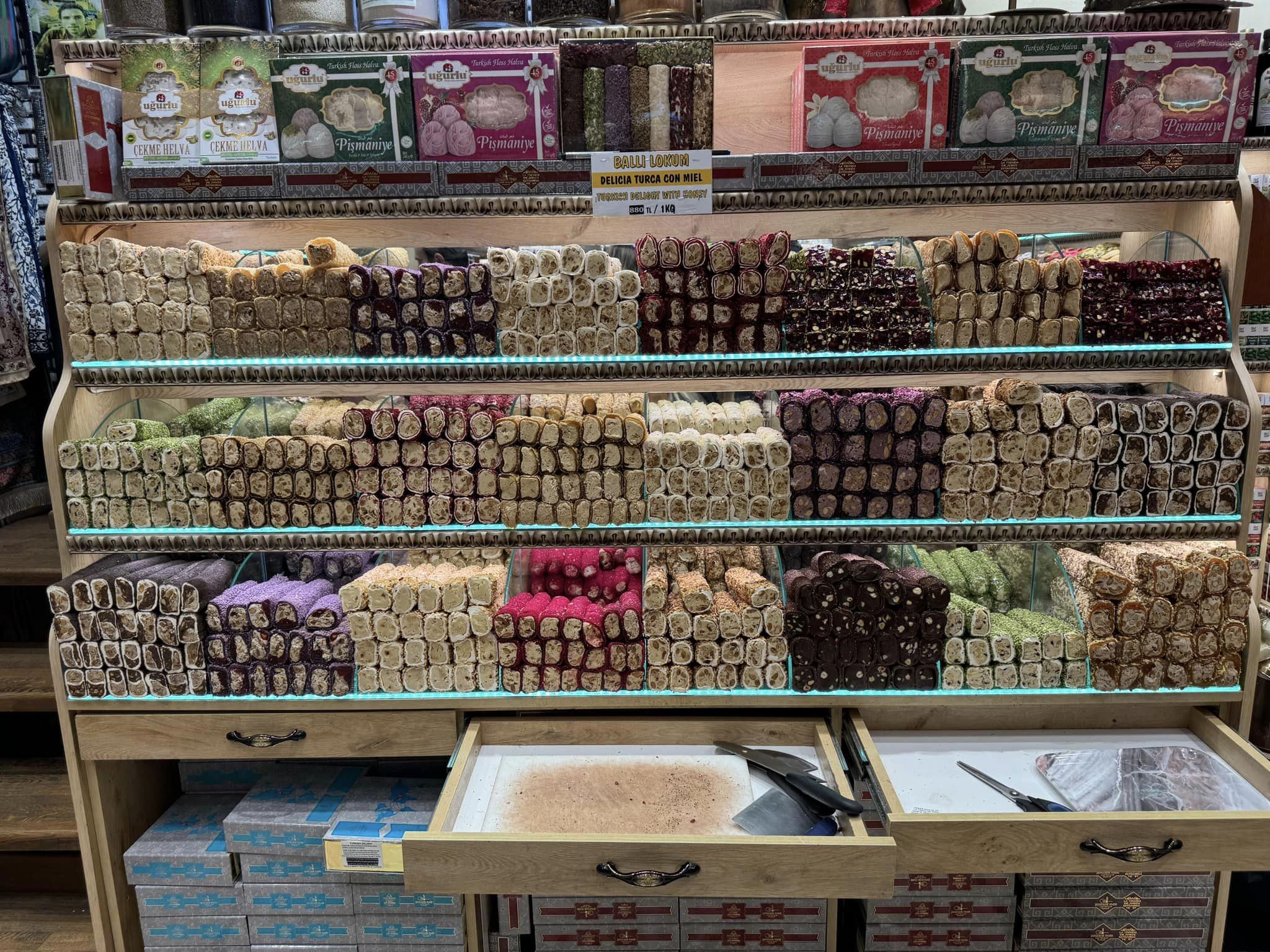
I can’t leave out the Turkish Delight. This is nothing like the sickly sweet stuff we get at home. This is downright addictive. I’m not much for the jelly ones but the rolls with the creamy centres! I think pomegranate is my favourite...but I think I'll have to come back a few more times to validate that!
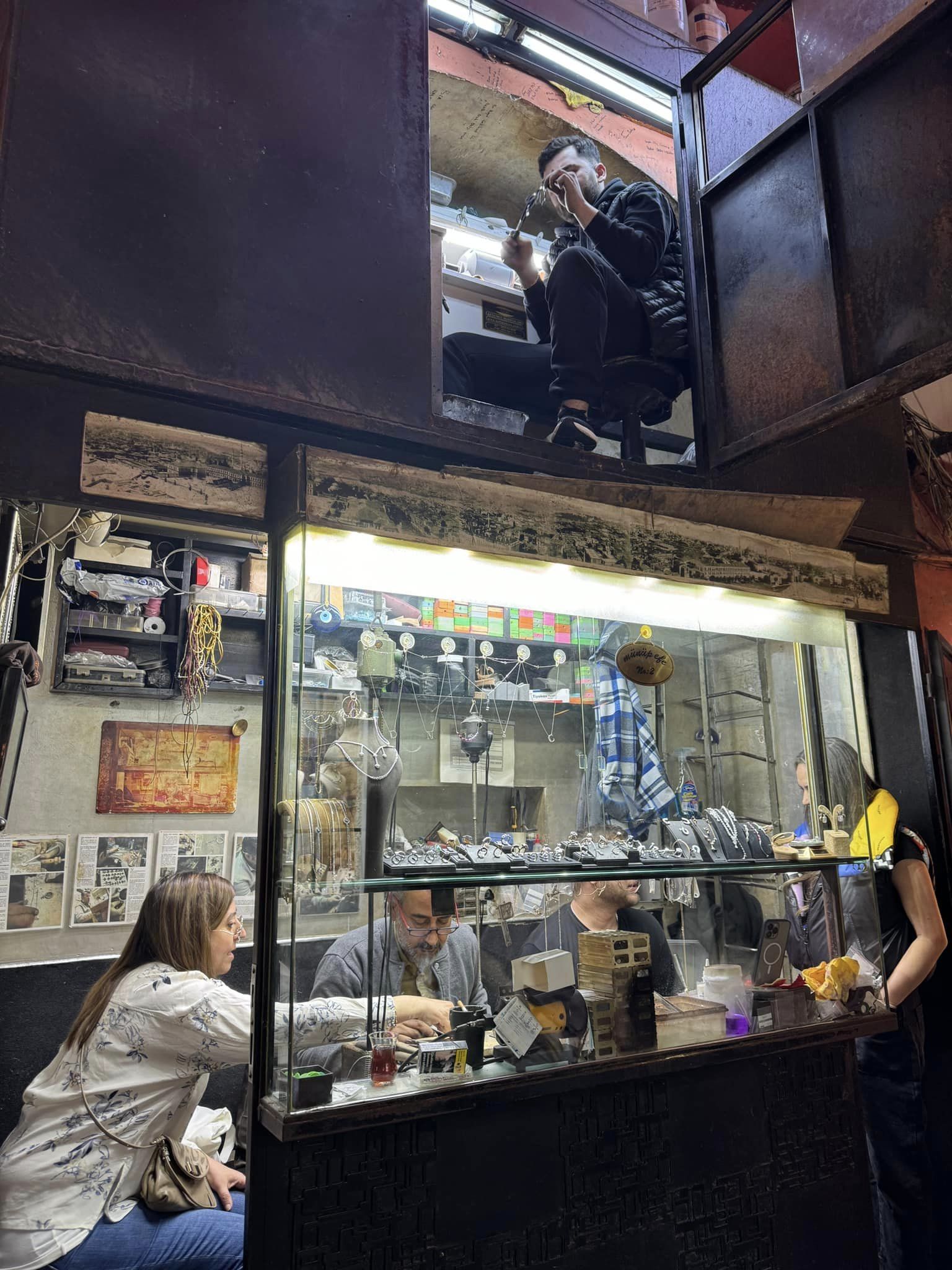
Jewellery making in a corner of an offshoot lane in the bazaar. Notice the guy one level up. This is where the noisier equipment is.
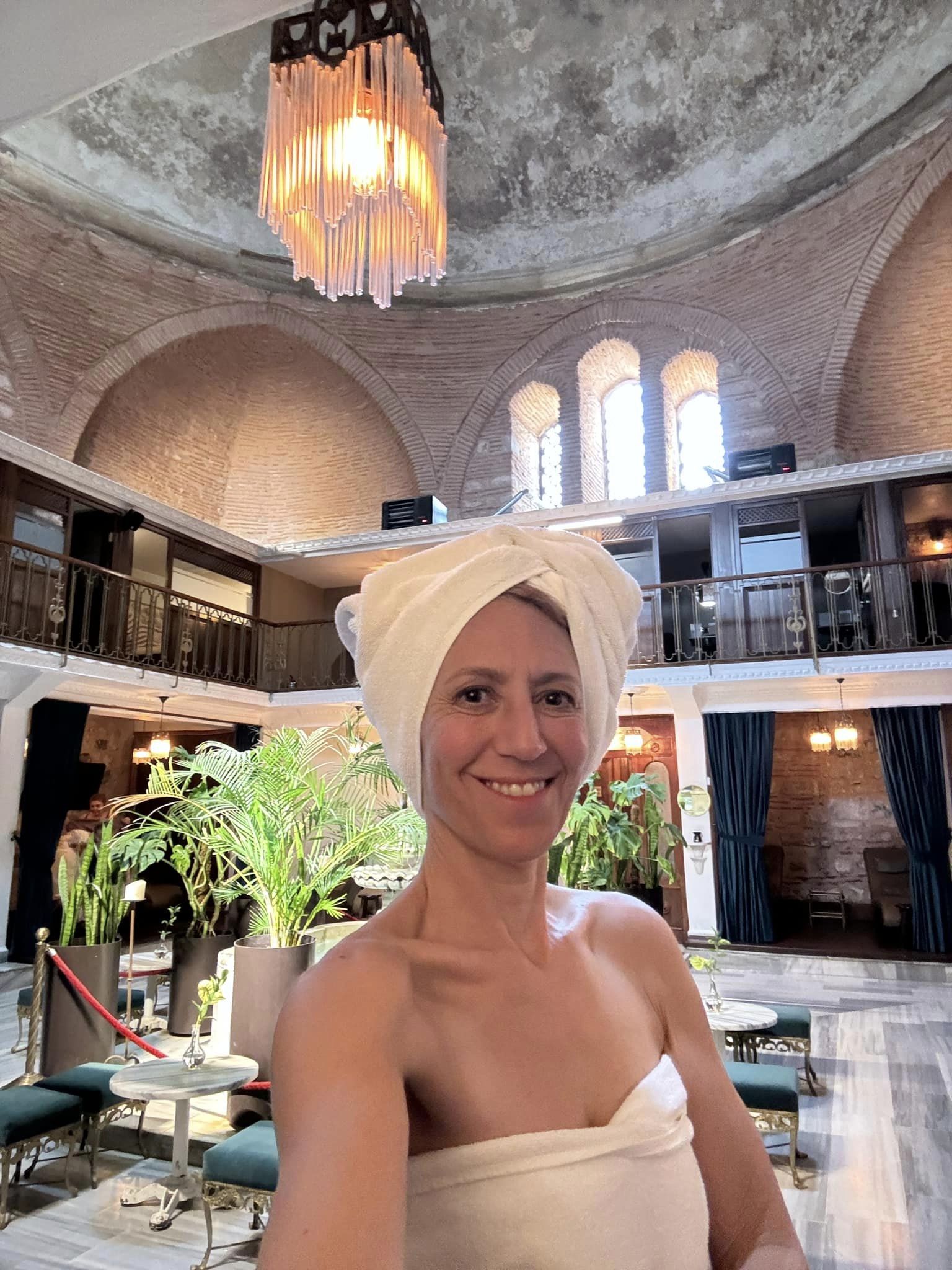
My first real hammam! The sauna kicks things off to get your body ready for the next onslaught: the scrub. Off came the layers of skin that apparently shouldn’t be there. I then opted for a full body clay mask followed by the most wonderful bubble experience. Volumes of bubbles cascade over your body while the attendant provides a full body massage. Lots of rinsing in between each step and I came out of there glowing! Five weeks in Turkey should certainly give me time for another hammam experience…
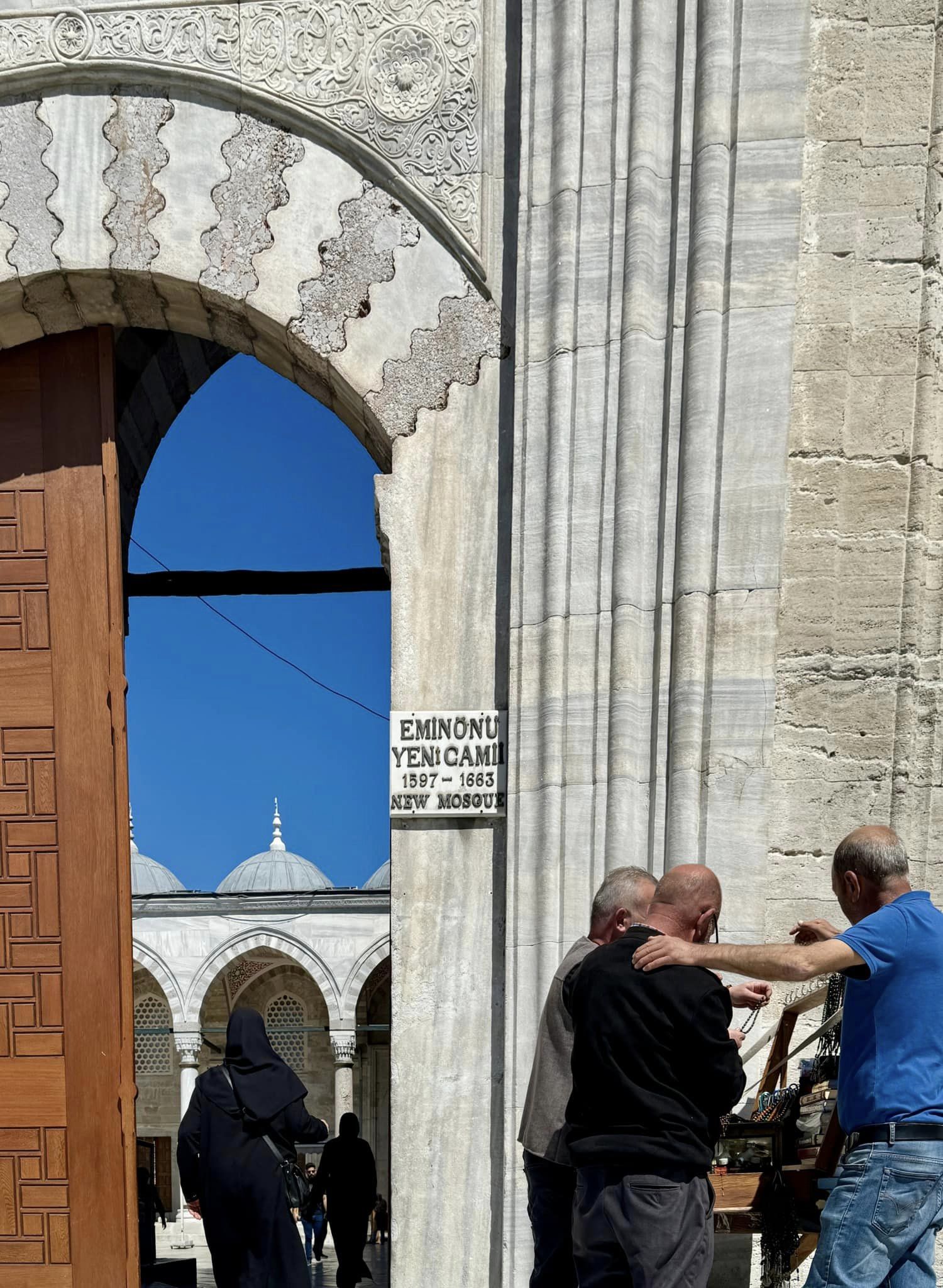
The “New” Mosque is 200 years older than Canada!
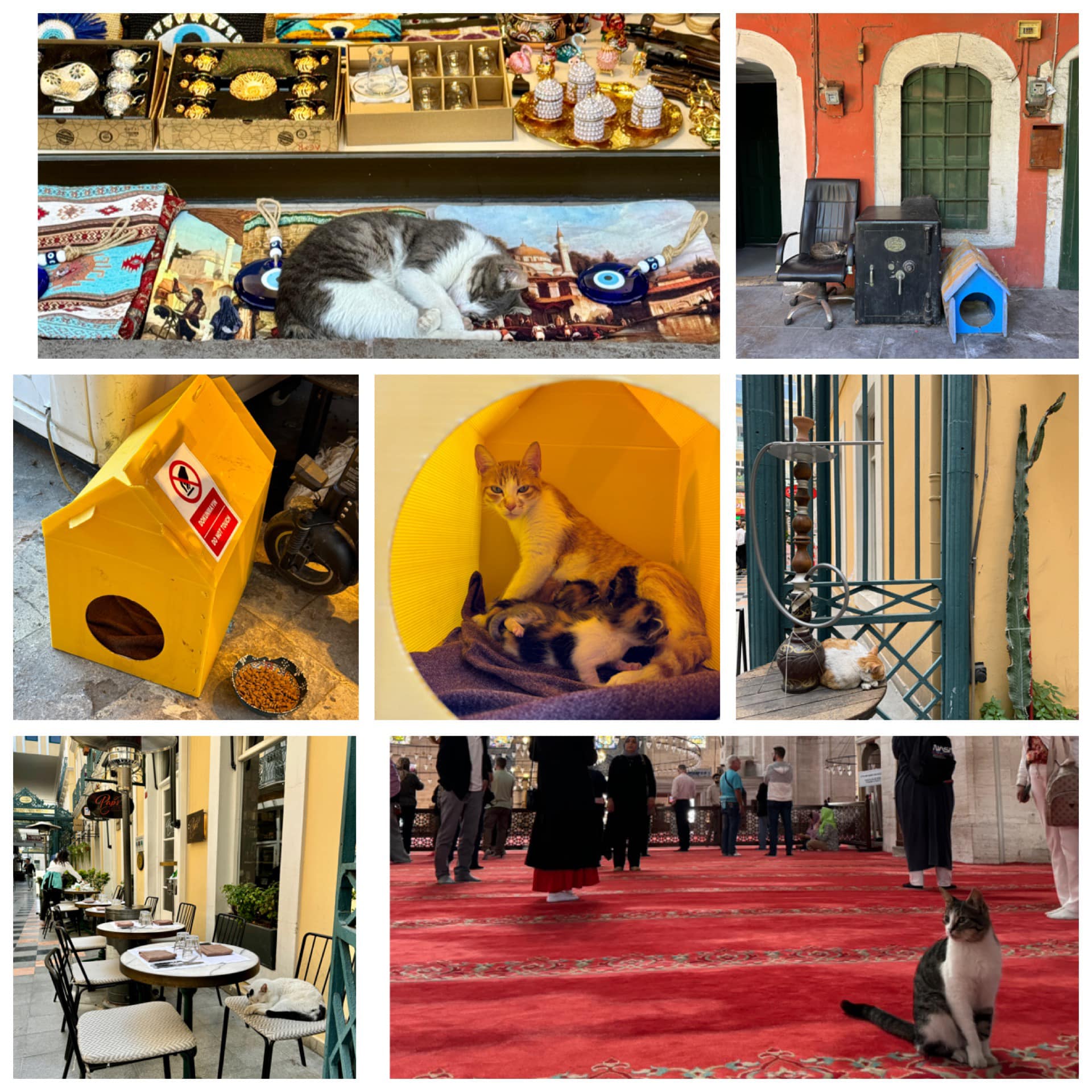
Istanbul has the most cats of any city in the world. Estimates range from hundreds of thousands to a million intermingling with the population of 20 million people…given that cats are more fertile than humans, there will soon be more cats than people. People here like cats (apparently Muhammad did too) and actively take care of them and their kittens. The government and the locals keep them safe by providing necessary vaccines, housing and food. Cats live in graciously provided cardboard boxes or little plastic houses which help them keep their kittens safe. They are considered to be shared pets rather than strays. And nobody shoos them out of mosques because they are such clean creatures. Why so many cats and why are they lovingly protected? The answer is rooted deep in Istanbul’s history. It starts with how did they get here? Throughout the centuries, ships arriving in this bustling port city carried cats to keep the rats and mice on board under control. Cats would take shore leave and settle in the city. Here they remain and I honestly have yet to see a mouse or rat, even in the Grand Bazaar where people put their empty plates of food on the floor.
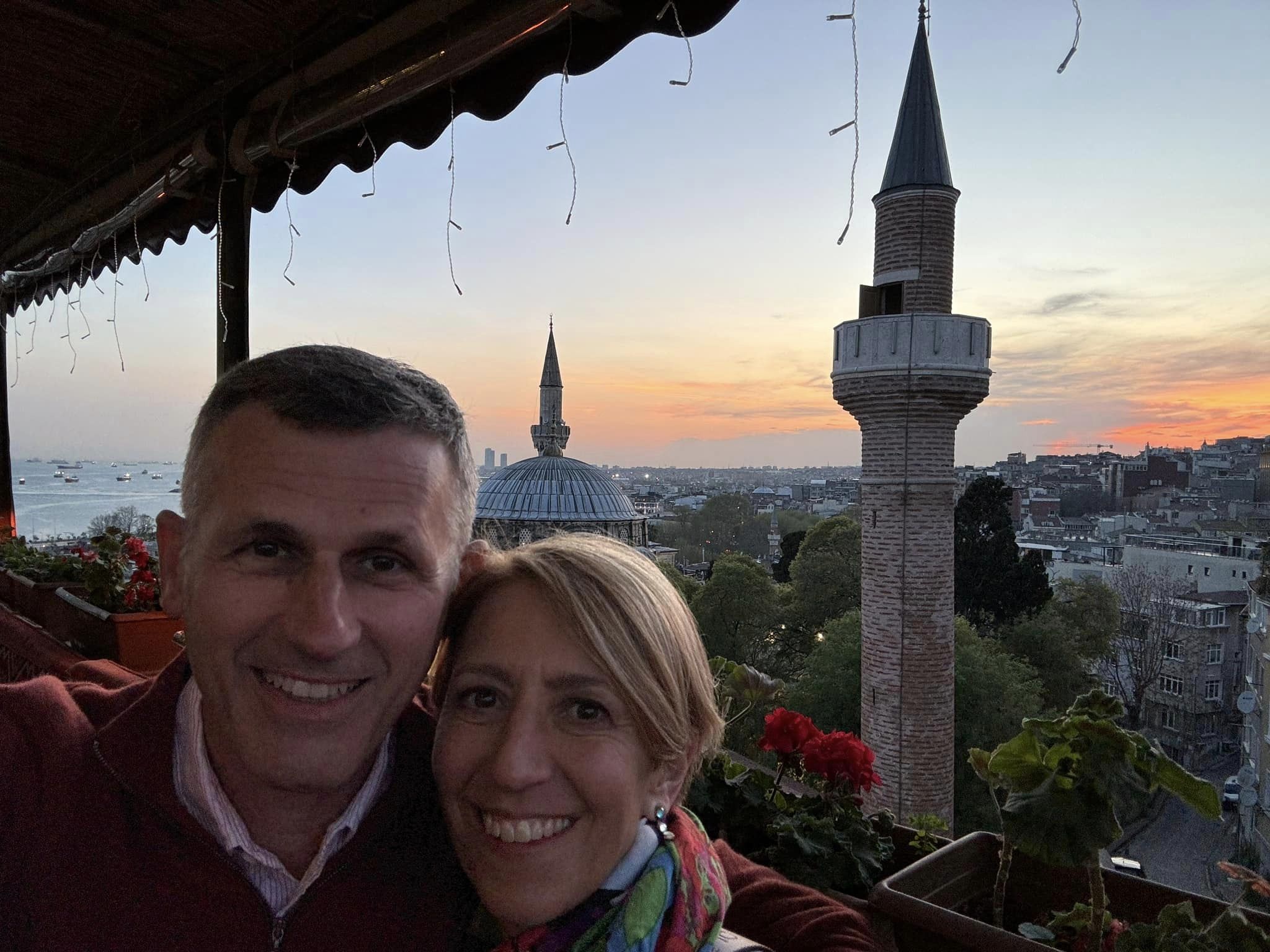
The old city is full of restaurants with rooftop terraces. We lucked out with this one at sunset. And the food was pretty awesome.
Istanbul Immersion
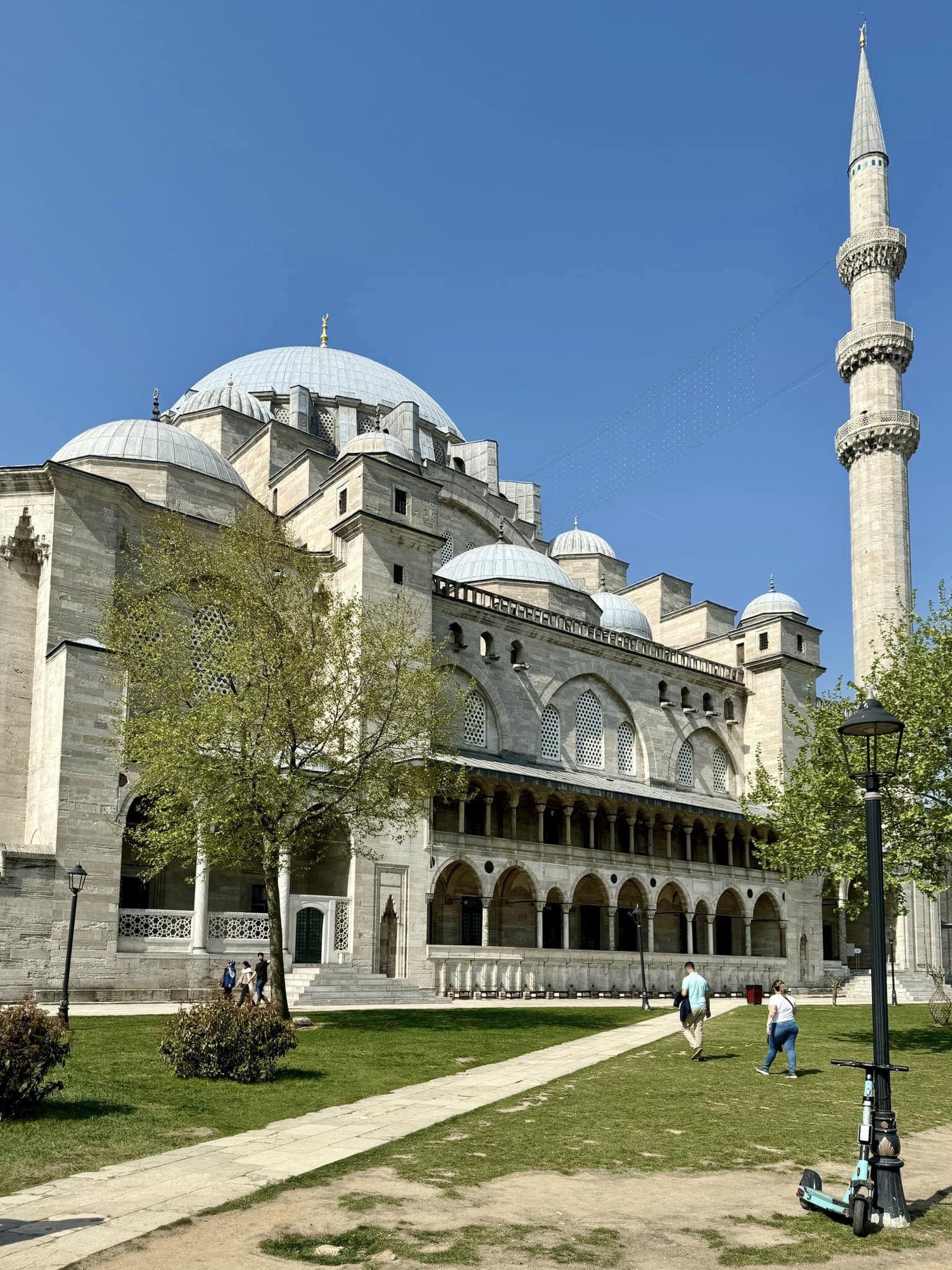
The Süleymaniye Mosque was commissioned by Sultan Süleyman the Magnificent in the 16th century. In a show of one-upmanship, he wanted it to rival the Byzantine Hagia Sophia (more on that later). It didn’t end up being bigger but is deemed to be more graceful, as massive structures go.
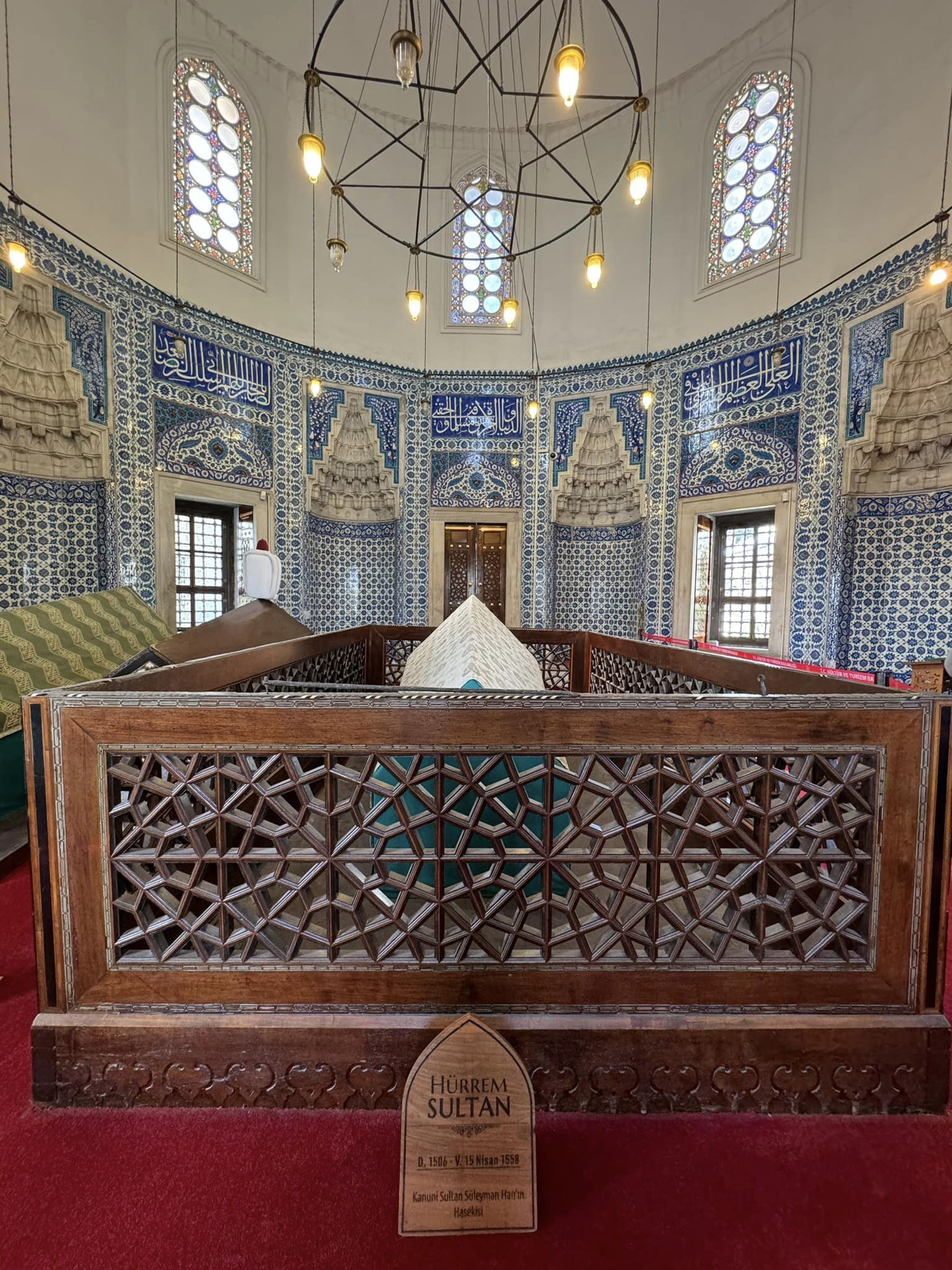
Unlike most Sultans, Süleyman had one great love. Roxelana was a young Ukrainian woman caught up in the slave trade when she was kidnapped by Crimean Tatars and purchased in Istanbul by Valide Hafsa Sultan as a gift for her son. Coming from those roots, she would have been bottom of the barrel in the harem but she apparently had a beautiful smile and joyful spirit (the name she was given, Hurrem, means cheerful one in Persian) and caught the attention of the Sultan. She rose the ranks to become his favourite and went on to break pretty much every rule in the harem handbook. She bore the Sultan four sons (and a daughter, but that part is inconsequential) where the rule with sons was one and done. More than one son could give the mother too much control and cause feuds between blood brothers for the throne. In fact, when a son ascended to the throne, he killed all his male siblings to prevent his own dethroning. Sultans only married free, noble women but she broke the mold again when he married Hurrem. She was also the first woman to spend her entire life in the palace. Typically when a son came of age, he would be sent off to rule some distant land and his mother would accompany him. She would return to the palace as valide sultan if her son became sultan. Hurrem even managed to insert herself into the affairs of the state through her husband. Once Hurrem captured Süleyman’s heart, he never slept with another woman. Can you imagine the drama in the harem?! She was a true trailblazer.
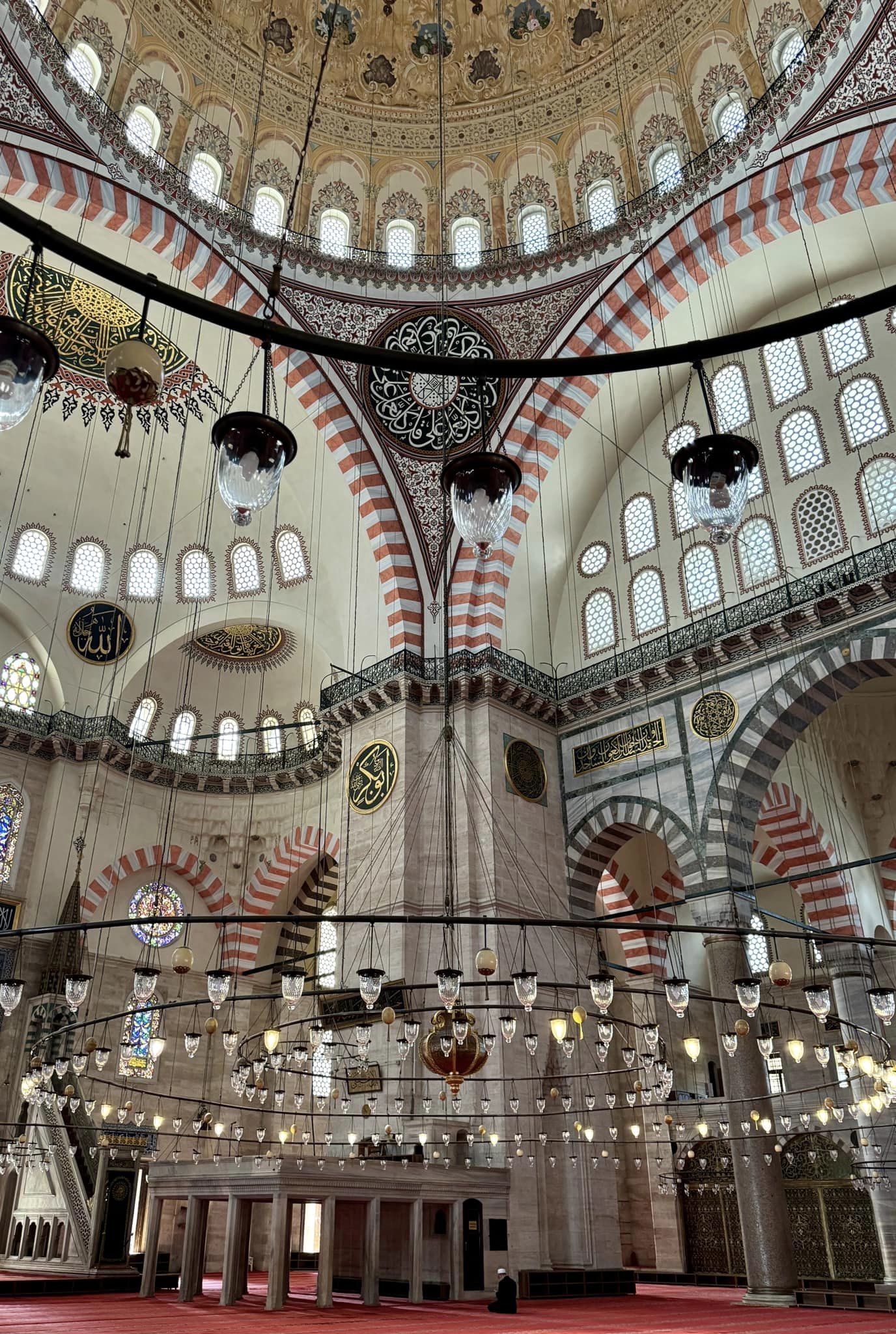
Süleyman hired his favourite architect, the renowned Sinan, to design and build his mosque. Sinan wanted to have the space bathed in light and managed to limit the number of buttresses and supporting pillars of the massive dome to allow for more windows. With very limited artificial light, this place is so bright. Perhaps this is why it was deemed to be more graceful than Hagia Sophia.
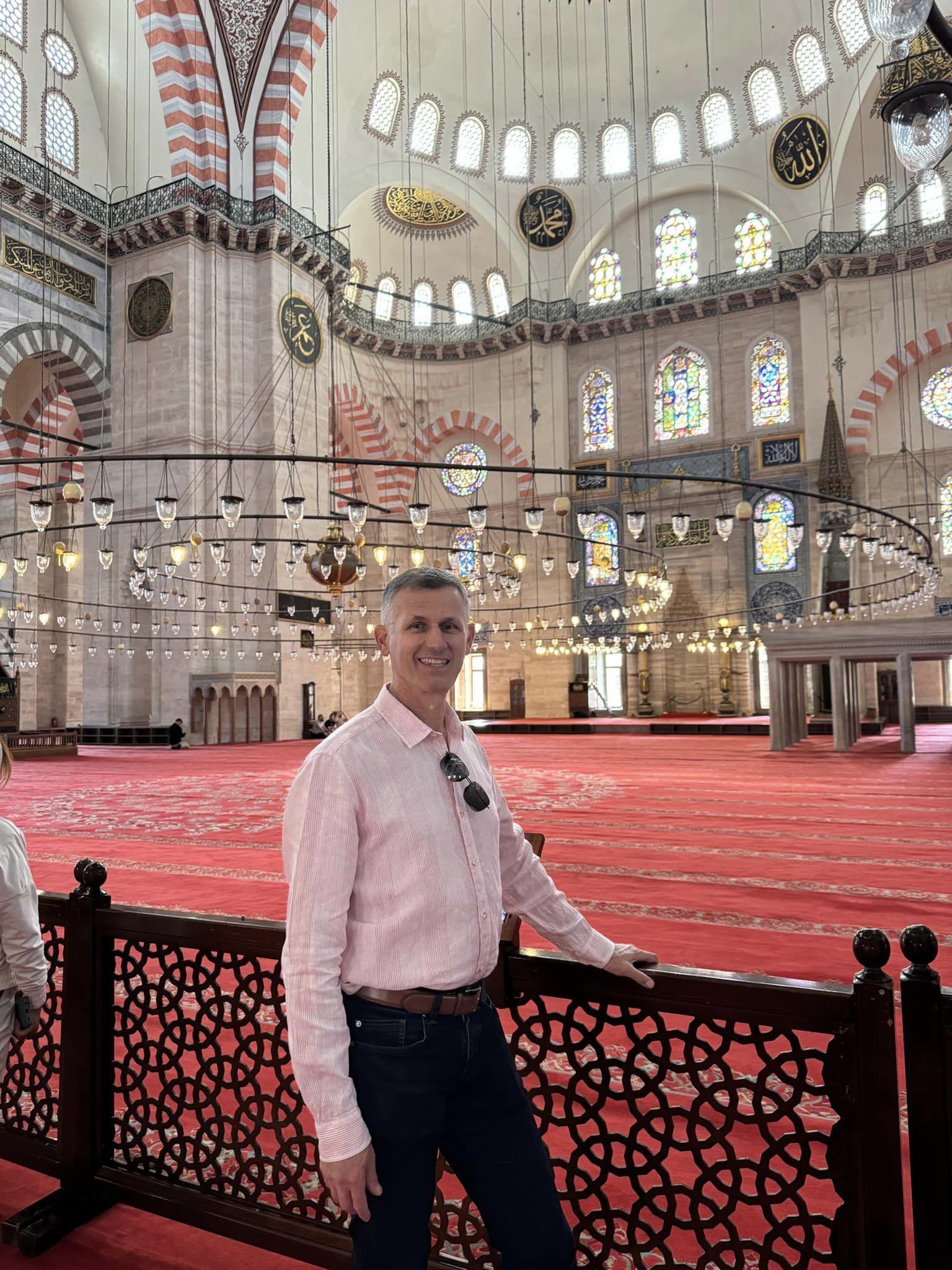
Here’s the men’s praying area. Note the stripes on the carpet…kind of like in a yoga studio, these stripes helped organize the men along lines for prayers. They would enter the space and fill between the lines from the front of the mosque to the back, standing shoulder to shoulder, united as one community.
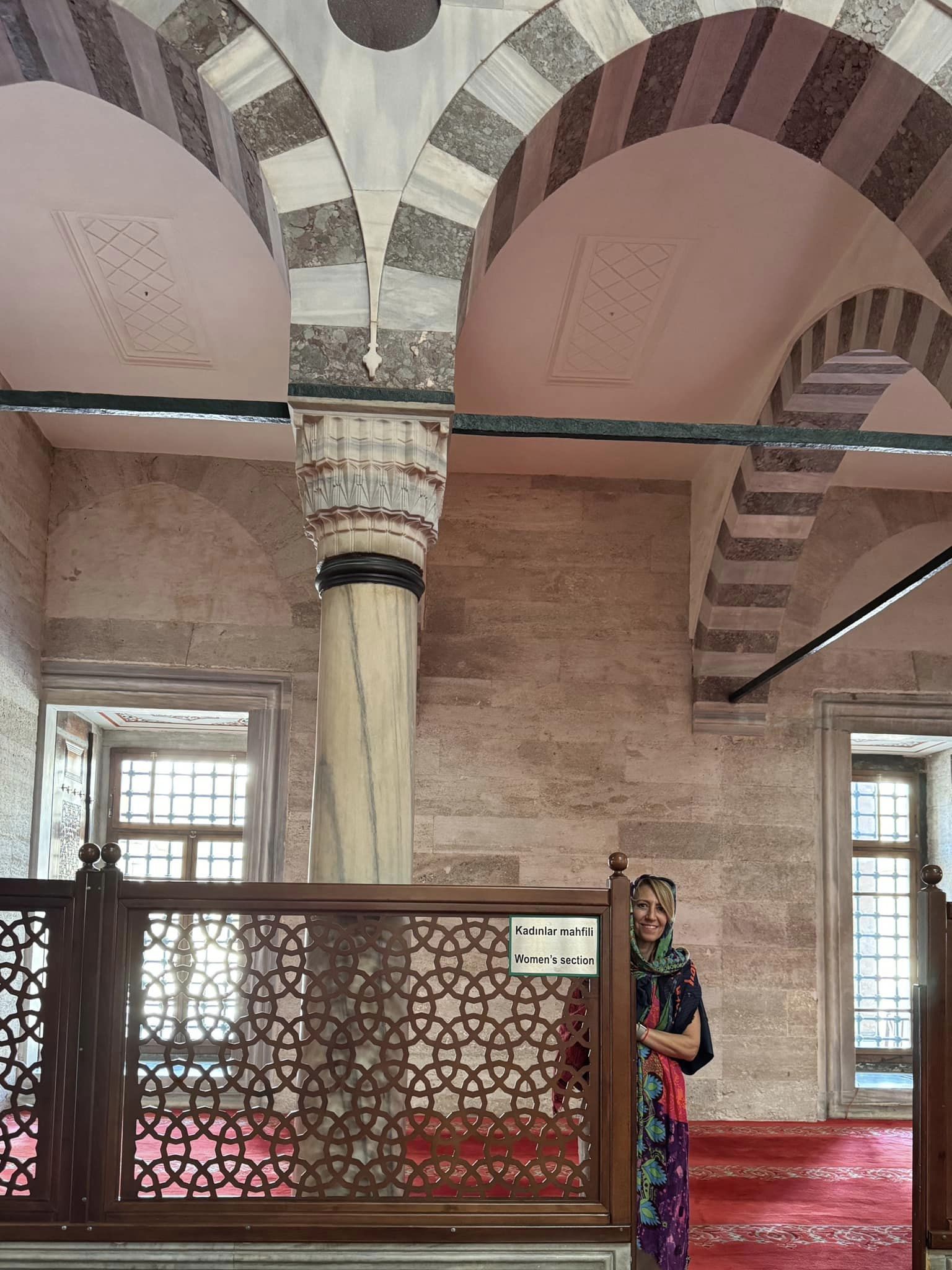
Oh, and here’s the women’s prayer space, tucked in the back. Not very big…but women were allowed to pray from home, unlike men who were expected to make every effort to get to the mosque for prayers.
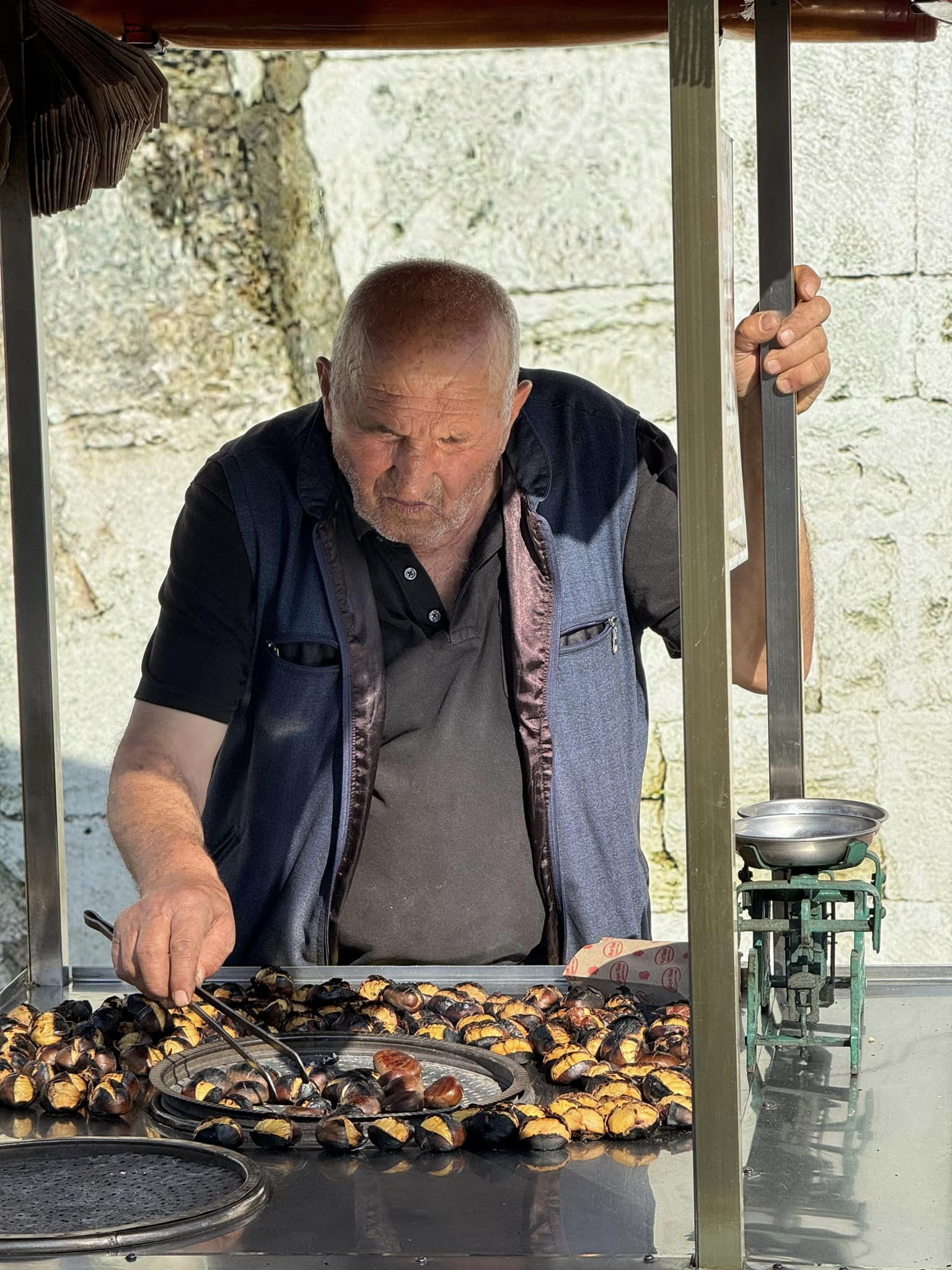
Last chance for snacks before entering the Topkapi Palace. Street food here seems to be pretty much limited to roasted chestnuts and roasted corn. The chestnuts are sold by weight; all these snack carts have one of these old fashioned scales.
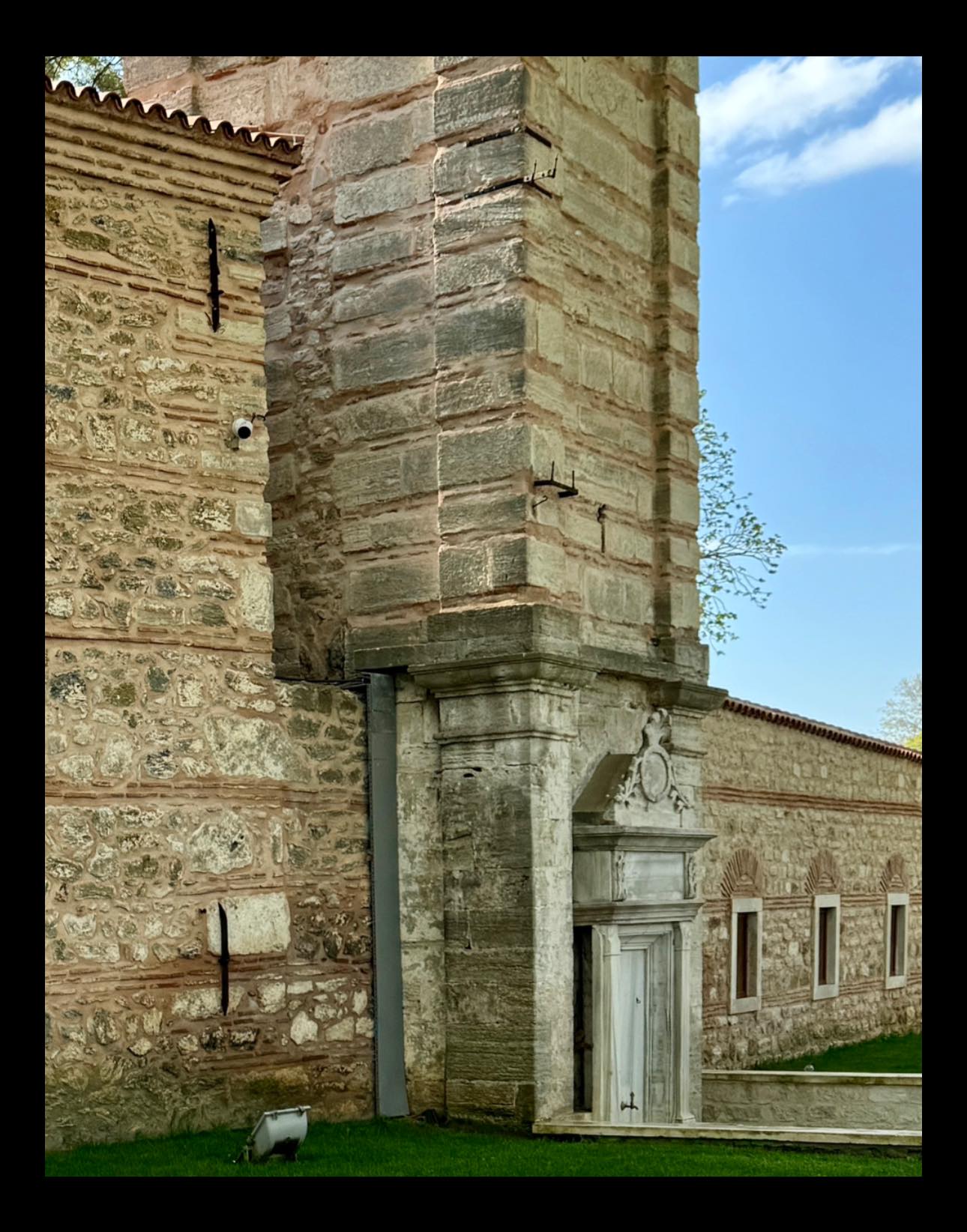
One of the first things you see after entering the first of four palace gates is this long wall with a doorway. Office and rooms and such are behind this wall but what is interesting is what is above the doorway, two layers of stone up from the base of the tower. Four thousand people lived here and the Sultan needed to maintain order. There were rules and rules were meant to be followed. If rules were broken, consequences ensued. Big behaviour breaches resulted in beheadings and to make sure everyone stayed in line, the heads were placed on those spikes above the door.
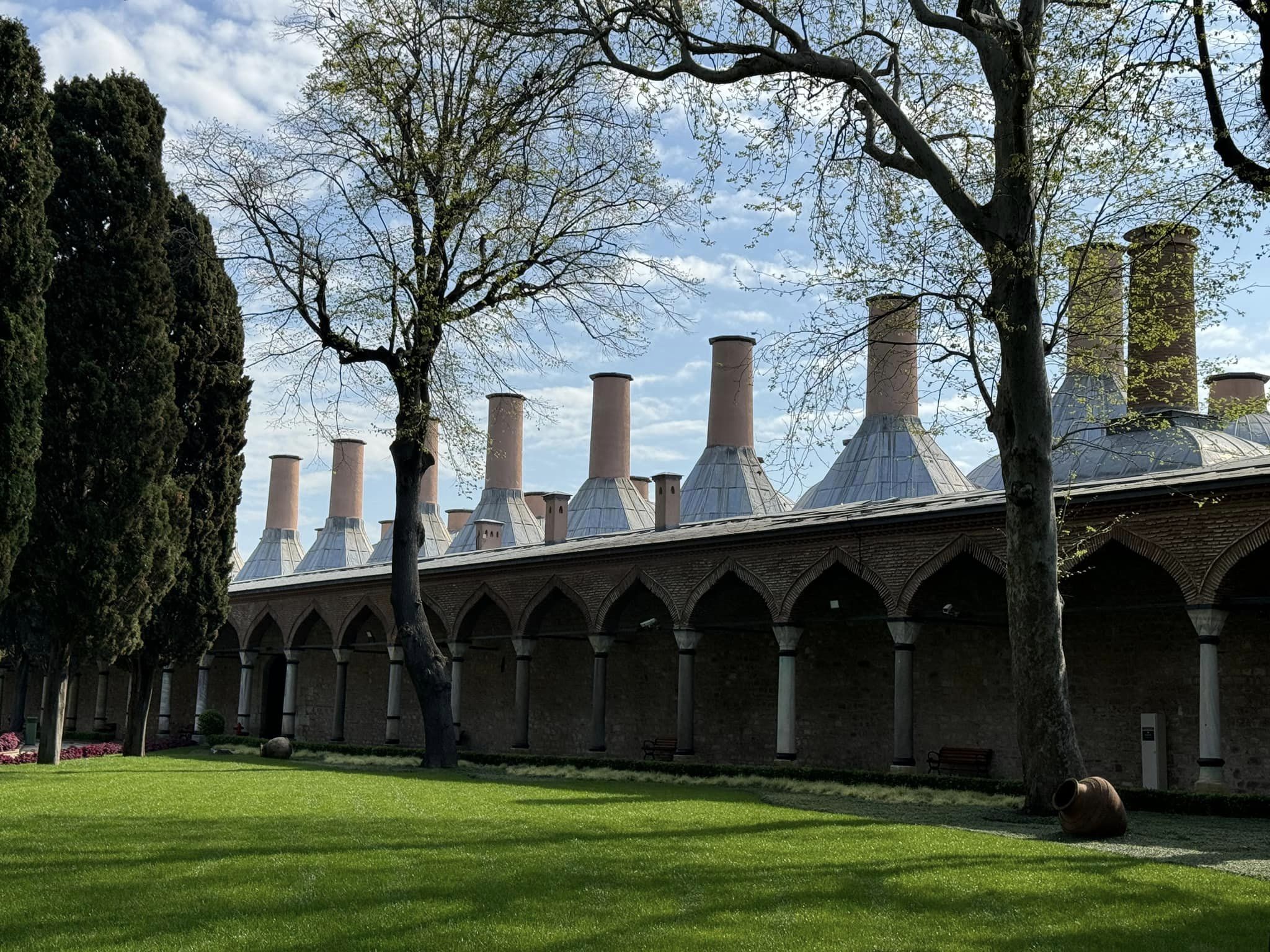
The palace kitchens are behind this portico. That’s a lot of chimneys but there were 4,000 people to feed! About 100 (of the 800 staff) worked in the kitchens.
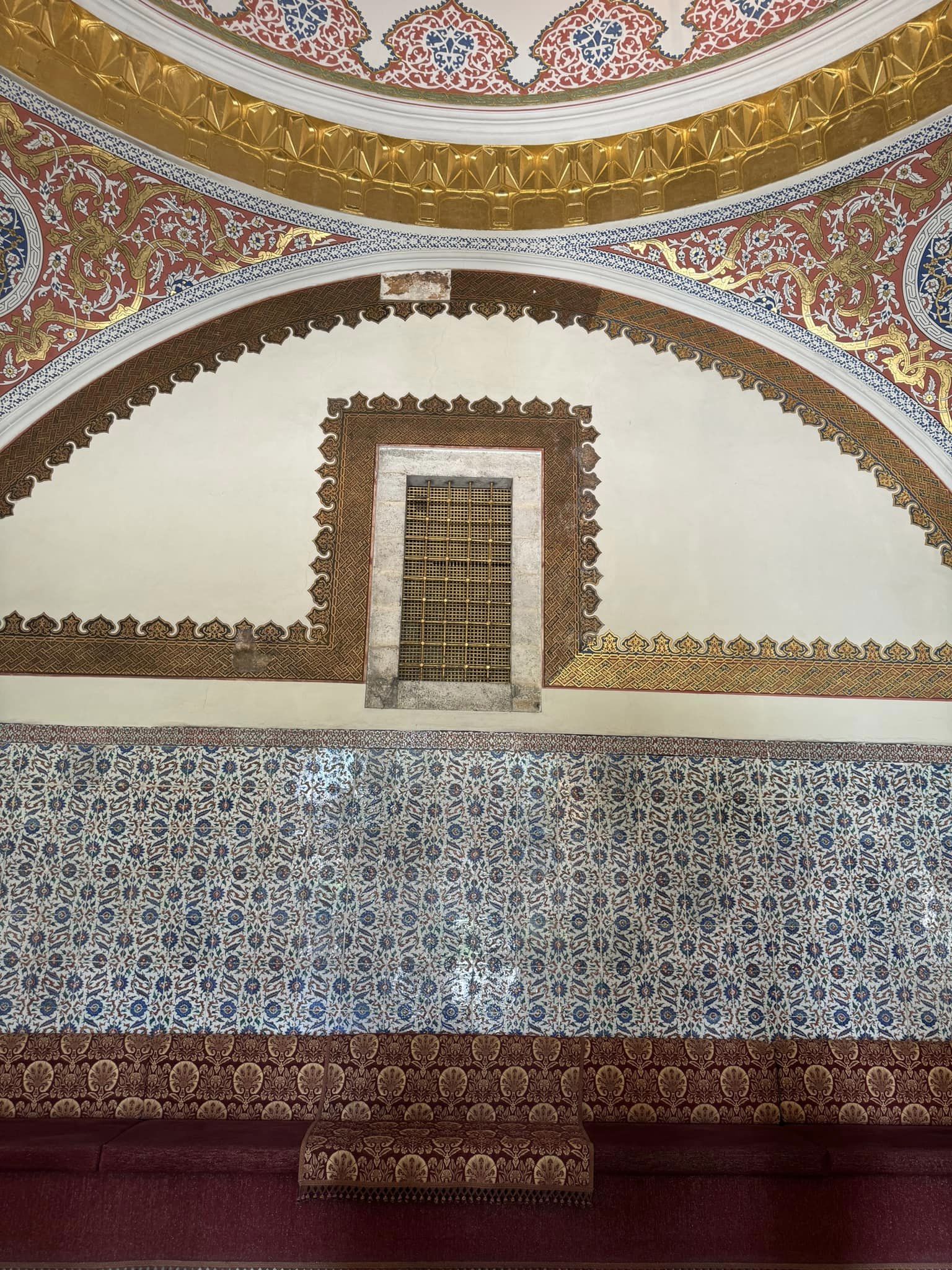
This gilded lattice window overlooks the Council Hall where the various Viziers and army judges would meet to discuss state affairs and hear court cases. This was where all the decisions of the empire were made. So what’s with the window? Well, the Sultan didn’t attend these meetings but every now and then, he would sit behind this window and spy. Nobody knew when or if he would be there so they always had to be on their toes. If the Sultan was there and disagreed with a decision, he would close the curtain. The meeting would abruptly end and the viziers would then convene with the Sultan to work out an acceptable decision. Despite handing over authority on decision-making to his statesmen, the Sultan made sure no injustices were made against his people.
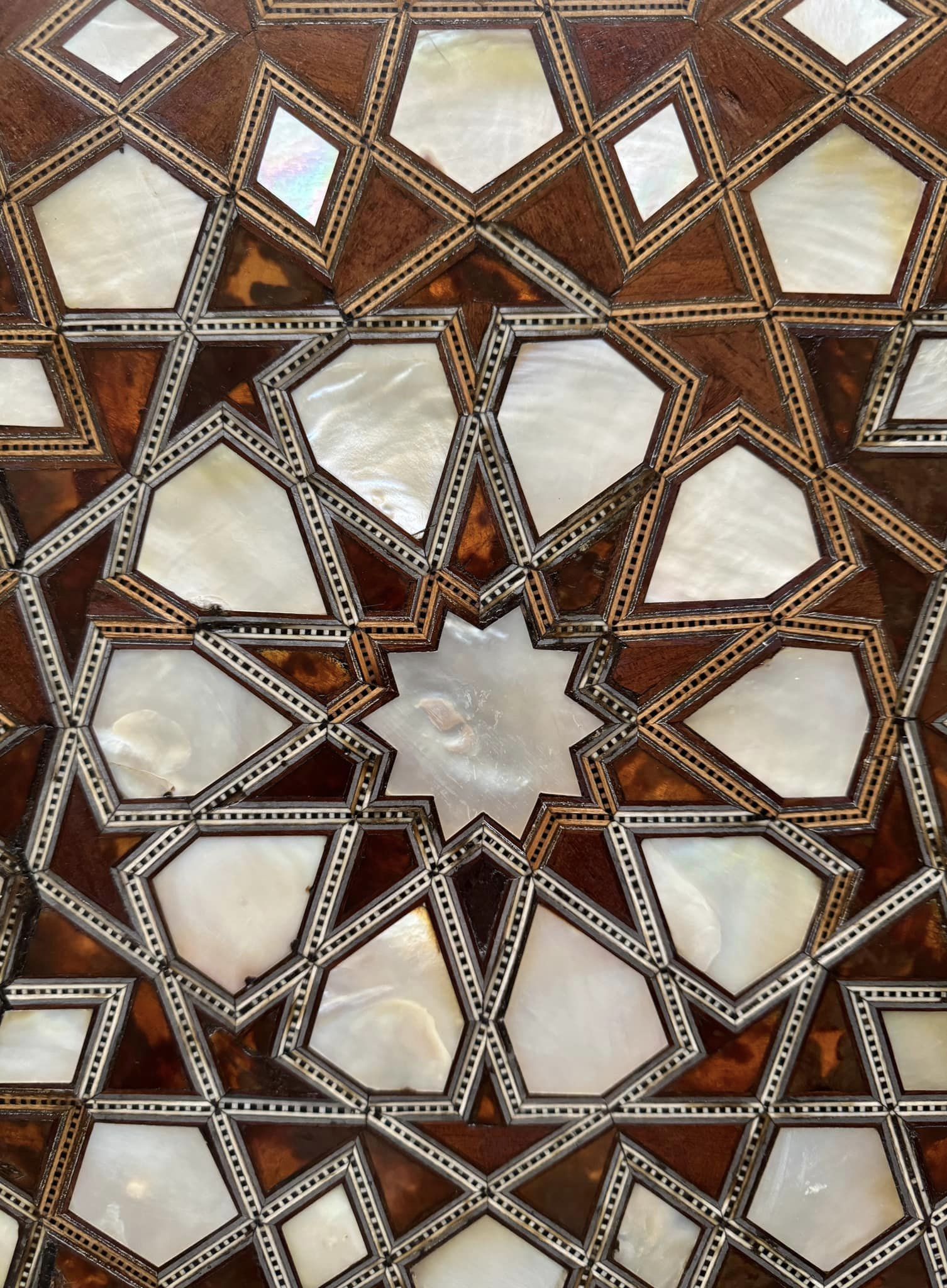
Beautiful mother of pearl inlayed doors in the Palace.
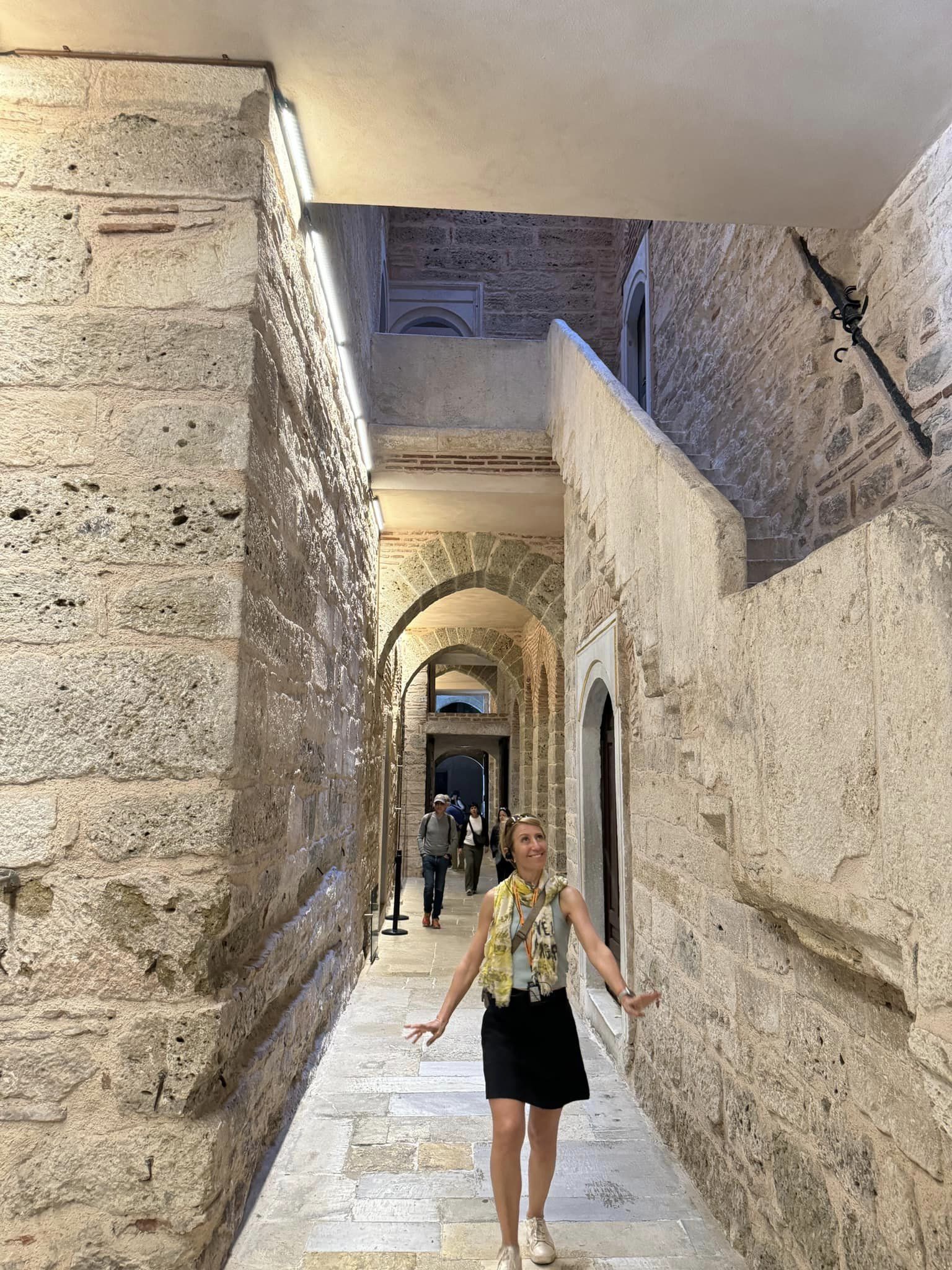
This is known as the Golden path. Here, the concubines marched with the Sultan looking on from above and tossing gold coins to them. If he particularly liked one, he dropped a handkerchief. Her golden ticket! She could then have audience with him (many of the concubines—there could be 1,000 at any given time—never saw the Sultan). This was critical in her upward mobility in the palace. Here’s how things worked. These girls (13-15 years old) came into the palace generally in one of four ways: war where they were taken as bounty (and all her relatives would be killed so there wouldn’t be any family to have any claims); as gifts from visitors to palace; procured from neighbouring countries; or bought from slave markets, notably one near the Grand Bazaar. While they entered at various levels of hierarchy, they still had to get noticed and strategically elevate their status. The best way was to have a baby with the Sultan (upgrade!) and if that baby was a boy, then even more of a bump! And if that son becomes the sultan? The sky’s the limit for that concubine. She elevates to the valide sultan, the most powerful woman in the palace. These women were not allowed to leave the palace, unless they were deemed favourites and then they had some freedom. After nine years, concubines were freed, either to keep the harem fresh or if the sultan died, a new sultan was able to build his new harem. The harem was a competitive place and freedom meant no longer having to deal with girl drama and jockey for position. It took until 1924 for slavery to be abolished in Türkiye along with the sultan’s harem. All the women, and the eunuchs who guarded them, were set free.
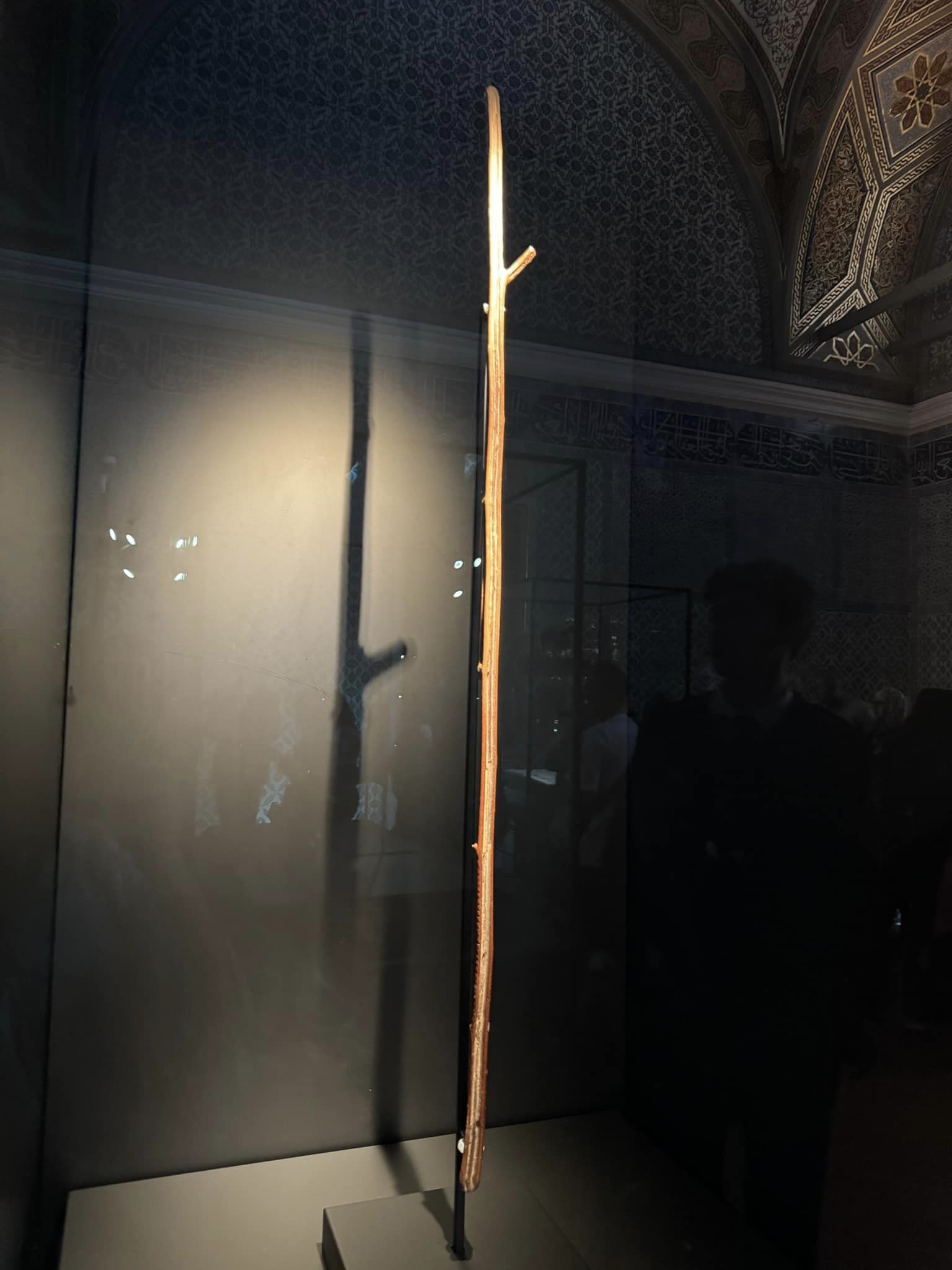
The palace had an amazing exhibition of ancient relics…really ancient! All gifts from foreign dignitaries to the Sultan. Just as well he had a huge palace to display all these items. Everything from many of Mohammed’s beard hairs (and special boxes for each little cluster), his shoes, a tooth and letters to drapes from various prophet’s tombs. A few pieces really caught my eye though. Here, Moses’ staff from the 13th century BCE. Pretty thin and not very long to support him through 40 years in the desert…
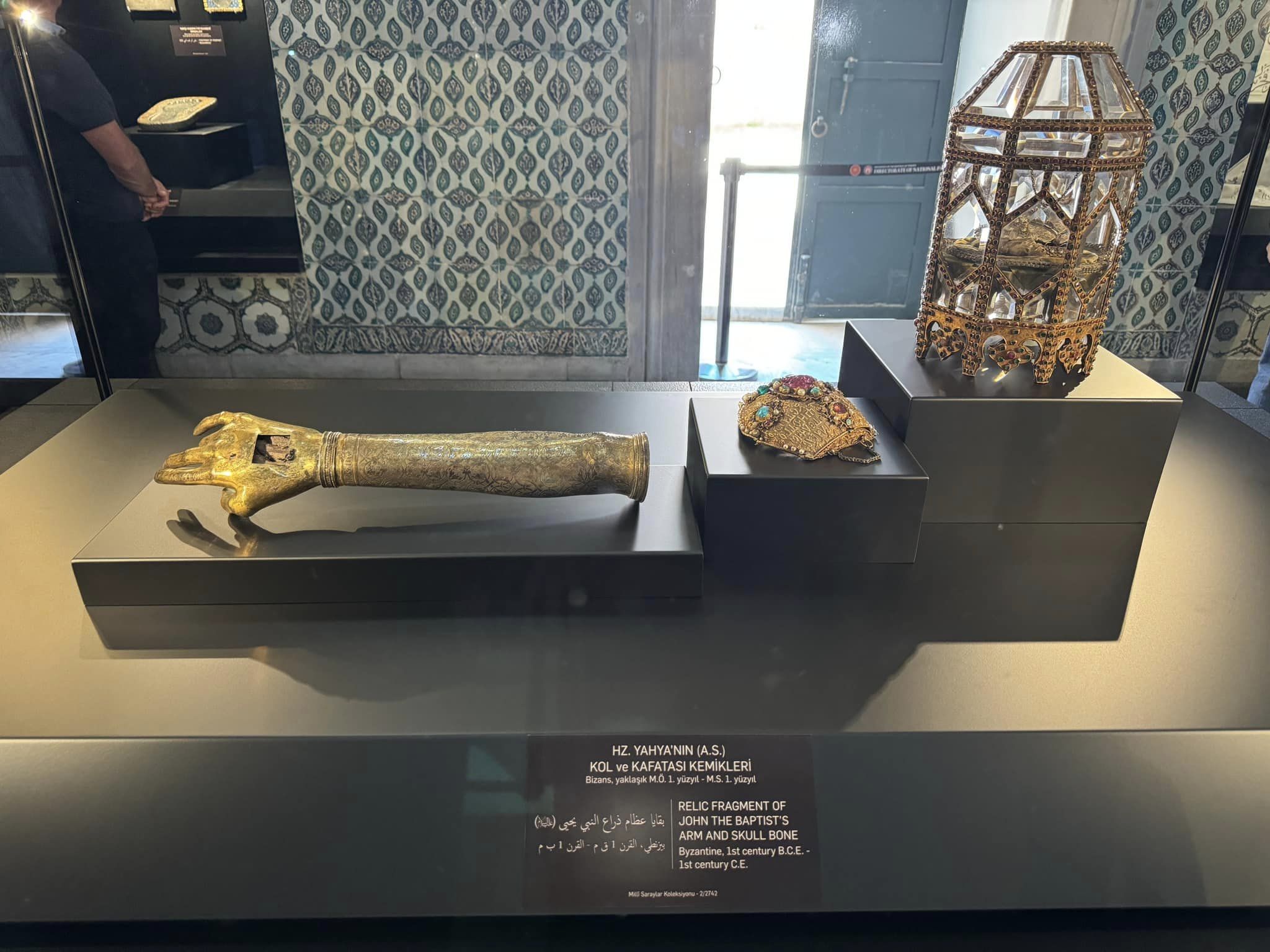
These are fragments of John the Baptist’s arm and skull bones. Interesting gift…
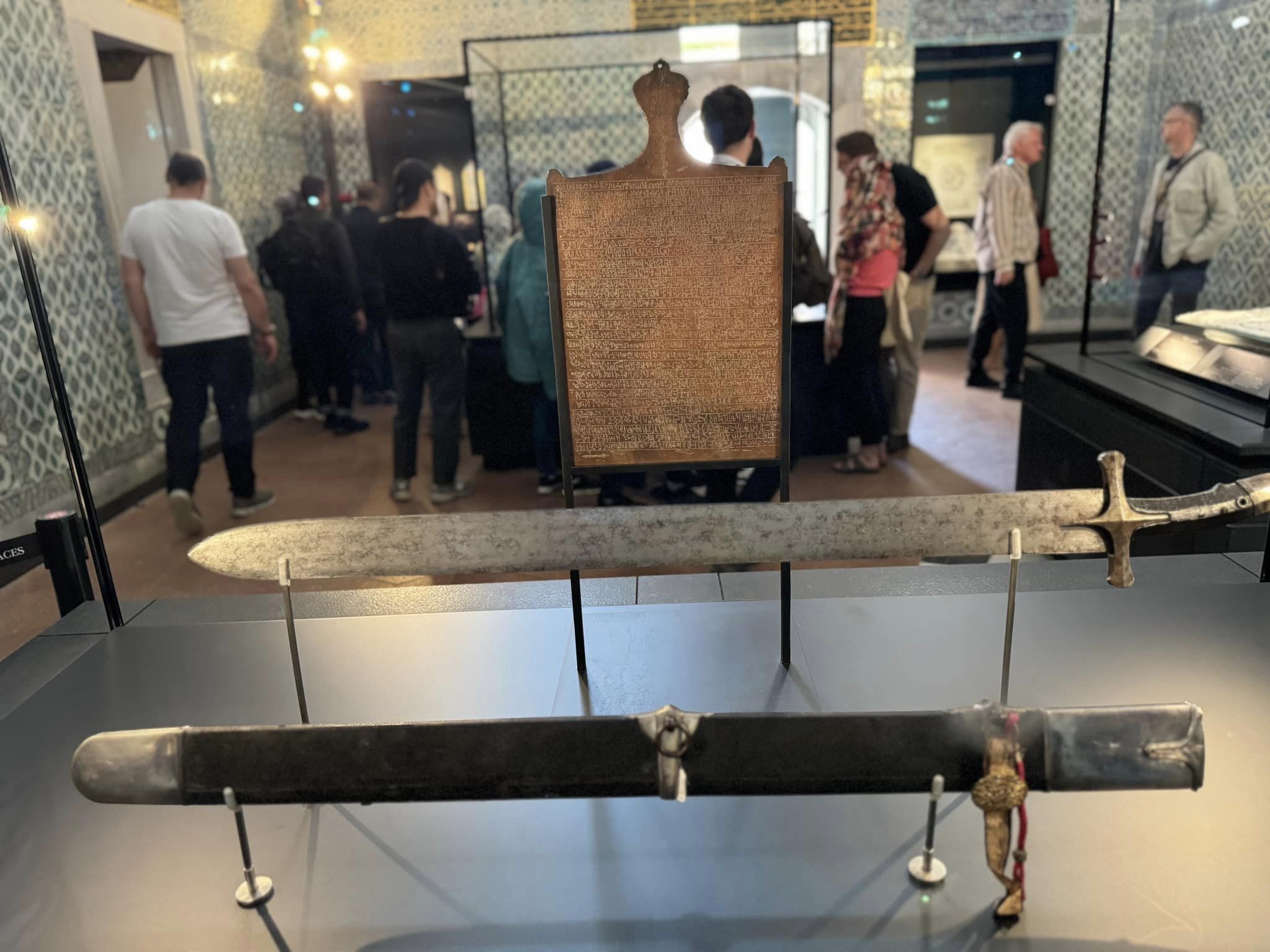
This is the Prophet David’s sword from the 10th century BCE. The symbols on the sword represent David’s famous clash with Goliath and is inscribed with the names of a bunch of famous prophets including David, Solomon, Moses, Joshua, Zachariah, John the Baptist, Jesus and Muhammad. Basically, all the movers and shakers of the time.
Sultan Selim I started the tradition of appointing hafizes (Muslims who know the Quran by heart) to recite the Quran ceaselessly. This practice continues to this day. This hafiz, one of five reciters taking turns throughout the day, is in place for a 45-minute shift (notice he has the Quran in front of him but his eyes are closed). Overnight, there are nine hafiz with two-hour shifts taking turns.
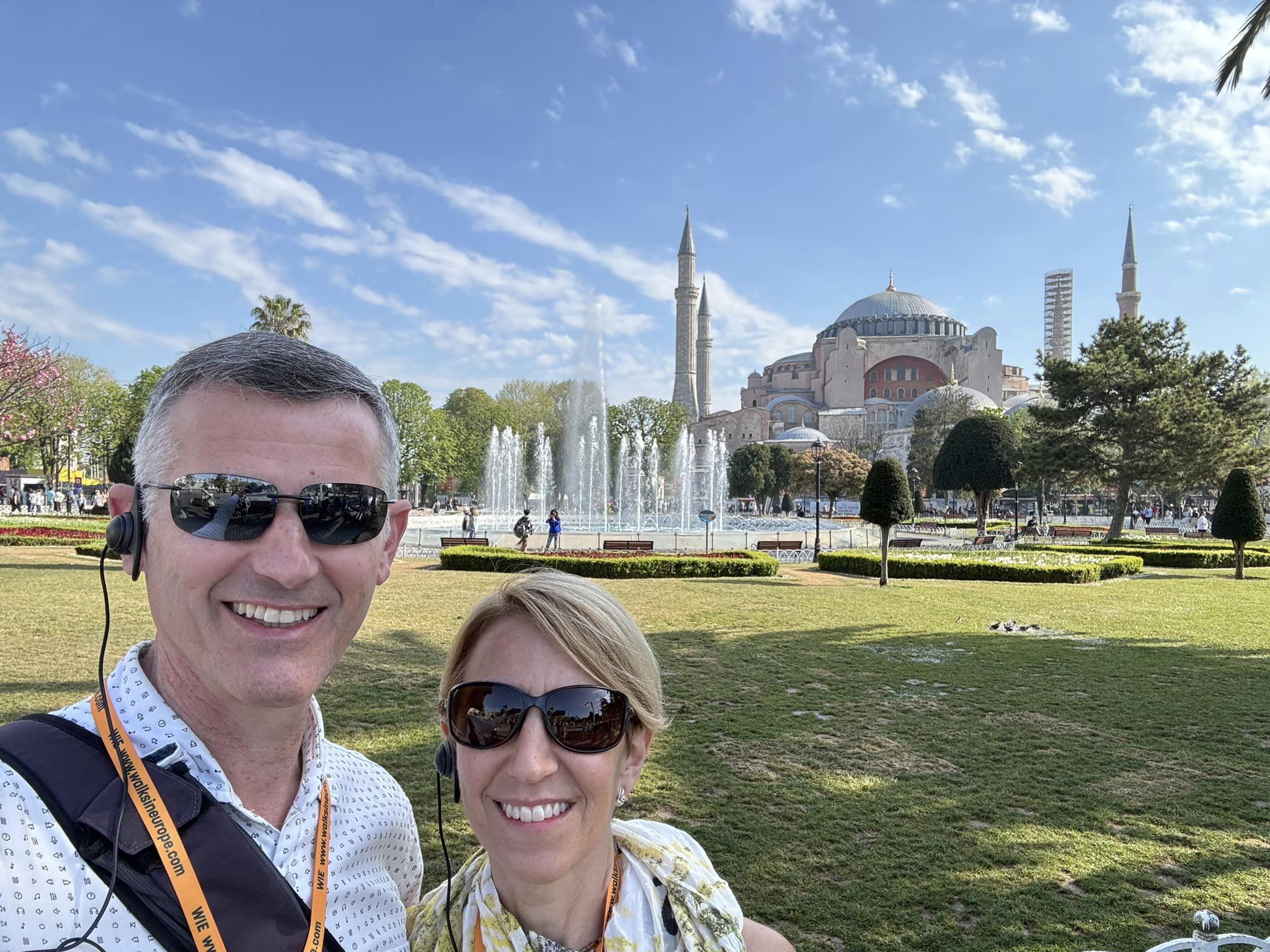
Hagia Sophia and the site it sits upon have made the rounds of functionality over a long and illustrious time. What started as Constantine’s church built over a pagan temple in 325, burned in riots in 404 (that’s the problem with wood!), and the restored church burned again in riots in 532. Justinian must have thought there was some bad karma going on so he took the opportunity to start his church from scratch and built Hagia Sophia as we see it today in 537. He was an early adopter of recycling, completing it in under six years using bits and pieces from other building and temples in the vicinity. Everything old is new again! In a show of one-upmanship, he declared it bigger than Solomon’s temple in Jerusalem! This was also the first ever structure with a rectangular base topped with a dome. It was a great idea but they didn’t have the engineering quite right and the dome kept collapsing. Over time, more and more buttresses were added to hold it up. To this day, there are ongoing renovations to keep this impressive building from falling.
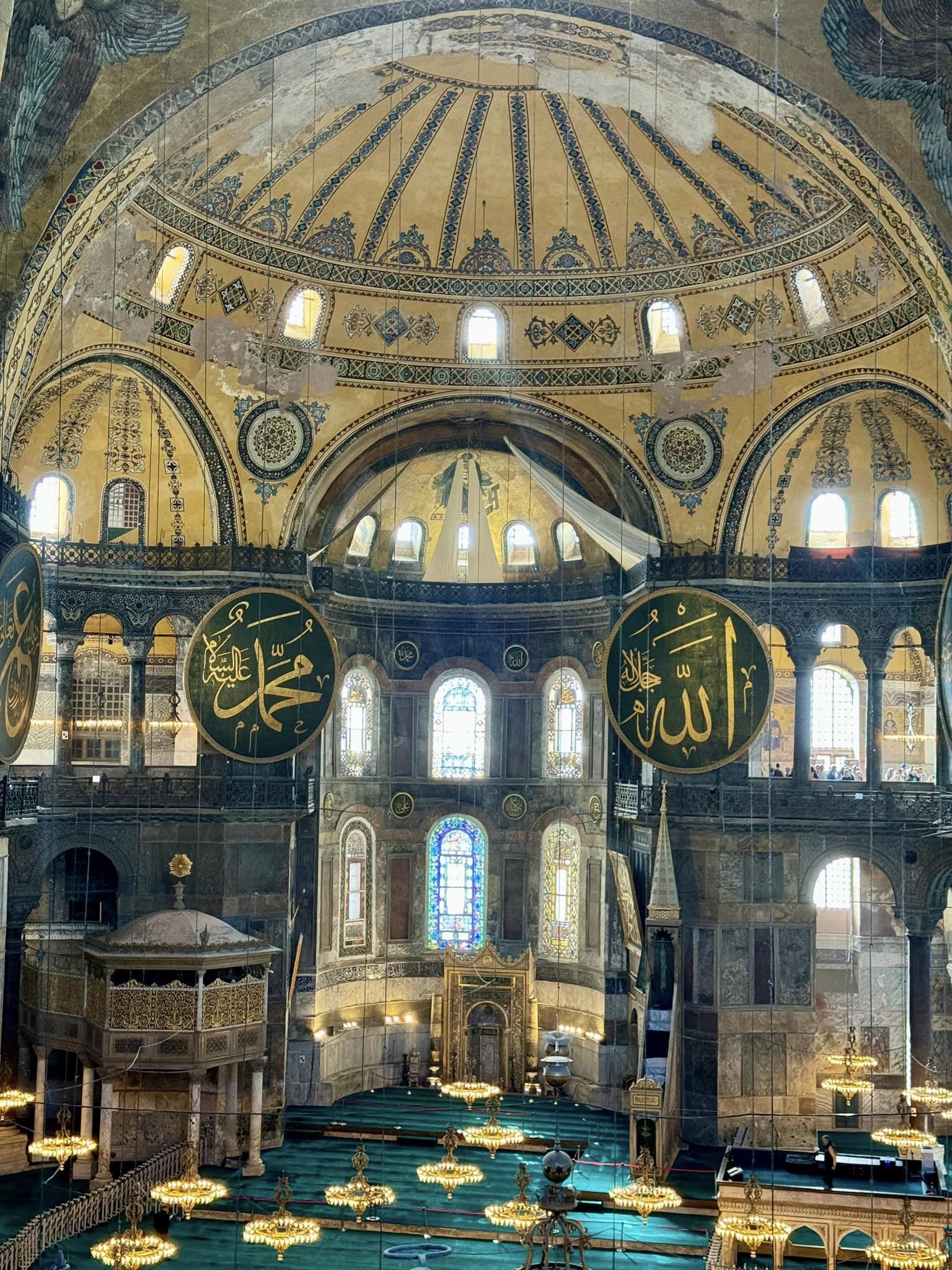
Sultan Mehmed II conquered Constantinople nearly a thousand years later in 1453 and turned Hagia Sophia into a mosque in a mere 2 days to be in time for Friday prayers. Over time, the Christian symbols and mosaics were plastered over and minarets were erected. Above what would have been the altar, there is a mosaic of Mary and Jesus. Muslims have no interest in gazing upon this as they prayed so it was loosely covered with drapery. At the right angle, we can see the mosaic. Notice that the altar is off centre. The mihrab is the niche at the end of the building and faces Mecca. The altar needs to face Jerusalem and that is not exactly in the same direction as Mecca. The gilded cage on the left is for the sultan to pray safely. Not easy to assassinate him in there. It remained a mosque for nearly 500 years until Atatürk decided to secularize it and turn it into a museum in 1934 for all to enjoy. There was a lot of secretive political haggling and backroom deals behind this decision such that nobody knew it was happening until it happened, not even the Manager of Museums. Needless to say, a controversial decision. Most recently in 2020, the current President Erdogan turned it back into a mosque but maintained the upper floor as a museum. Needless to say, you can’t charge people to enter a house of worship but you can sure charge them to enter a museum! Another controversial decision…and more fun stories!
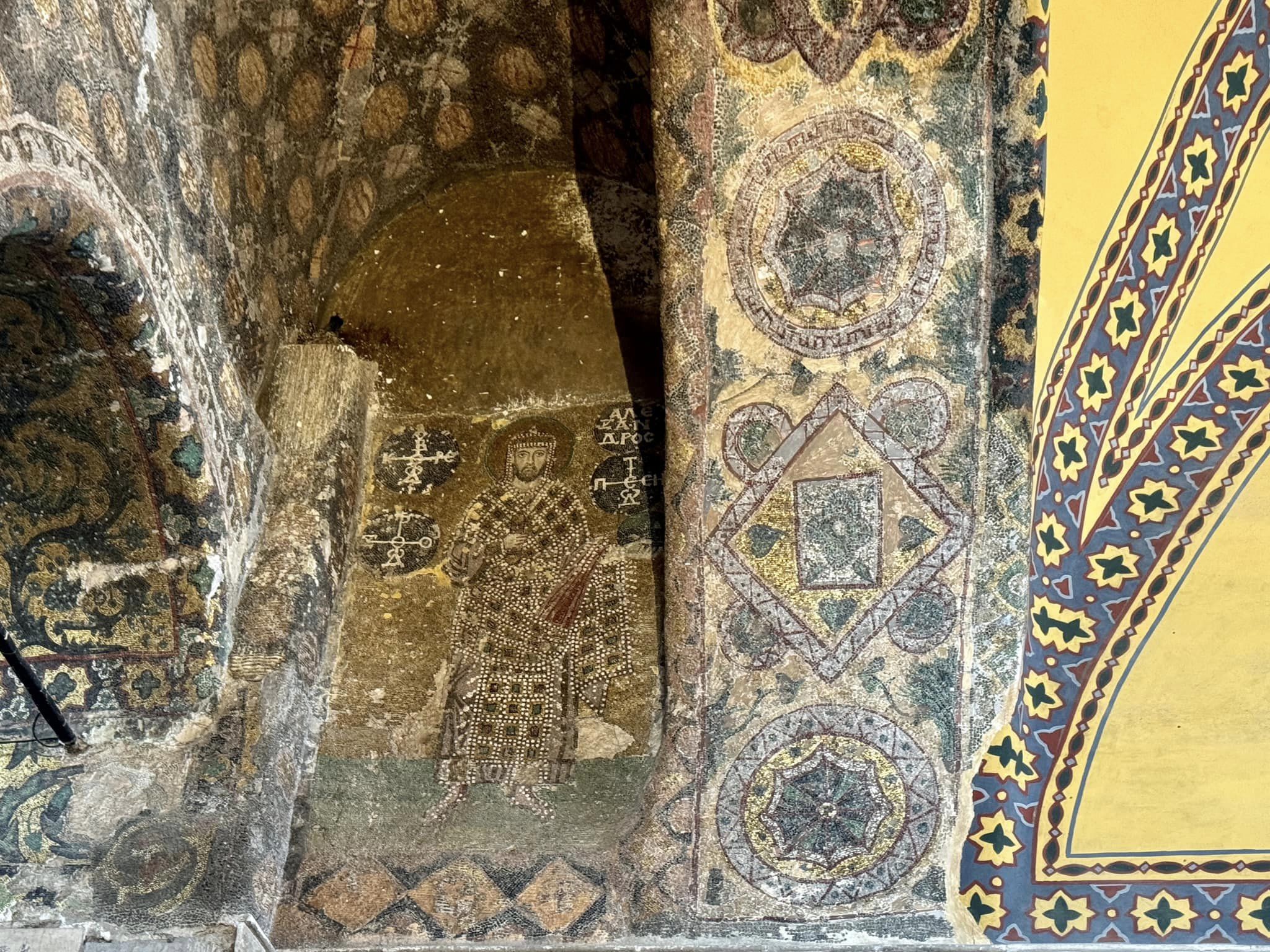
This is Emperor Alexei. Before he was emperor, the church refused his donation (which would result in some artwork in his honour) because he was gay. He ended up being crowned emperor for one year and now the church couldn’t refuse his donation. But as a snub indicating their displeasure with his personal choices, they put his mosaic in the least visible spot.
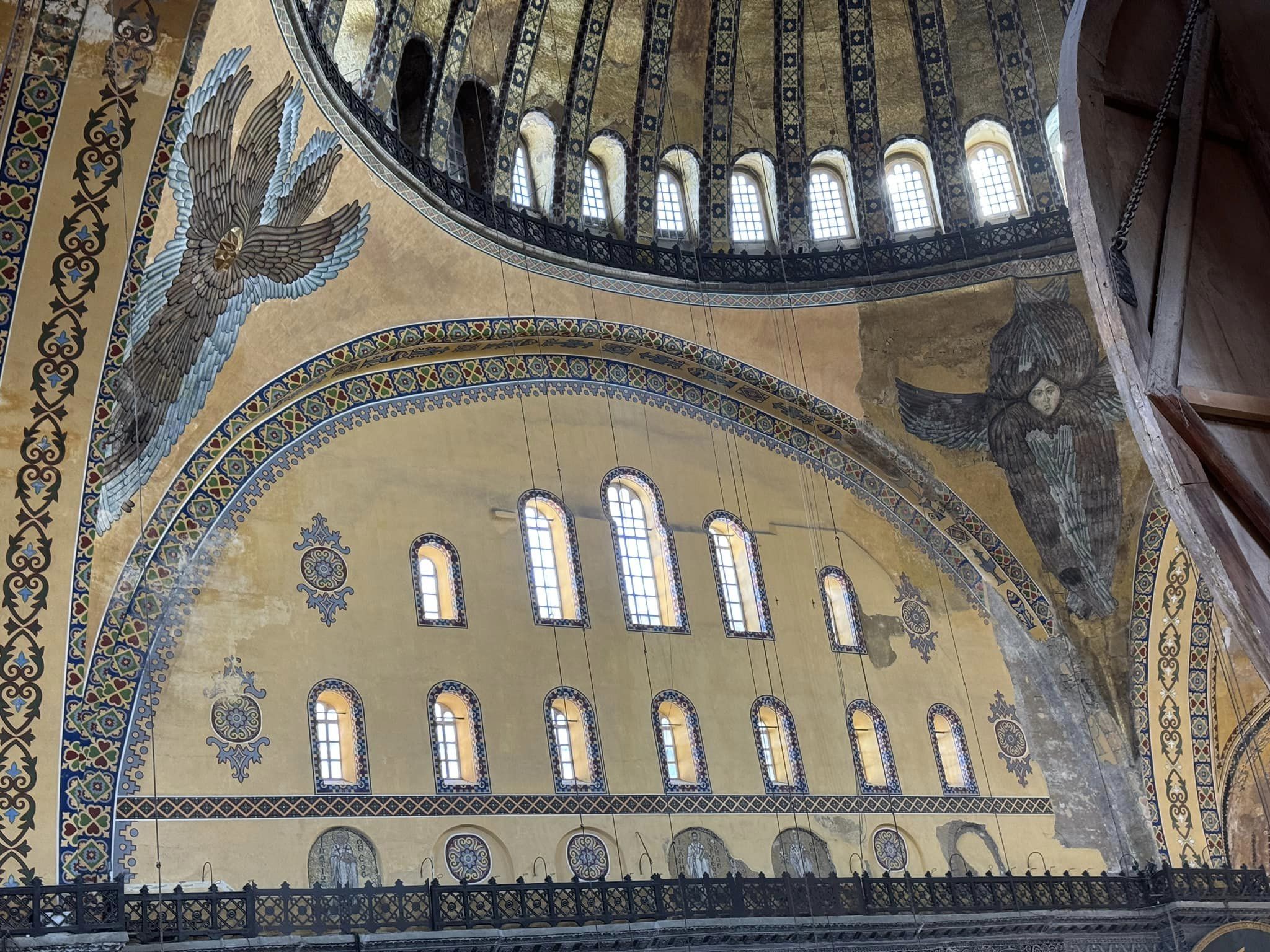
When turning the museum back into a mosque the angels faces were covered with masks. During the works, an angel’s mask was accidentally knocked off. The workers were afraid to replace it because they would come face to face with an angel so they walked away and the angel can now look down upon the worshippers.
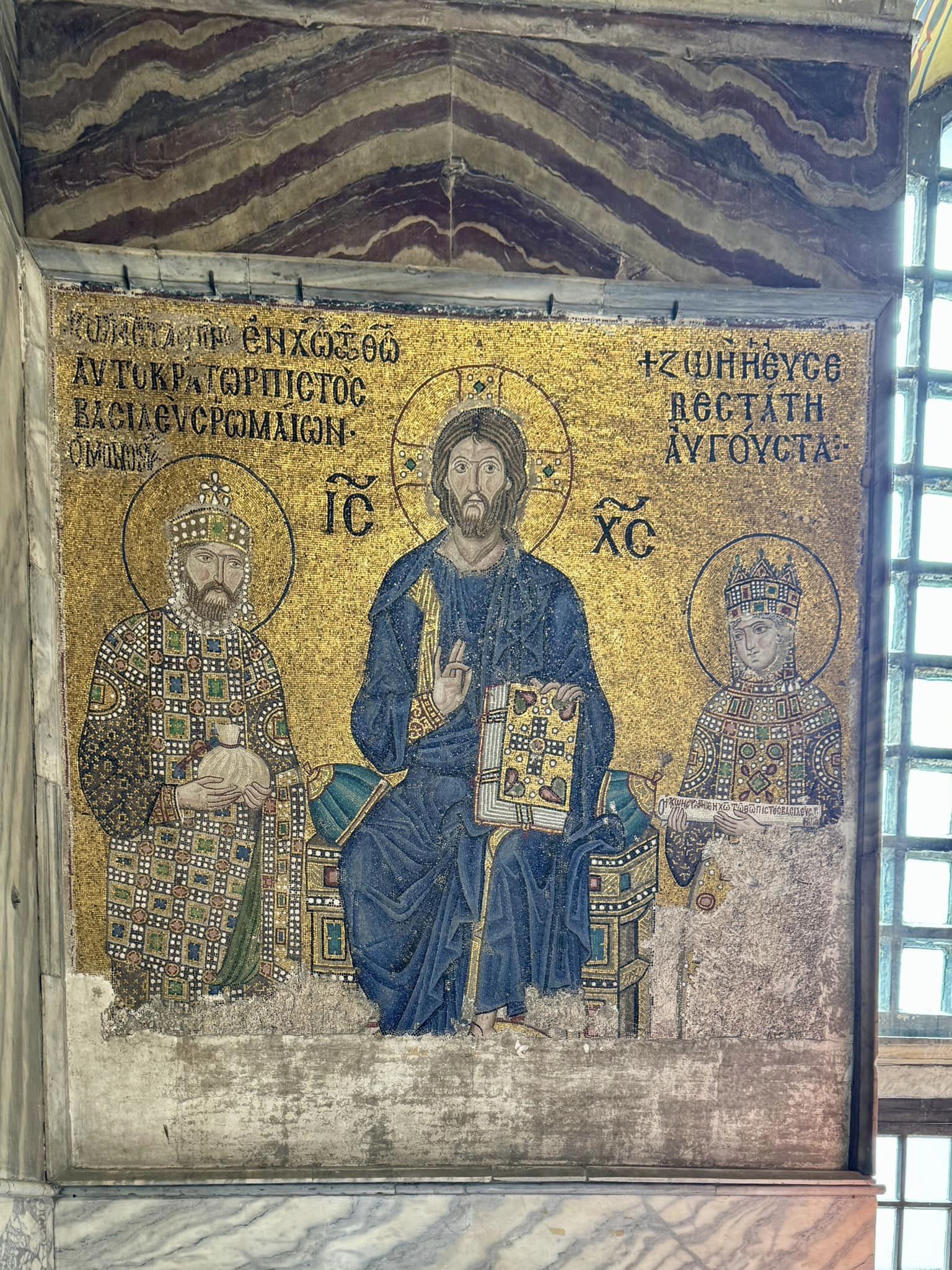
Here’s the first example ancient photoshop. This mosaic shows Empress Zoe the 50-year-old unmarried (and apparently virgin) daughter of Constantine VIII along side Jesus and her third husband Constantine IX. Here’s the backstory: Zoe’s dad wanted her to marry Argyros before he died. She did but then fell in love with Michael the stable boy. They drowned Agyros in the bath and Zoe married Michael who became Emperor. Seven years later, Michael IV died and his nephew, Michael V imprisoned Zoe and became emperor. Riots ensued and the second Michael was dethroned by Constantine IX who became Emperor and Zoe’s third husband. The original mosaic showed the face of Argyros, which was removed and replaced with the likeness of Michael IV which was ultimately replaced with the likeness of Zoe’s third and final husband, Constantine IX.
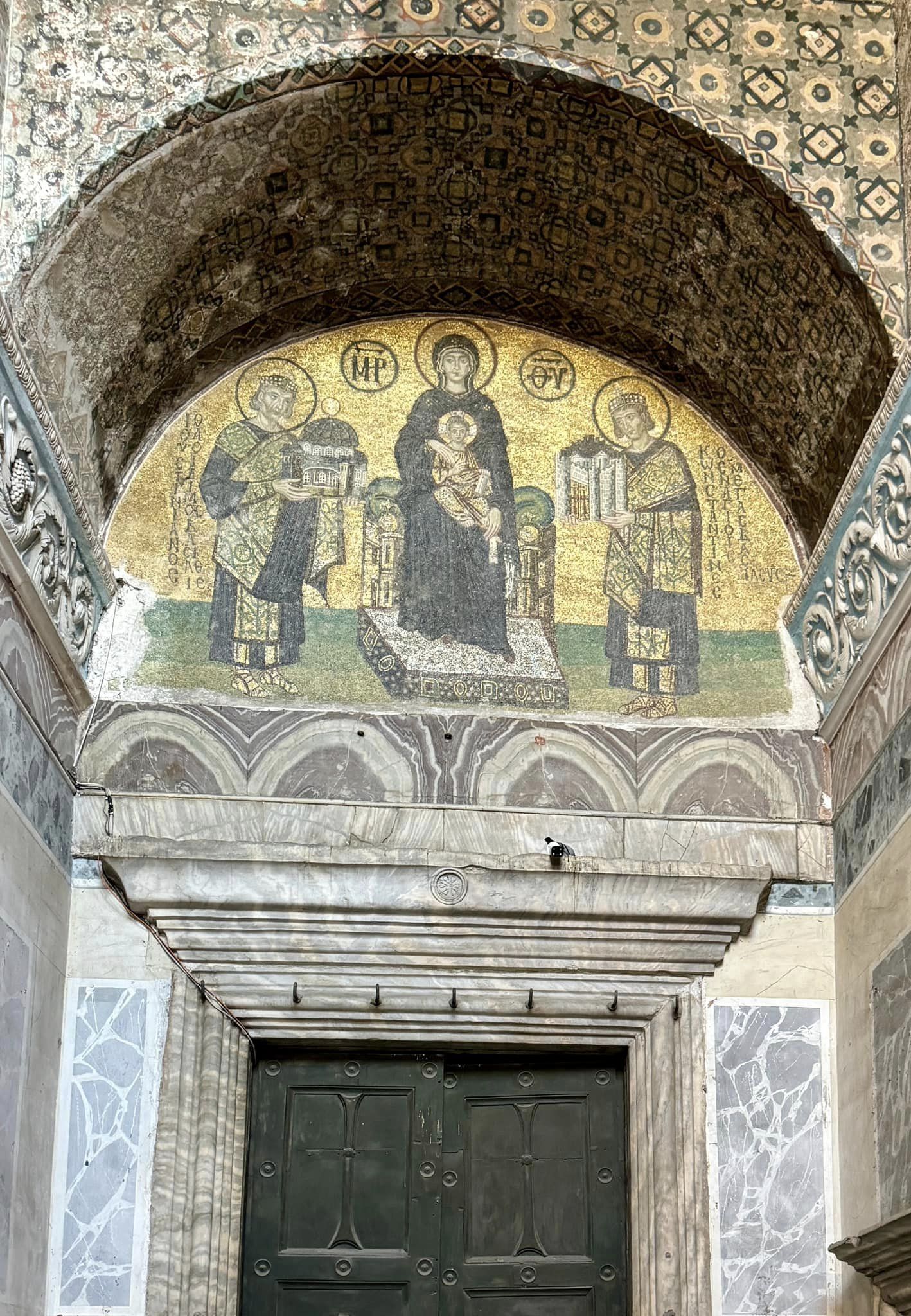
Funny how bigwigs felt the need to gift big stuff to Jesus to curry favour. Here, on the right is Constantine gifting the walls of Constantinople as a blessing, Justinian, on the left, is gifting Hagia Sophia.
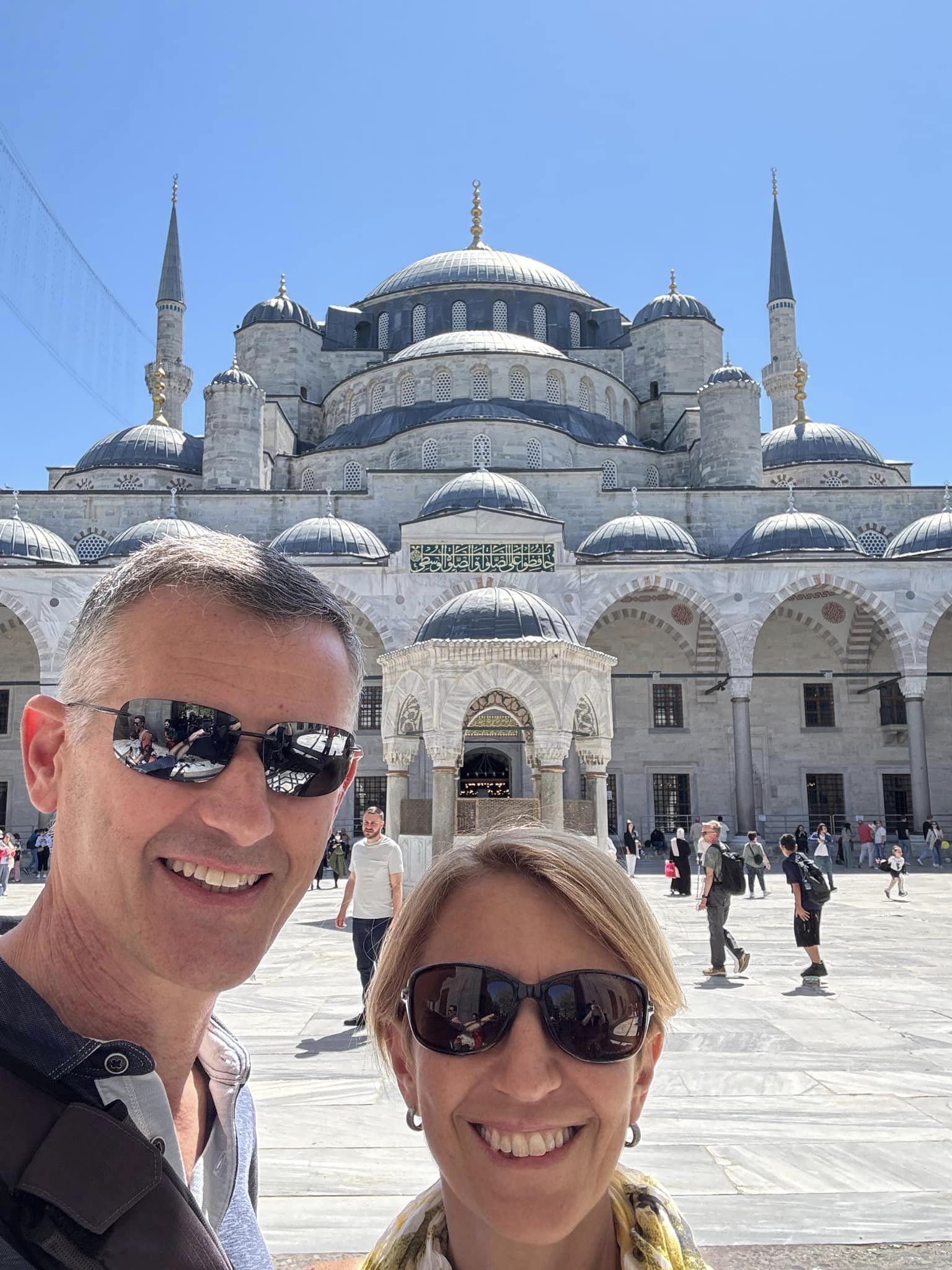
The massive Blue Mosque took 15 years to build using all original parts and opened in 1616. It typically holds 10,000 for prayers but that number swells on Fridays and during festivals. When the Sultan Ahmed commissioned the mosque, the architect misheard his request for “altın minareler” (golden minarets) for “altı minareler” (six minarets). This was a serious problem. The mosque in Mecca had six minarets and nobody, not even a Sultan, can compete with a prophet’s mosque. As a last-minute dive and catch, the Sultan commissioned an extra minaret for Mecca to keep its predominance in numbers of minarets.
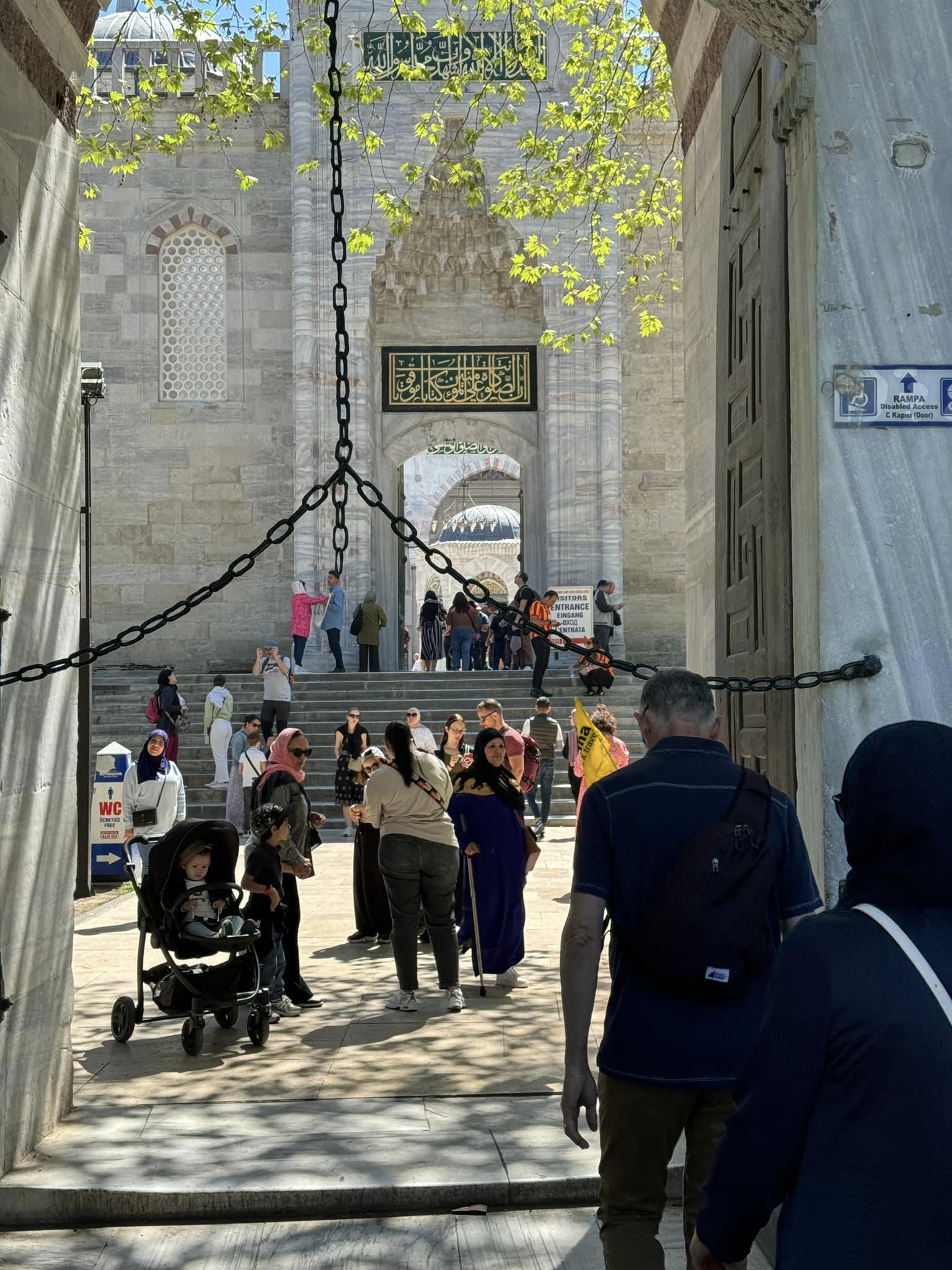
Chains are strung across the first entrance into the Blue Mosque, forcing worshippers to bow their heads as they enter.
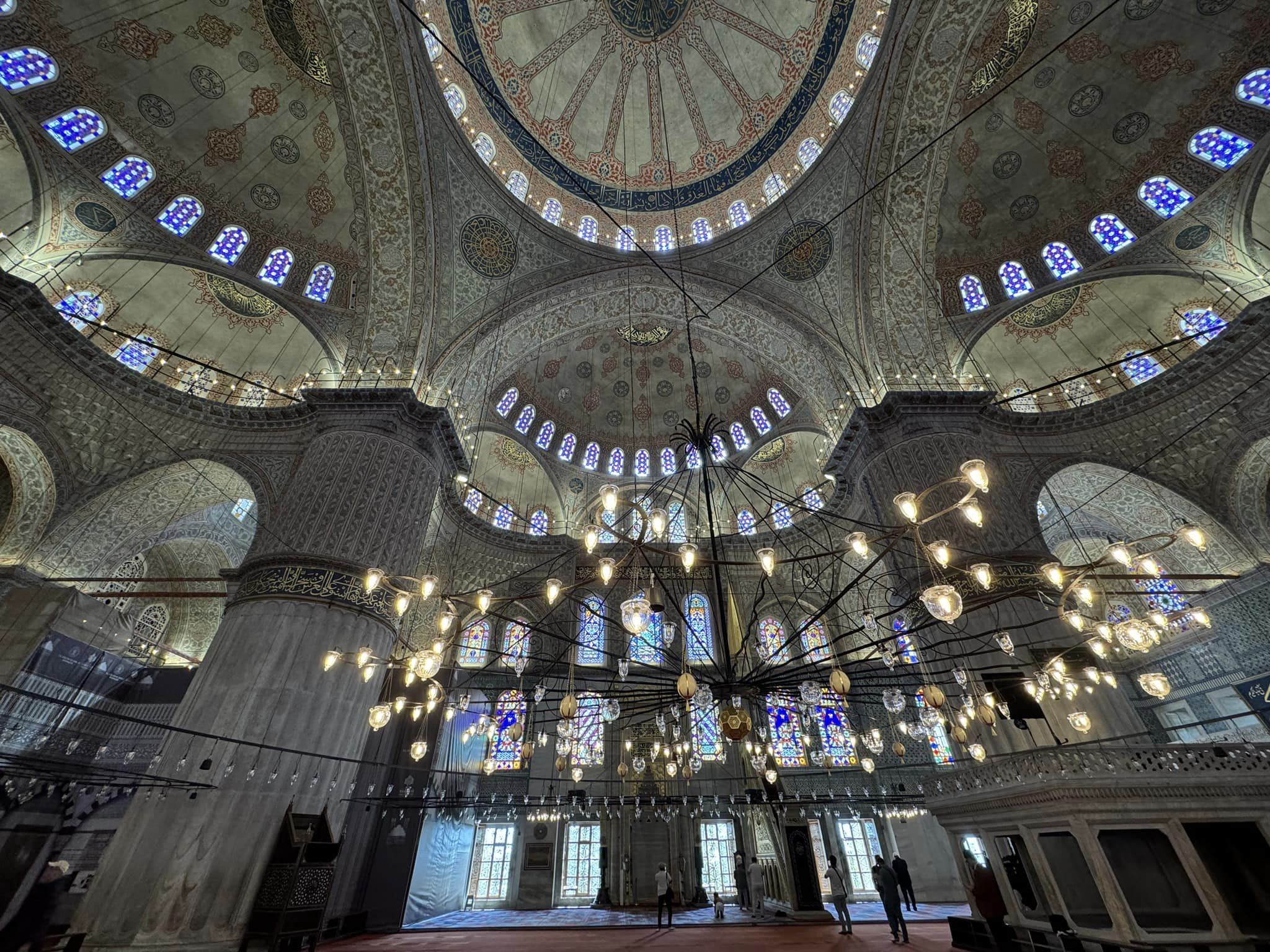
Learning from the mistakes of Hagia Sophia, coupled with advances in engineering, the Blue Mosque solved the collapsing dome problem by incorporating four massive fluted columns around its base to help support the weight. One-upmanship in this neighbourhood continued with the Sultan’s goal to be taller than the Hagia Sophia but it ultimately failed. Hagia Sophia’s dome and minarets beat the Blue Mosque.
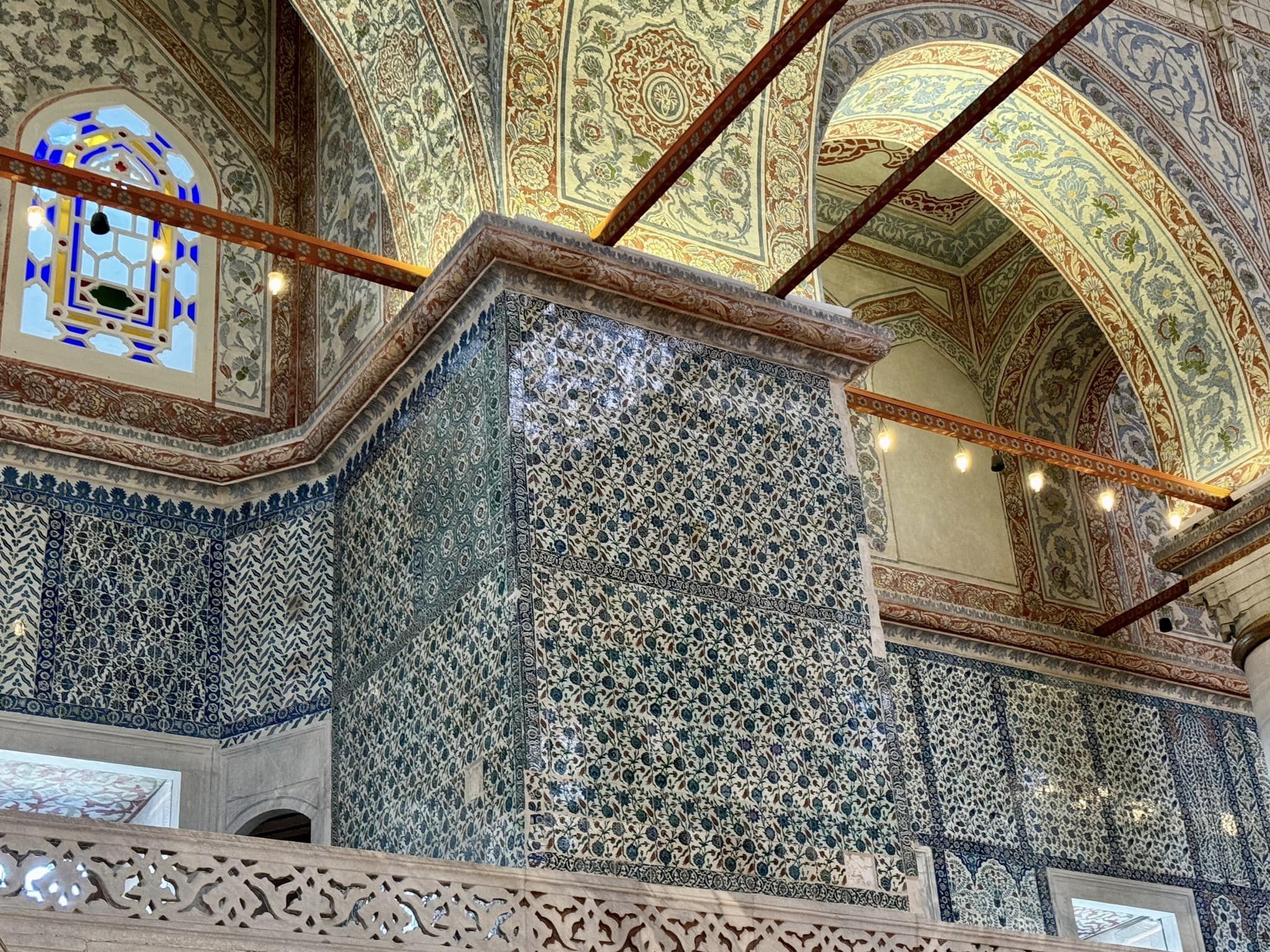
The Sultan Ahmed Mosque gets its much more familiar nickname, the Blue Mosque, from the colour of its interior which is, oddly, not overwhelmingly blue despite the 20,000 handmade turquoise İznik tiles adorned with tulips. The tulip is the flower of god as the letters used in the Ottoman word for tulip are the same as those in the name of Allah.
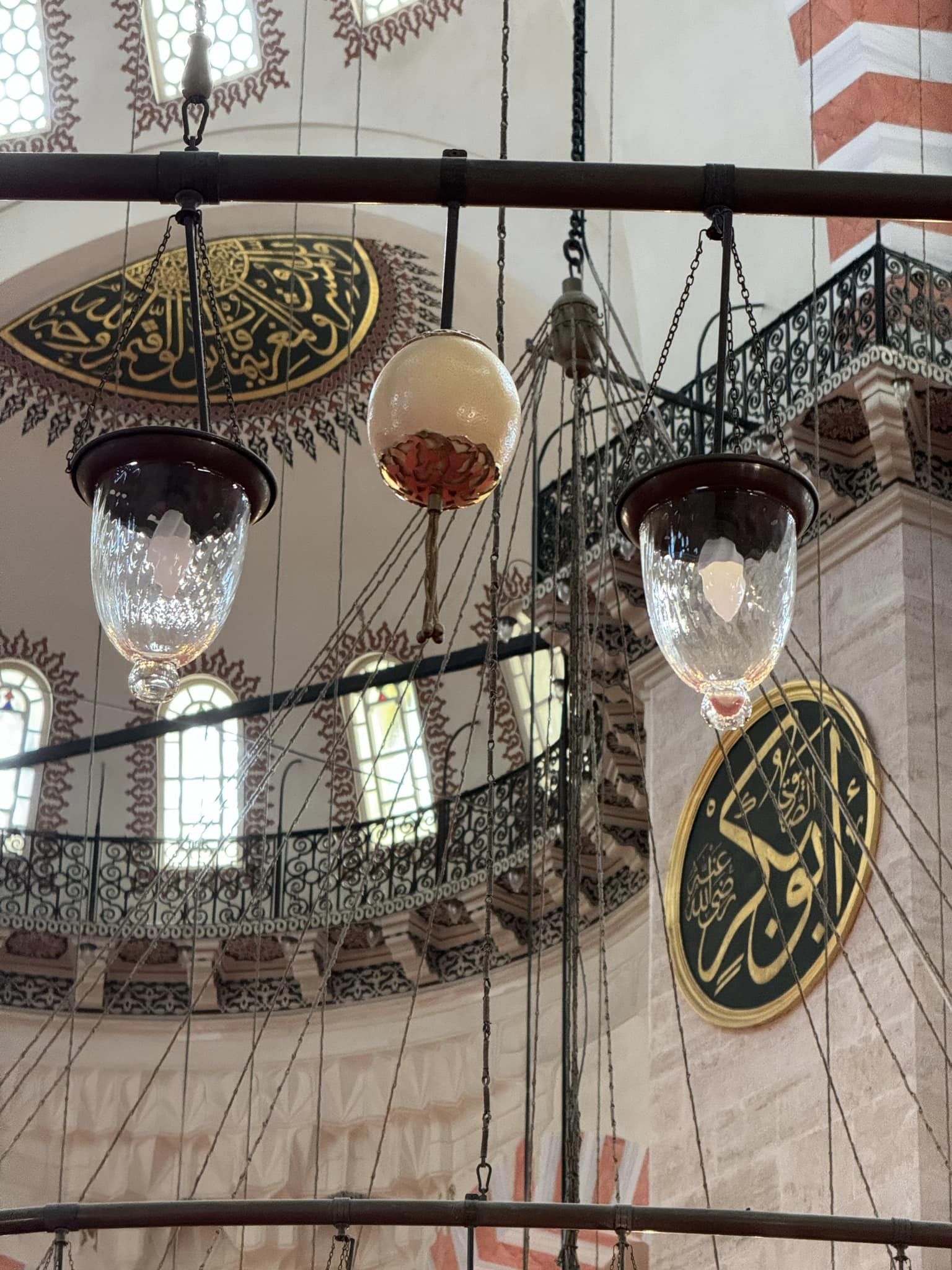
What’s this between the lights? It’s ancient spider control. The belief was that ostrich eggs emit an odour that we don’t smell but is repulsive to spiders. This has not been scientifically proven but these big eggs are sprinkled around many of the mosques. As you look at the picture of this mosque and the Süleymaniye Mosque, you’ll notice that there are no images of people (or Jesus, Mary…), just Arabic script with words and phrases of the Quran. Muslims believe that God is beyond imagination, beyond colour, race, face and gender. It’s all about a one-to-one relationship with God, regardless of where one is from, with no middlemen getting in the way.
Absorbing and Consuming More of Istanbul
Five glorious weeks in Türkiye, steeped in ancient history, vibrant culture and fabulous food has come to an end and we are all the better for it. Back to Istanbul for a few days to enjoy the neighbourhoods without the pressure of visiting the “must see” sites was the perfect way to wrap up this incredible adventure.
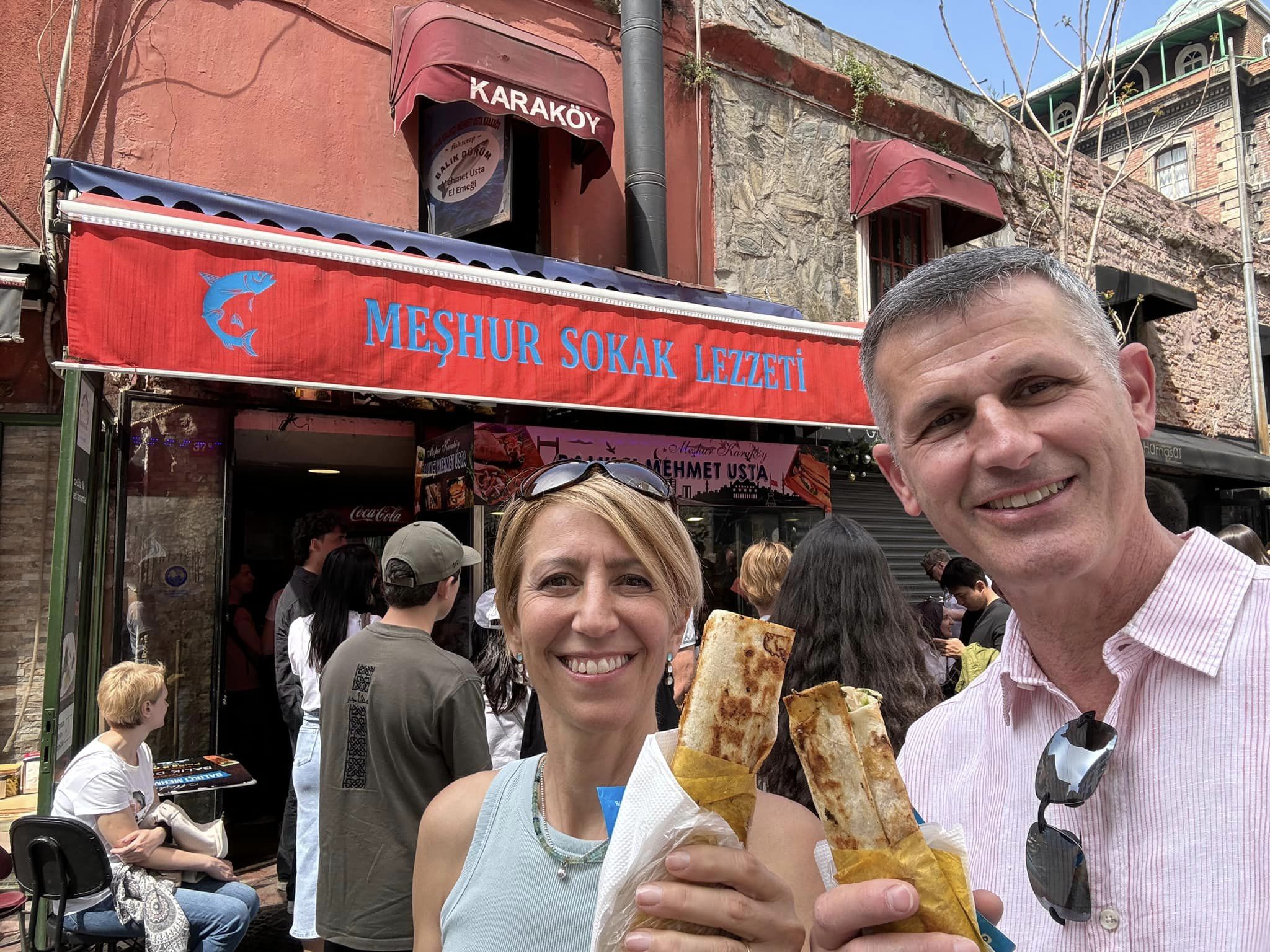
We have learned that whenever you see a big line for food at a hole in the wall, join it! Despite about half an hour’s wait, we weren’t disappointed. Who knew we stumbled across the place that created the Balik Dürüm, fish wrap. Mackerel is grilled with secret spices (we asked and they wouldn’t divulge), loaded into a thin, rectangular wrap and piled with shredded vegetables, more spices and secret sauce and grilled till crispy. Magic!
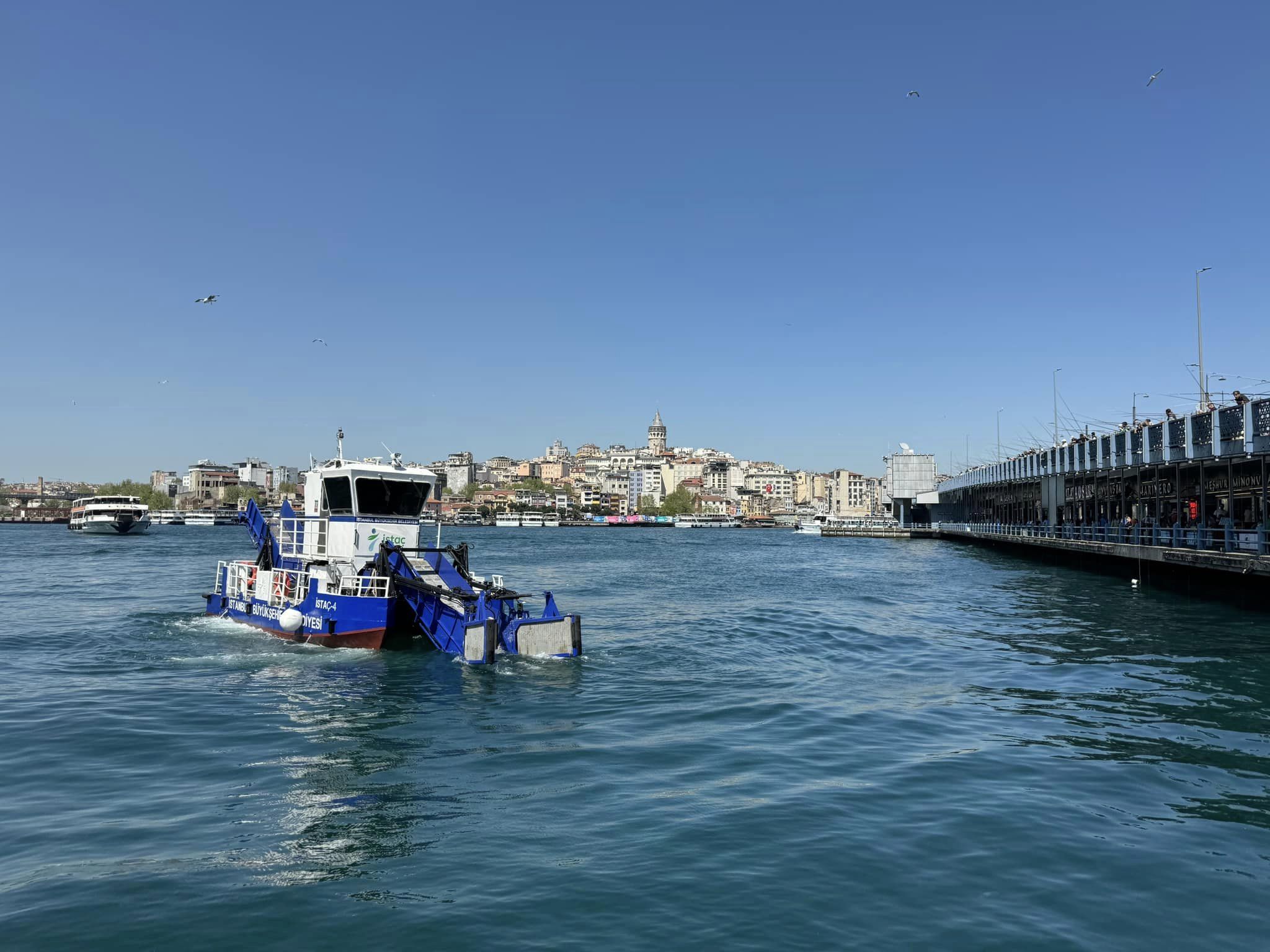
The Bosphorus used to be a filthy body of water, full of garbage. Istanbul realized it had a goldmine of waterfront under all that garbage. They cleaned it up and now it’s full of action. Keeping it nice and clean are these water garbage trucks, scooping up the mess before it piles up.
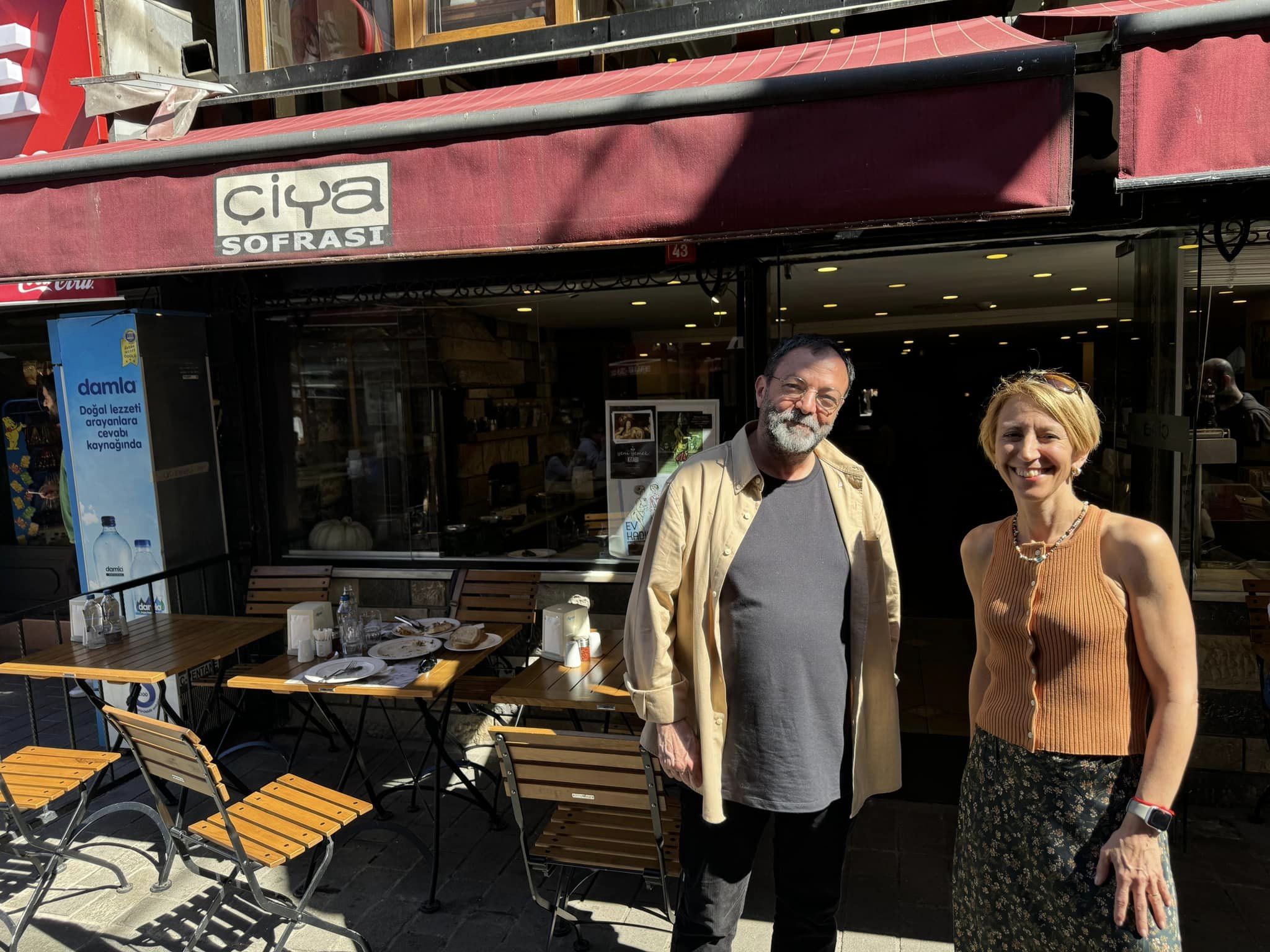
We heard about Çiya Sofrası and found our way there on the Asian side of Istanbul. How lucky were we to get to meet the owner who is venerated in the food scene not only here but internationally. Chef Musa Dağdeviren’s claim to fame is as a culinary anthropologist. For him, food is about geography and he brings classic dishes from all the ethnic and minority groups who call this country home to his three restaurants that sit within a block on this street. This is far from fancy but is the real deal when it comes to Turkish food. Traditional food and its culture is alive and well at Çiya.
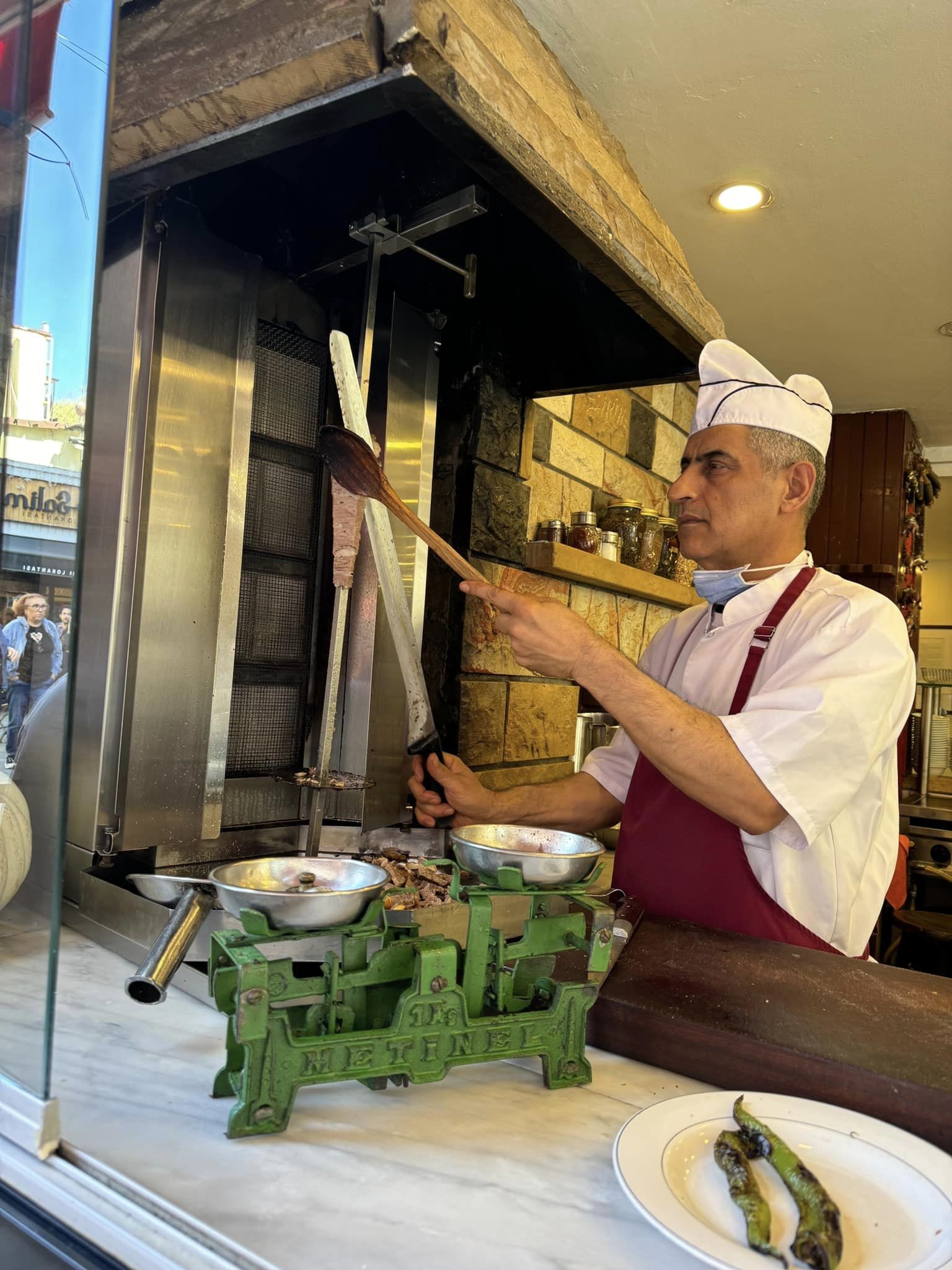
We sat in the street at Çiya right by the window where some of the magic happens. This chef wields an impressive knife that he sharpens every few cuts. At 2pm, this is what’s left of his lamb that started as ten kilos in the morning, slow roasting. It’s almost done and that’s it until tomorrow.
Classic Turkish dondurma antics.
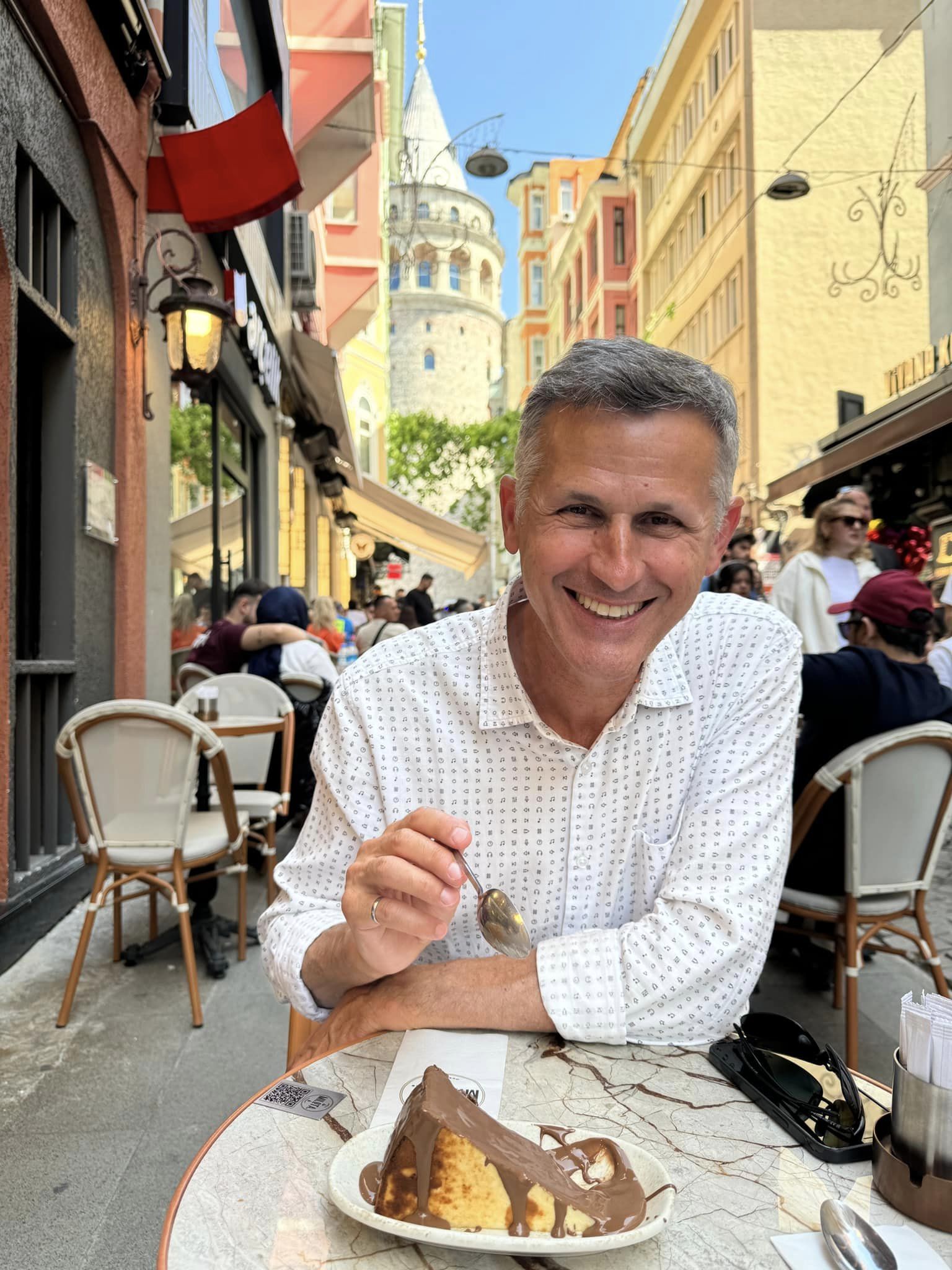
What’s with San Sebastián cheesecake in Turkey? We saw it everywhere, with a huge concentration of cafés on this street by the Galata Tower. Yes it’s from food mecca in Spain but a café in this street amped it up with melted chocolate (definitely not jarred chocolate sauce) and it’s hit the big time! Thanks to social media, is this vying with baklava and Turkish Delight as most popular sweet here? I’d say not, but it’s certainly up there. I am not a cheesecake fan and would never willingly order it in a restaurant but I had to give it a try. Adam thought I had been abducted by aliens and replaced with a lookalike. It was fantastic. Light and perfectly caramelized, but not burnt, on the top with a soft, creamy centre.
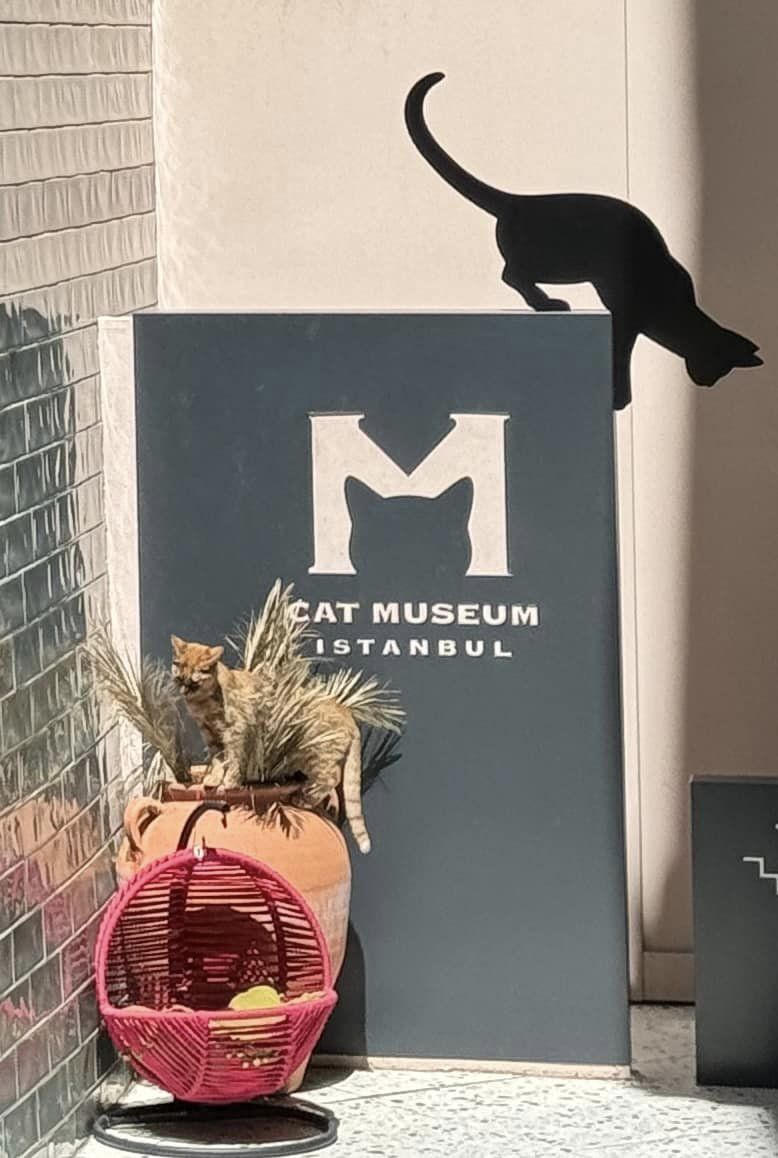
Of course Istanbul has a cat museum! Nice touch to add the cute, hanging basket chair but clearly the plant pot is the more desirable spot for feline lounging.
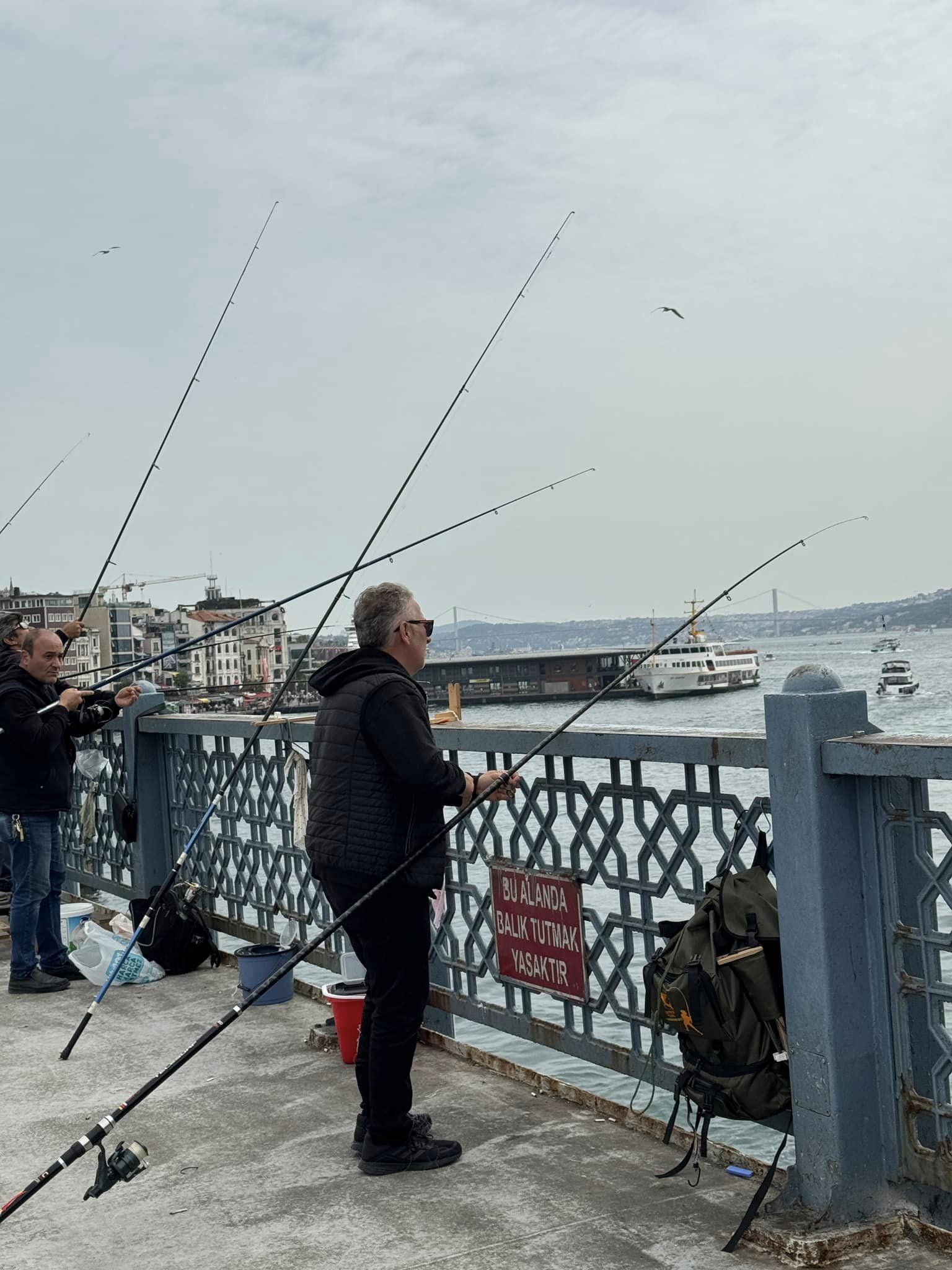
We’d already seen the fishing off the Galata bridge but hadn’t seen this sign before. Bu alanda balik tutmak yasaktir: it is forbidden to fish in this area. On the other side of me were a couple of police officers who clearly couldn’t care less.
Testi Kebab: Dinner and a show! And this guy is making the most of it. Our food arrived and for nearly five minutes he played with fire before breaking open the clay pot to release the steam and serve our lamb stew cooked in a clay pot that is essential mini pressure cooker. And he made sure everyone was enjoying the show, not just us…maybe a bit of promo for those who hadn’t ordered yet. The outside of restaurants that specialize in Testi Kebab is littered with the remnants of used pots.
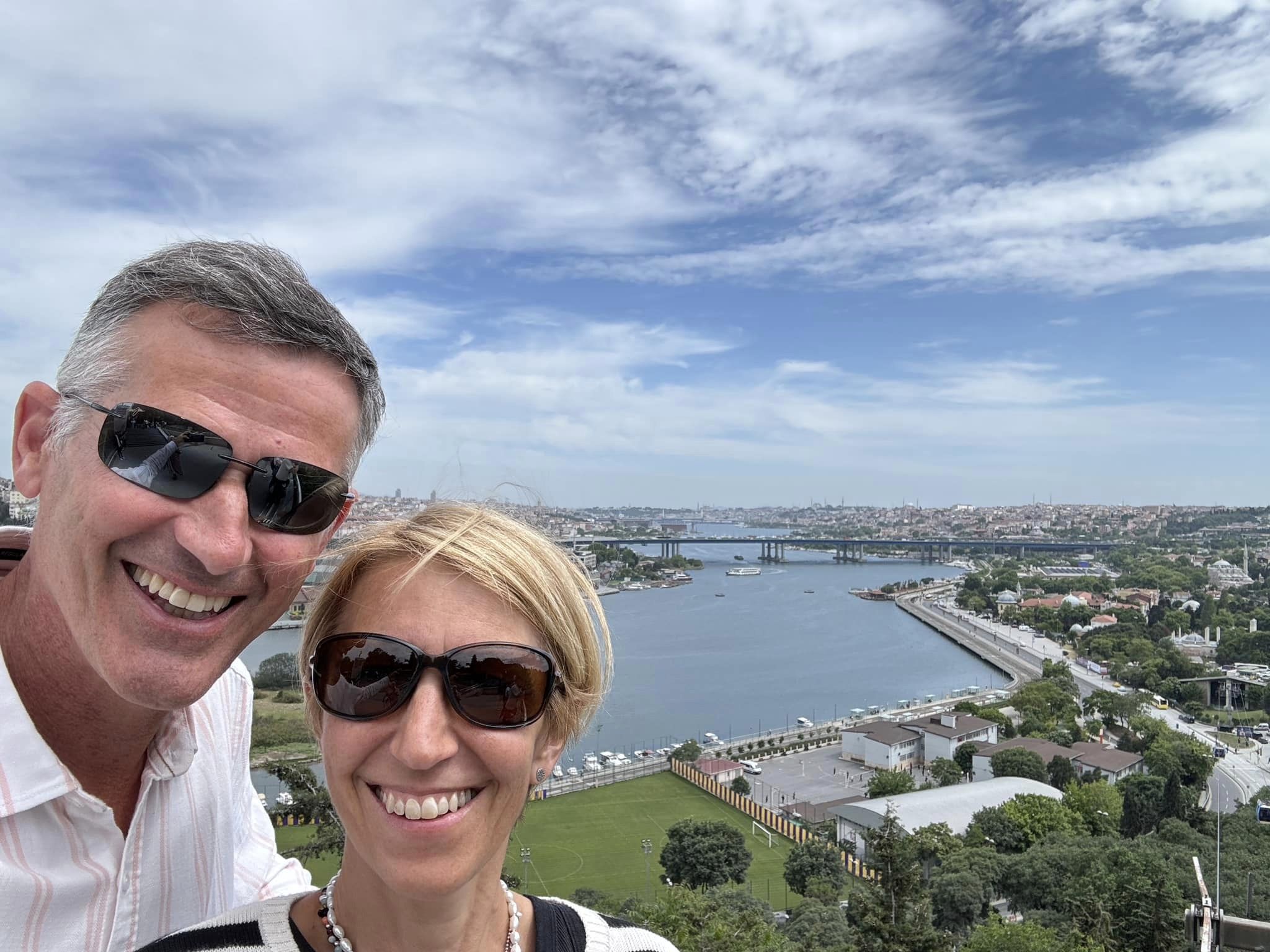
The hustle and bustle of Istanbul off in the distance down the Golden Horn.
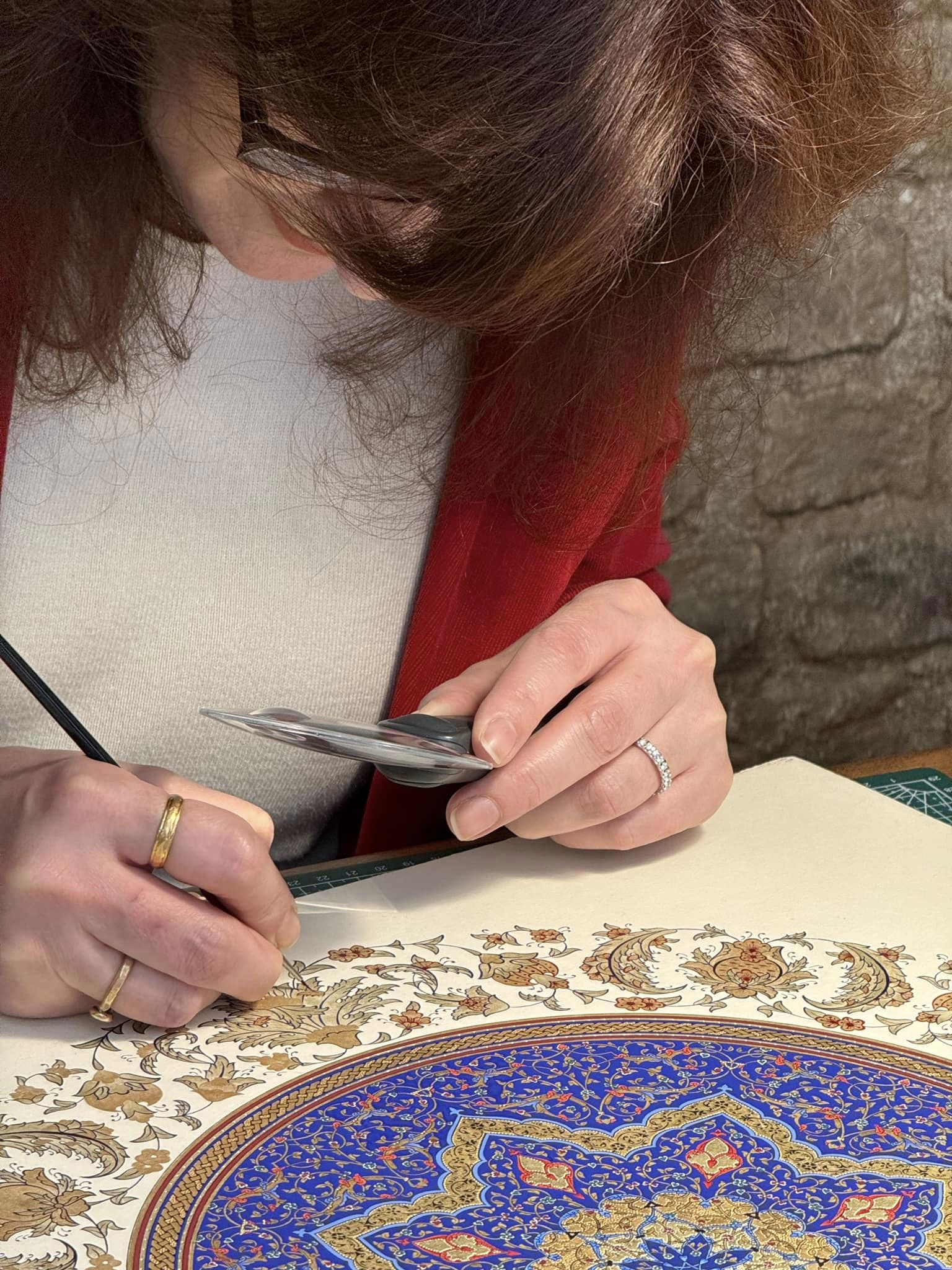
We happened upon this artist’s gallery while we were winding our way through the steep, cobbled streets of Beyoglu. Her passion is the art of shamsa which means “little sun” in Persian. These stunning circular paintings often appear in the front of manuscripts and are incredibly detailed. You could count the hairs on her brush; it’s so fine. She told us she’s been working on this one for five weeks and it’s almost finished. She paints with gold (18k, 22k and 24k as they each have different shades on the paper) which is her other passion...even her shoes were gold!
Ah, Turkish coffee…the self-ascribed coffee snob had to give it a try. While I didn’t buy all the special gear to bring home and open café 2.0, I did come to appreciate its nuances. There is an art to the preparation of good Turkish coffee and it’s all about technique. There is no discussion here about types of beans and origin, precise water temperatures and how many grams make a perfect brew. Here, the beans are finely ground almost like icing sugar. The cezve (pretty copper pitchers with a long handle) sit on a heated base (either straight on coals or with sand on top) with room temperature water and an imprecise spoonful of coffee is tossed in. It heats for a bit and often sugar is added. It gets a bit of a stir and then the “barista” will swirl it in the sand until it starts to bubble. Some of the coffee is poured into the cup to make room for it to bubble more on the heat and create a thick foam. Then the pour is completed before it boils over and the coffee is served with extra sugar on the side. They like it sweet! This is such an integral part of the culture here, particularly in the morning, that the word for breakfast is kahvaltı meaning “before coffee”.
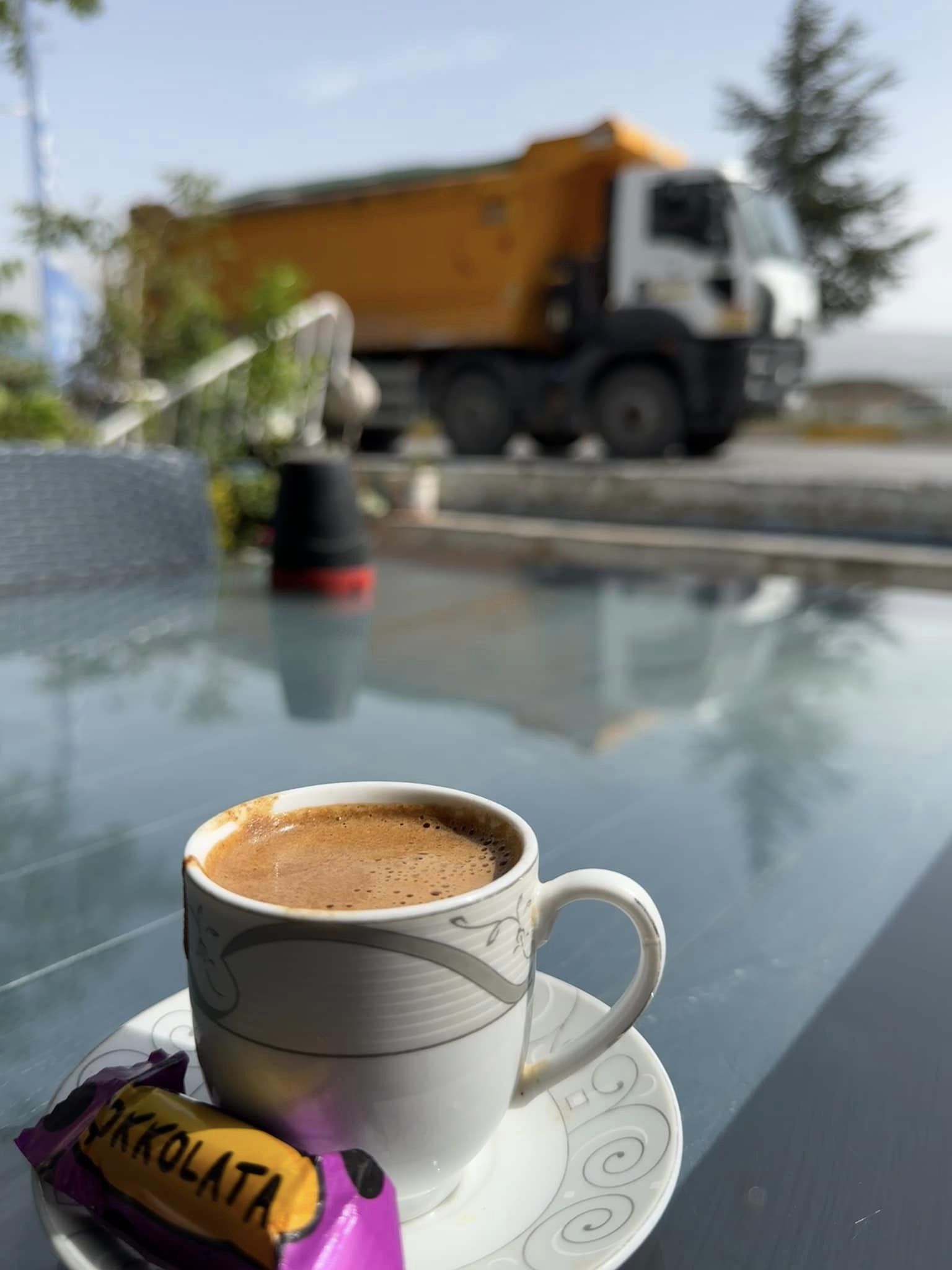
There is pride in preparation, even in roadside coffee.
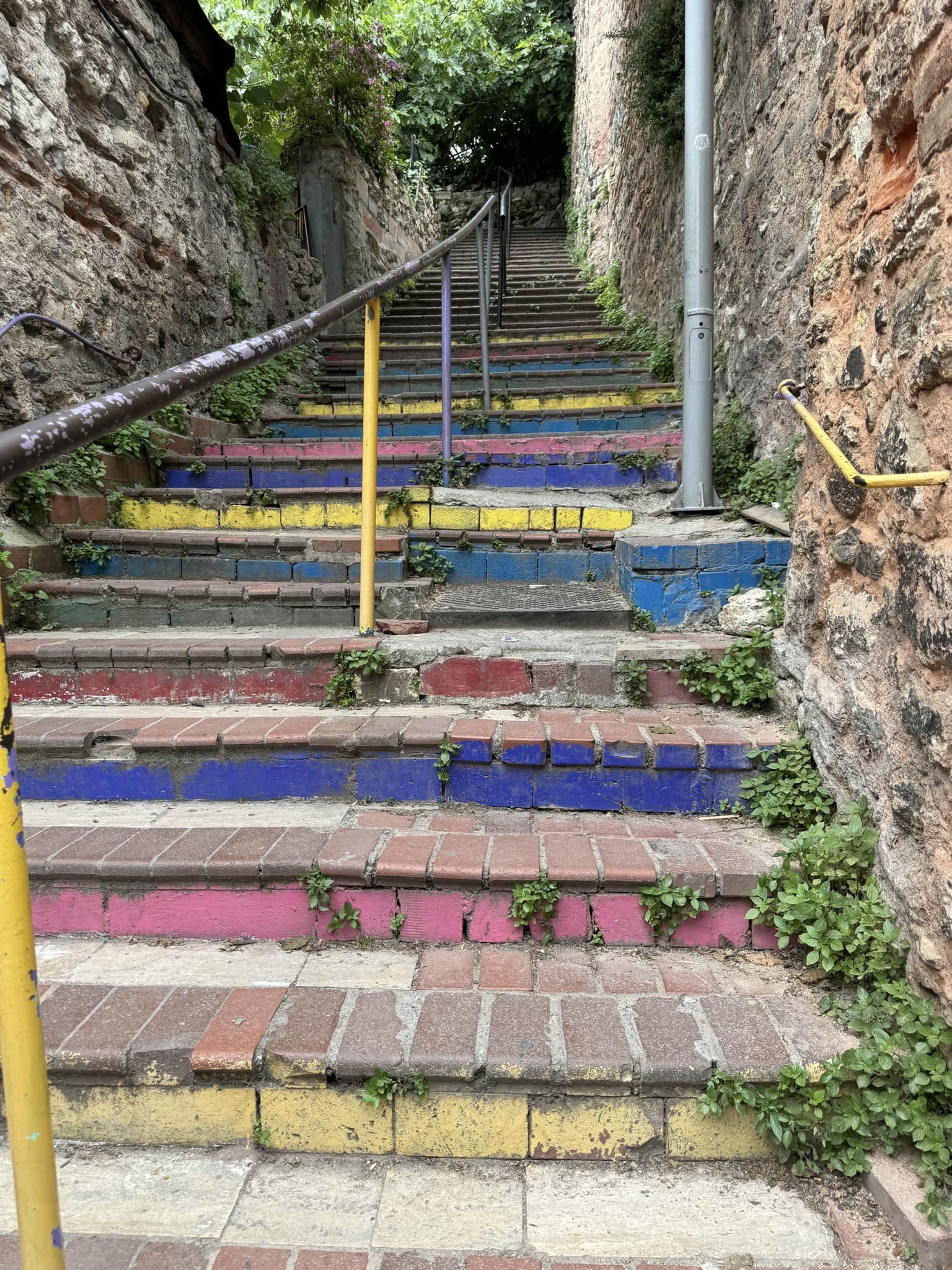
The pretty Balat neighbourhood has a very hippy, artsy vibe. This is an Instagrammer’s paradise; the pretty and cool places are easily identified by hordes of people posing. I guess the serious influencers show up at the crack of dawn to get their same same pictures before the crowds descend and block the view. For me, the beauty was in places just past the crowds who couldn’t be bothered to go up a few more steps where nobody ventured and weeds grow between the stones.
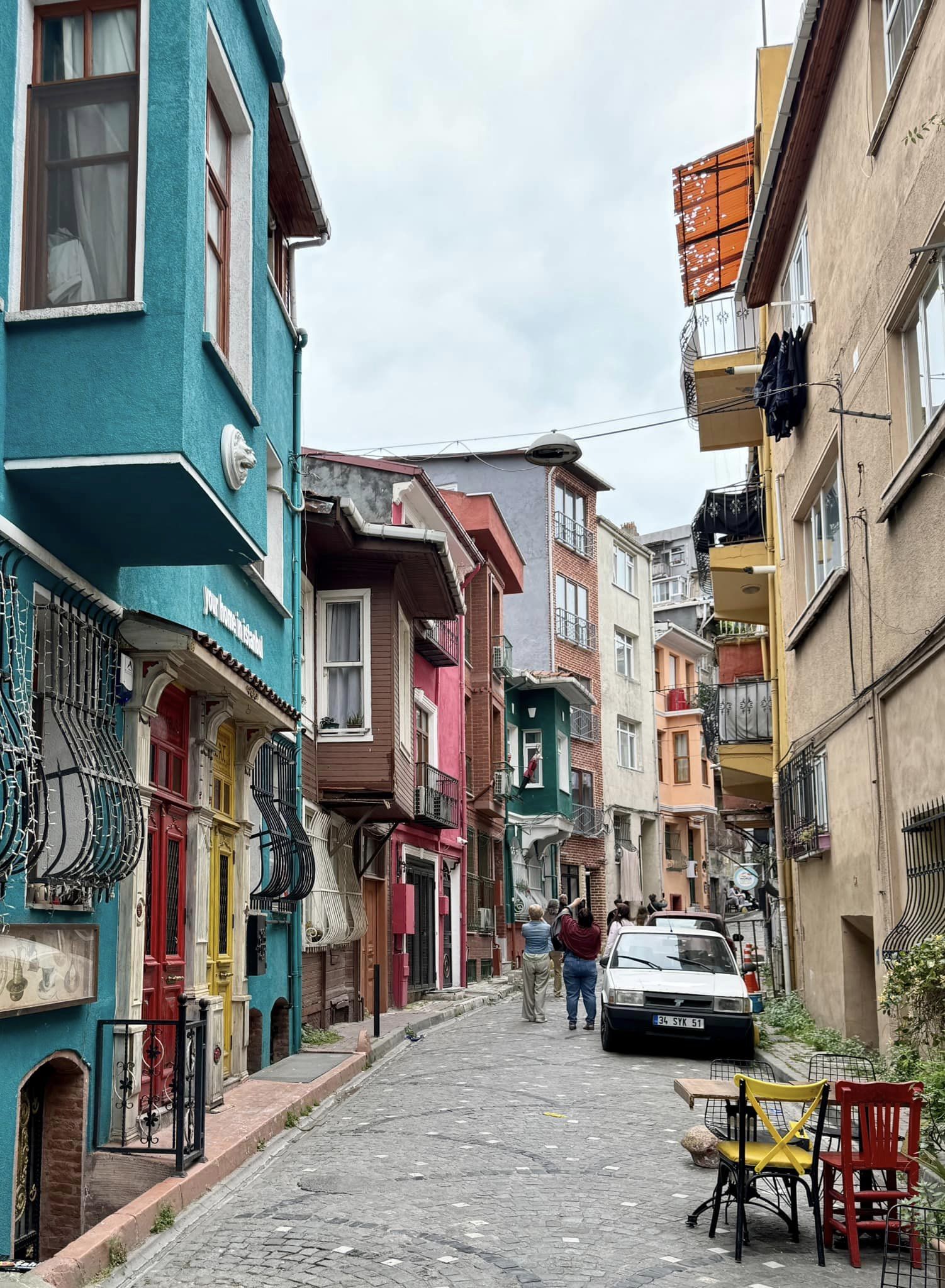
These houses add a much needed pop of colour on a grey day.
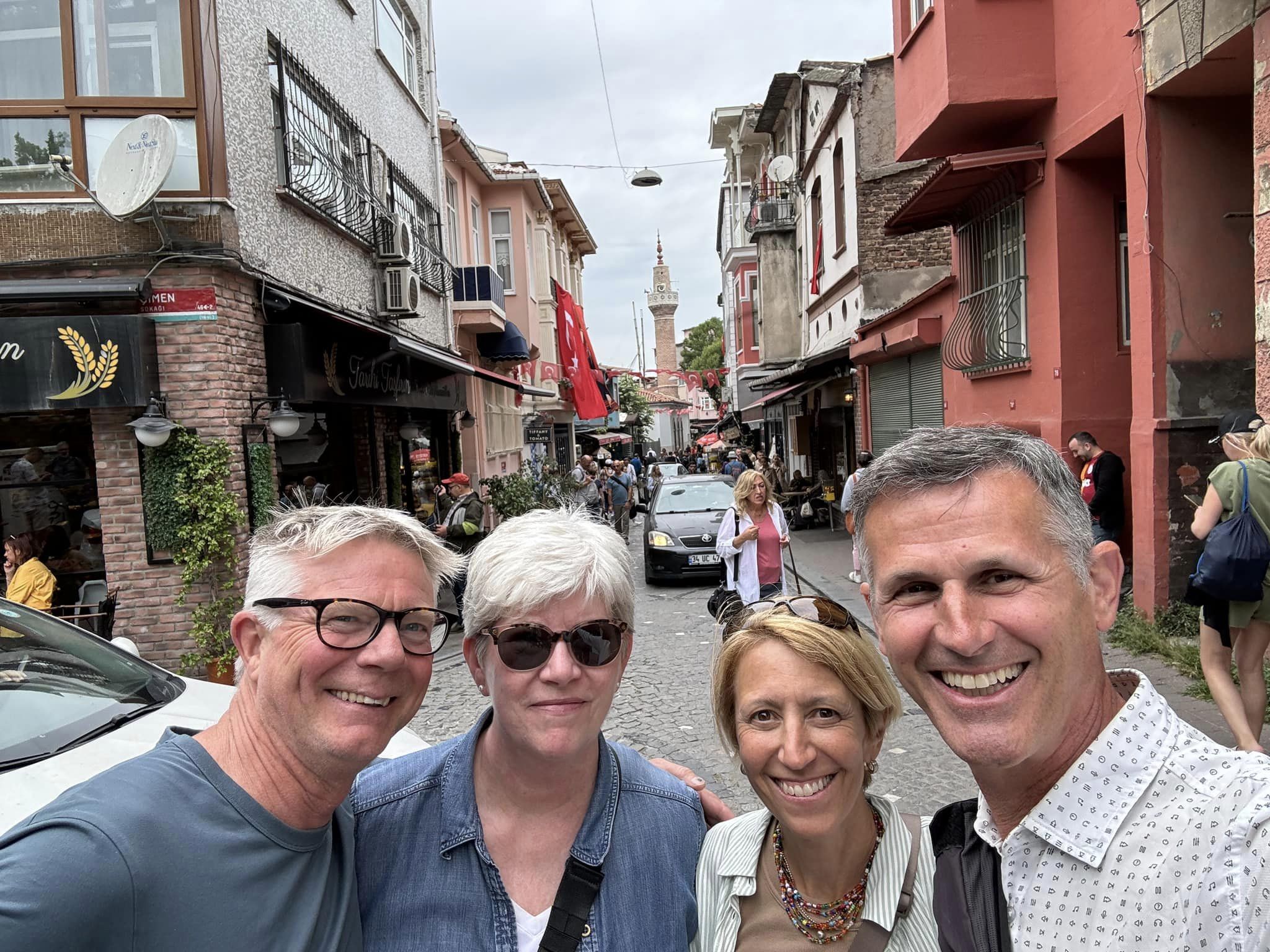
What are the chances! In a city of 16 million people (not including the tourists), we rounded the corner and bumped into friends from home.
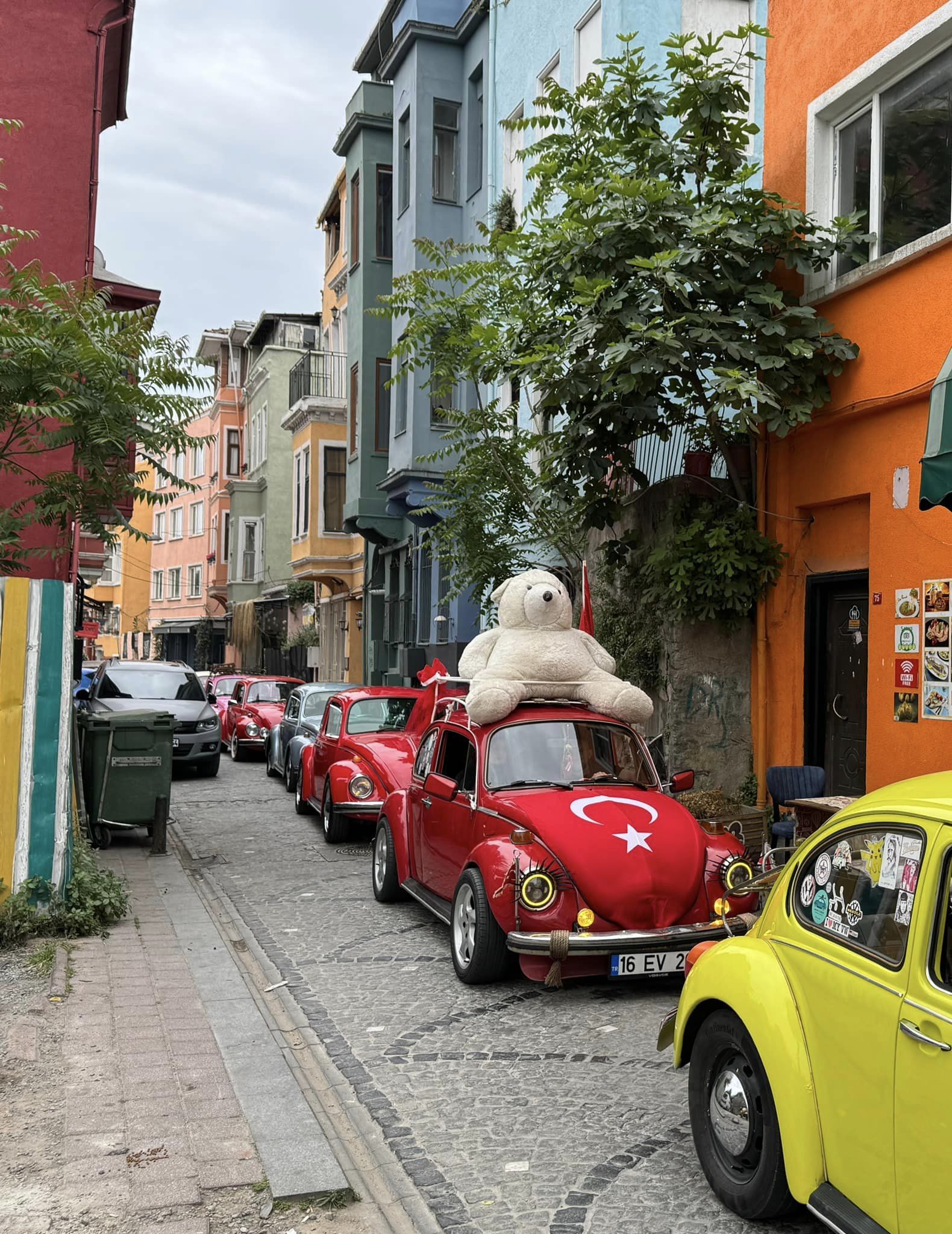
We were sitting having lunch on a relatively quiet street in Balat when it suddenly wasn’t quiet anymore! Hundreds of VWs (mostly Beetles) paraded through, music blaring, horns honking, flags waving. It was on May 19th, the anniversary of the start of Türkiye’s War of Independence in 1919 when Mustafa Kemal (whose name later changed to Atatürk) stepped off his boat at the Black Sea city of Samsun and kicked off the war that changed this country forever.
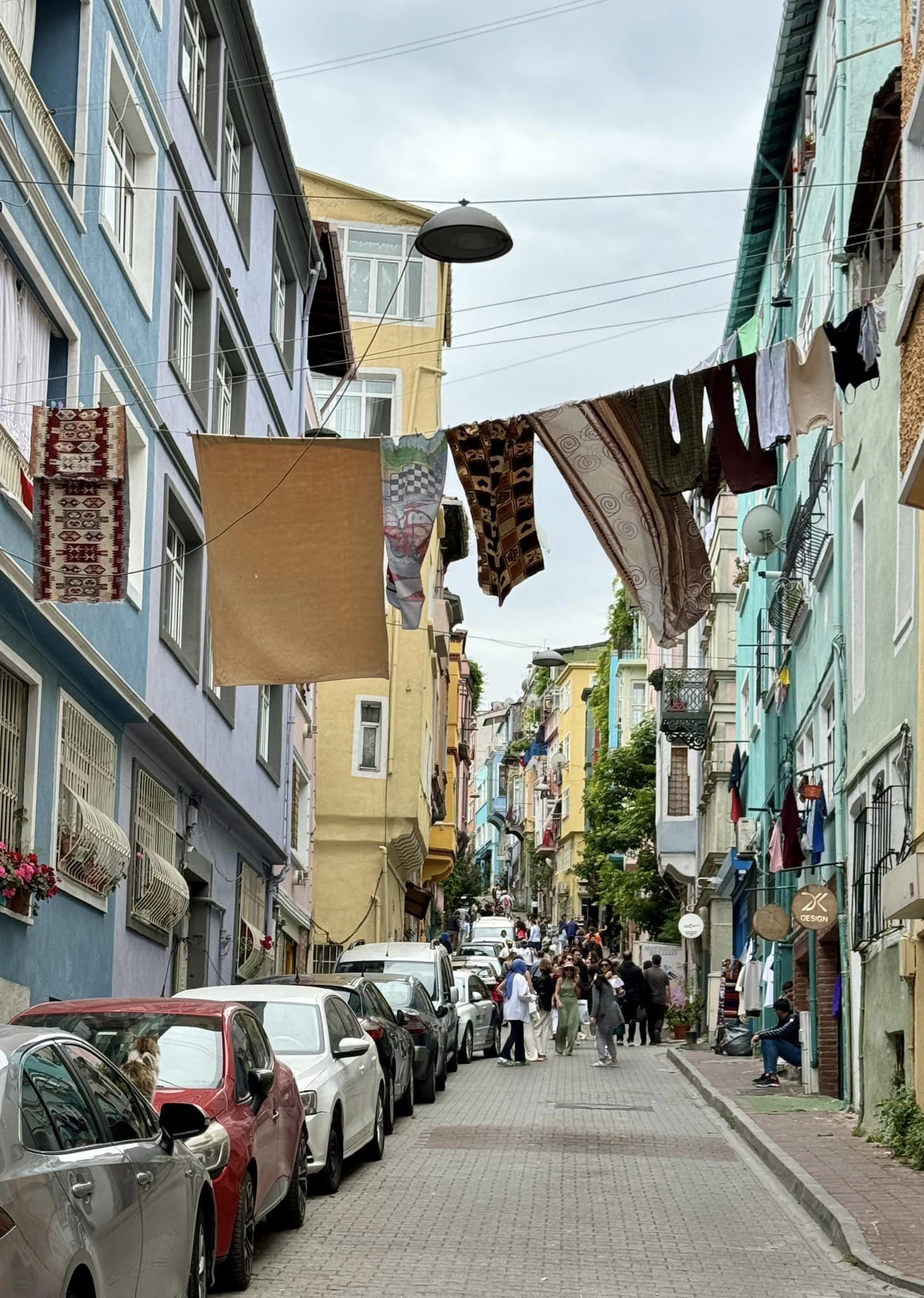
I guess you get to know your neighbours when you share a laundry line across the street.
Pide is the Turkish equivalent of pizza. Who did it first and who does it best is a matter of opinion and perhaps contention.
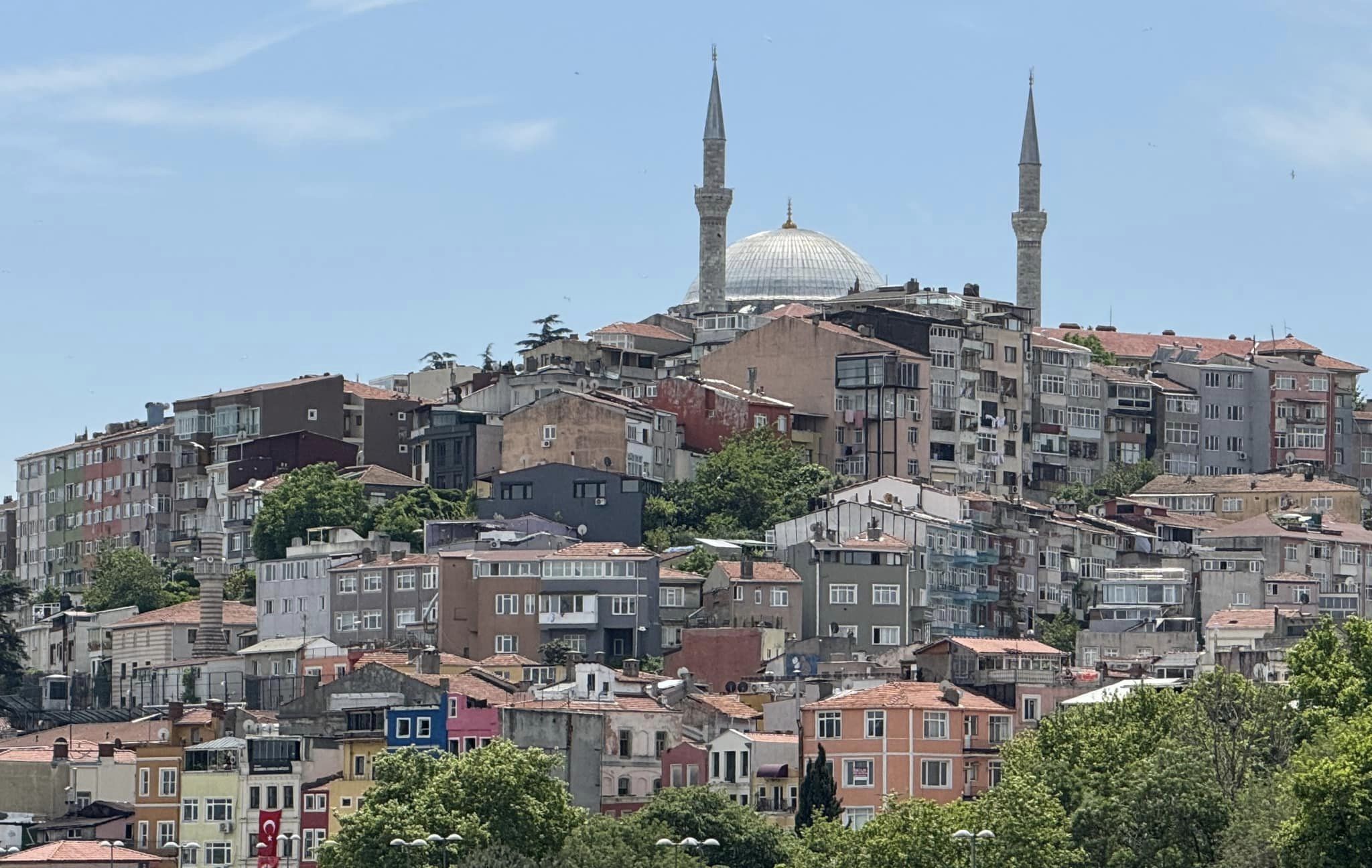
Chock-a-block houses holding up the mosque.
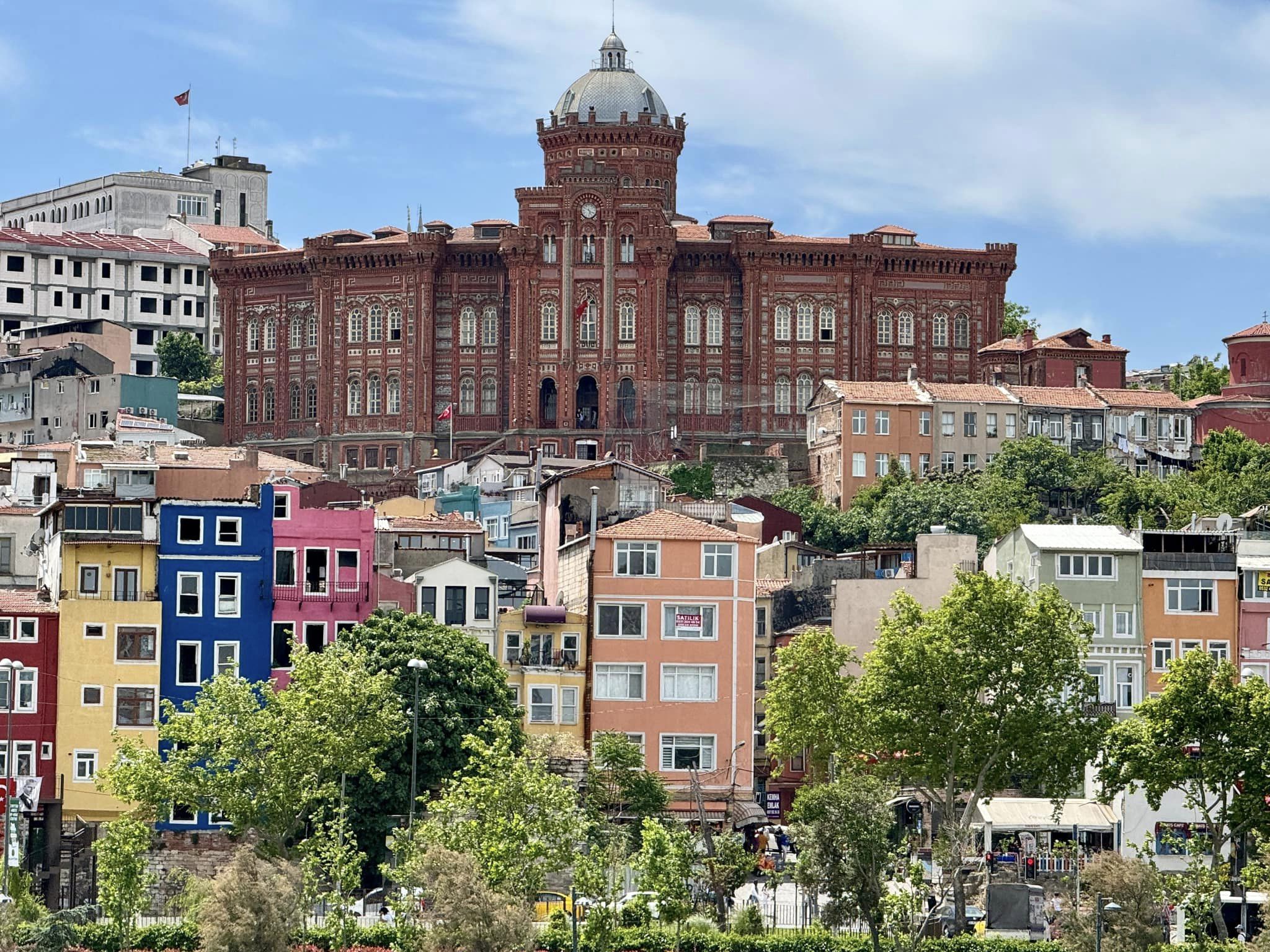
Balat from the water is a beautiful mix of colours.
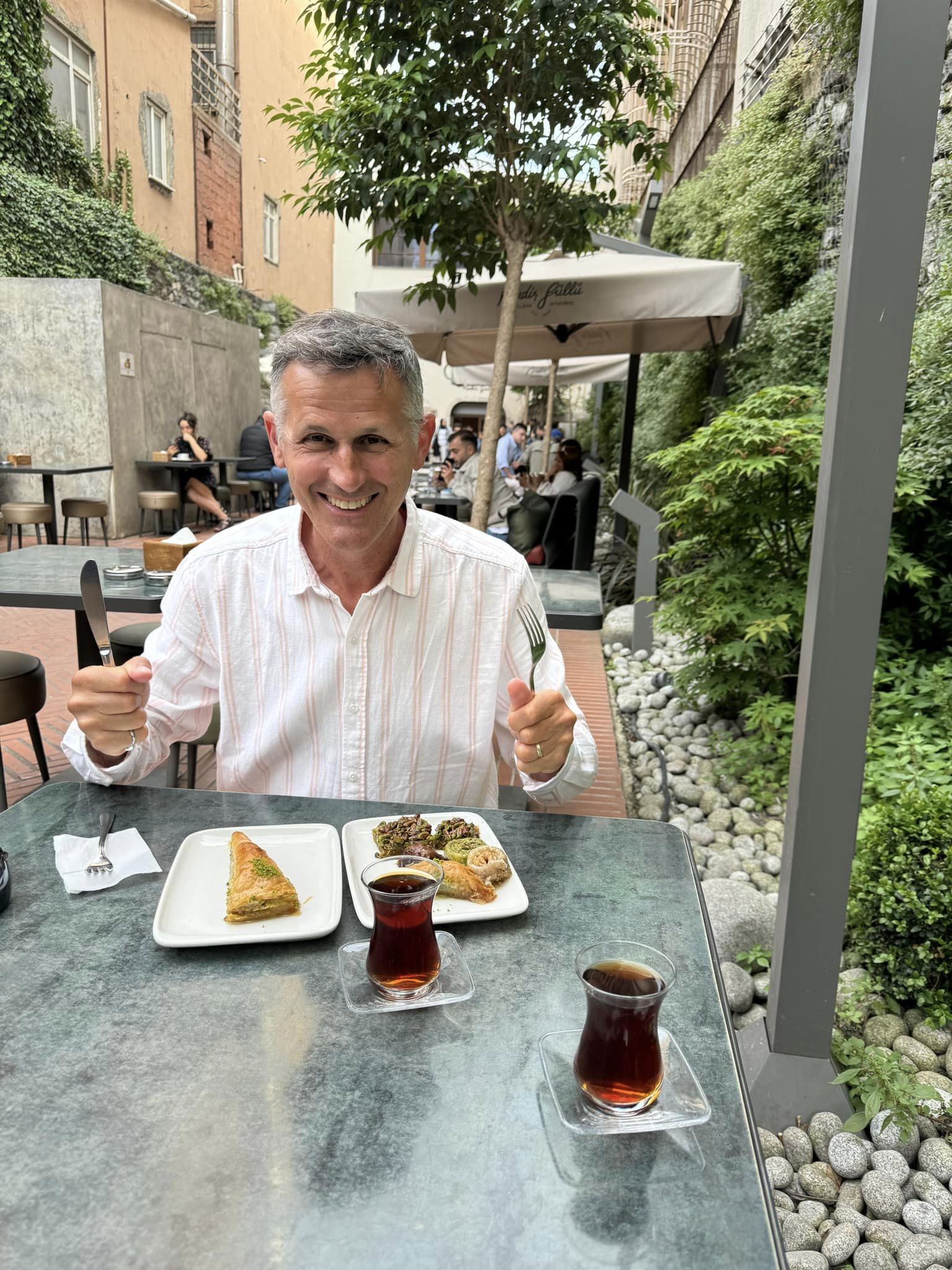
A fitting way to end our Turkish adventure.
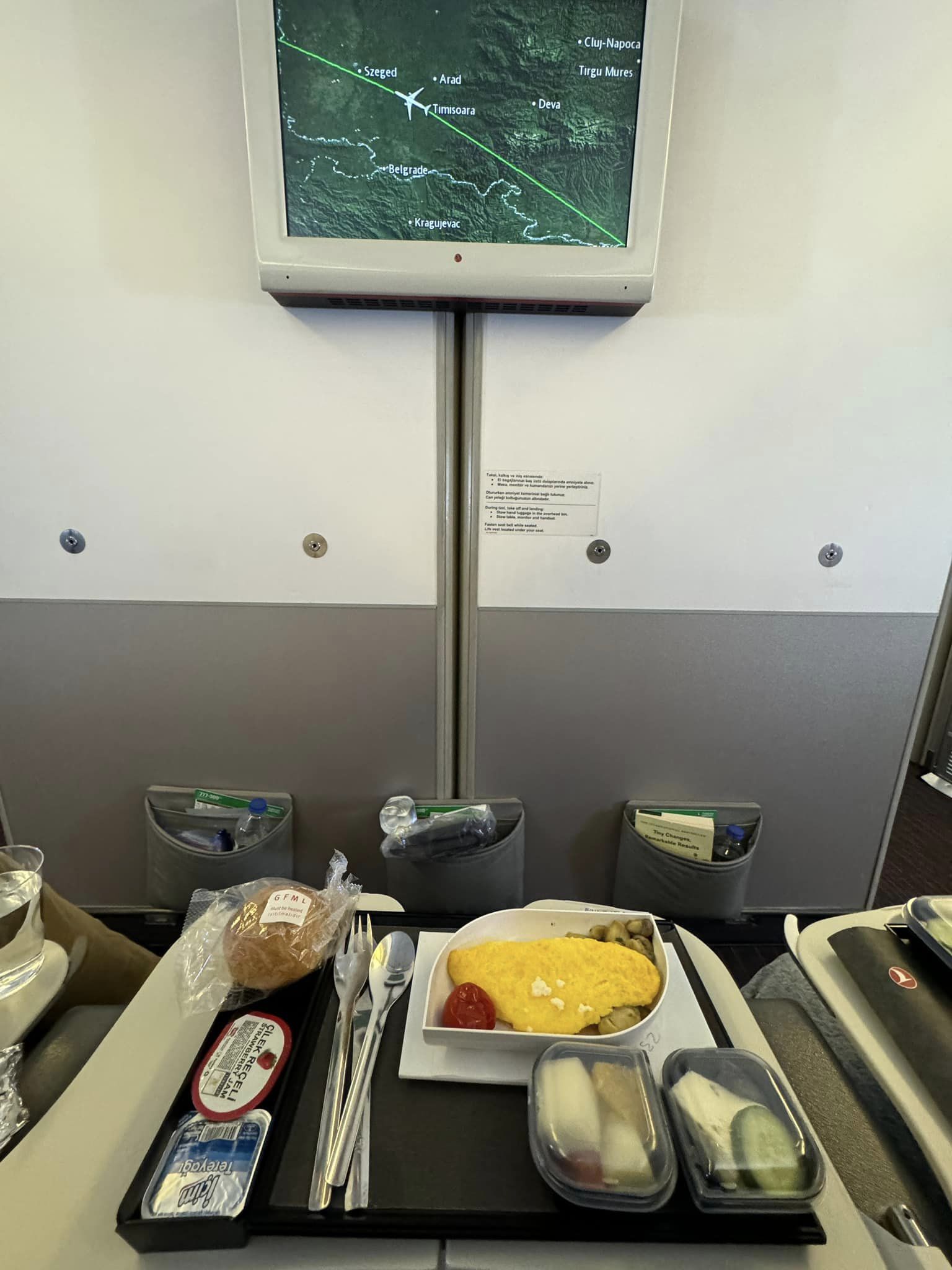
Toto, this isn’t Türkiye anymore…