May, 2026
Padova
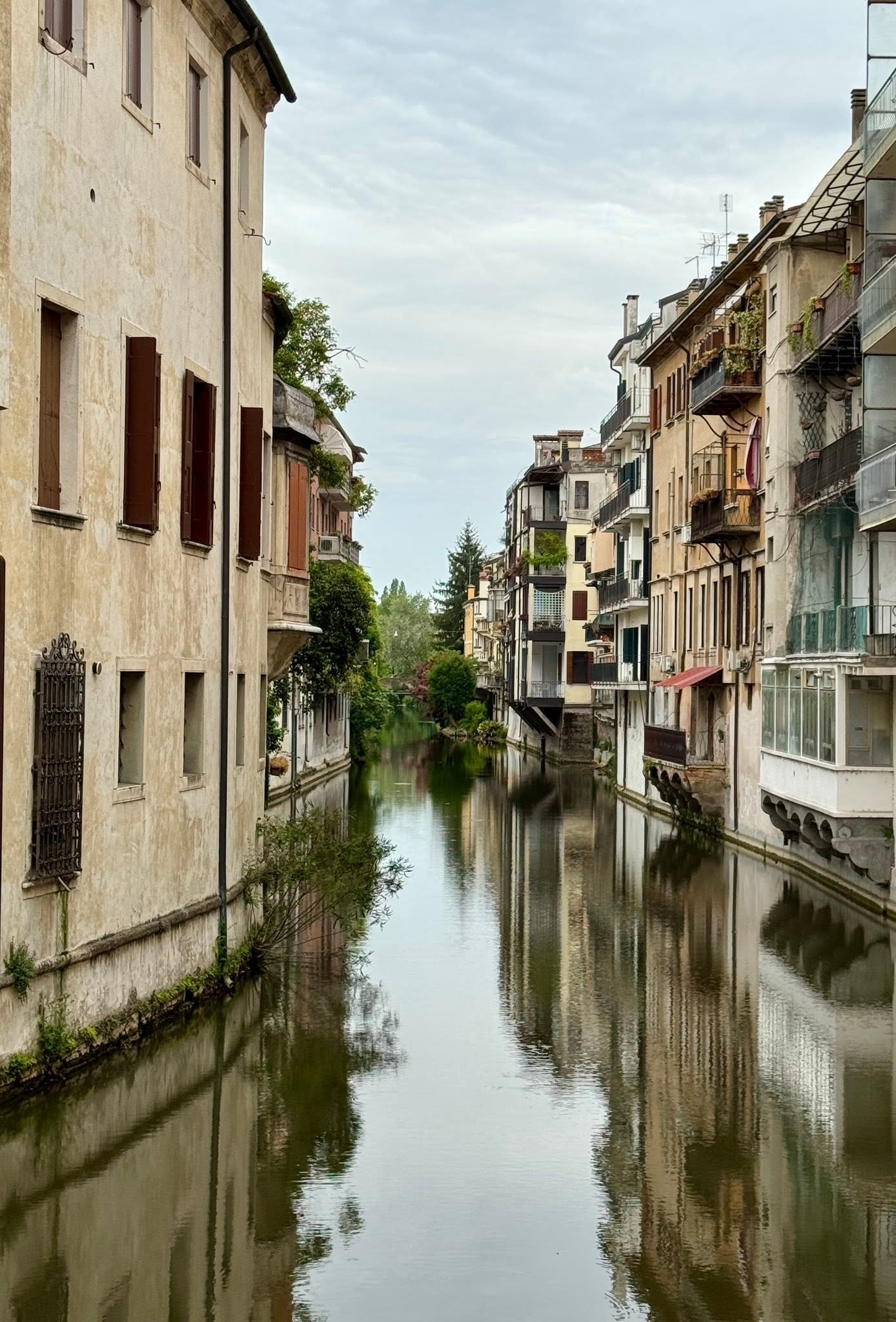
The Canale Alicorno from the Ponte delle Torricelle gives Venice vibes. Much of Padua's ancient canal system has been filled in to create the city's roads in the 19th and 20th centuries but in their heyday, they were critical for trade and defence and actually linked Padua to Venice.
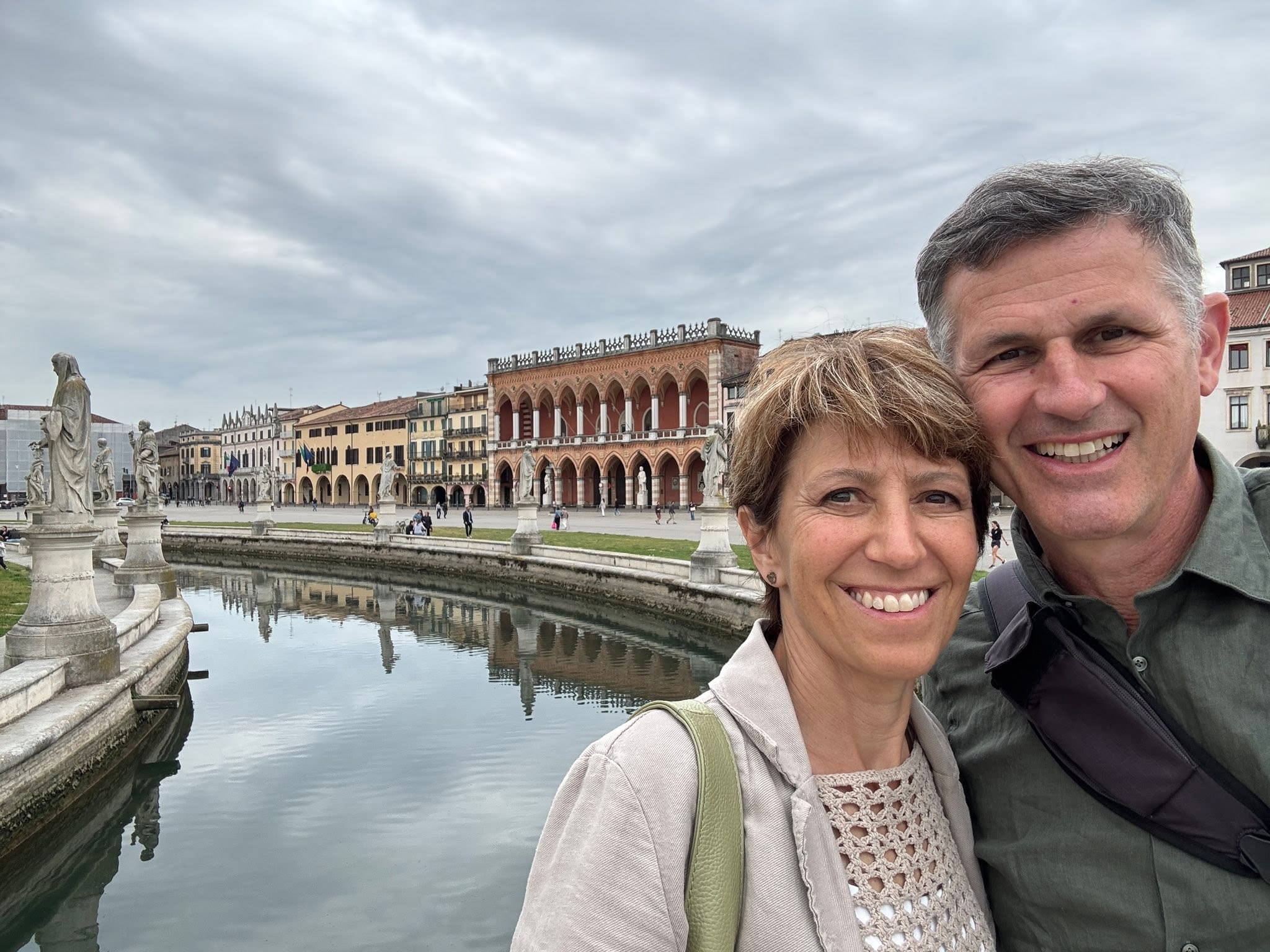
The Prato della Valle is the second largest square in Europe, with its 90,000 square meters just a bit shy of Ukraine's Freedom Square 116,000 square meters. Prato della Valle square dates back to 1775 when Venetian architect Andrea Memmo reclaimed marshy land to build an oval island surrounded by a canal and decorated it with a double ring of 78 statues of notables. It begs the question: which are the most notable notables. We decided to go on a hunt for two of the 78. Gallileo is one and the other is Elena Lucrezia Cornaro Piscopia. She was the first woman in the world to graduate with a university degree. Here's where the scavenger hunt begins!
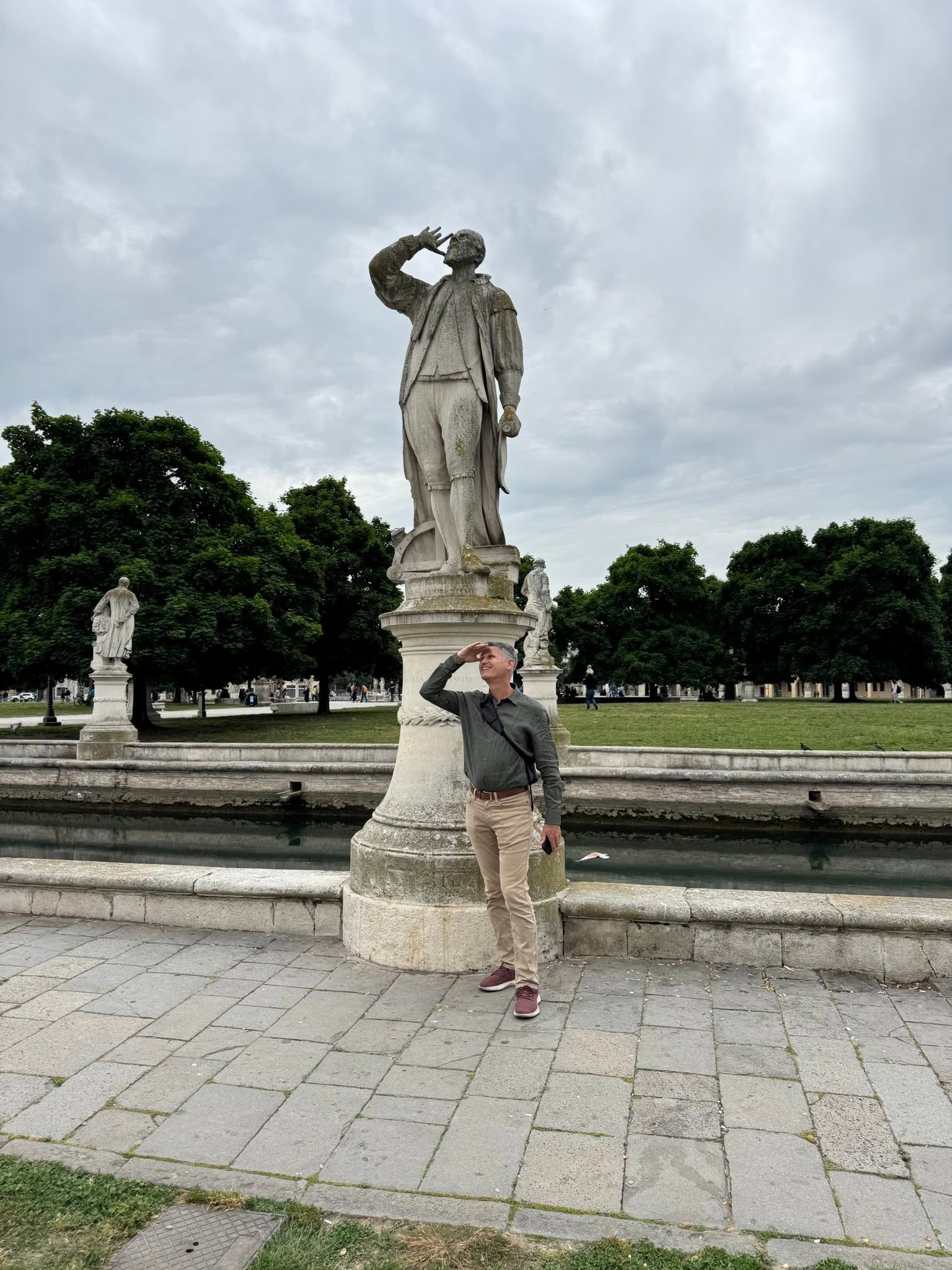
Galielo was easy. He was recruited from Pisa for a better gig at the University of Padua in 1592, to head up its Math Department. He stayed for 18 of what he said were his best years. He had the freedom to explore whatever he wanted, no restrictions from the Venetian Republic which was pretty liberal. This was a pretty plum job but it didn't have the cachet of Florence. He manipulated his way to Florence by buttering up the Grand Duke of Tuscany, Cosimo de' Medici, naming his recently discovered moons of Jupiter "the Medicean stars" and sending him a telescope so he could admire his eponymous stars. In 1610, Galileo became Chief Mathematician to Florence and didn't even have any teaching duties. A stroke of genius… Maybe not. Galileo should have been careful what he wished for. While he may have started out as a celebrity, by 1633 he was tried by the Roman Inquisition for heresy for his ideas. Astronomy was already a dodgy subject and the Pope was ok with Galileo's work as hypothesis, but certainly not truth. His 1632 book Dialogue centres on heliocentrism, the idea that the Earth moves around the Sun, which directly contradicted the Church. The Church was not happy that Galileo believed that observation and mathematics could override ancient authority and advocated that scripture needed reinterpretation in light of physical evidence. That was it for Galileo. He spent the rest of his life under house arrest. It took 360 years but in 1992 Pope John Paul II issued a declaration formally acknowledging the Church's errors in the Galielo affair.
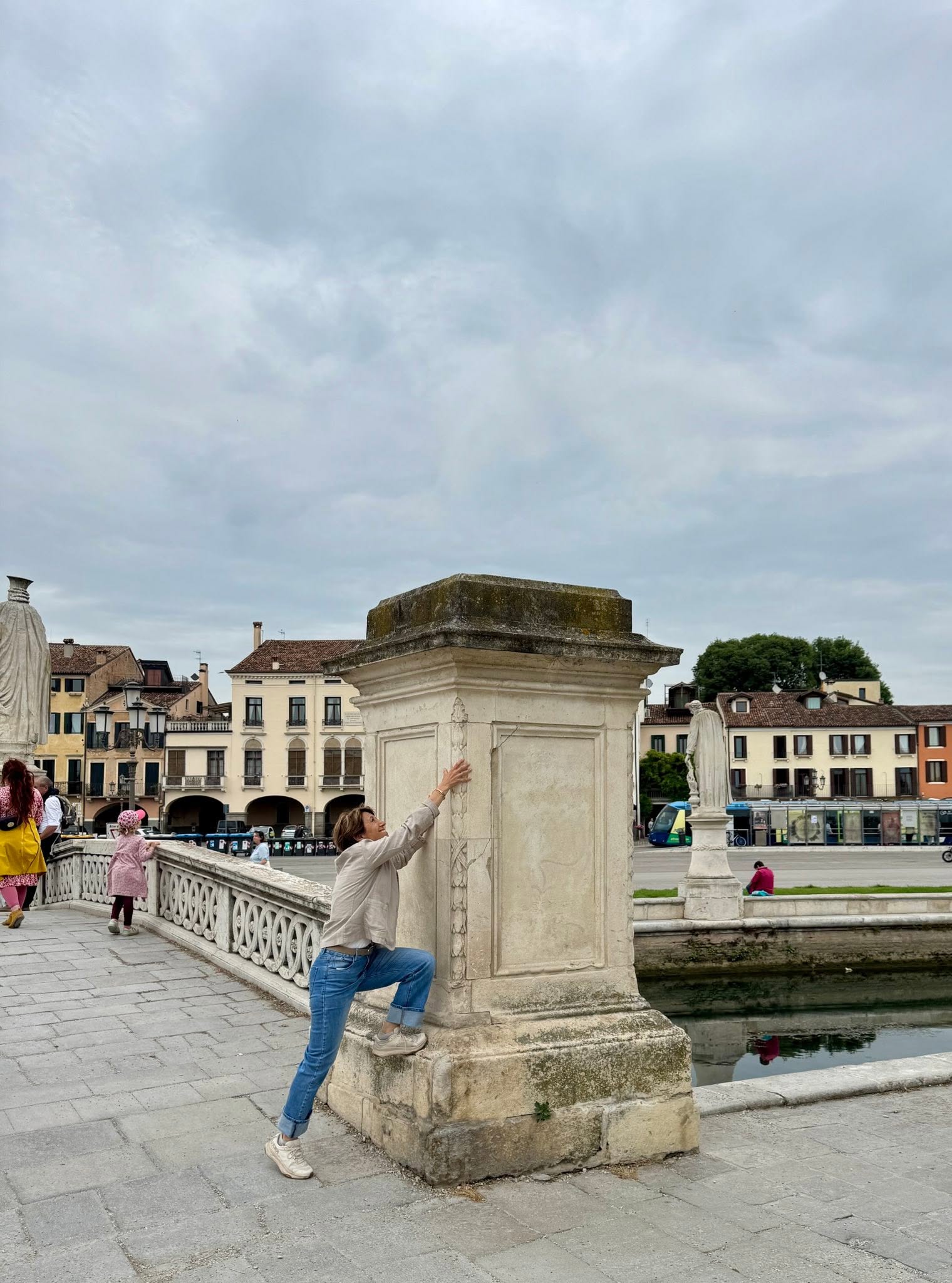
The hunt for Elena proved to be more difficult. It turns out her statue is not actually here. For probably classic 1776 misogynistic reasons, she wasn't included in the original selection of notables. Then, in 2022, a statue of her was proposed to be placed on an empty pedestal in the ring of male notables but it was turned down. Where is the legacy of this incredible woman?
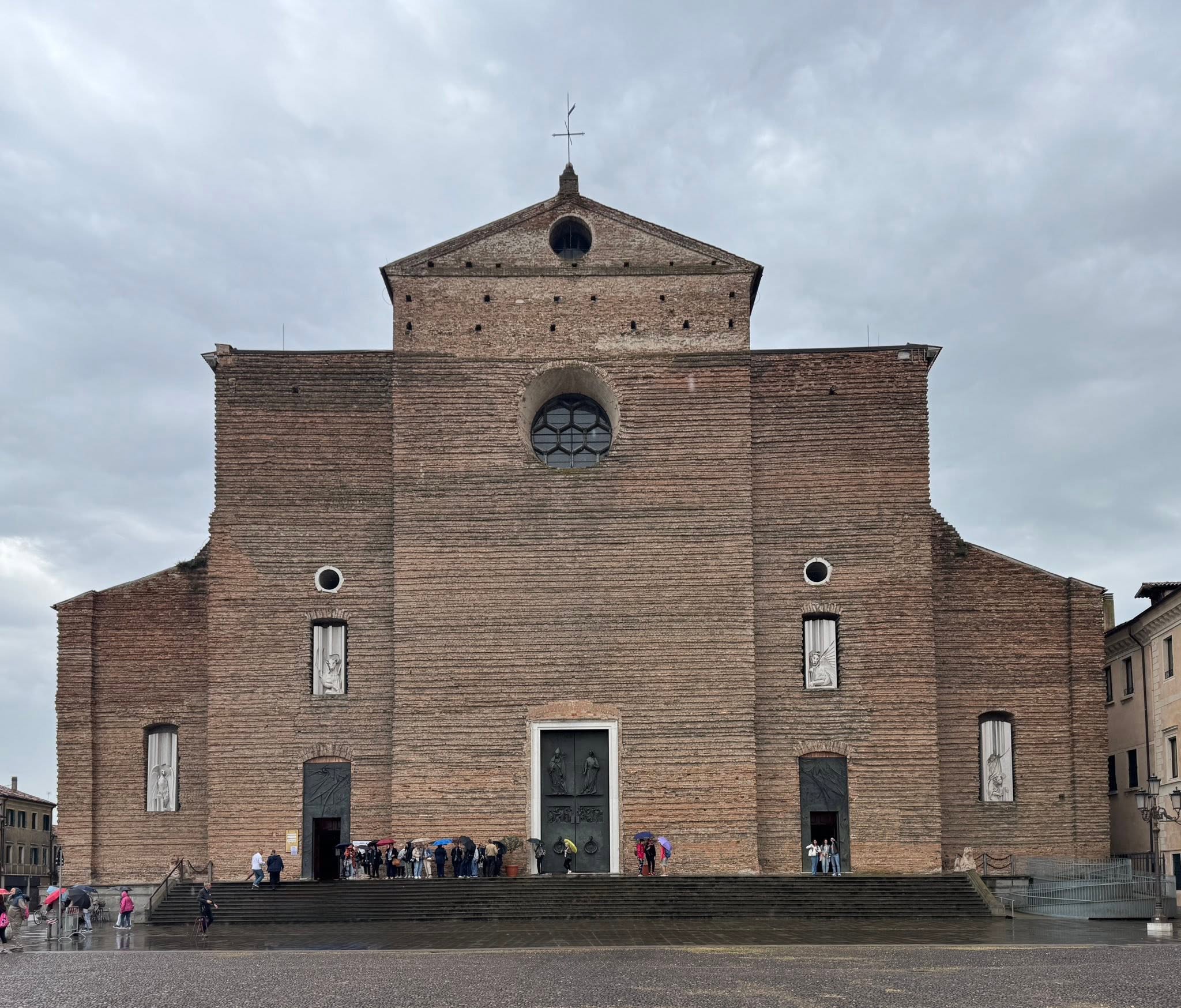
We discovered that Elena's tomb was here, in the Church of Santa Giustina, a Benedictine basilica. Elena was a woman with a strong brain but a weak body. Her father knew she was special and pushed her hard in academics, relying on her to build the family's prestige. The toll of the studies and the serious self denial she practiced as a Benedictine oblate weakened her to the point that Tuberculosis took her out at the age of 38.
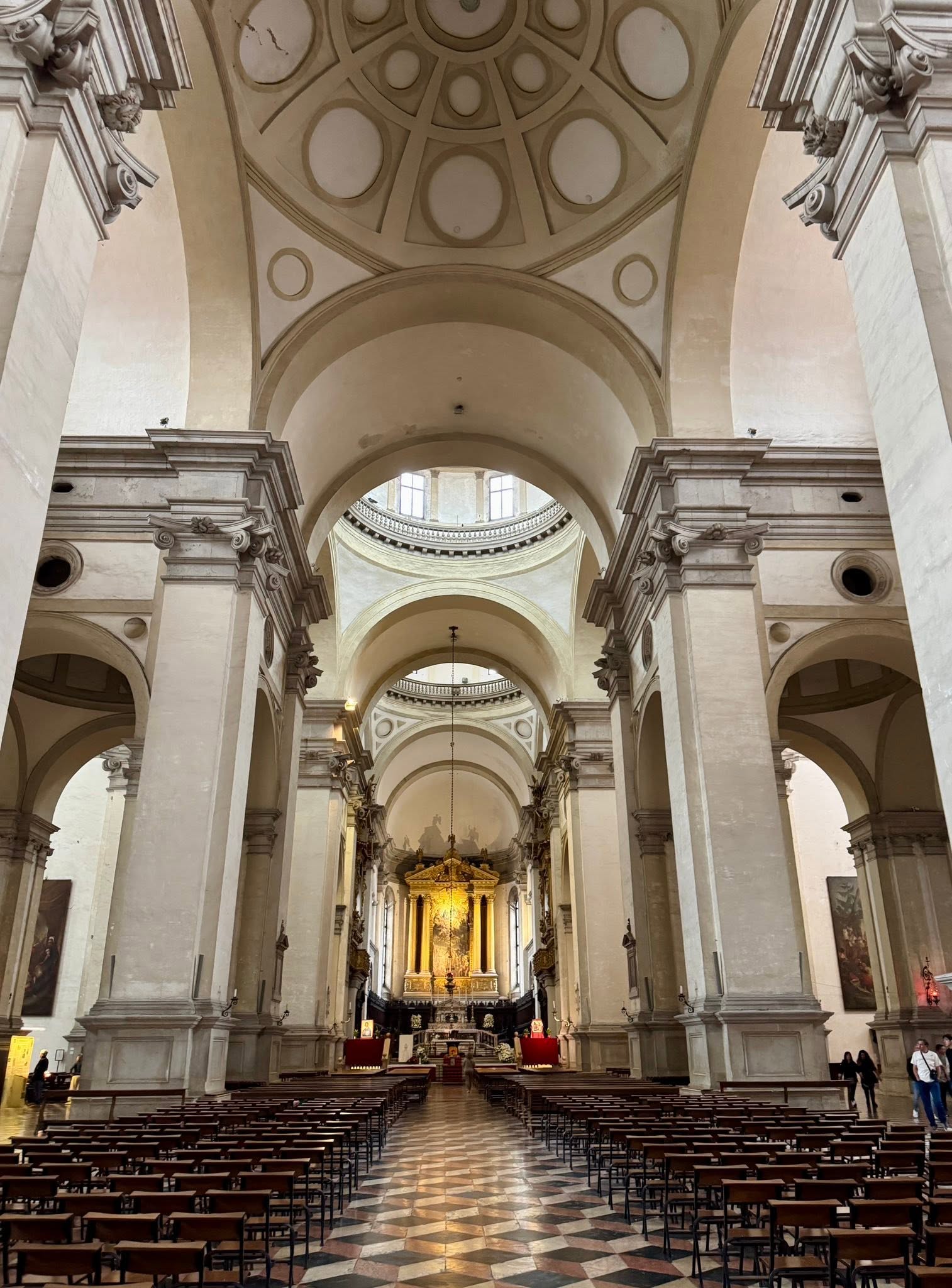
She knew she was dying and her wish was to be buried here in the Benedictine basilica. As a Benedictine oblate, this was the place for her. The Benedictine monks buried her in the floor, as she wished. Her father, Giovanni Battista Cornaro, had other ideas. He needed something grander so he commissioned sculptor Bernardo Tabacco to create a cenotaph to be placed in the central nave. The Benedictine monks refused a grand monument so her father found a home for his monument with the Conventual Franciscans at the Basilica del Santo. But that's not the end for poor Elena who had all these men messing with her legacy!
Thirty eight years later, the cenotaph was demolished under pressure from friars who complained it "blocked the view of the high altar," The last heir of the Cornaro Piscopia family, having squandered the family fortune, needed money so he sold off the statues from the now removed monument.
As for Elena, she remains here in the Church of Santa Giustina. But it's not as simple as being forgotten again. In 1895, Abbess Mathilda Pynsent of the English Benedictine Nuns in Rome had Elena's tomb opened, the remains placed in a new casket, and a suitable tablet inscribed to her memory. Her simple tomb is beyond a small door off the corridor of the masses but it's only open for a few days a year around the anniversary of her death in late July.
The hunt for Elena continues! We found out that there was a statue of her at the University of Padua, where she got her PhD…as there should be!
Established in 1222, this is the fifth oldest university in the world after Bologna, Oxford, Cambridge and Salamanca. Annoyed by the academic restrictions imposed by the City of Bologna, some trail blazing students, along with some professors, up and left for nearby Padova, to start their own thing. The students ran the show, making the hiring decisions and setting salaries and the student fees. Even the rector and his 20 councillors were students.
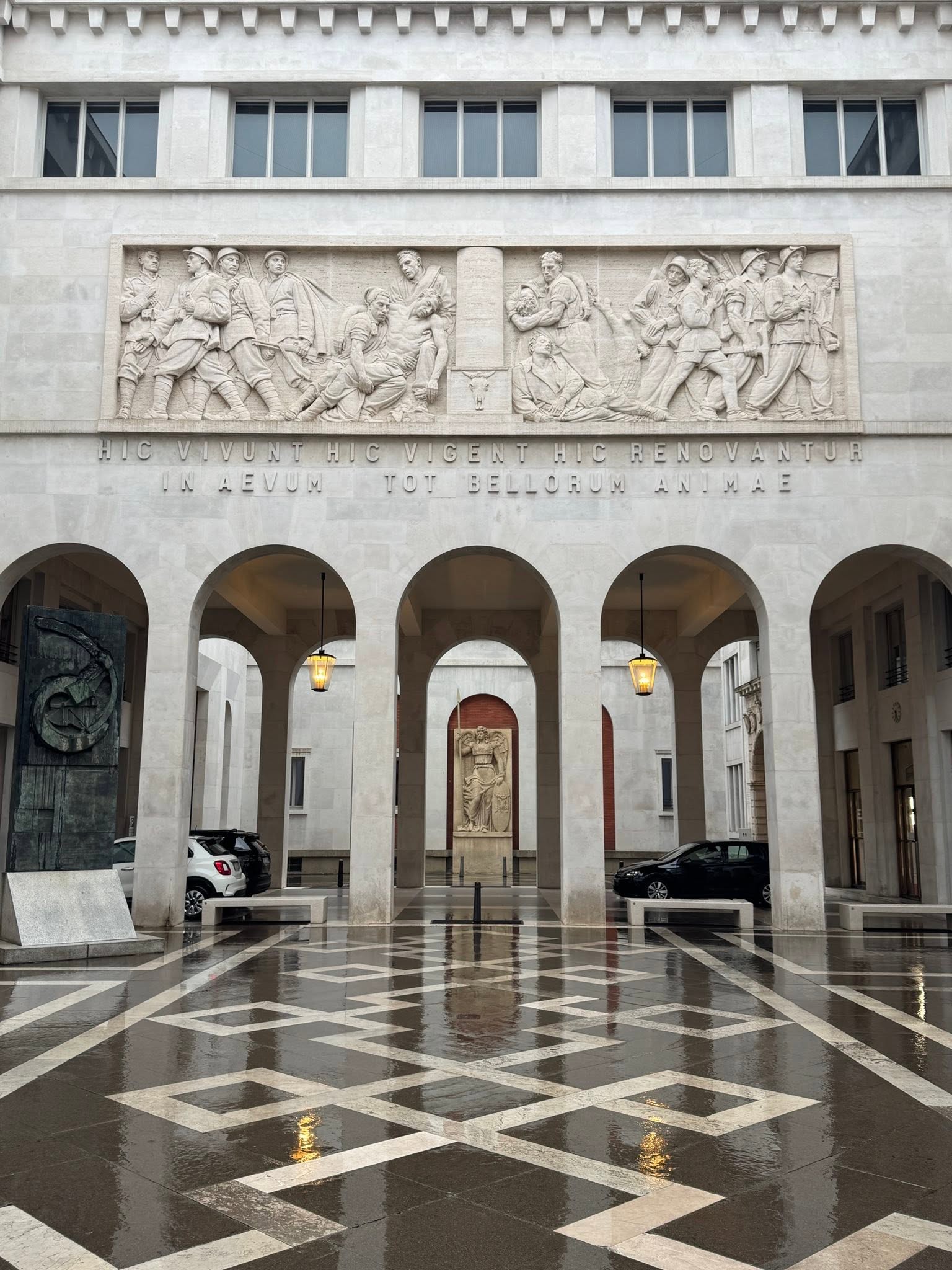
Classrooms were wherever professors could find space and, as the student population grew, the university bought and renovated Palazzo Bo, originally a hotel owned by a butcher called "Hospitium Bovis", the Inn of the Ox, (an apt name for a butcher owner). The location became the official seat of the University of Padua. As a nod to the building's origins, the skull of an ox is part of its official coat of arms and is carved in the centre of this 1939 relief sculpture commemorating the students and professors who fell in the wars, just as a new war was beginning.
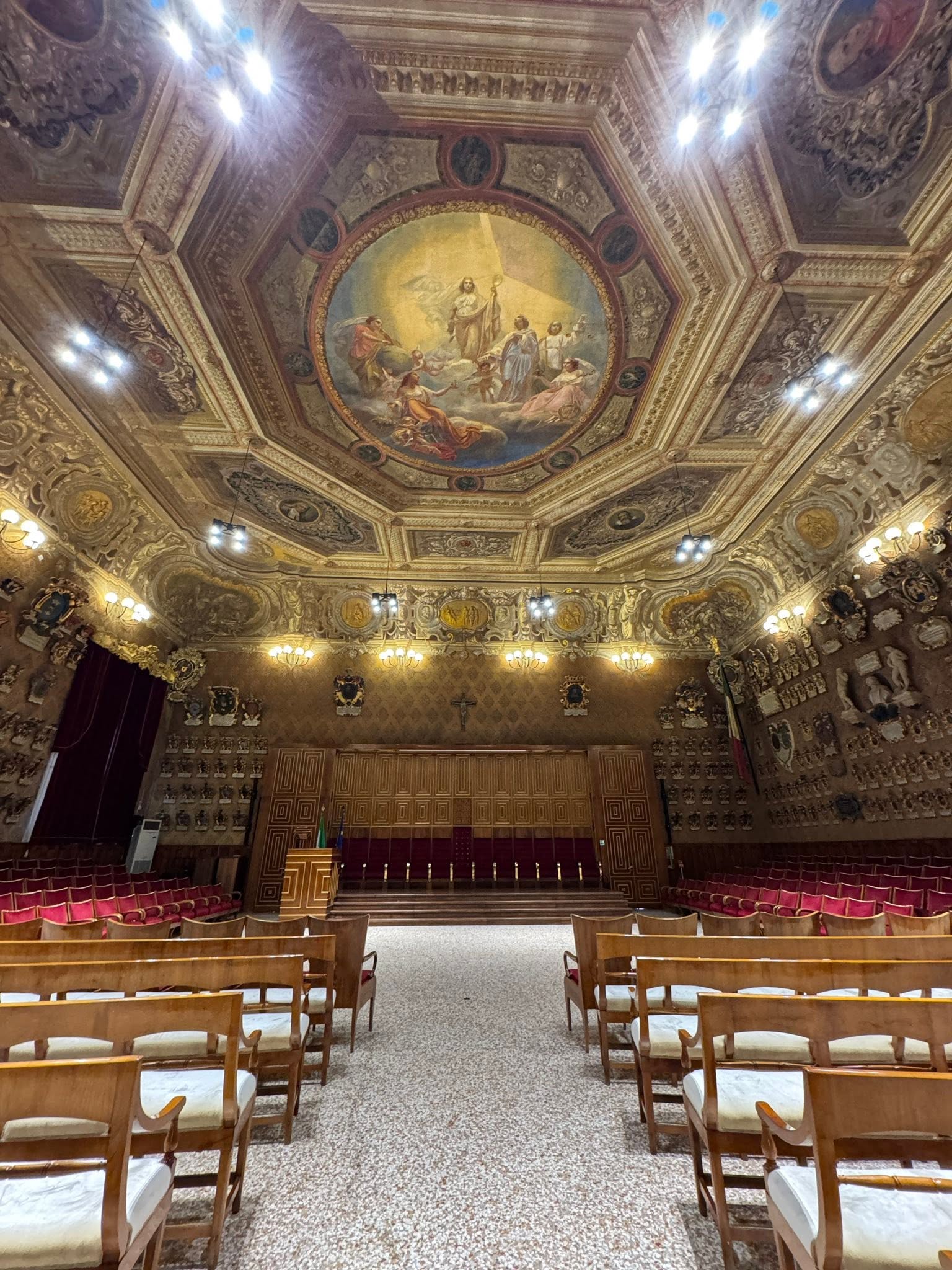
The Aula Magna, originally the hotel's dining room, was the first lecture room. The professors must have been thrilled to get their homes back! These walls (and all of the other walls on campus) are lined with the crests of the 21 students who were elected annually as rector and councillors. There are more than 5,000 crests on the walls but there could have been more; they stopped acknowledging the practice in 1688 when they ran out of wall space!
It was the people who could afford it who studied at that time, predominantly aristocrats. And who would have family crests but the wealthy. This was a place run by and for a privileged, cosmopolitan class; students wealthy and connected enough to travel from across Europe, pay their own teachers, and govern themselves.
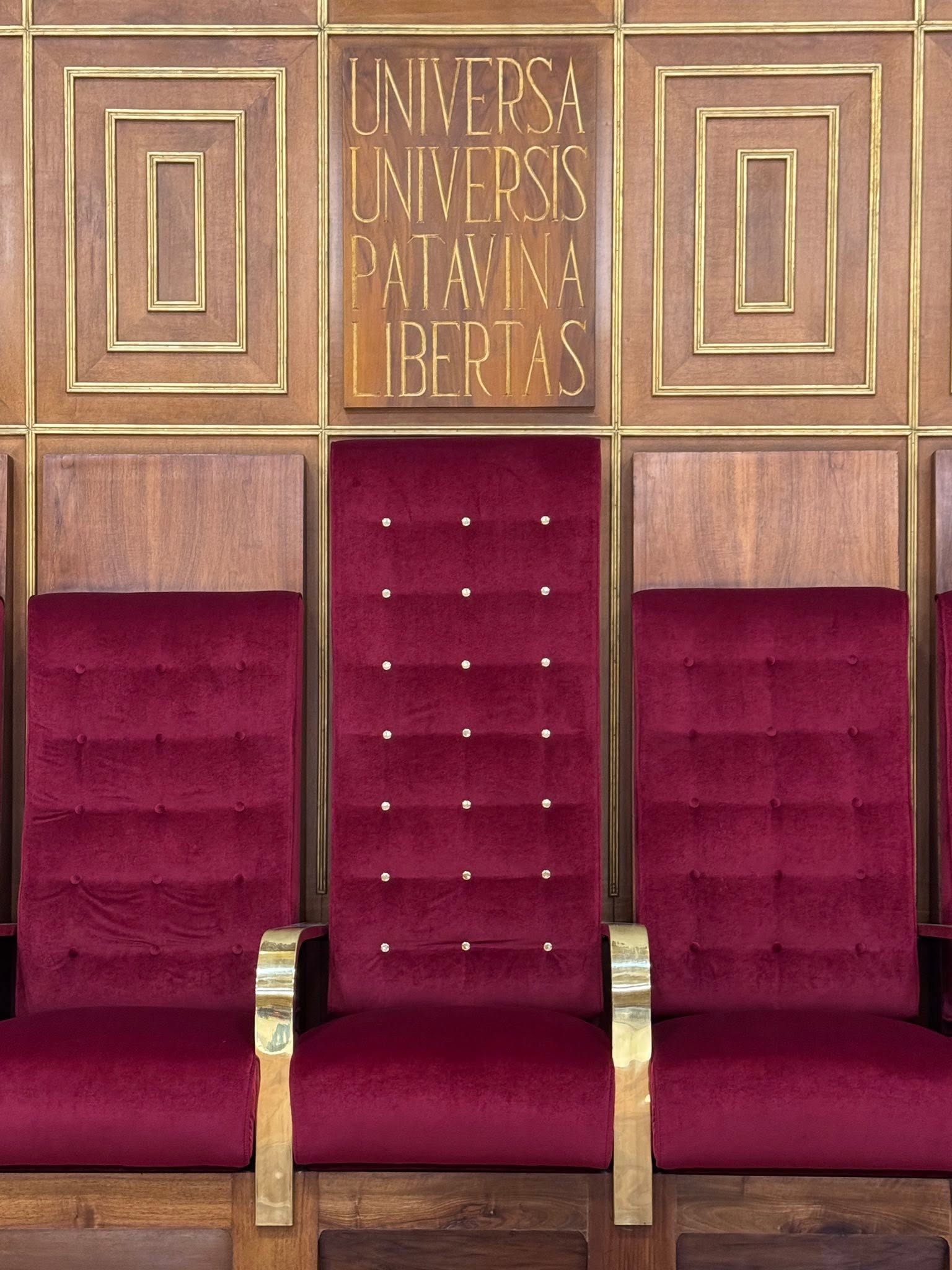
The motto of the University: The freedom of Padova university is for everyone. That's why they came here, after all.
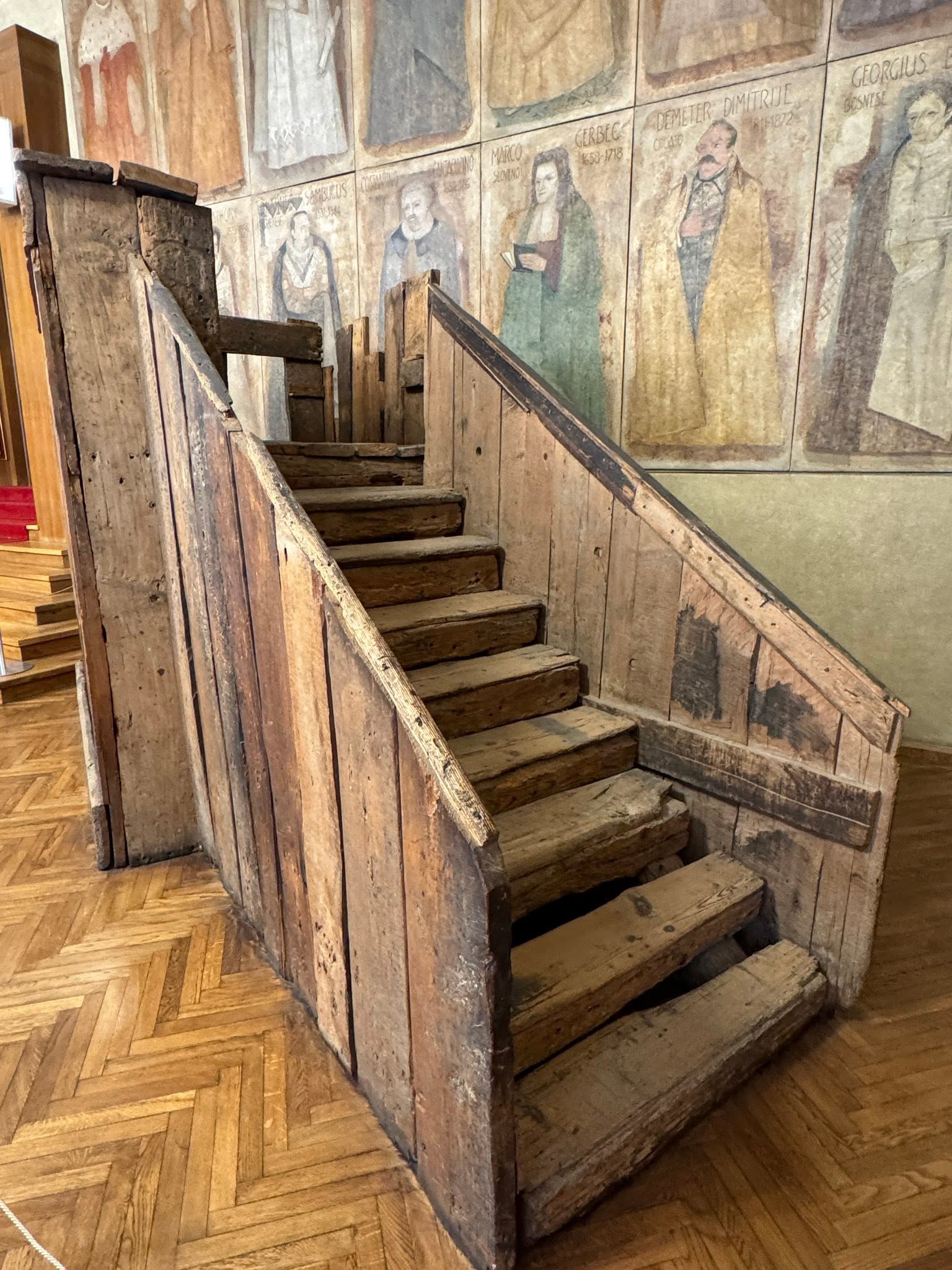
Gallileo's lectures were so popular that his students built him a podium so that he could be seen above the crowd in the lecture hall. Not elegant but certainly effective! He was even allowed to use the Aula Magna as a lecture space because of the sheer number of students he attracted.
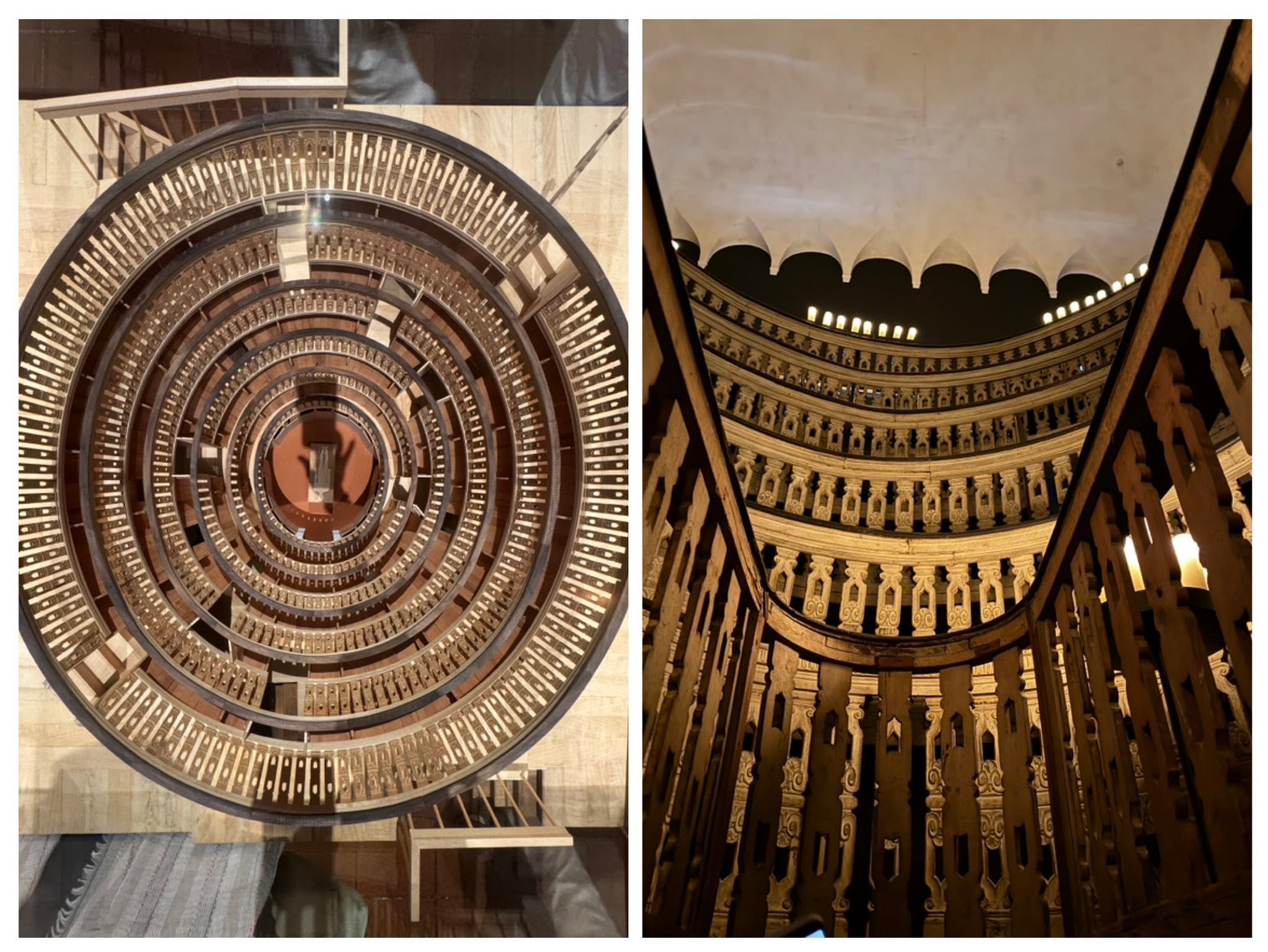
This is the world's first permanent structure built to teach anatomy through the dissection of corpses. It's a big claim and creates some confusion between here and Bologna. Bologna actually did the first dissection of human corpses in 1315, 280 years before Padua built this room but Padua's claim to fame was that it was the first to have a dedicated and permanent space and not a space that was assembled and disassembled as needed.
This room was an engineering and optical marvel. The photo on the left is a model of the room, taken from the top looking down towards the table where the cadavers (executed criminals) lay. There would have been as many as 200 spectators at these dissections and the biggest problem would have been how to give everyone a clear line of sight. So the magic was creating an inverted cone, six levels with circles that gradually widen from bottom to top.
It took about six days to complete a dissection so autopsies only took place in the winter when it was cold enough to preserve the body for that time. The adjacent room was called "the anatomy kitchen". It's where the body was boiled after the dissection so they could study the skelton next.
The theatre carried a Latin inscription: "This is a place where the dead are pleased to help the living." Medical science is thankful!
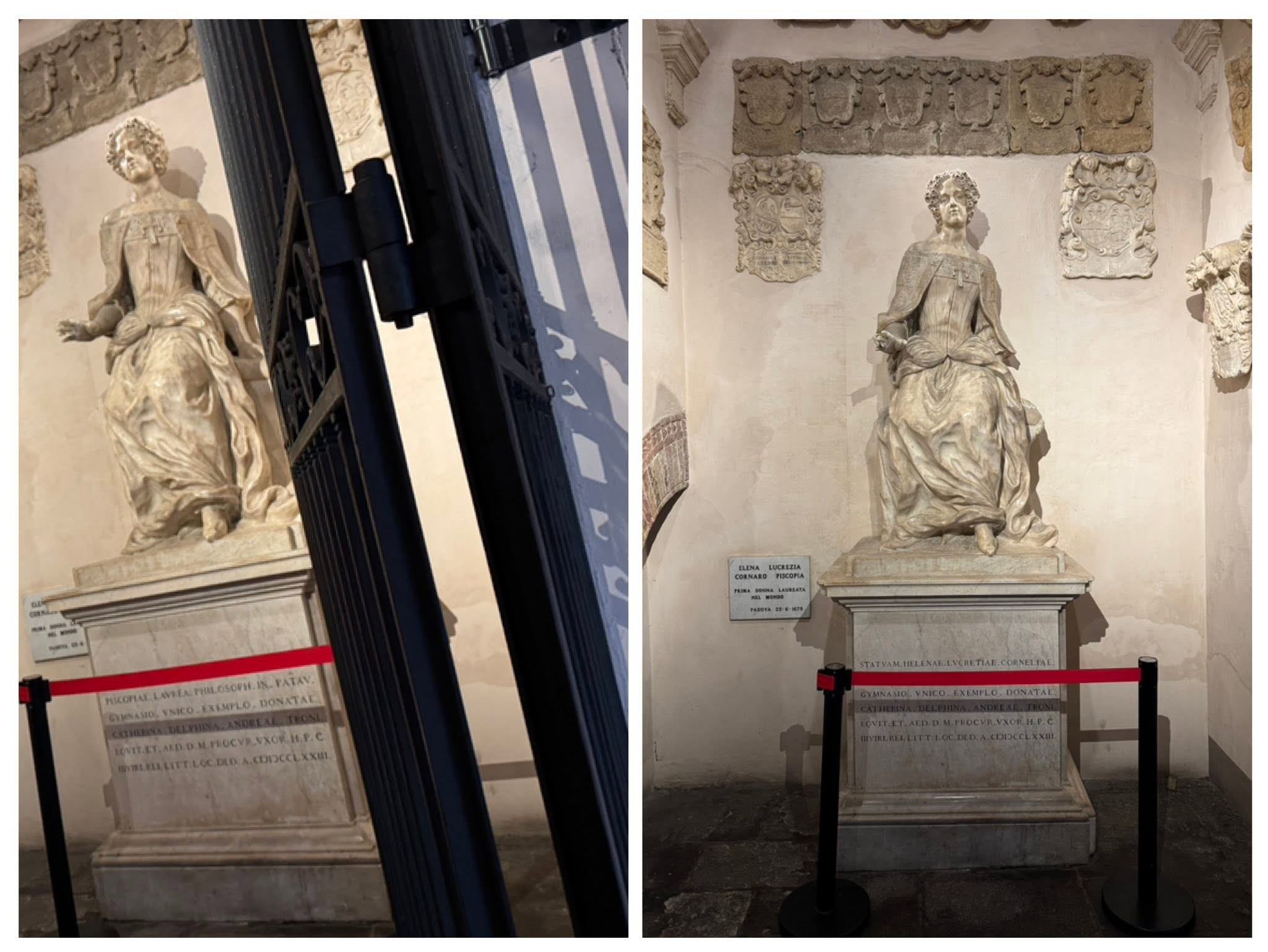
Remember, we came to Padua University and Palazzo Bo searching for Elena. We found her! I introduce you to the incomparable Elena Lucrezia Cornàro Piscòpia, the first woman in the world to graduate from university and with a PhD, no less! From a noble Venetian family, Elena showed her academic talents from a very young age and, as we know, her father supported her passion, knowing she would bring great prestige to the entire family. When she applied to study theology, the university chancellor, Cardinal Gregorio Barbarigo, refused and said that it was absurd for a woman to study for a degree. Elena graduated on the 25th of June 1678. But her degree was not in theology, it was in philosophy. That was the hit she had to take. In those days, they just couldn't let her study theology because to do so you needed to be a priest and as a woman, that was impossible.
So what's with the weird photo above? Italian rules! When we first went to the Palazzo Bo looking for Elena, we didn't have a ticket for a tour and the guard would not let me take a picture. I was not allowed to climb the four steps and step through the iron gate for five seconds without being on a paid tour. So I made a big performance of climbing the four steps anyway and leaning in as far as I could to take the picture. I got what's on the left. We then came back for a tour (which was absolutely worthwhile) and I could now be blessed with a proper picture.
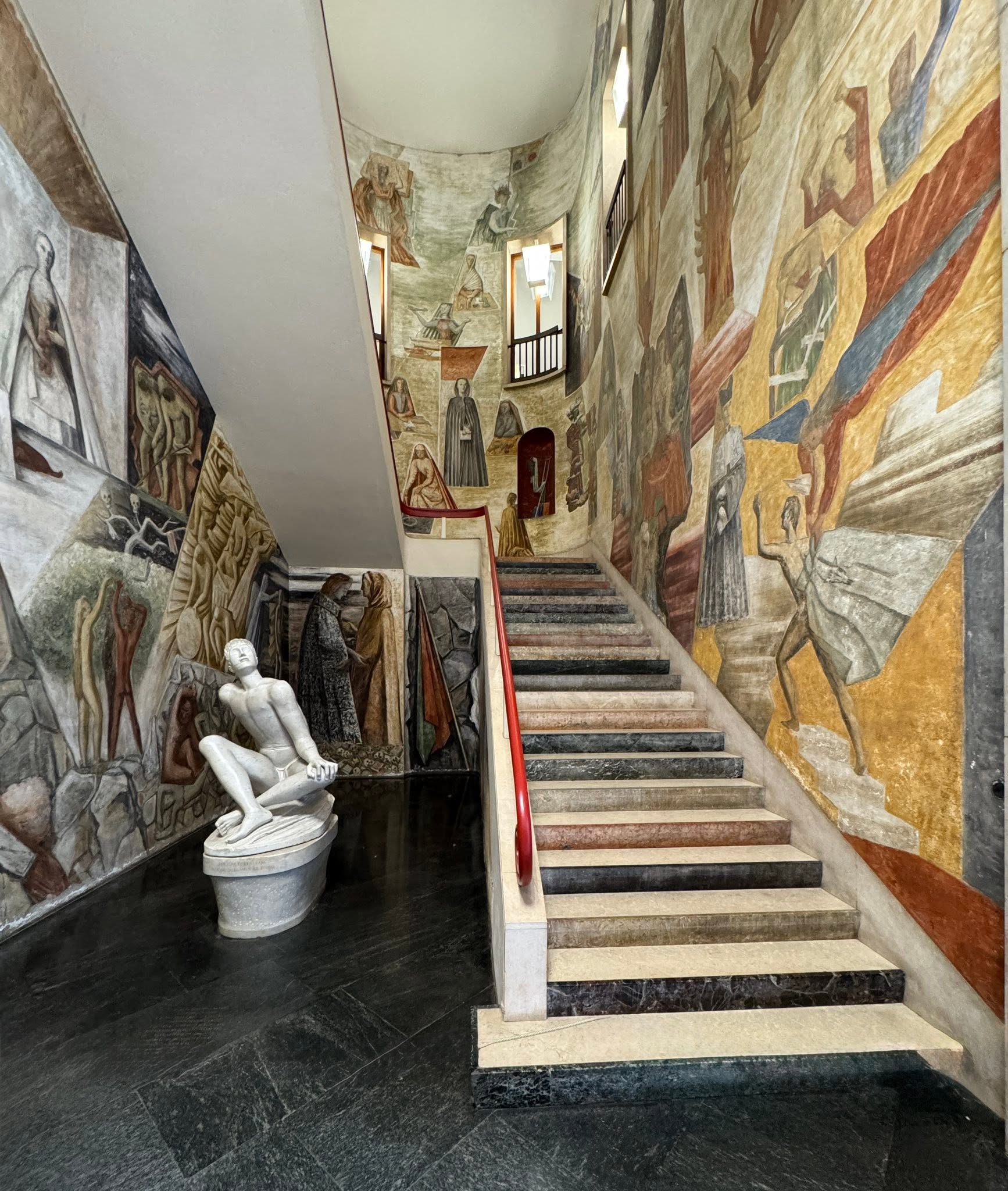
The Atrium of Heroes is the main entrance hall of the Palazzo Bo and is dedicated to the 116 students who gave their lives to fight against Nazi-fascism.
On the left is Arturo Martini's statue of Palinurus, dedicated to Partisan commander Primo Visentin (aka Masàccio) one of the fallen and a graduate in art history from here.
Milanese architect and designer Gio Ponti created the Scala del Sapere, a stairway of polychrome marble steps and a fresco celebrating the Growth of Humanity Through Culture, personified by a scholar completing his university studies.
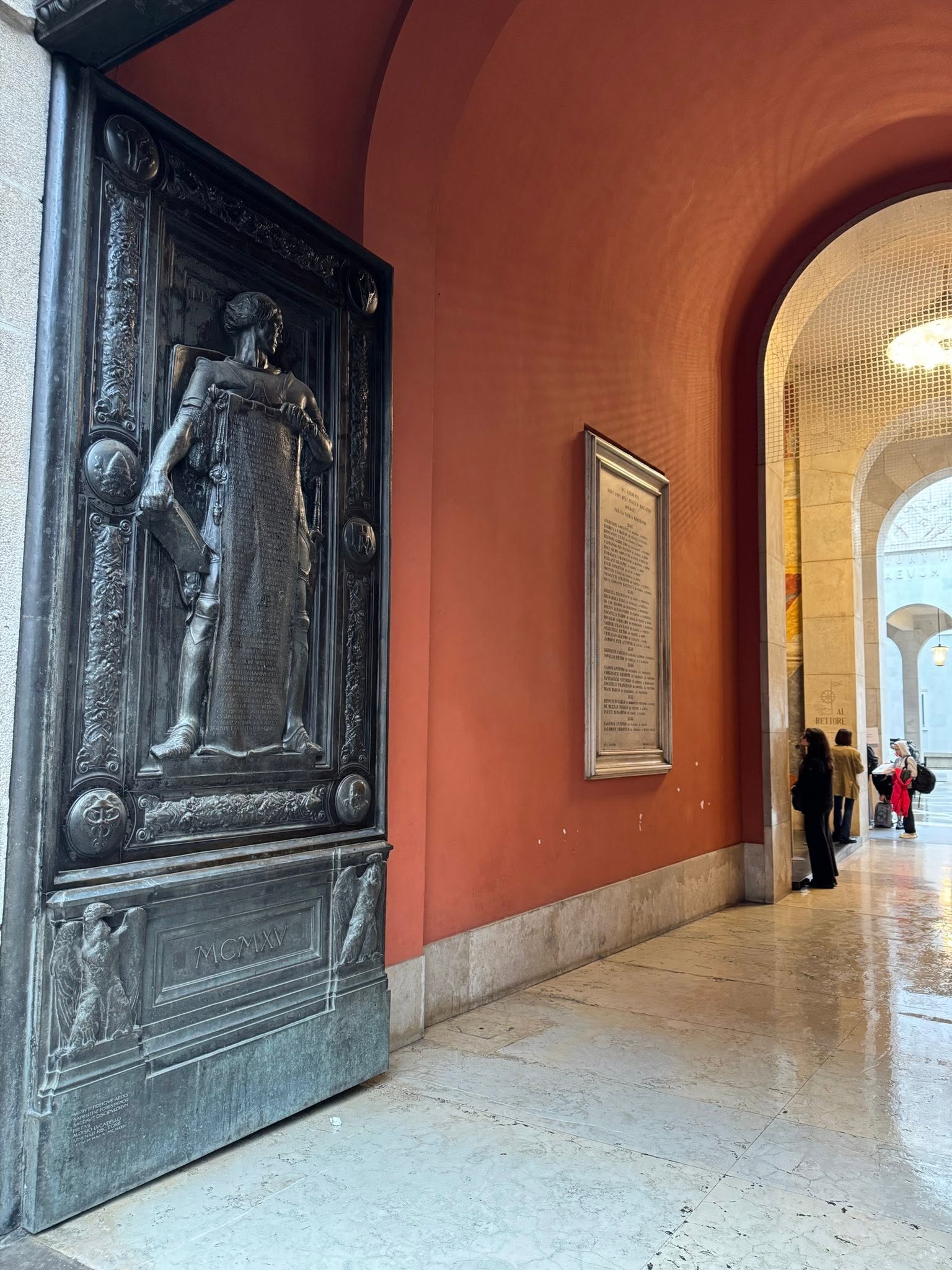
The two bronze entrance doors from the street were made from melted down enemy cannons from the First World War.
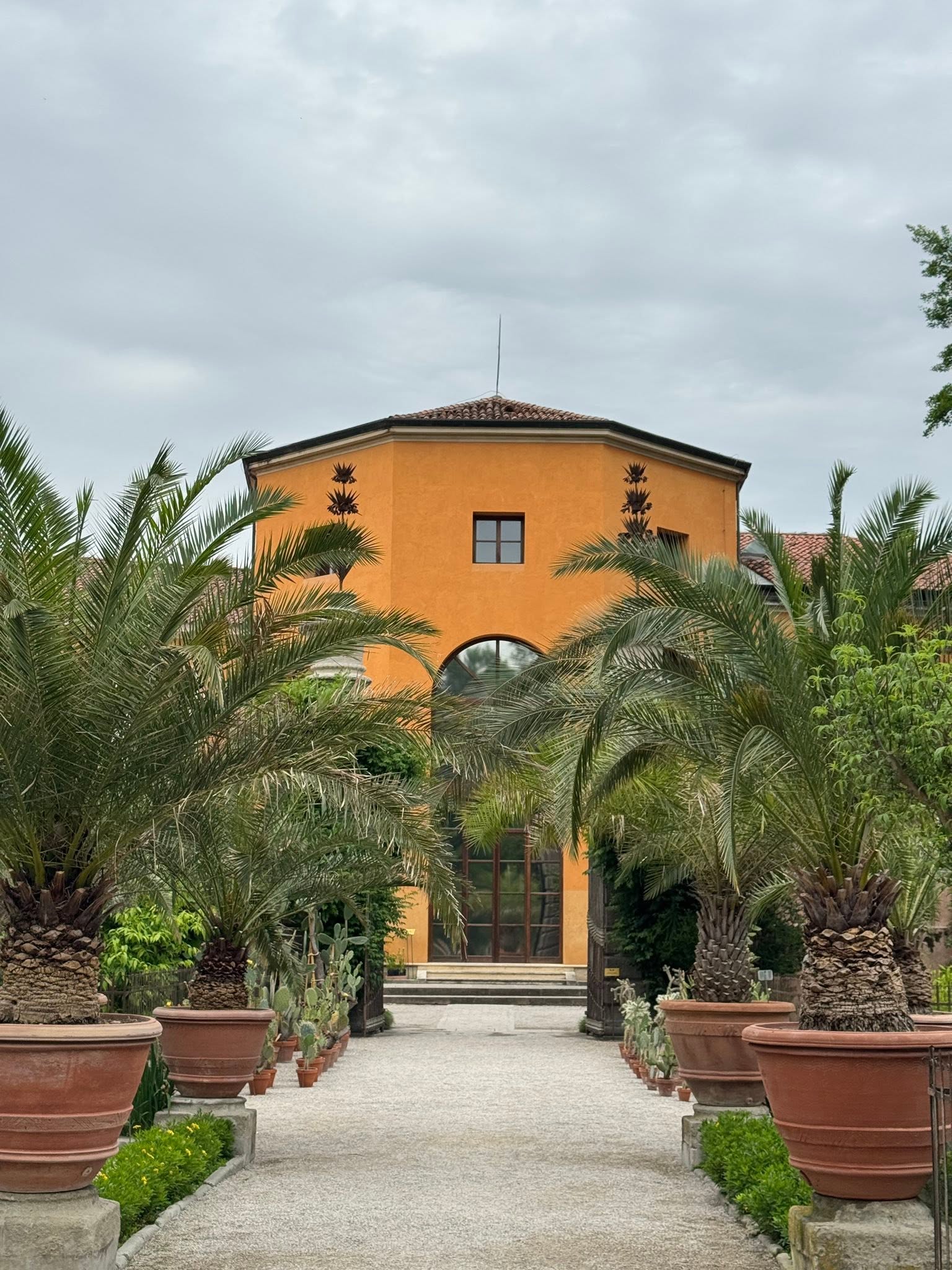
We've unpacked Elena's story so now onto unrelated parts of Padua. Also part of the University of Padua is the Orto Botanico, the world's oldest university botanical garden, growing and studying plants since 1545.
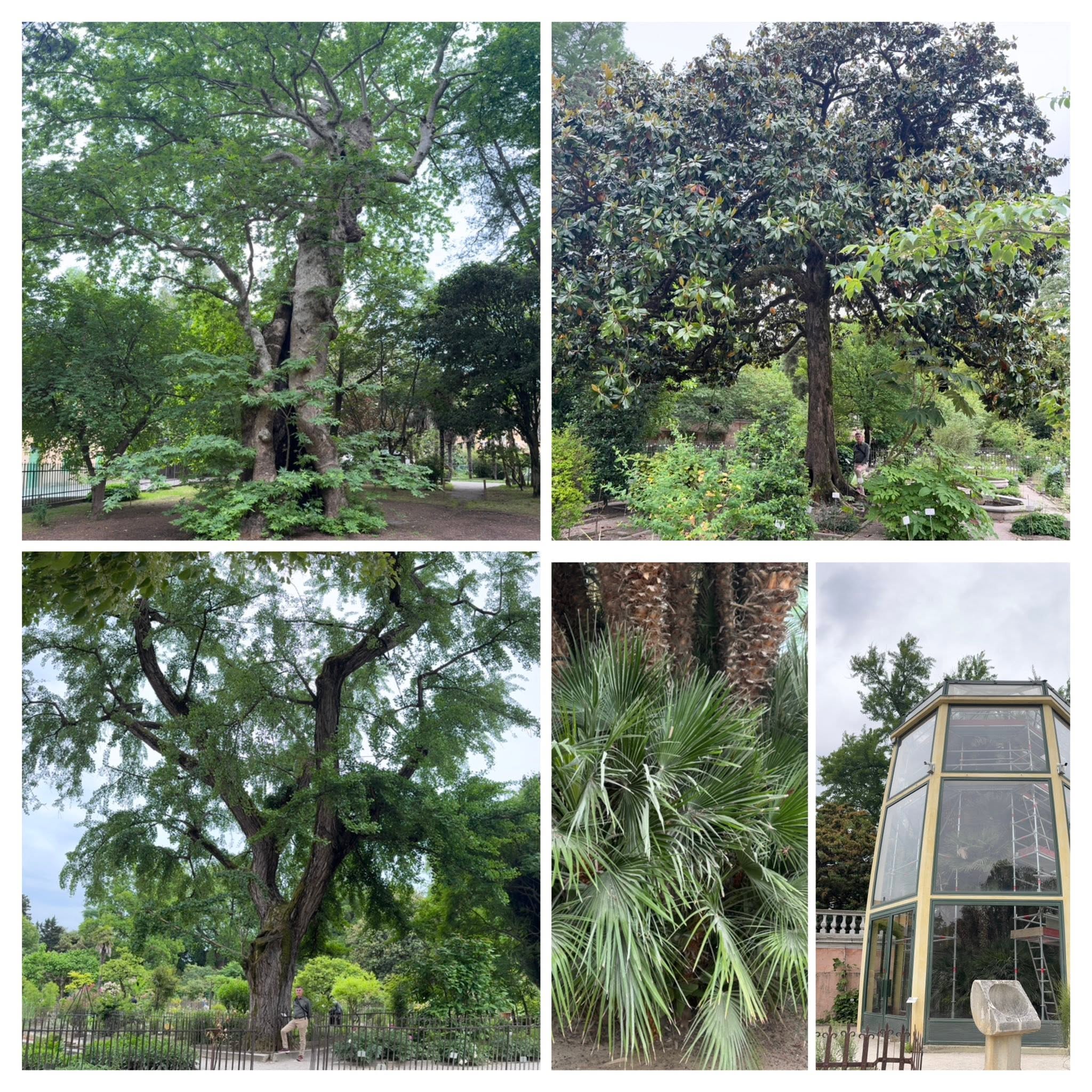
The grounds, the plants and the research are impressive and could occupy a post to itself but for the sake of highlights and time to dedicate to reading this post, I'll stick to two highlights. Amazingly, there are some incredibly old trees here. From top left clockwise: this eastern plane tree started its life in 1680 and survived a lightning strike which left a huge hollow in its trunk; this magnolia from 1786 is among the oldest in Europe; Goethe's palm from 1585 is a Mediterranean dwarf palm that apparently inspired Goethe to develop his naturalist theory in his "Metamorphosis of Plants". The section on the left of this photo is a shot through the window of the dedicated building to house this dwarf tree (not so small if you ask me); and finally this 1750 male Ginko had a female branch grafted to it in the mid-19th century.
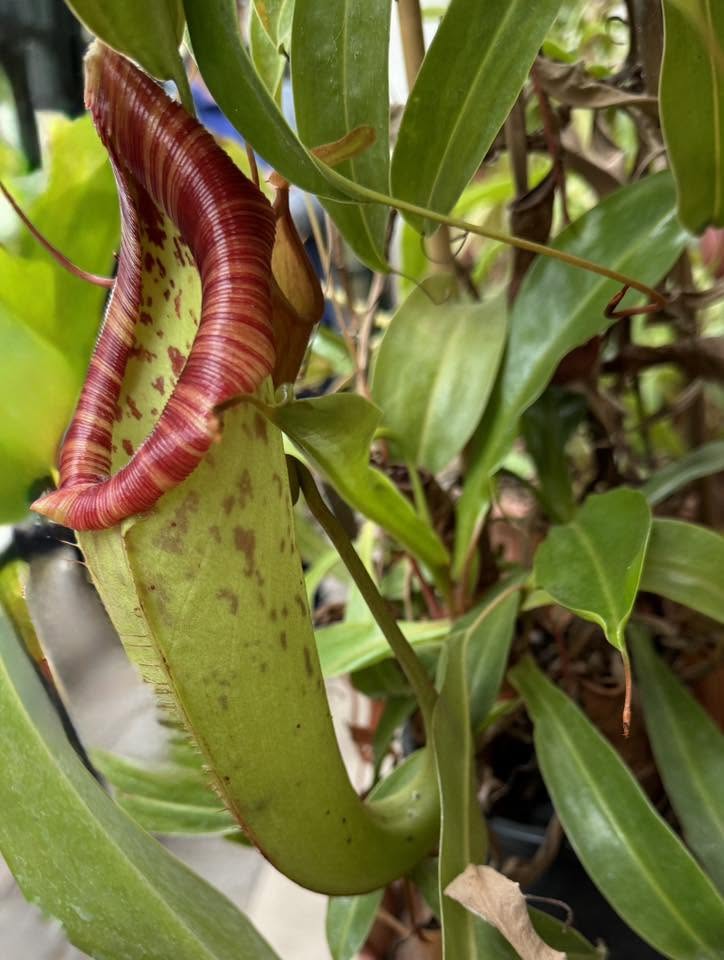
There was an impressive collection of carnivorous plants here and this was my favourite. This is a Nepenthes (aka the Monkey Cup). The ribbed, rolled rim at the top is slippery and lures insect in by its nectar. The poor creature slip and slide their way down into pitcher body, which contains a pool of digestive fluid where they are slowly digested.
If I was an insect, I think I would definitely fall into the Nepenthes trap.
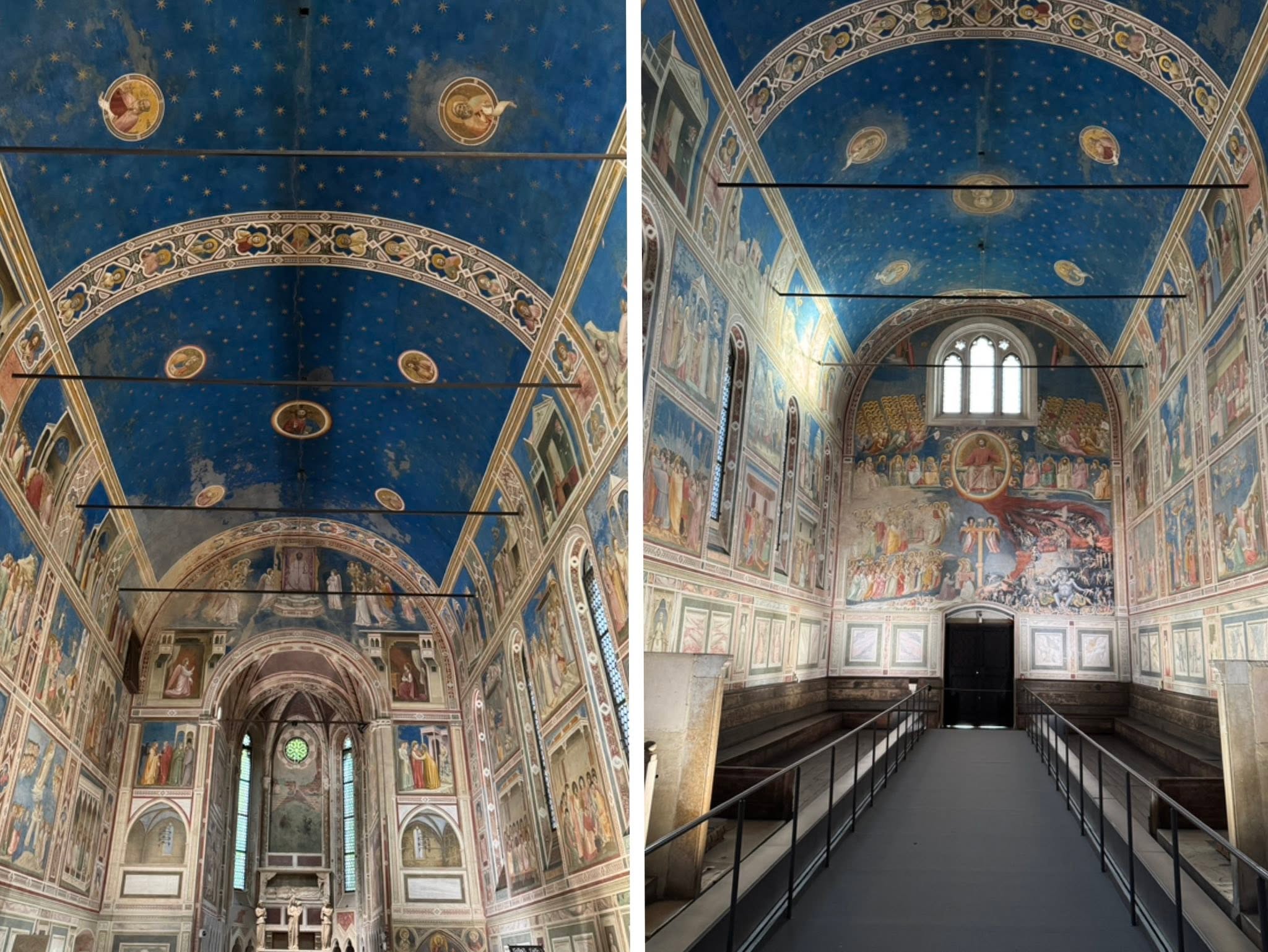
One of the main draws to Padua is Giotto's art-barrier-busting Cappella degli Scrovegni. This was the wealthy Scrovegni family's private chapel, commissioned by Enrico Scrovegni in 1303, as an attempt to atone for his father Reginaldo's notorious usury. In those days, money lending at interest was a mortal sin because the lender was essentially profiting from time and time belonged to god. But Reginaldo was aggressive, made a ton of money and everyone knew it. Even Dante knew about him and placed him in the Seventh Circle of Hell in the Inferno with a purse around his neck bearing his family's coat of arms. There was no ambiguity there!
So along comes Enrico who inherited not only the family fortune but also the nasty legacy. What could he do to clean up the family name and get himself a spot in heaven? Use the same ill-gotten wealth to buy retroactive mercy for his father and spiritual insurance for himself by building a sacred space, filling it with the greatest art money could buy and dedicating it to the Virgin Mary! The irony of it all!
Giotto turned the conventions of Byzantine art on its head. It took him six years to paint every surface of the chapel and by the time he finished in 1310, art was forever changed. Giotto gave his subjects movement, personality and emotion and his landscapes depth, dimension and reality. Giotto set the stage for the likes of Masaccio, Piero della Francesca, Michelangelo, Raphael, Mantegna and Bellini to perform.
And for a bit of context, Giotto painted this chapel 200 years before Michelangelo took a brush to the Sistine Chapel.
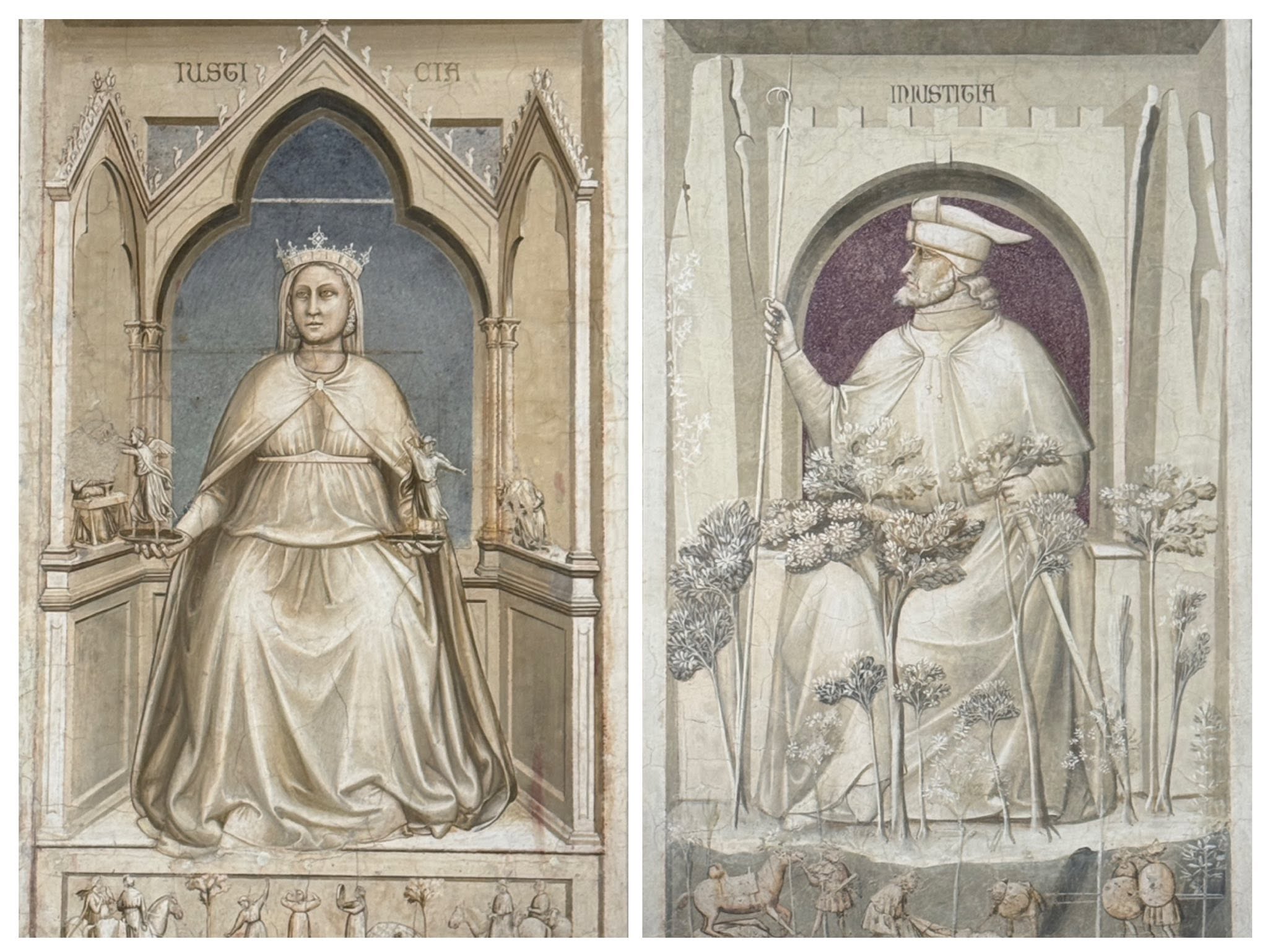
Giotto revived trompe-l'œil painting that had been abandoned for nearly a thousand years since the Ancient Greeks and Romans did it. When Christian and Byzantine art came along this kind of visual deception was not ok; sacred art certainly was not intended to fool the eye (hmmm, I beg to differ). So here, Giotto painted a series of Virtues and Vices along the base of the chapel walls to look like stone sculptures in niches. Radical! Giotto was saying that painting could be about seeing again, not just meaning.
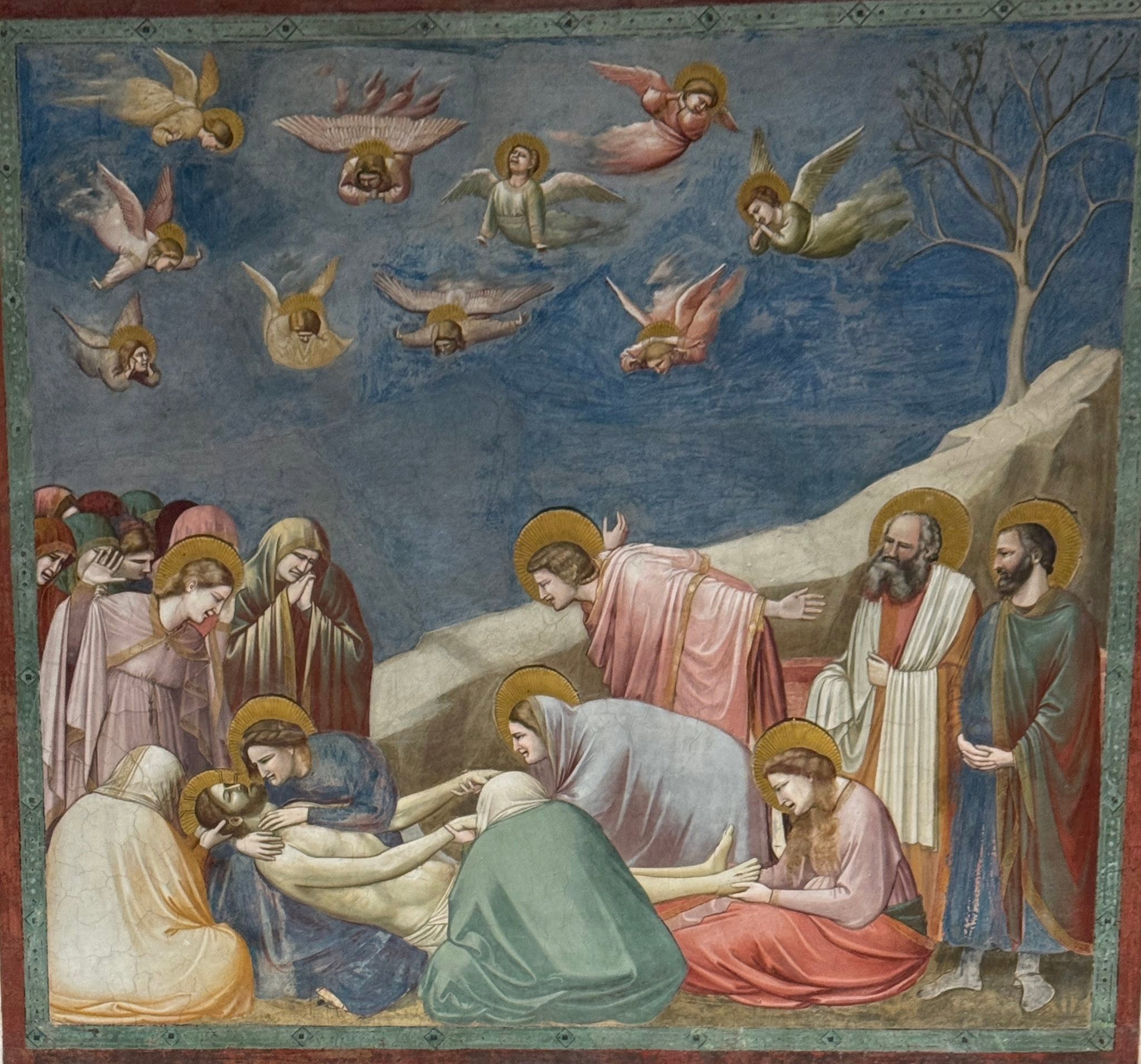
The Lamentation of Christ, another revolutionary panel is showing us different expressions of grief. Before Giotto faces were not individual, they were types: the grieving face, the holy face, the mean face. Here, different people are showing their grief in their own, personal ways:, screaming, disbelief, numbness, head shaking... and Giotto is also using his landscape as a means of telling his story. Behind the grief-stricken people is a diagonal rock that draws one's eye to Christ's face. It's serving a purpose, not just decoration.
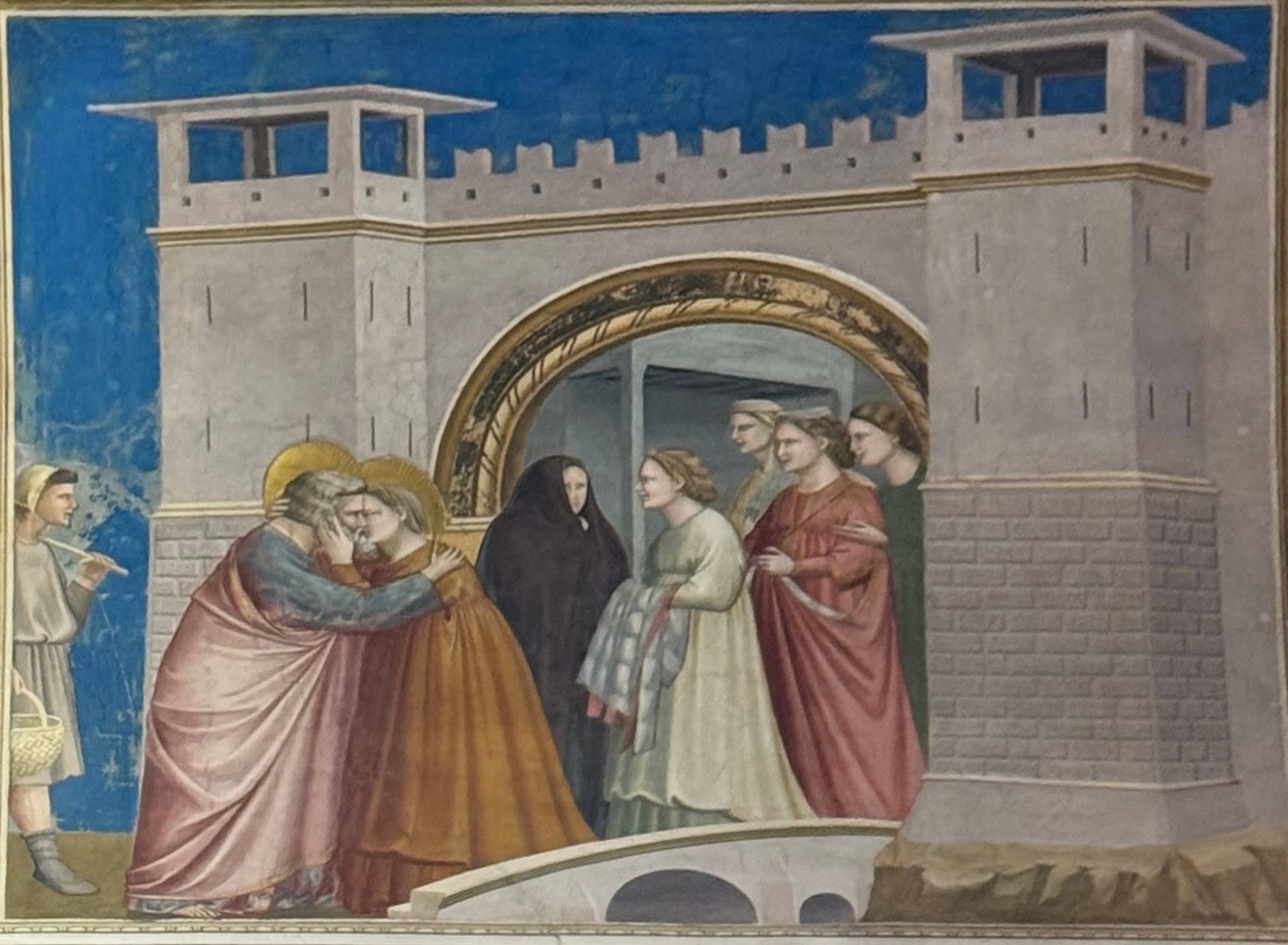
The first intimate kiss in Western art! This is the Meeting at the Golden Gate where Mary's parents (Joachim and Anna) are reunited after a long period of time when Joachim fasting and praying after having been humiliated at the temple. He had tried to make an offering and was refused by Reuben, the high priest, because a childless man had no right to present himself to god before those who had fulfilled their multiplying duty! Of course god intervened and an angel was dispatched to each of them to share the news that she would get pregnant. It's a tender moment shared between the two; not something ever seen in western art. There is a lot of precedent in the Old Testament. Extraordinary children are born to seemingly barren people who seemed to be beyond home. Mary needed to be extraordinary because she would become the mother of Christ. Her conception had to be divine and not simply the result of two people having sex.
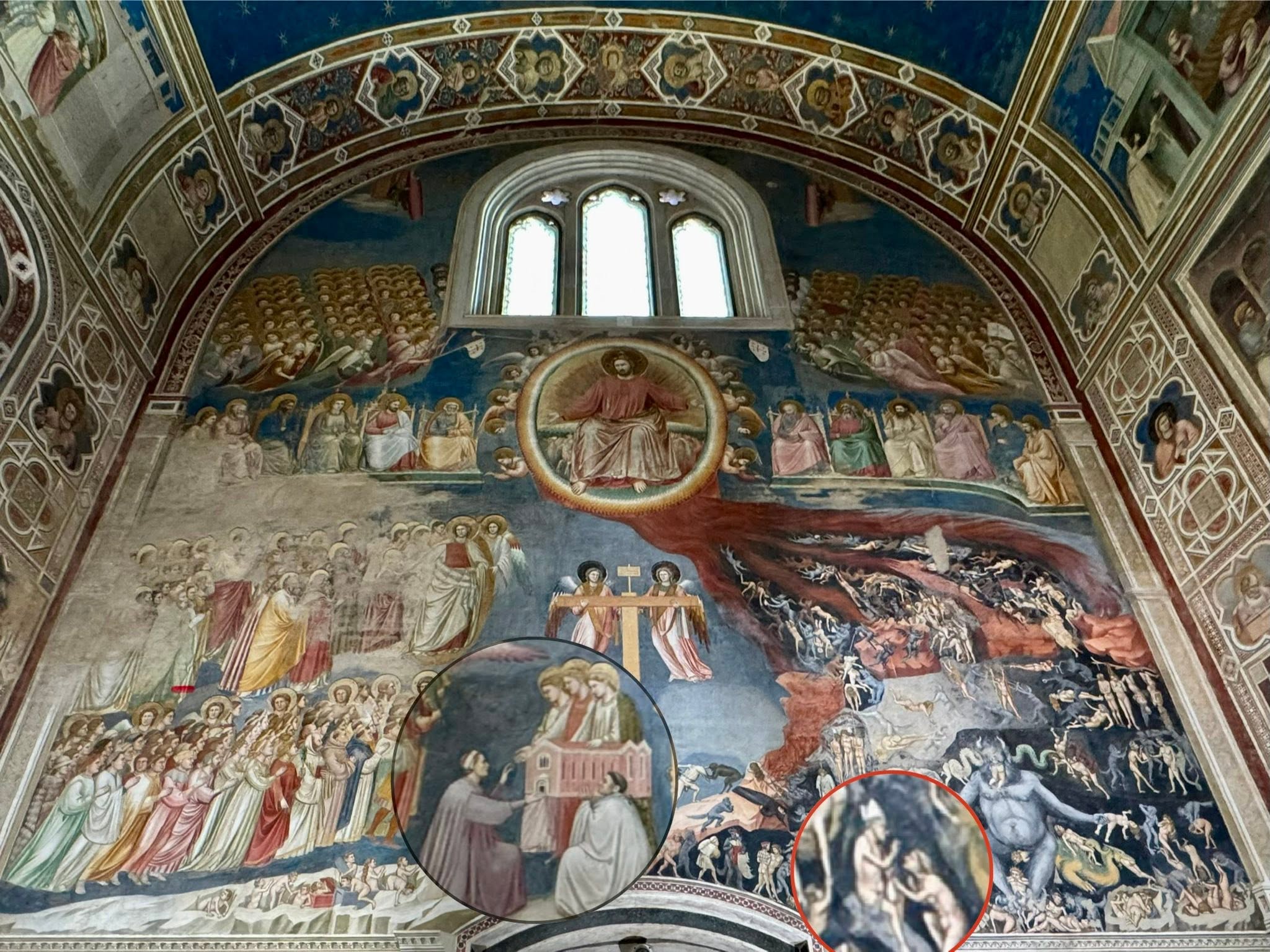
And finally, the classic Last Judgement panel. A few interesting things are buried in here which I've blown up a bit in the picture. On the lower right near Satan's right knee, Giotto daringly painted a pope carrying a bag of money; just another sinner condemned for avarice and corruption. Perhaps a little ironic that there is an image of a pope condemned for the same crime that the chapel is trying to absolve...
Just left of the lower centre, Giotto painted in his patron, Enrico, boldly making sure his good deed was not forgotten. He is presenting a model of this very chapel to the Virgin for whom it was named. I built this for you so be sure to remember me when the time comes! Whether it worked out for him (and his father) in the end we will never know...
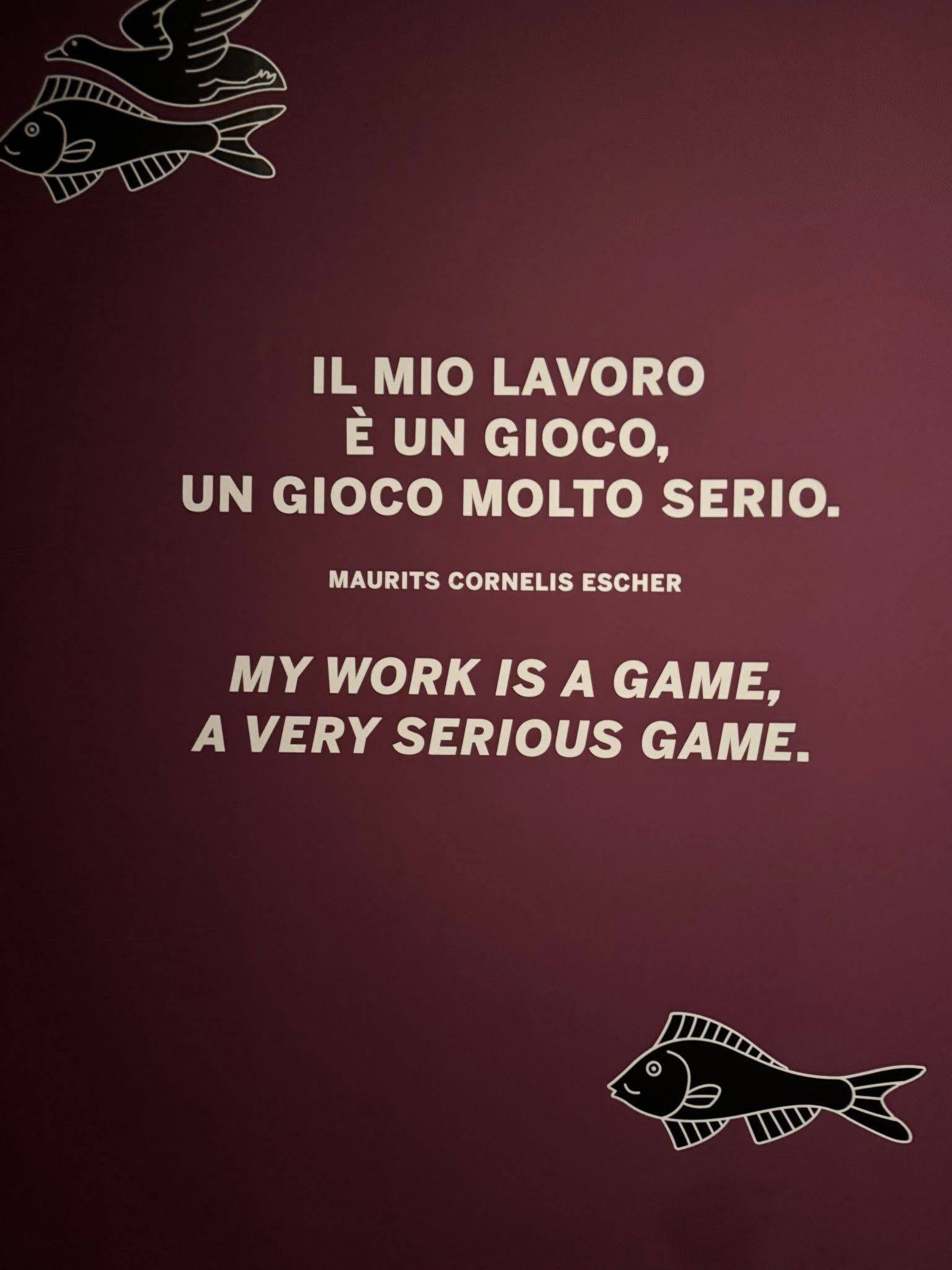
And now for something completely different! After all that serious art, we managed to see an MC Escher exhibition before leaving town. And this quote of his really sums it up!
It was a circuitous route that took him from failing math at school (quite a thing for the son of an engineer) to a groundbreaking career in art. He was a detail-oriented person, doing detailed drawings of landscapes that inspired him in southern Italy but when he went back to his native Holland the landscapes had no allure. His transformational moment came when he went to Spain and discovered the Alhambra's intricate, decorative geometrical symmetries with interlocking repetitive patterns. He fell for the logic of it all with his work revolving around perception, real or otherwise. Maybe he couldn't do math at school but he felt it in his soul.
While his work wasn't appreciated at a time when the art world was consumed with Picasso and Kandinsky style of abstraction, his innovative style was finally appreciated near the end of his life and continues to influence art and design. Another rule breaking artist!
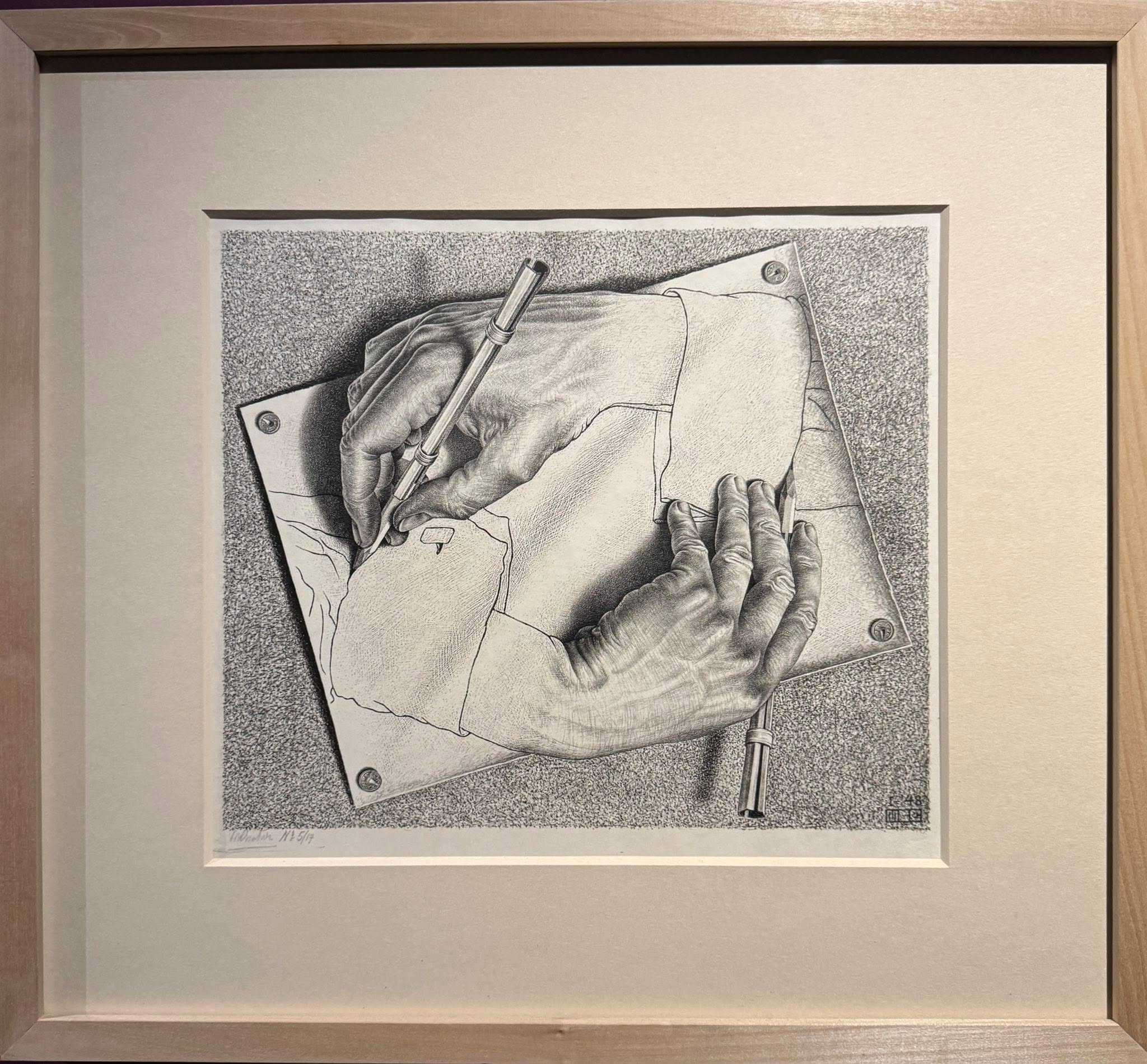
If you're not familiar with Escher, this should look familiar. Drawing Hands from 1948 is one of his most famous pieces. It is a mastery of transition, from the paper into the two hands drawing each other: a bit of a chicken and egg image. This, from an artist who spent his life exploring what perception can and cannot be trusted to tell us, it may just be his purest statement.
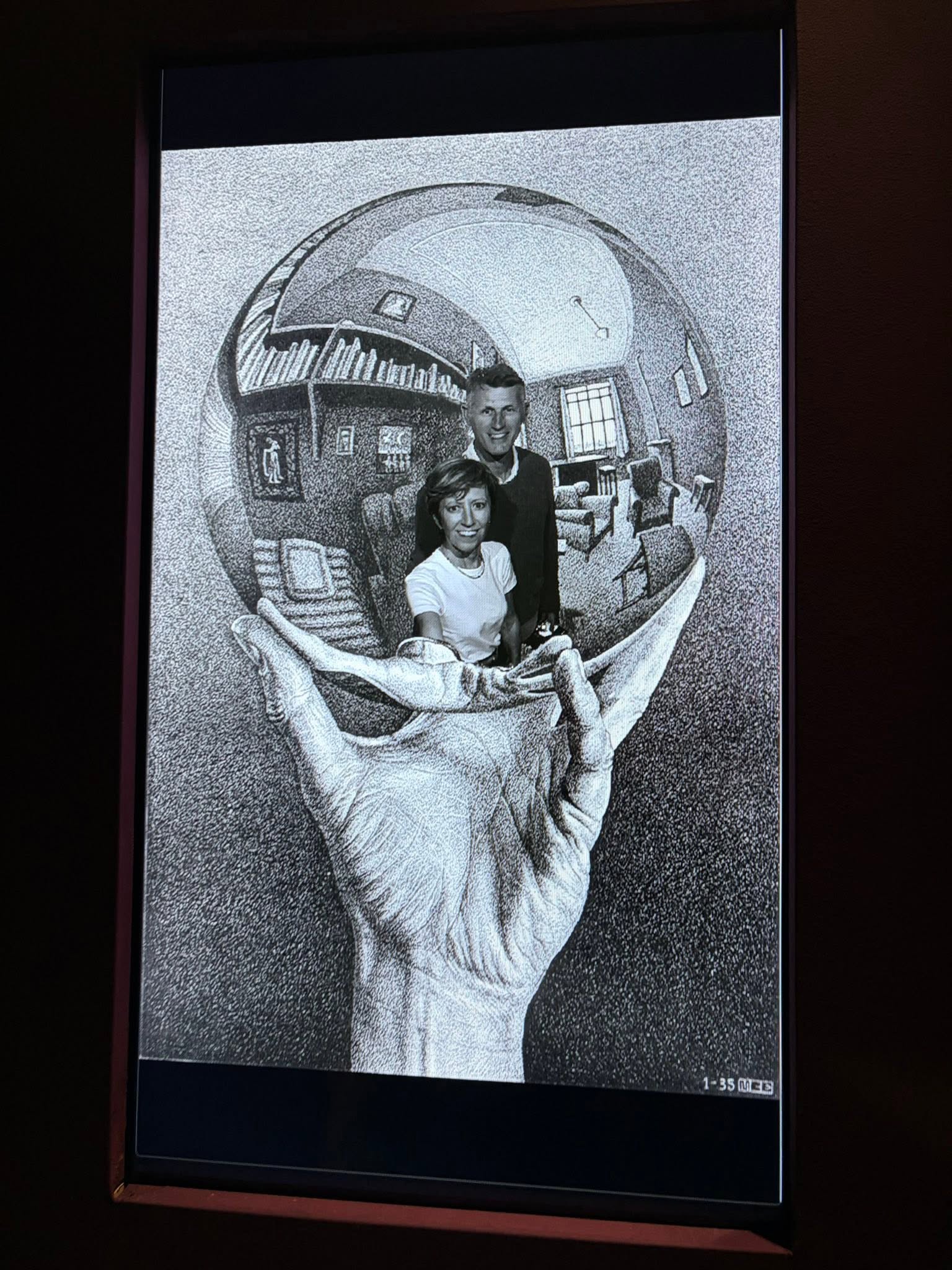
Hand with Reflecting Sphere from 1935 (also known as Self-Portrait in Spherical Mirror) is another quintessential piece. In this one, the way the room wraps around the edges, the way his hand and the room behind him (or should I say us...) curve into distortion at the periphery while the center remains relatively clear. He essentially solved, by hand and eye, the same problem a wide-angle lens solves mechanically. He is both inside and outside of the image. He is the subject of the image and his hand is holding what is essentially his canvas and as a sphere the canvas has no edges so the whole world is somewhere in the sphere.
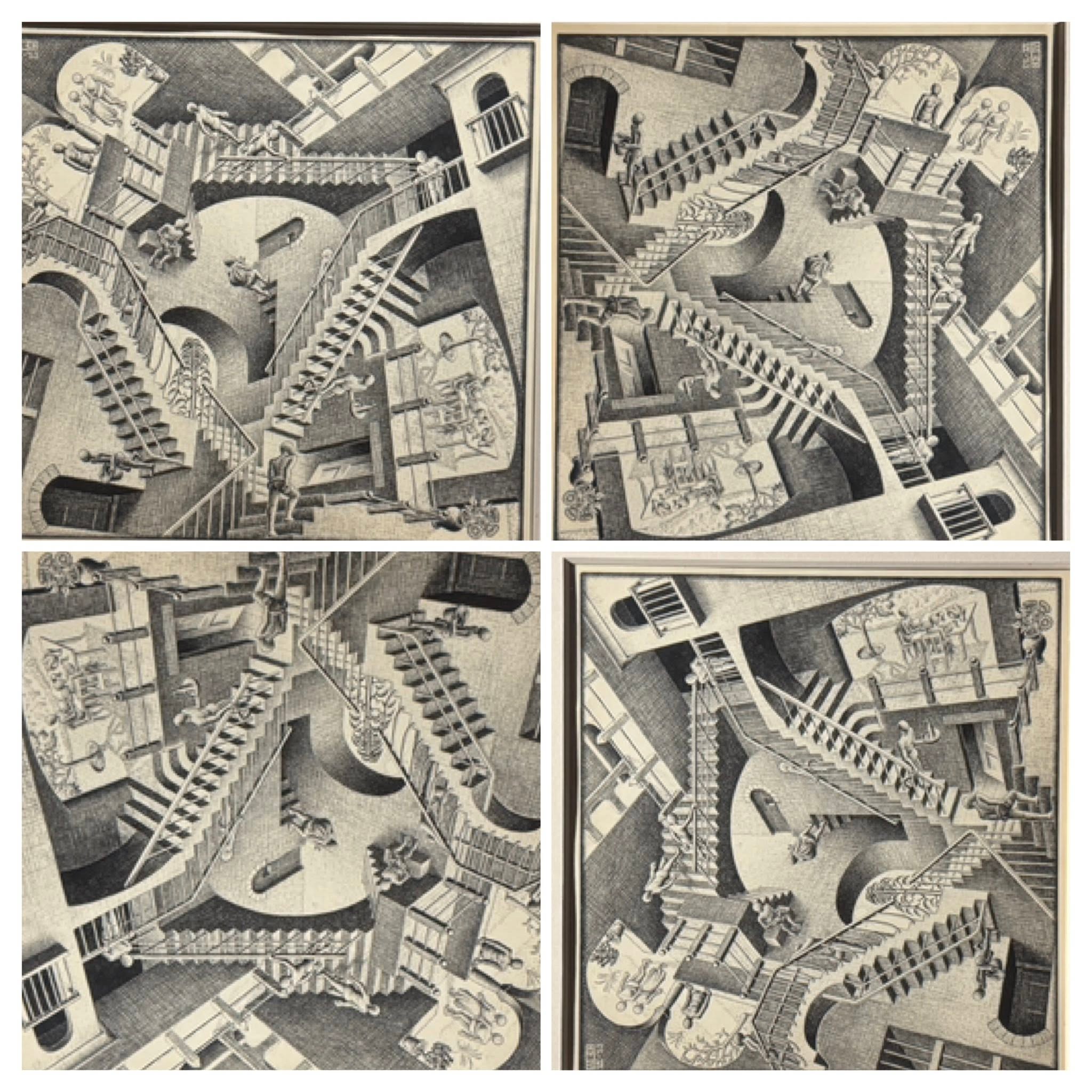
I had a bit of fun with Relativity, done in 1953, another iconic Escher image. Here we have a world with three different gravity forces pulling in different directions. If your brain could isolate each one, each would make sense. But what is a floor for one is a wall for another and a ceiling for yet another.
So in this photo, the original image is in the upper left corner. I then duplicated it three times and rotated each one a quarter turn. For me, I can see something akin to reality in the first three (going clockwise from top left) but the last one doesn't sit. And that must be because the original image is three different forces pulling in different directions so the fourth version is off.
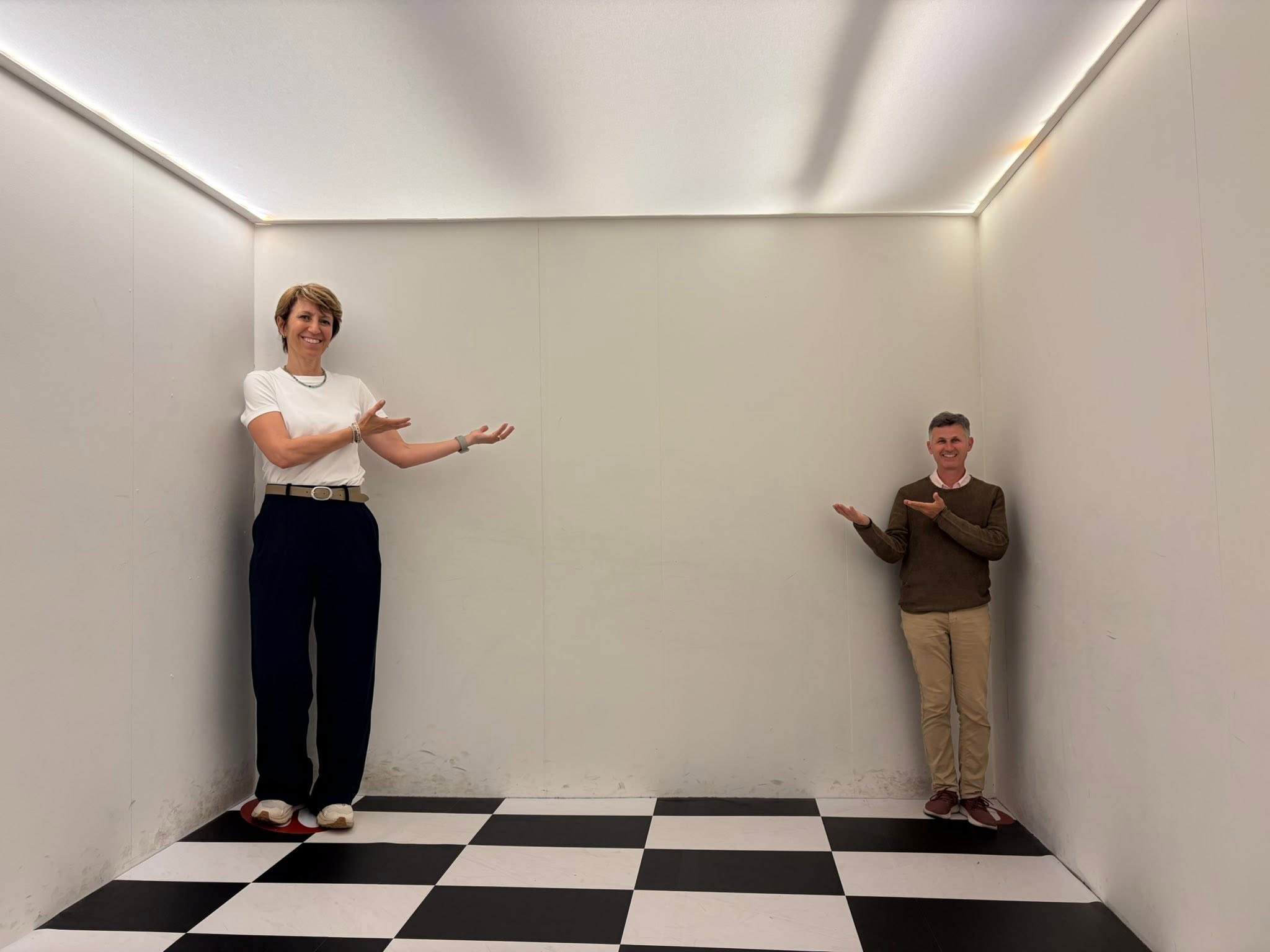
Another bit of fun at Escher's exhibit. Finally I am not the smallest in the family!
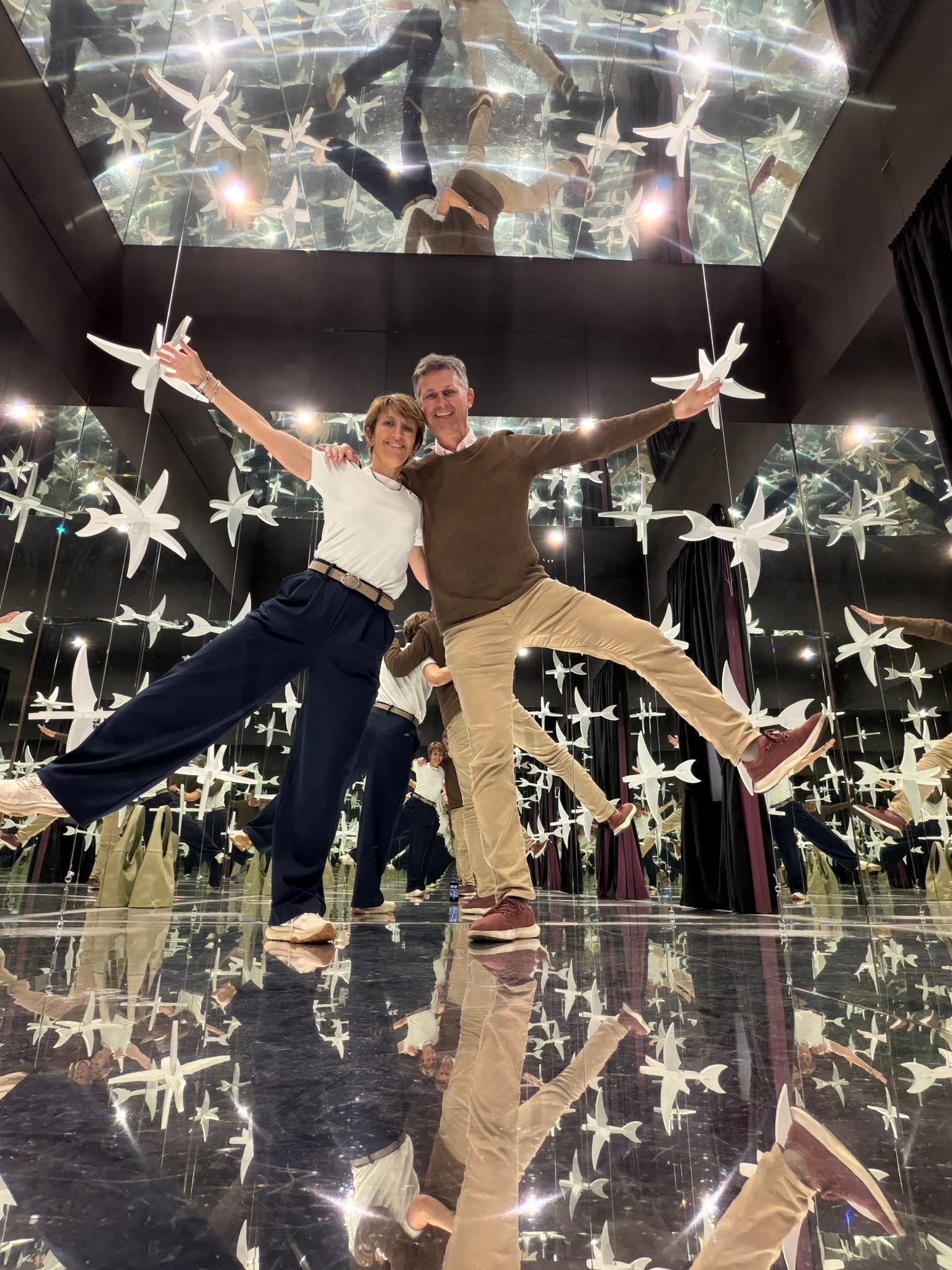
Our Eurovision finale!
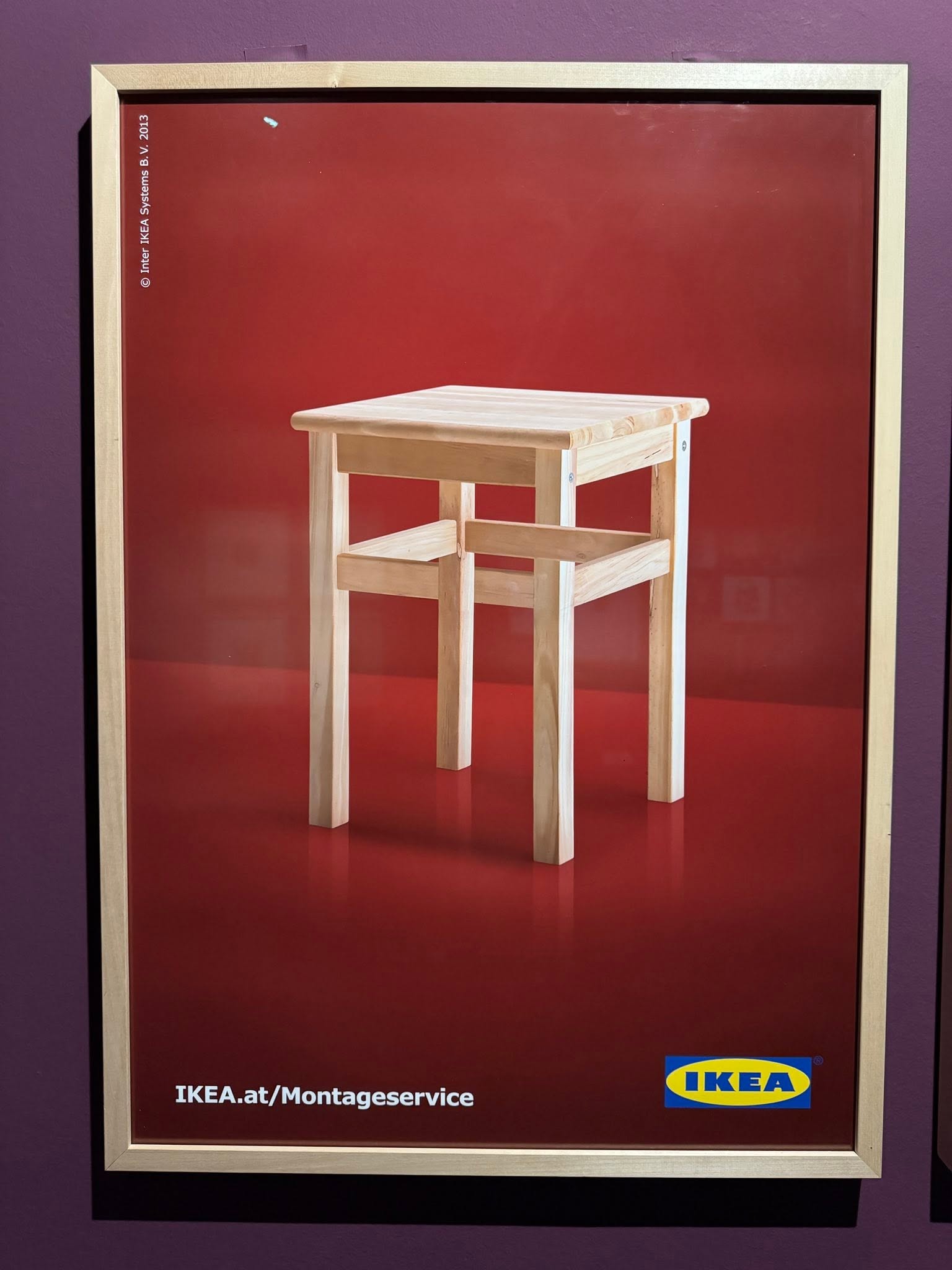
There are countless advertisements and other artistic endeavours inspired by Escher. He died in 1972 at the age of 73. If only he knew the impact he had on our perception of the world around us.