April, 2022
Bubbling Bologna
Coming from sleepy Sicily we took the overnight train to Bologna. Of course Adam totally geeked out over how they got all the train cars onto the ferry at 1am (when we should have been sleeping). Pretty fascinating actually.
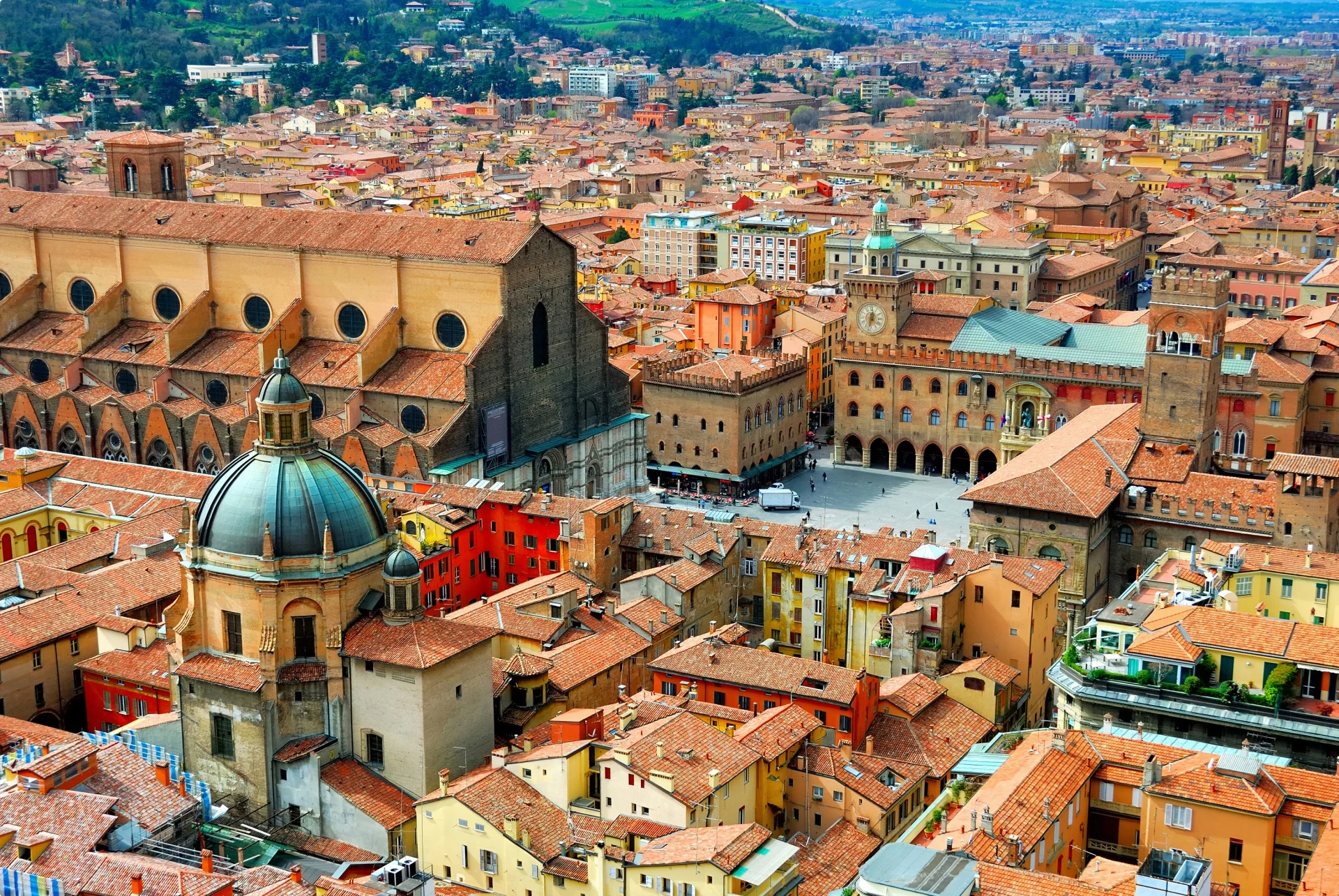
Bologna is a hip, fashionable, youthful, foodie city with the world’s oldest Western university, founded before the close of the 11th century. Oh, and there’s food there too! Bologna is the seat of ragù (aka bolognese sauce), lasagna, tagliatelle and tortellini, in all of which the locals take great pride. It’s no wonder the city's nickname is La Dotta (the learned, for its academia), La Rossa (the red, for its rooftops) and La Grassa (the fat, for its devotion to food).
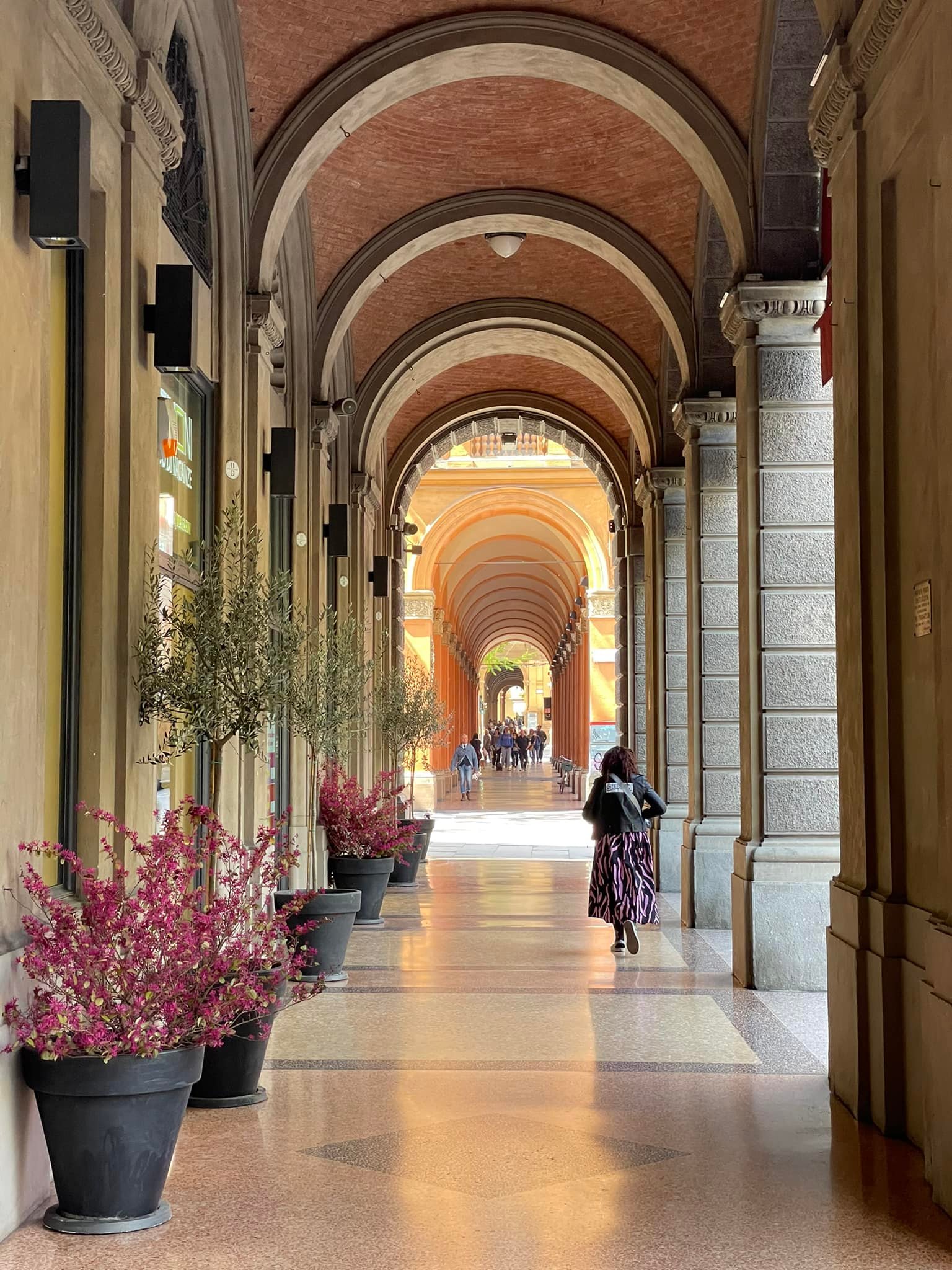
Bologna is known for its extensive network of porticoes, 62 km in the city, 42 km of which are crammed into the historic city centre. Some stunningly beautiful and others merely functional, they started being built in the Middle Ages to extend living spaces. The growth of the university probably had a lot to do with the accommodation pressure. Sound familiar? Maybe some Canadian university towns could take a page out of Bologna’s book!
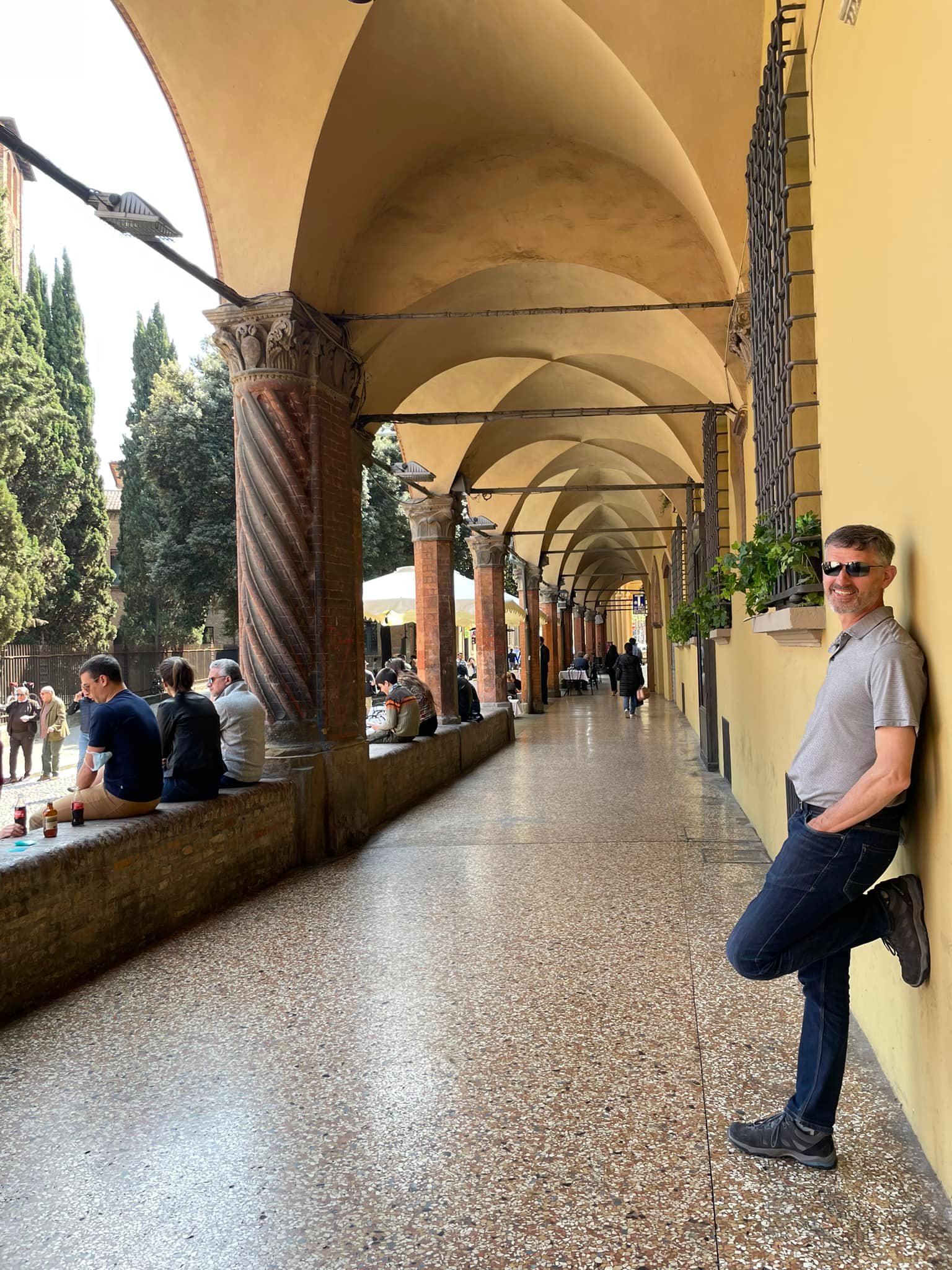
Hanging out in a portico.
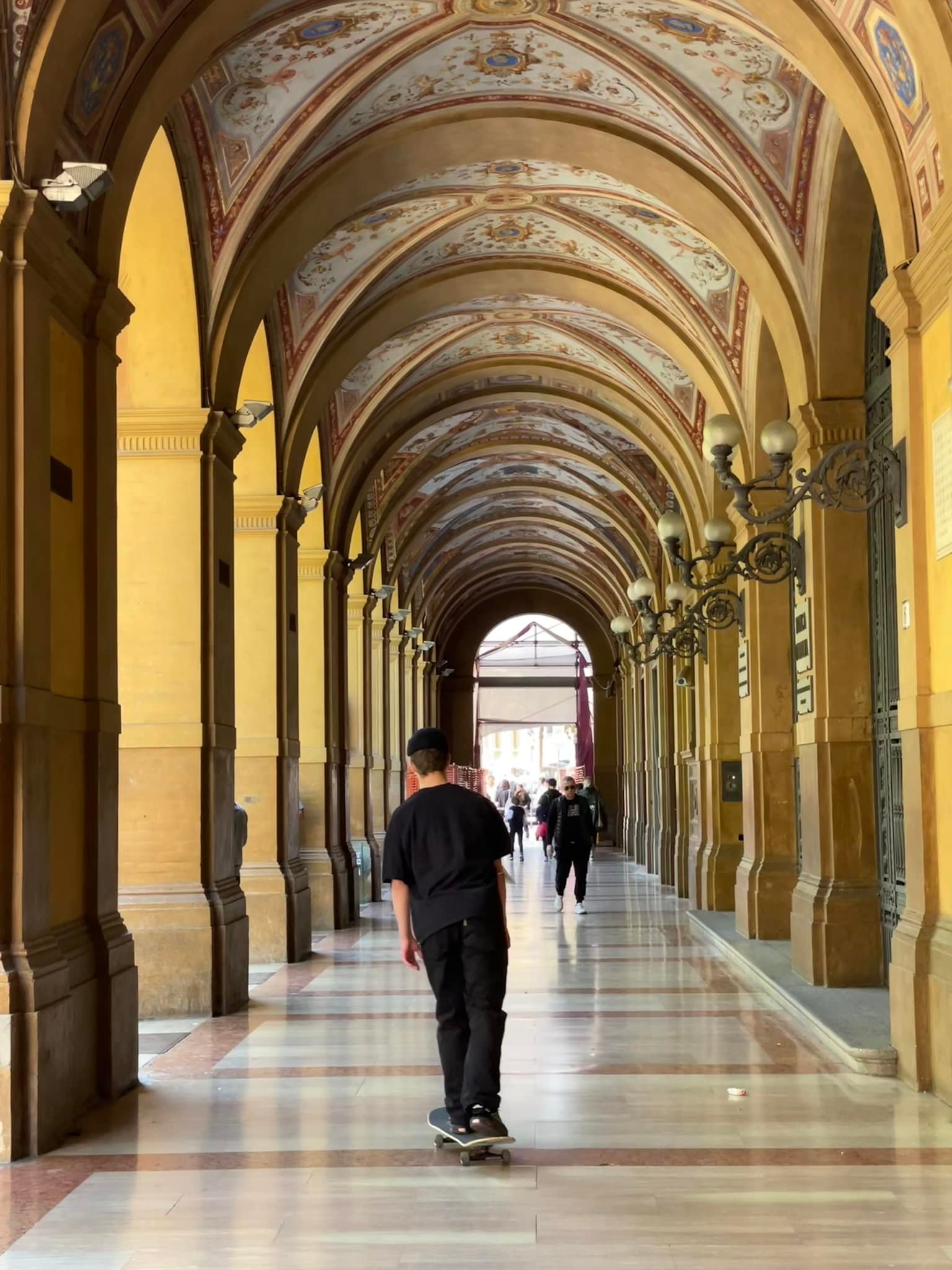
Porticoes are for everyone!
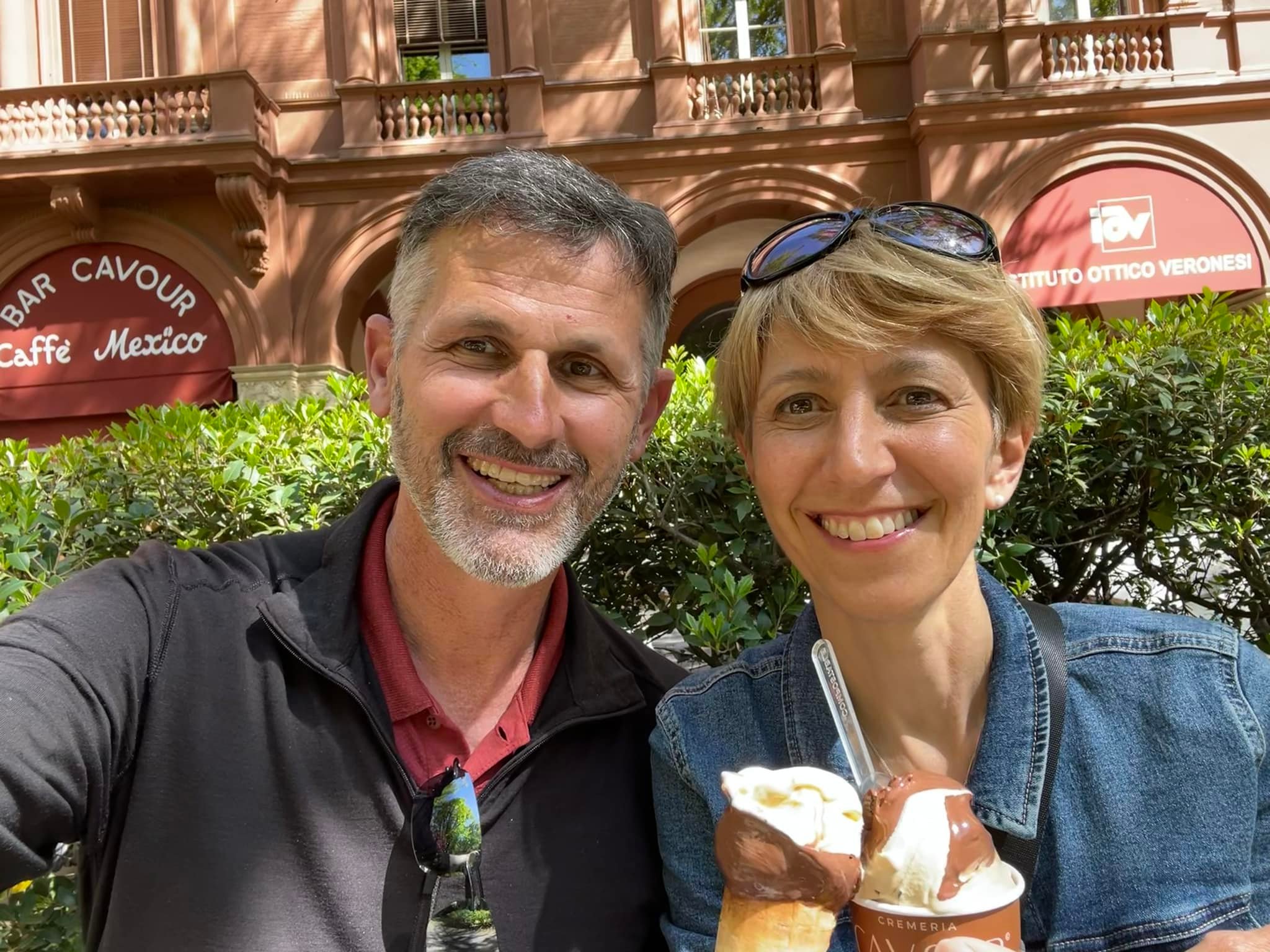
Somehow we caught wind of an ice cream shop in Bologna that was supposed to be the best. Well, every gelateria lays claim to being the best, I’m sure, however Cremeria Cavour is hands down the winner. Seriously worth the trip to Bologna just for the gelato. The best gelato we’ve EVER had and that is saying something. Creamy like you’ve never had before. Classic and unusual flavours that will entice you back the next day so you can try something different. I admit that this was our lunch three out of four days in Bologna. The third lunch we went traditional (full disclosure: it was Easter Monday and the gelato shop was closed) and had lasagna and tagliatelle with ragù. Excellent. Bologna deserves the title.
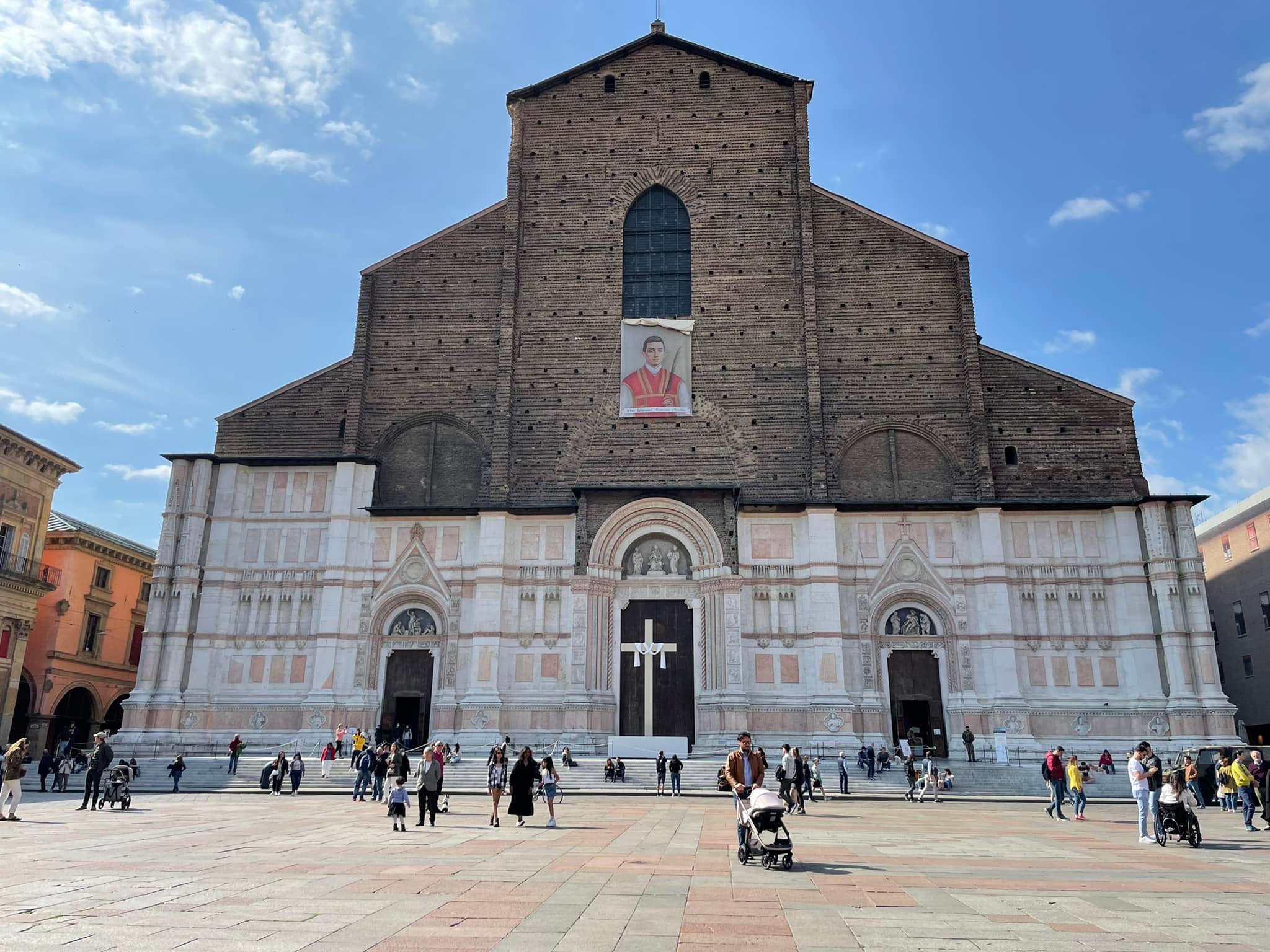
The enormous and imposing Bologna Cathedral (San Pietro) had some of the most interesting stories, features and quirks. The facade is the first point of note. It’s unfinished. The bottom half is finished with elegant pink and white marble. The top half is uneven brick (this uneven brick is part of the design to attach the marble facade). Turns out they ran out of money during construction so some details were dropped. Personally, I would have pushed for curb appeal and cut some corners inside but apparently that’s not the way they build cathedrals. Kind of like landscaping when you build a house. If you run out of money, it’s the landscaping that suffers.
Another interesting tidbit is this basilica has no transept. As with many of these old churches, they expanded over time and this one was heading towards being larger than St Peter’s in Rome. The Pope was not about to be upstaged so he ordered the construction of the Archiginnasio, the first seat of the university, adjacent to the church, thereby using up the space where the transept would have been. Needless to say, the basilica did not end up bigger than the Pope’s home turf.
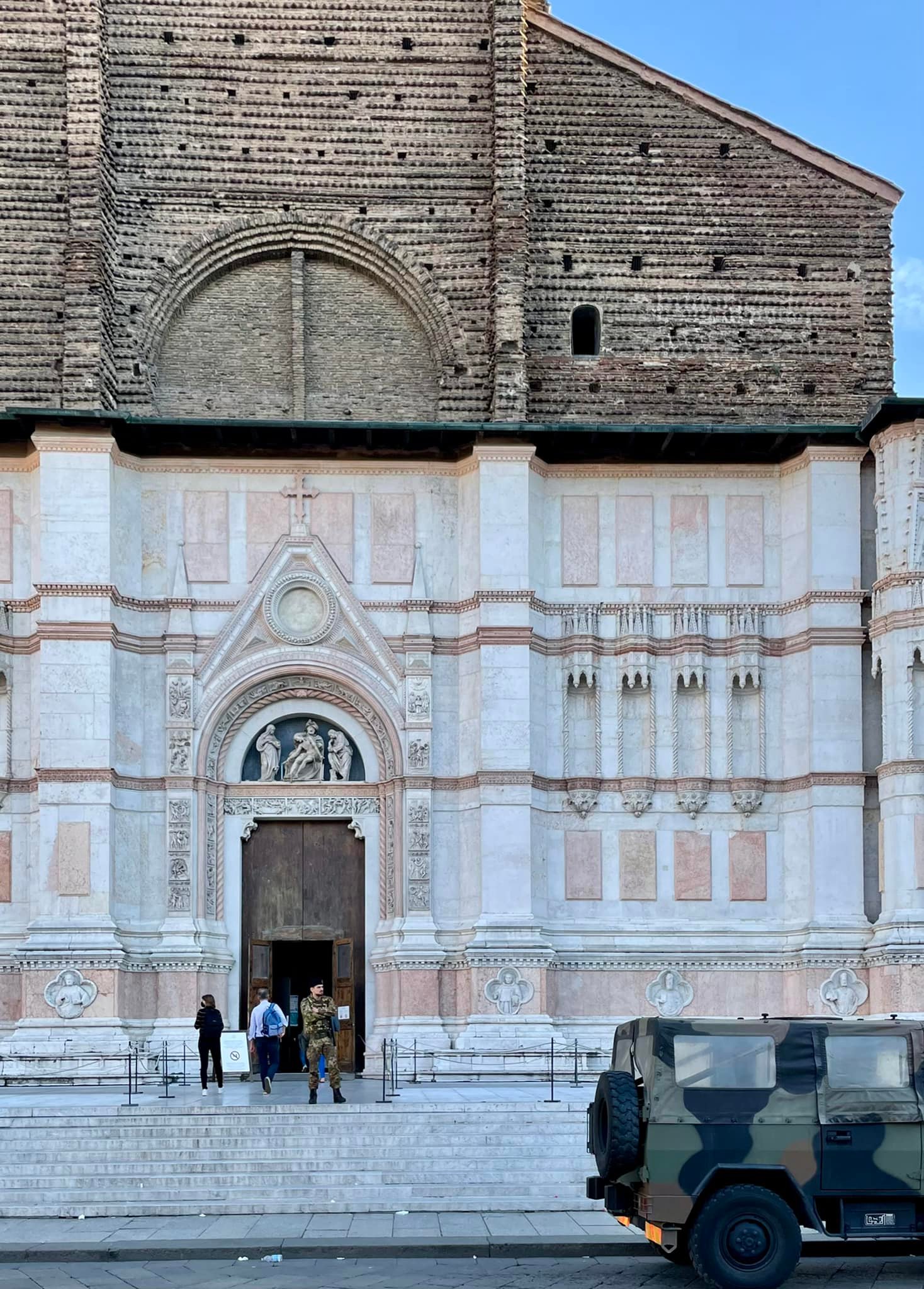
Another unusual fixture of this church is the police presence outside. It turns out it’s due to something inside that got some people’s knickers in a knot…
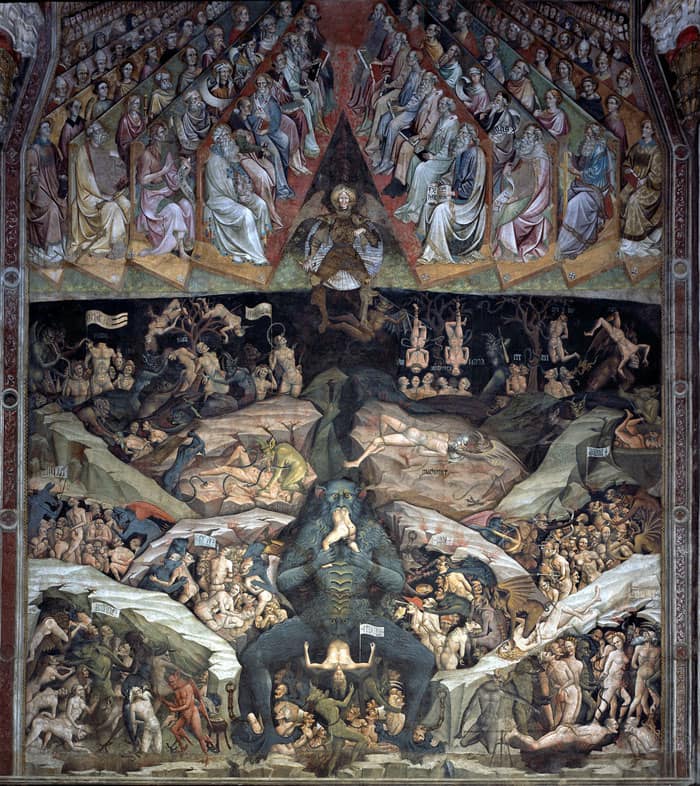
…so inside the cathedral, wealthy patrons helped fund the construction but, of course, needed something in return for their contributions. Twenty-two chapels complete with naming opportunities and personal decoration did the trick. One chapel in particular, the Cappella Bolognini, is still talked about to this day. Its rather original painting by Giovanni da Modena of Heaven and Hell, inspired by Dante’s Divine Comedy, is a sight to behold. Zoom in and look at the details. Sorry, it was hard to get a good angle for the photo as the space in front was roped off, so I’ve picked one off the Internet. The monster in the middle is eating people through its mouth. Now look down between its legs to see the unfortunate folk on their exit. Now here’s why the police are stationed outside: In 2002 and 2006, Islamic terrorists were thwarted in their efforts to blow up the basilica. Why? Because this fresco was an insult to Islam as there is a depiction of Mohammed being devoured by demons. And if there’s any question as to whether it’s really Mohammed, his name has been written under his image. You’ll find Mohammed’s foot dangling over the central demon’s head.
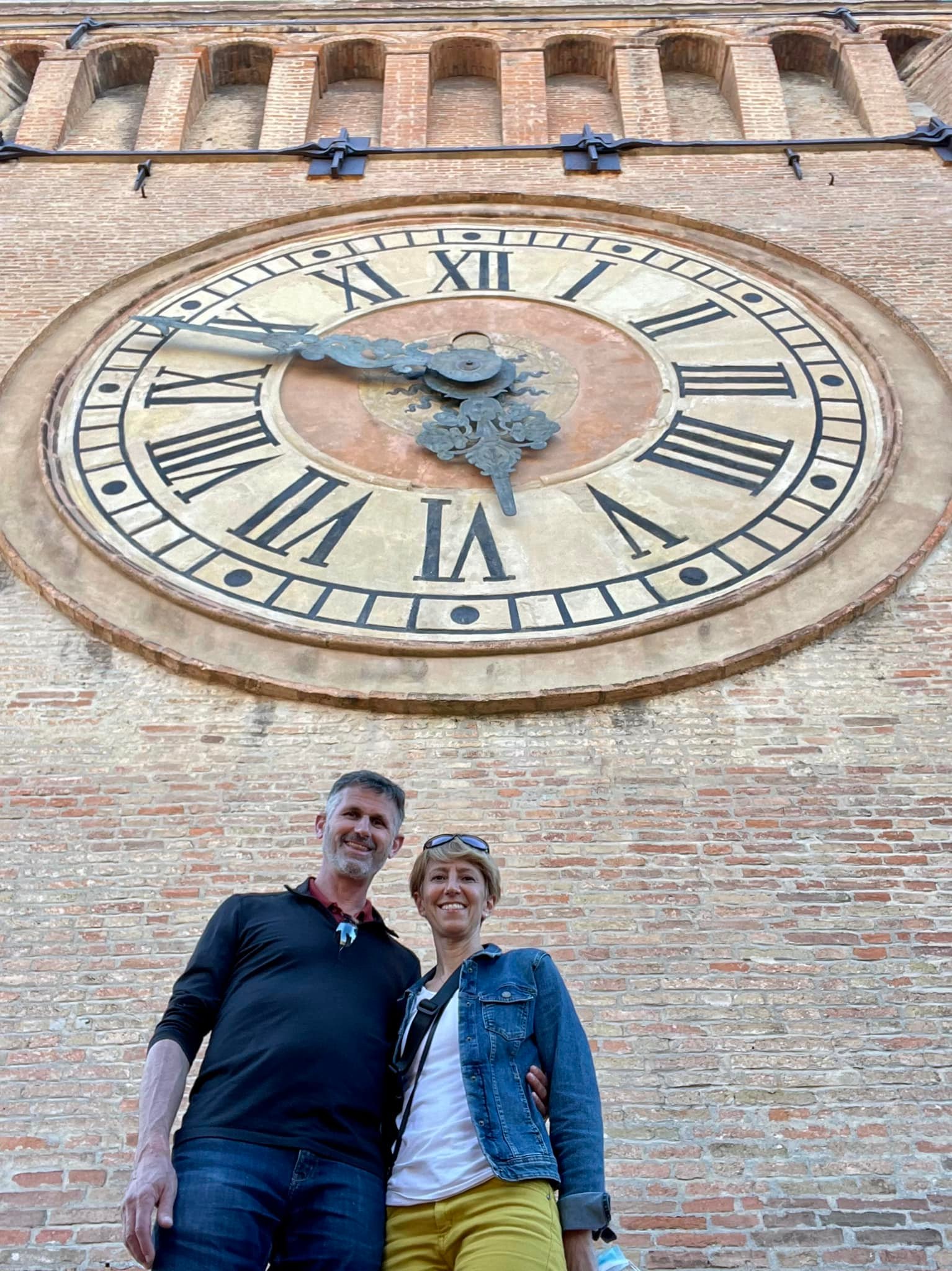
Almost time for aperitivo!
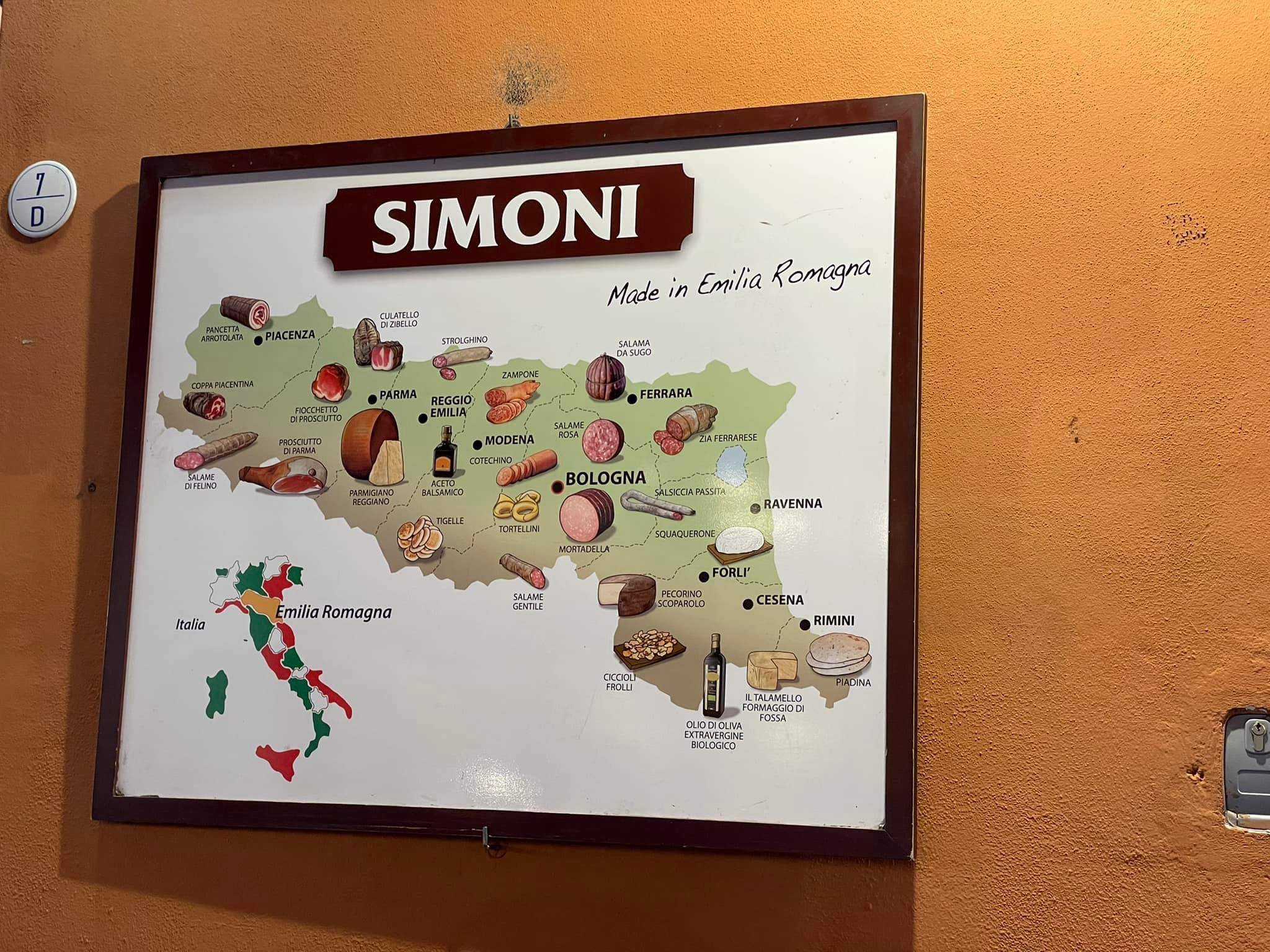
You know a region is proud of their food when they have a map showing the different cities’ specialties.
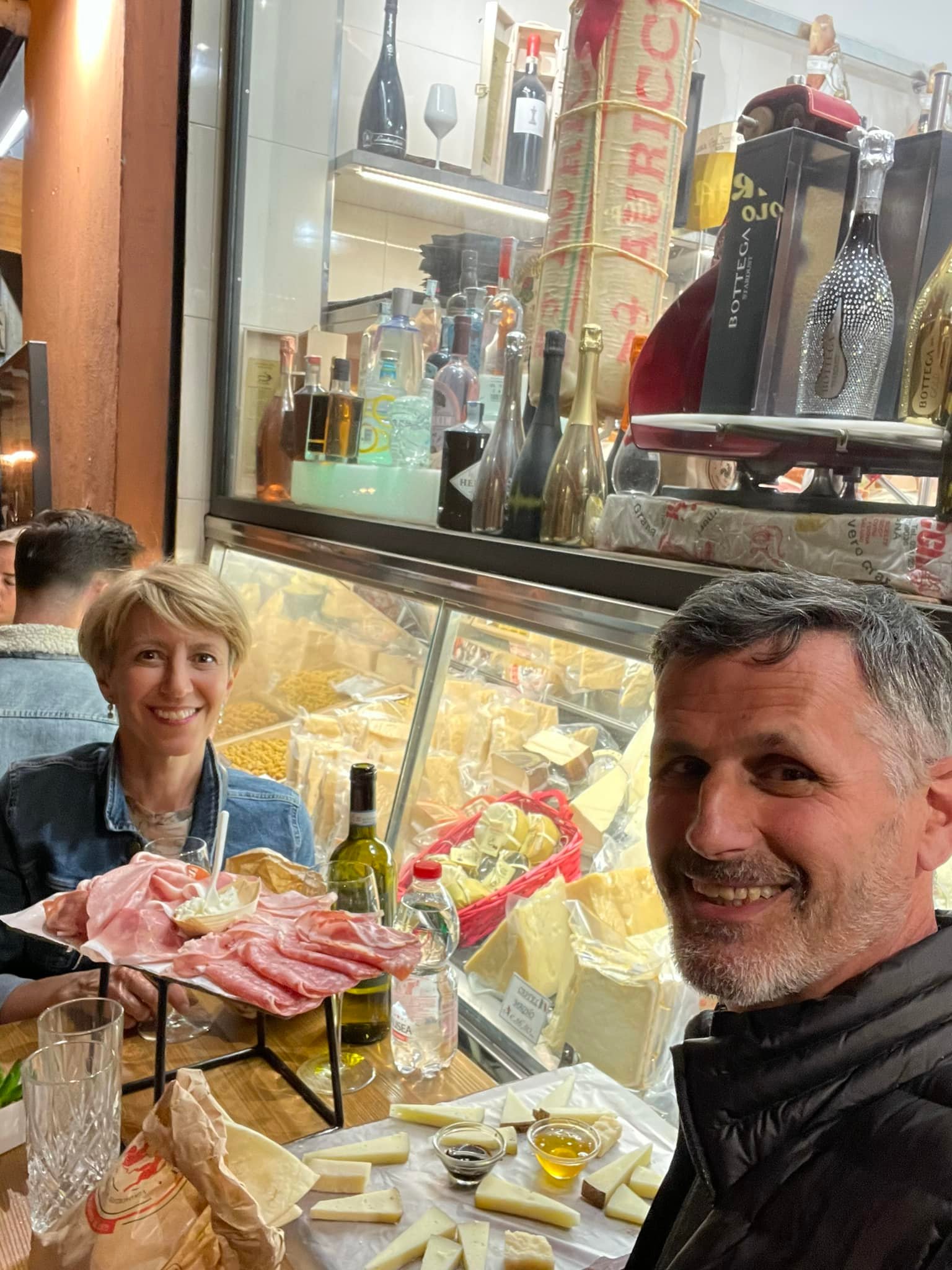
Partaking in the various specialties with a taglieri or two for dinner.
The table next door was occupied by a young British woman (on a date?) who was speaking excellent (to my ear) Italian. I asked where she learned her Italian and she said "here!" This was April, and she had arrived in Bologna in September.
I'll say it here and now...I'm coming back to Bologna to learn Italian!
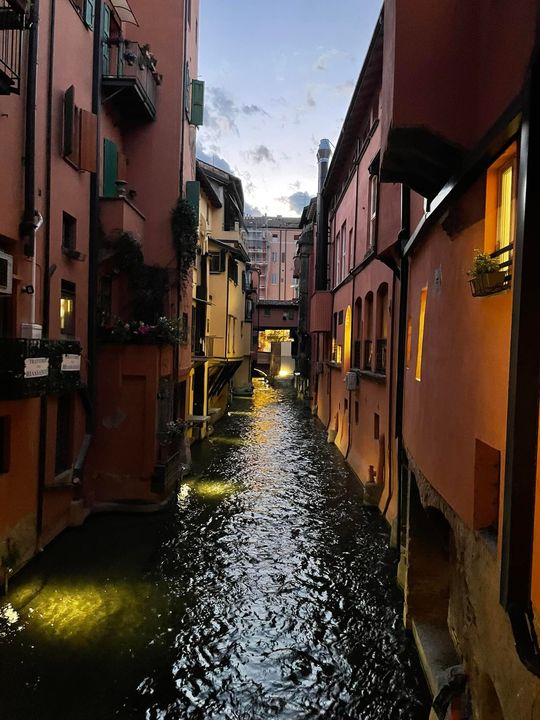
Bologna was strategically located here between the Reno and Savena rivers. It’s always about being near water for food, trade and manufacturing. The rivers were gradually covered over thanks to urban sprawl but some hidden bits can still be seen. This view, through a peep-through window where people line up for their turn to see. We didn’t line up behind the 50 or so people we saw on our way to dinner. But after dinner there were just five people so we waited our turn.
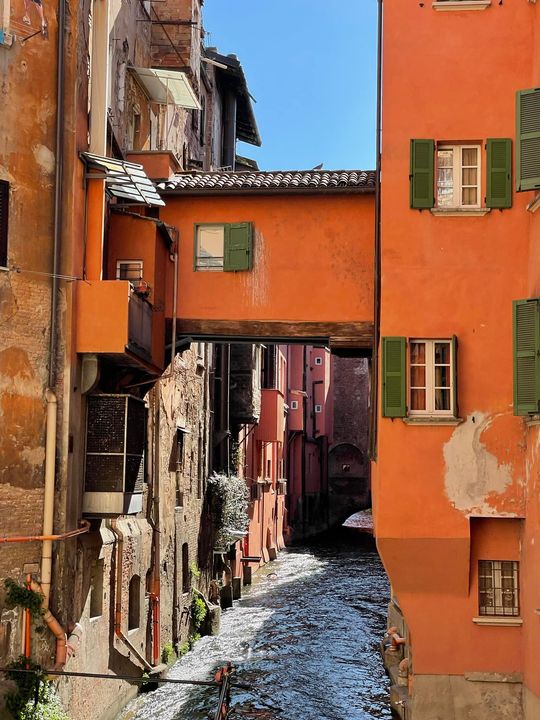
So the next morning, we happened upon this scene… look deep into the centre of the picture. Notice the brown brick at the very back. Notice the little window at the bottom of the brick, under the arch. That’s where everyone is lining up to peek through at the old river canal.
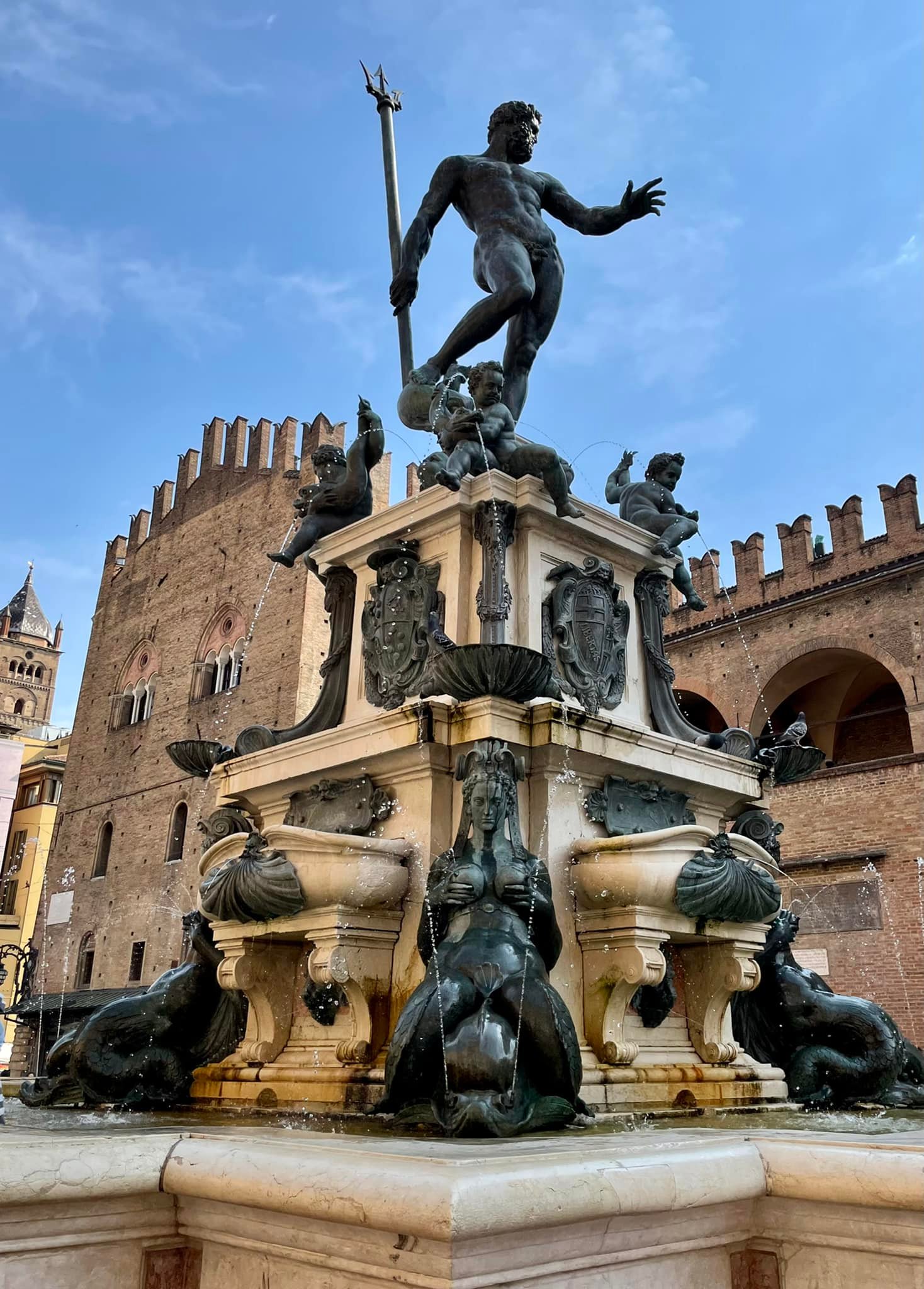
In homage to the abundance of water, this fountain in honour of Poseidon sits at the entrance to the Piazza Maggiore. Water comes from everywhere, including the breasts of the four not so graceful sea nymphs at the base of the fountain. Apparently this fountain is still fed by the water from the now underground rivers.
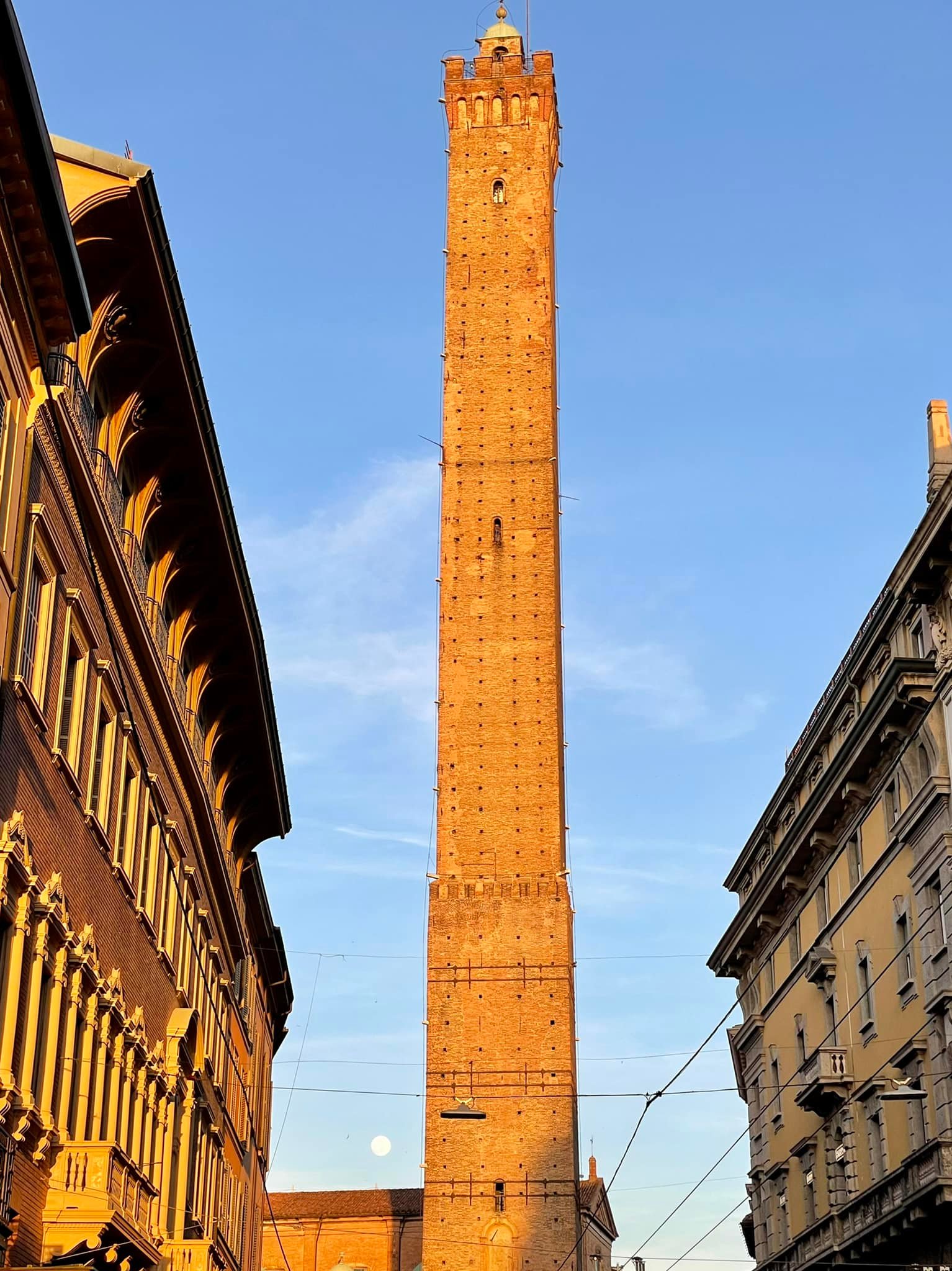
At the city's peak (12-13th centuries), there were 180 towers in Bologna, built by the wealthy to show off their power but they also served as a means of defence. This is the moon rising up beside the Asinelli Tower, the city’s tallest at 97 metres.
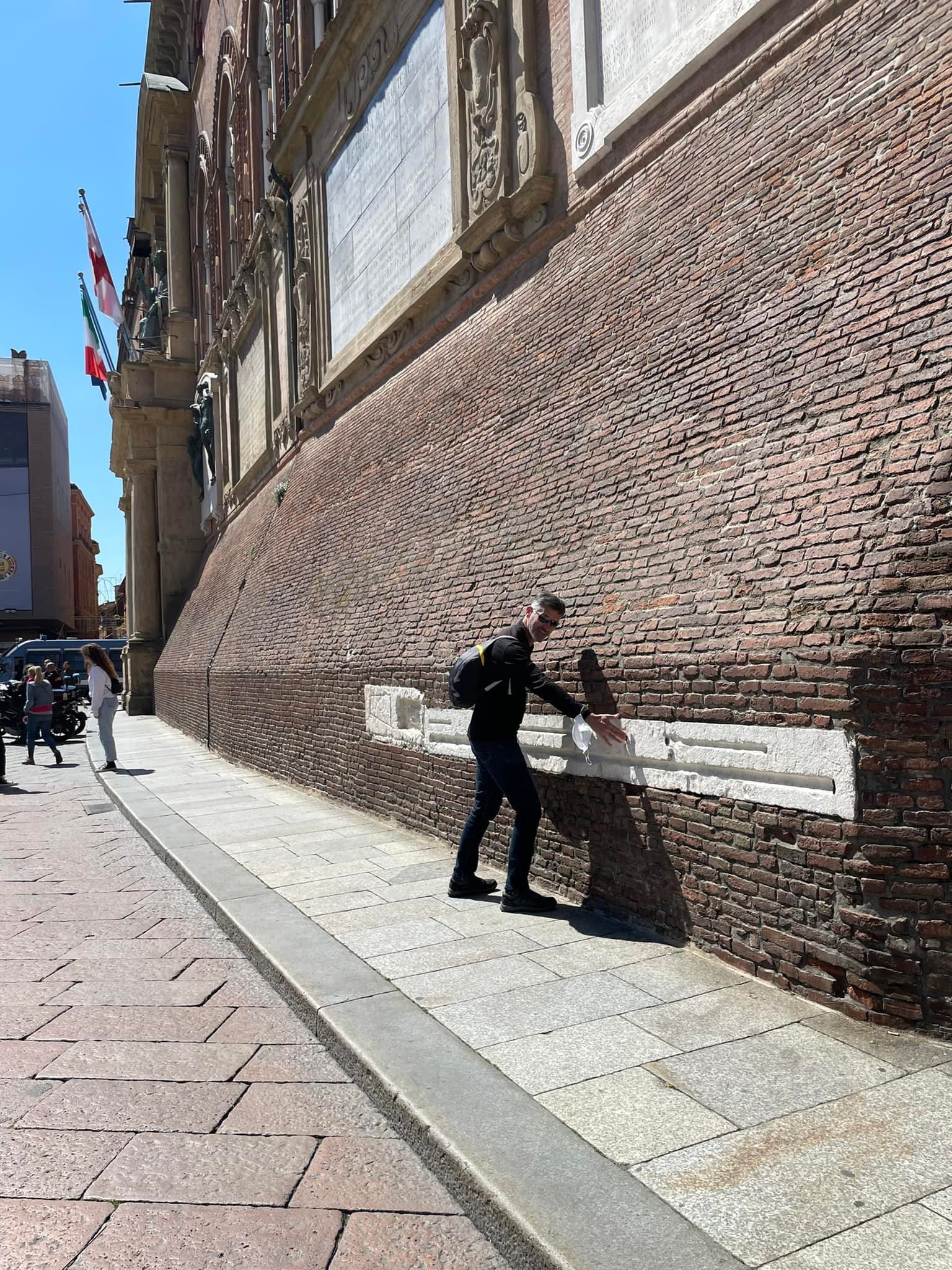
The Pietre di Paragone are unnoticed markings in squares in Italy to show the dimensions of local measurements to avoid any confusion in trade. These were used until 1861 when Italy adopted the metric system.
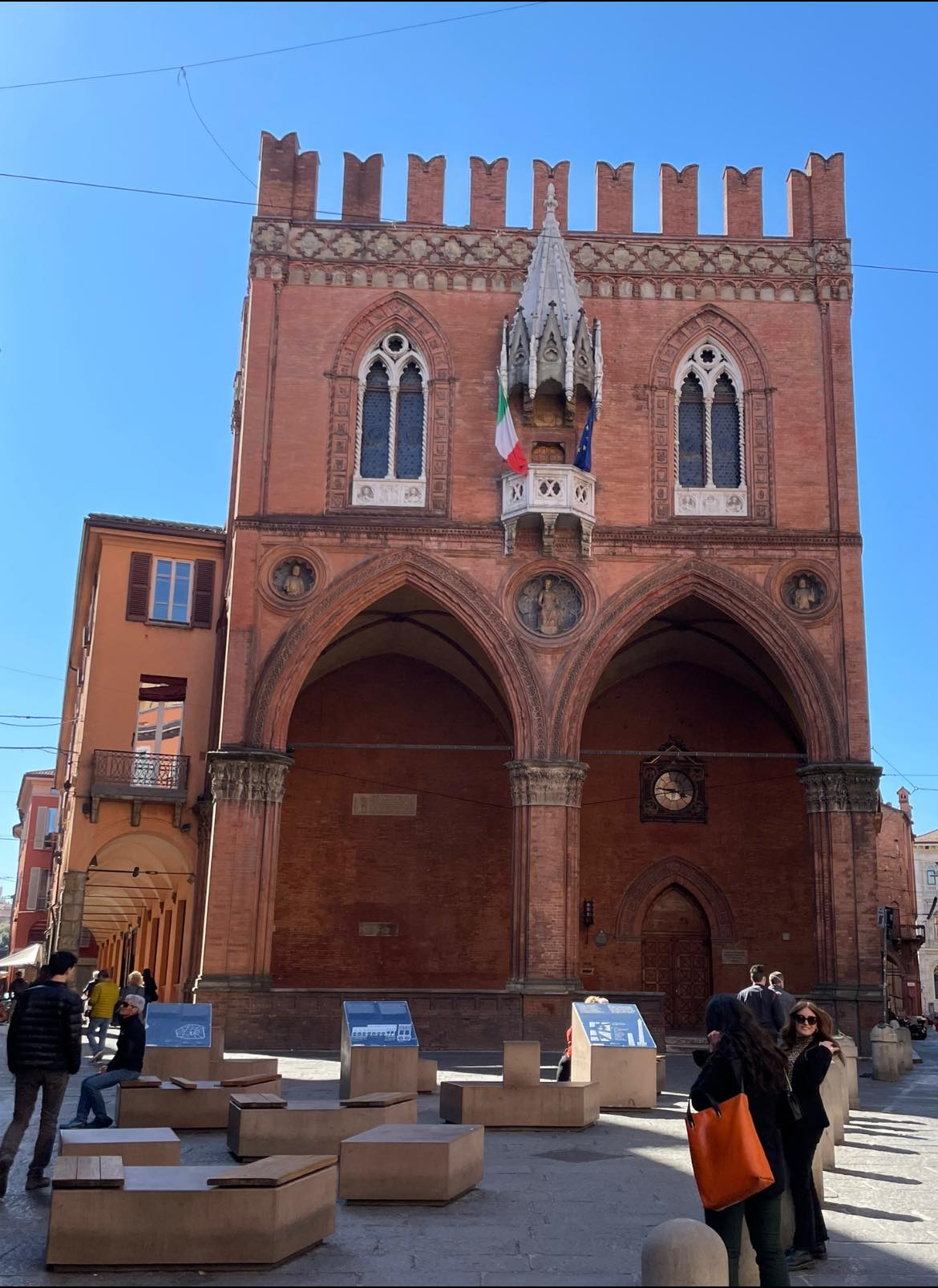
Piazza della Mercanzia is the Chamber of Commerce. Note the white balcony in the centre. This is where the sentences of merchants accused of dodgy business would be read out. If the merchants were found to be guilty of bankruptcy, they would be tied to a stake in the front of the building and subjected to public ridicule.
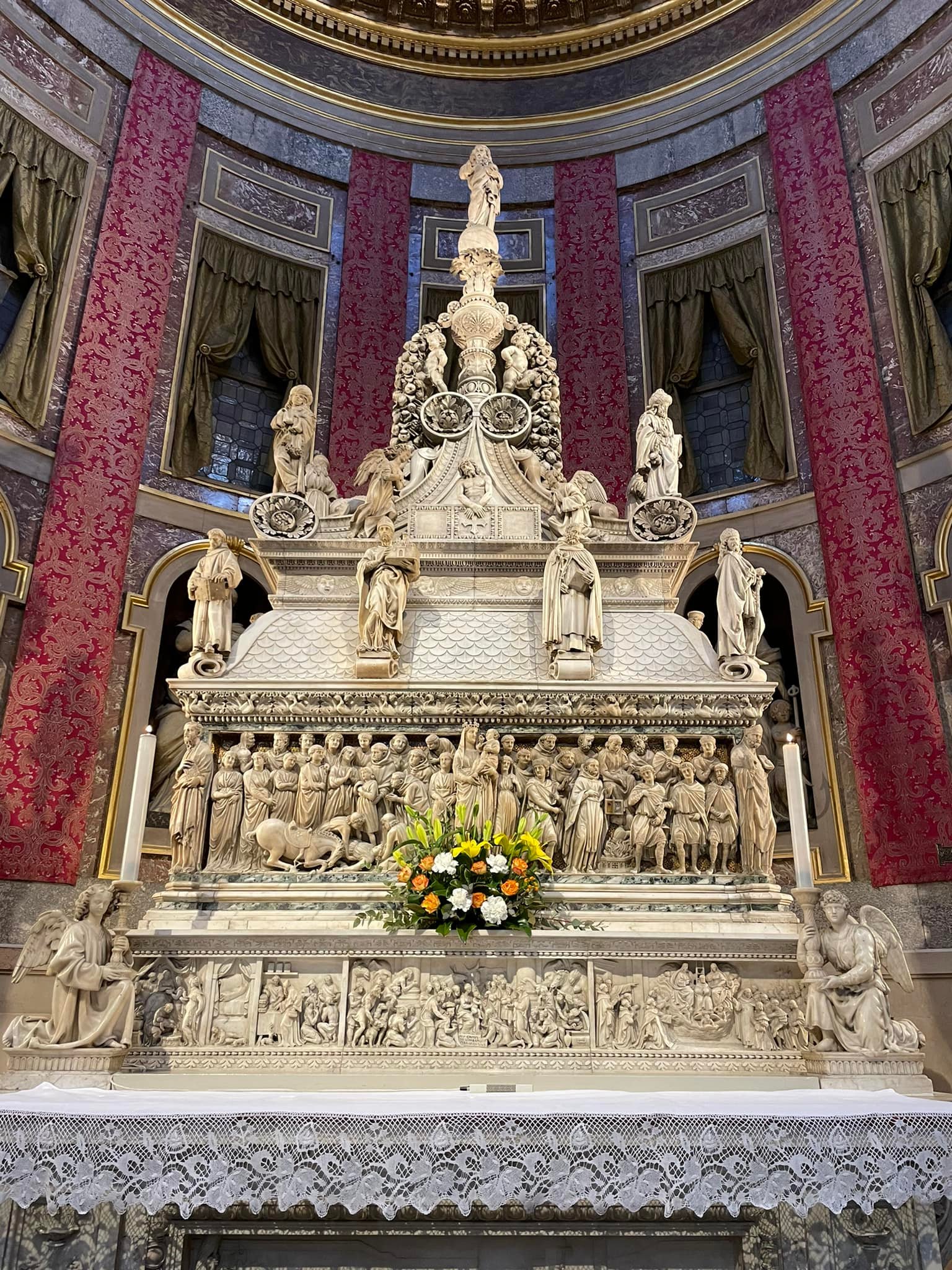
St Domenic’s Chapel in the Basilica San Domenico. Most of St Domenic is buried in the Ark of St Domenic. This very elaborate sarcophagus has a few special treats. Three of the statues are the work of a very young Michelangelo.
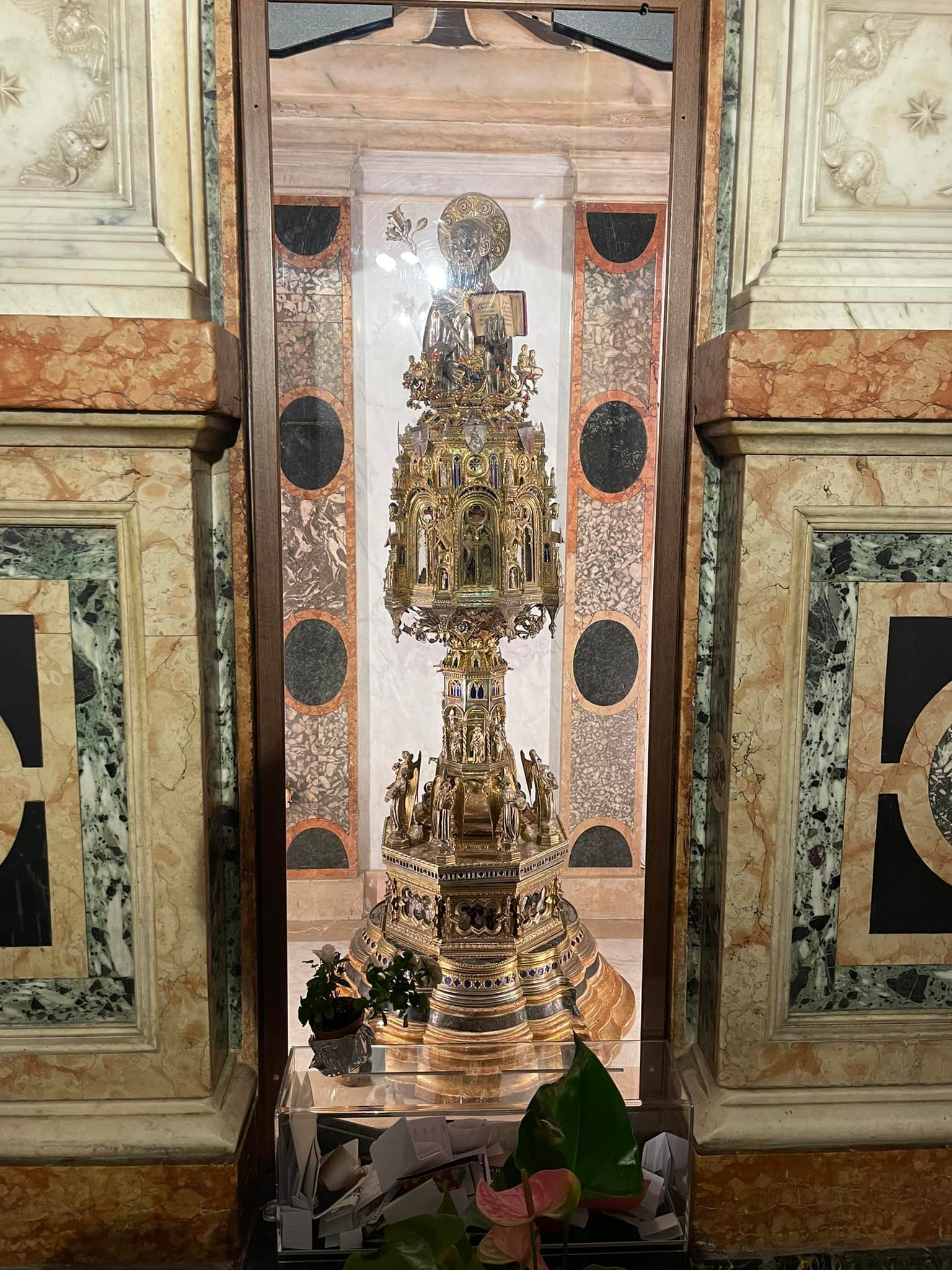
So I mentioned that most of St Domenic’s remains were in the sarcophagus. What’s missing is his head. Zoom in on this photo of the reliquary. Look in through the window 3/4 of the way up and notice St Domenic’s skull looking out at you!
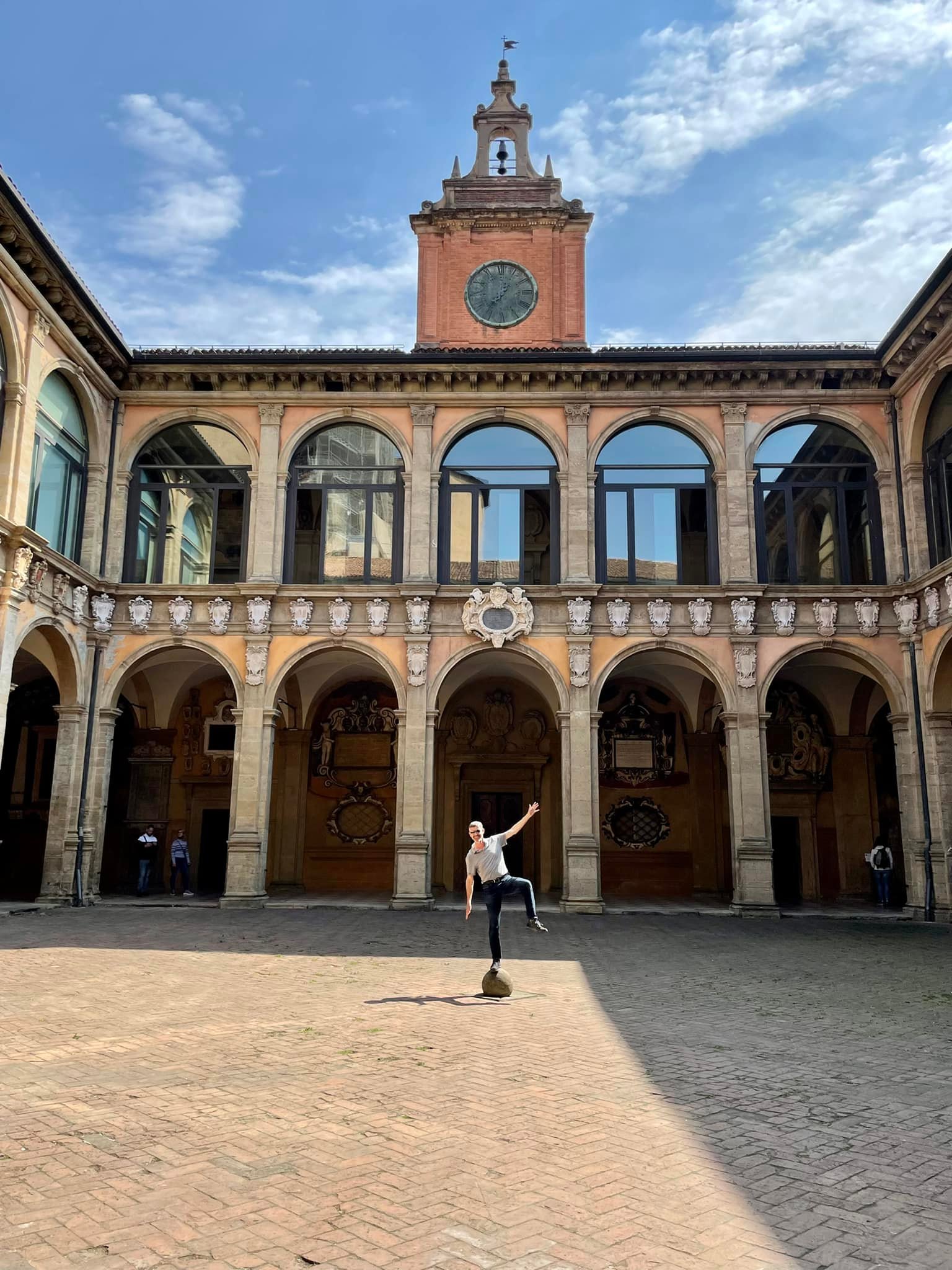
The courtyard of the Archiginnasio of Bologna which once housed the university. It is now the site of the med school’s anatomical theatre and the Archiginnasio Municipal library. This must have been taken during recess.
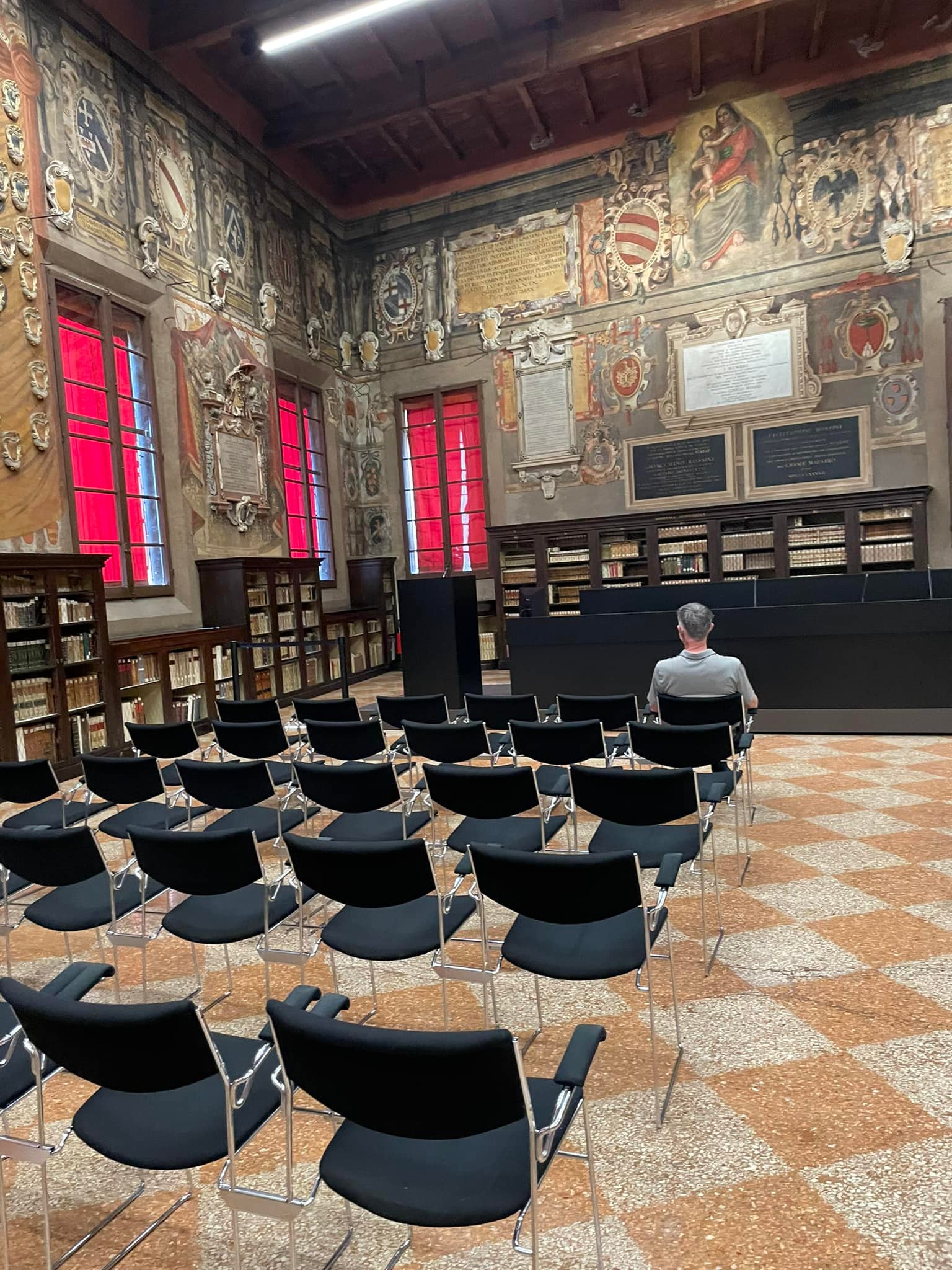
Front row keener. Can you imagine trying to concentrate in class surrounded by all this artwork!
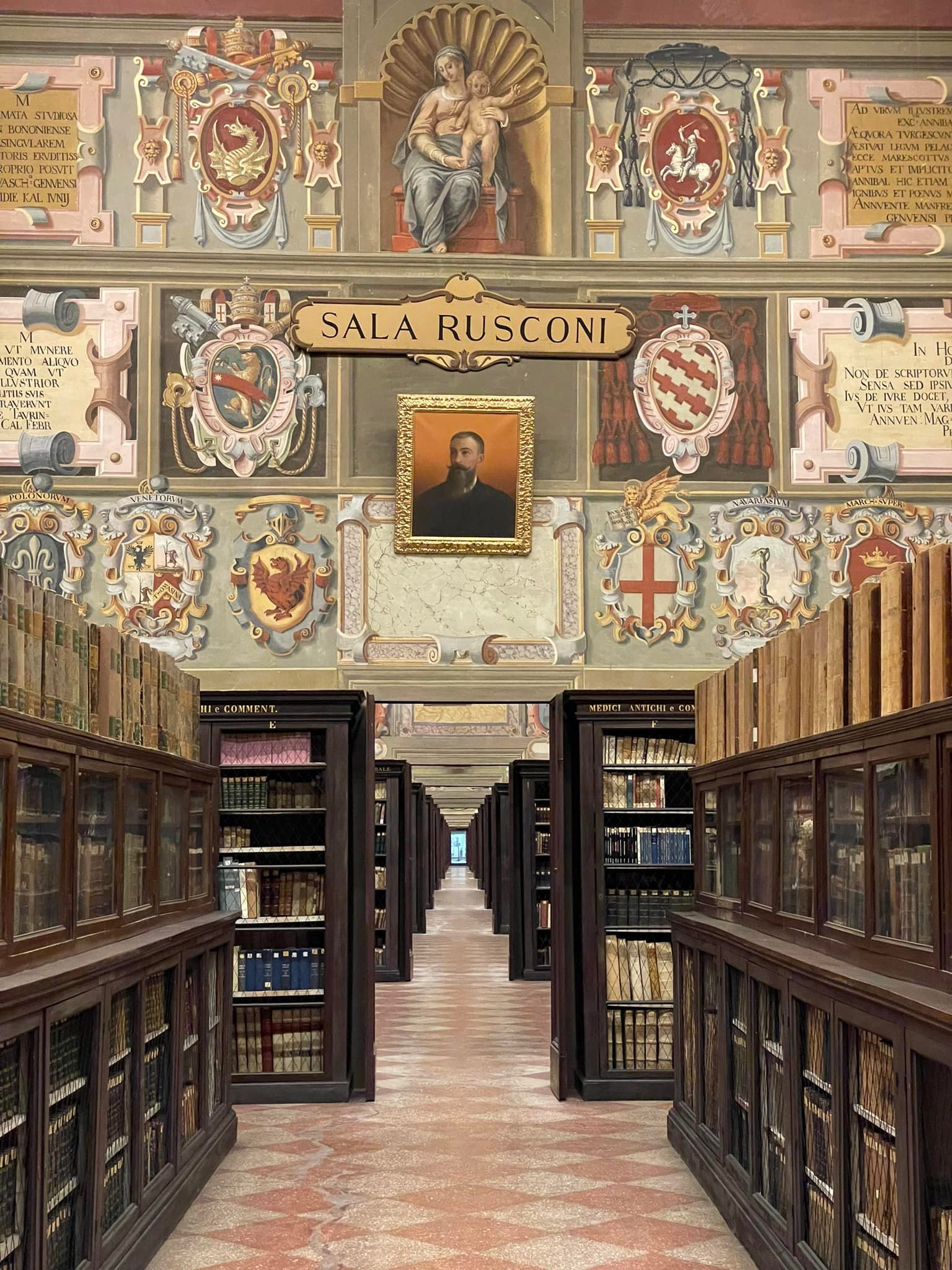
The Municipal Library full of ancient texts.
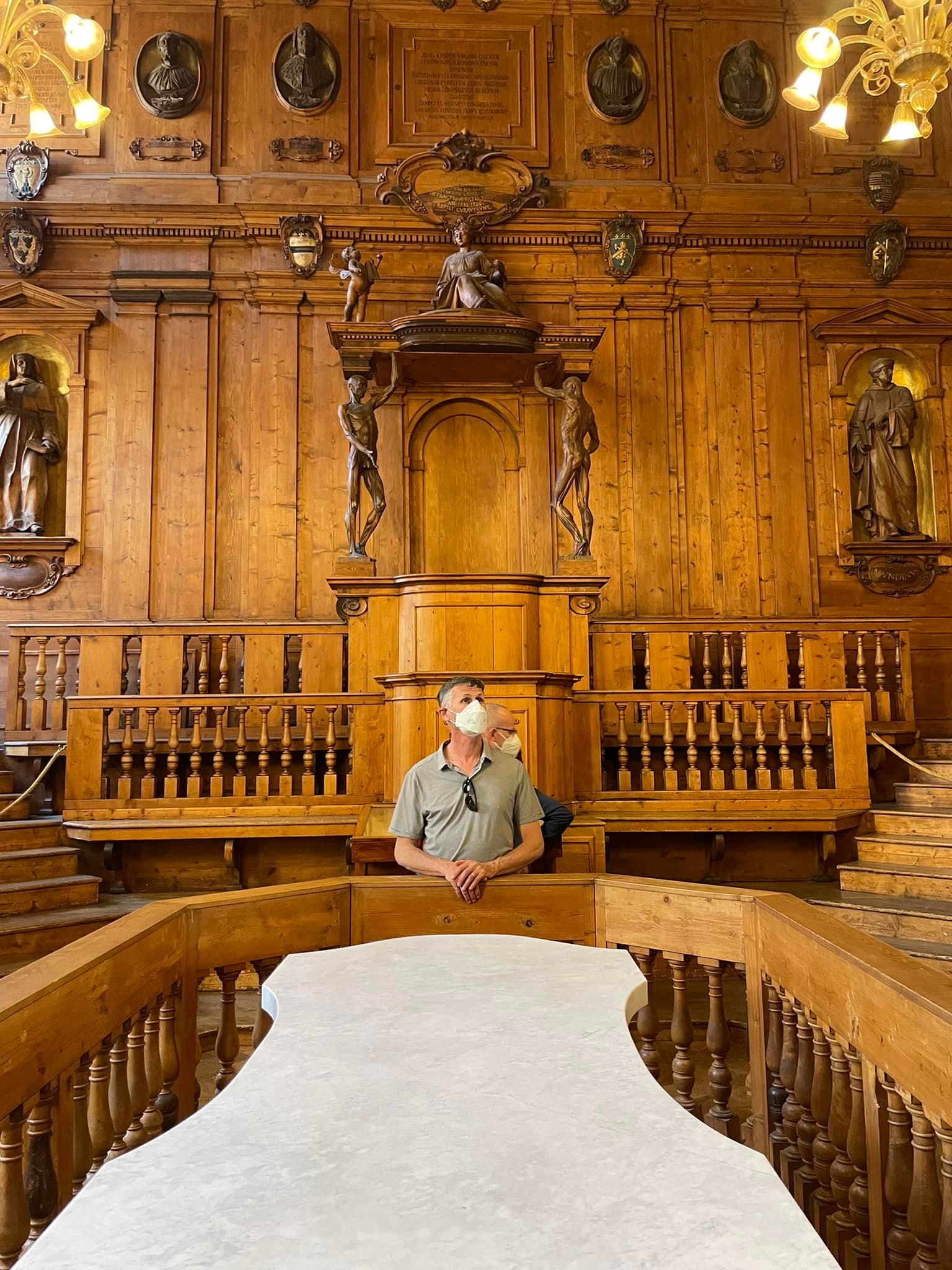
The anatomical theatre. I guess this is where dissection demos take place.
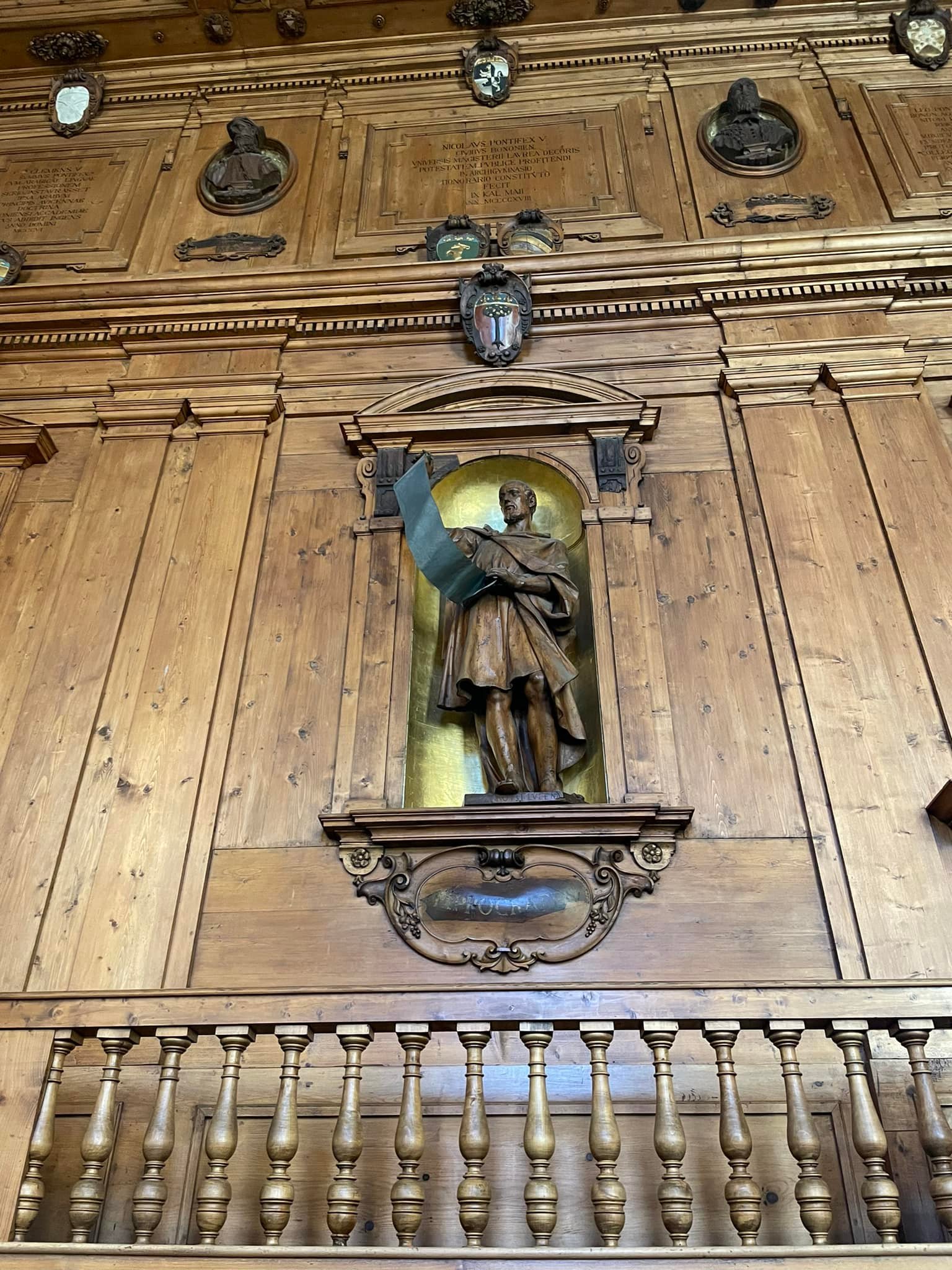
Statues of famous doctors surround the room. Here is Hippocrates.
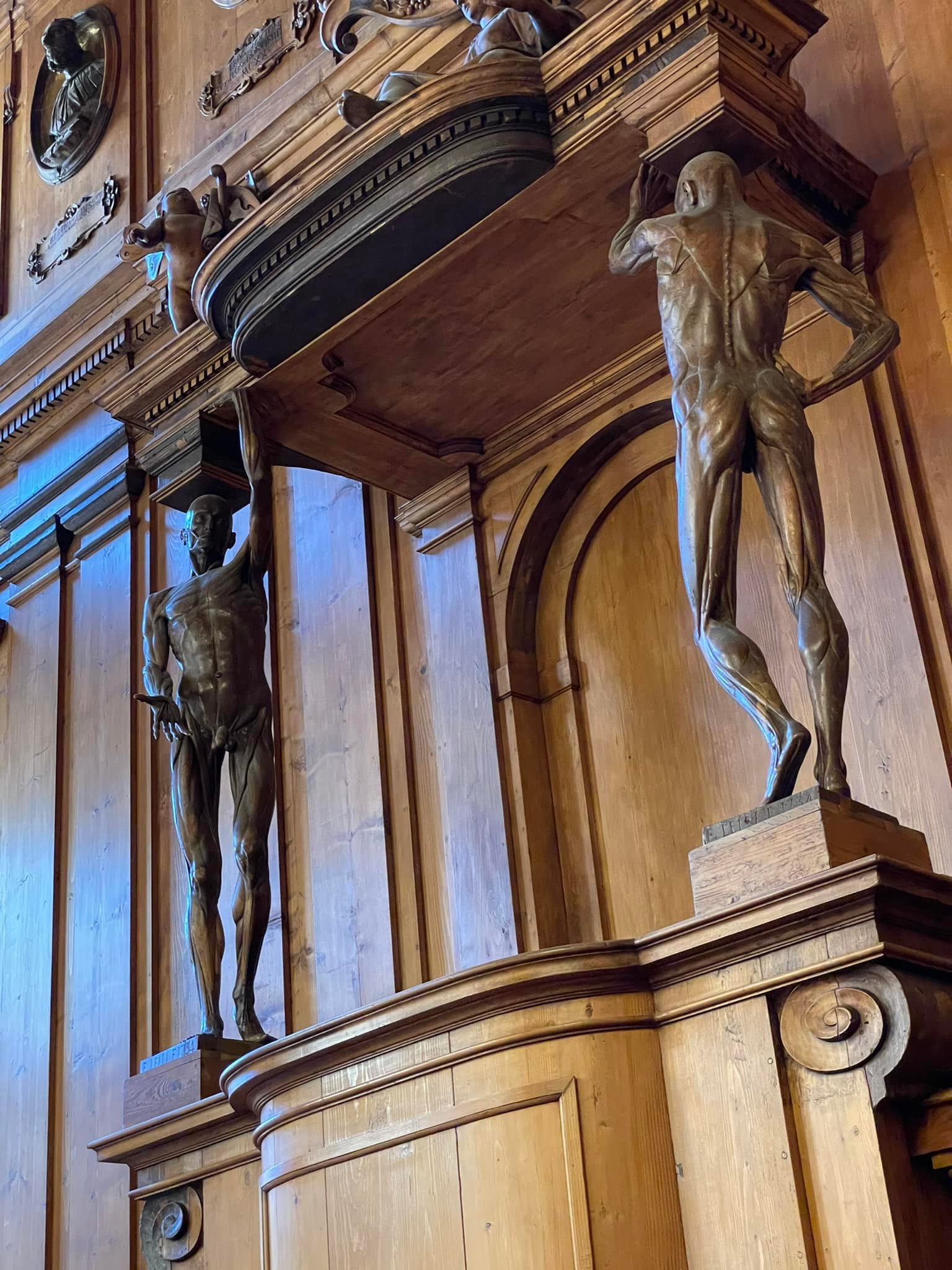
Above the front lectern with skinned statues in case you need some anatomy prompts.
May, 2024
Bring on Bologna
I said it the first time we visited Bologna, and it took two years to come to fruition, but I am back in Bologna to learn Italian!
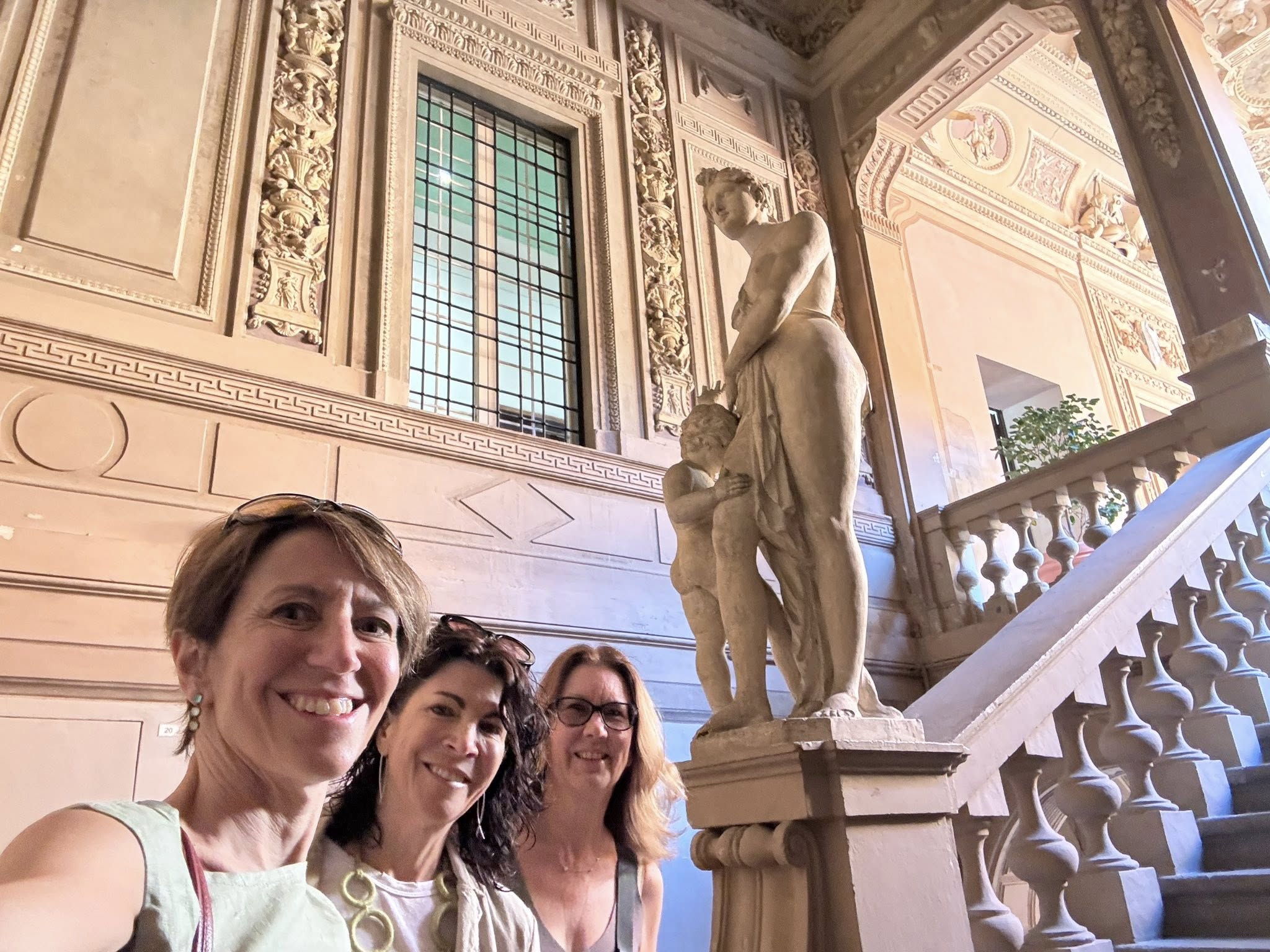
We had to get a First-Day-of-School photo! Who gets to go to a school in a historic building with statues adorning the staircase? We do! We spent three glorious weeks at Academya Lingua and I can’t wait to go back! What a way to learn! The school was amazing, the teachers were fantastic and we came away with way more language skills and confidence than we arrived with.
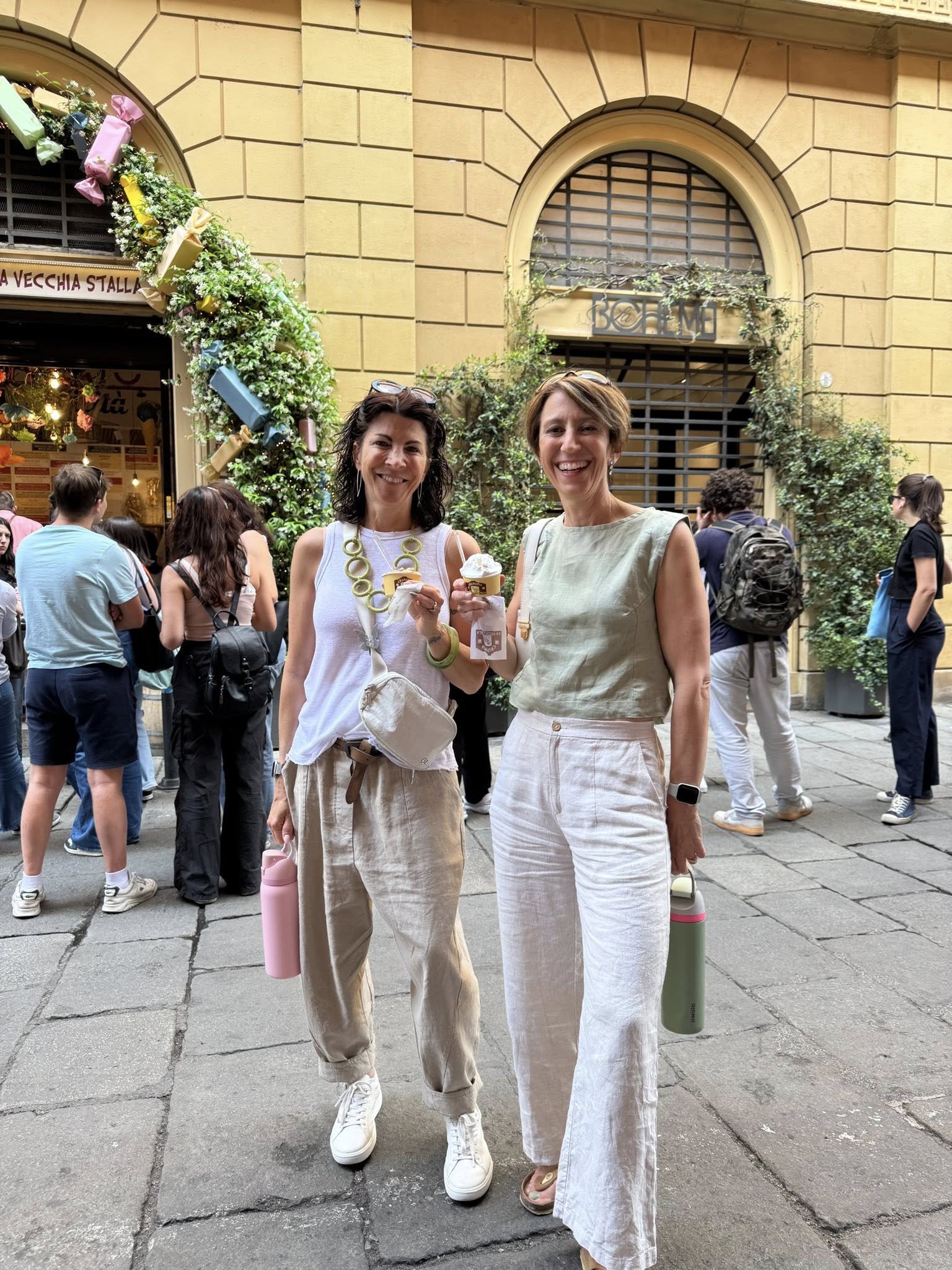
Our studies were not just in the classroom. Not only is the oldest university in the western world here, Bologna is also home to Carpigiani Gelato University and as such is a bit of a gelato Mecca. It became evident that many locals sit firmly on one of two teams: Team Cavour and Team Santo Stefano. This was clearly an invitation for further study. We decided to supplement our language studies with a PhD dissertation on the best gelato in Bologna. Gilly already did one PhD so it was an easy leap into a second one. And this time she had two collaborating researchers! Research design and method were easily established over our first tasting and then very serious data collection and analysis ensued. Sometimes we had to collect multiple samples in a day to ensure fair comparison without the risk of forgetting intricate details. Fortunately there were no ethical considerations involved in this research as we conducted the testing on ourselves. Our results are as follows: the best hazelnut was at Cremeria Cavour, the best pistacchio was at Cremeria Santo Stefano and the best unique flavour, cherry with chocolate and hazelnut pieces, was at Cremeria La Vecchia Stalla. The surprise result was that each one of these flavours is from a different cremeria and there isn’t ONE best cremeria. The conclusion is that when in Bologna, enjoying the best gelato involves a combination of consumption and exercise - one flavour at each location!
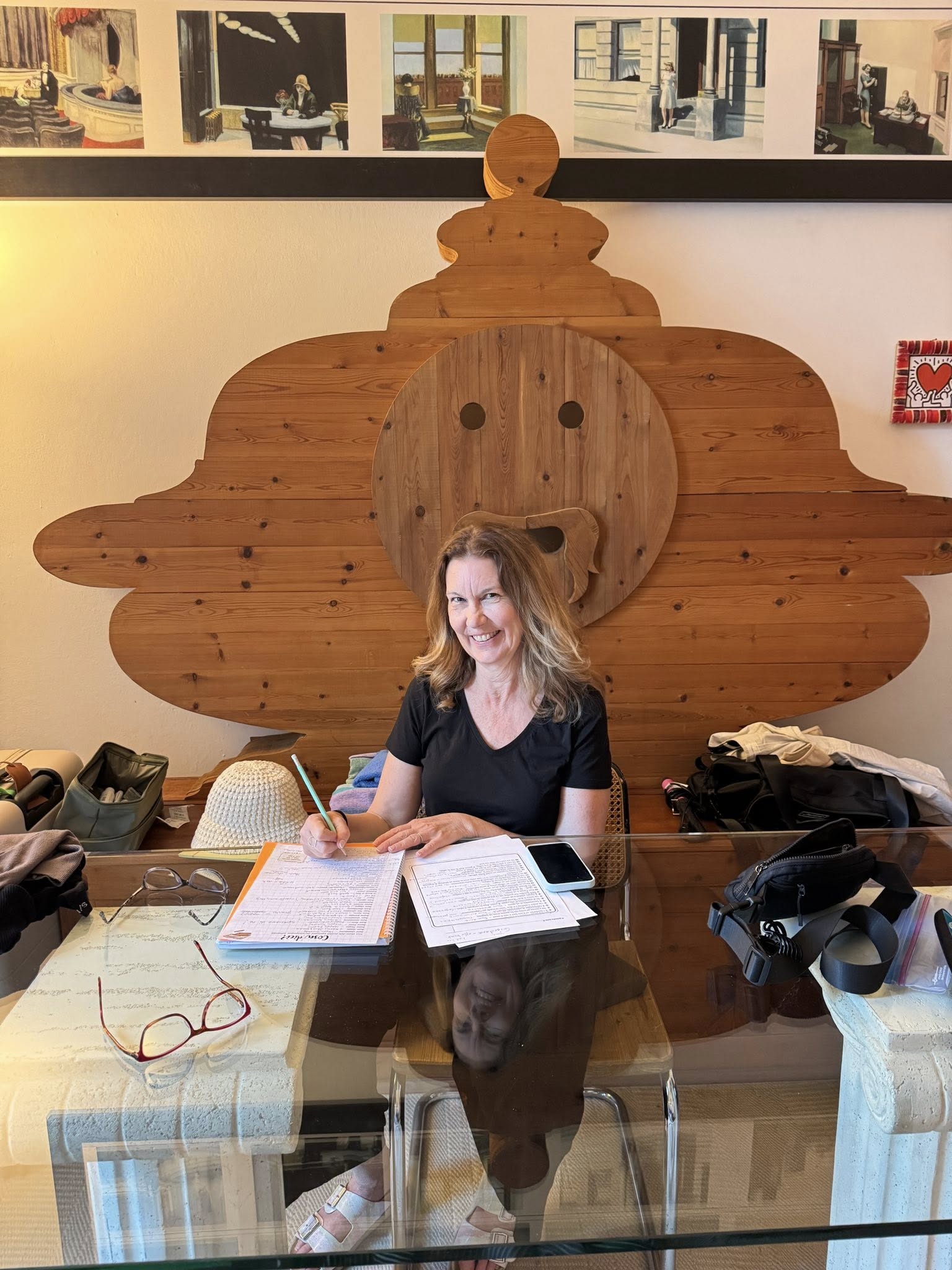
Laurie is very serious about her studies! All that gelato feeds brain activity.
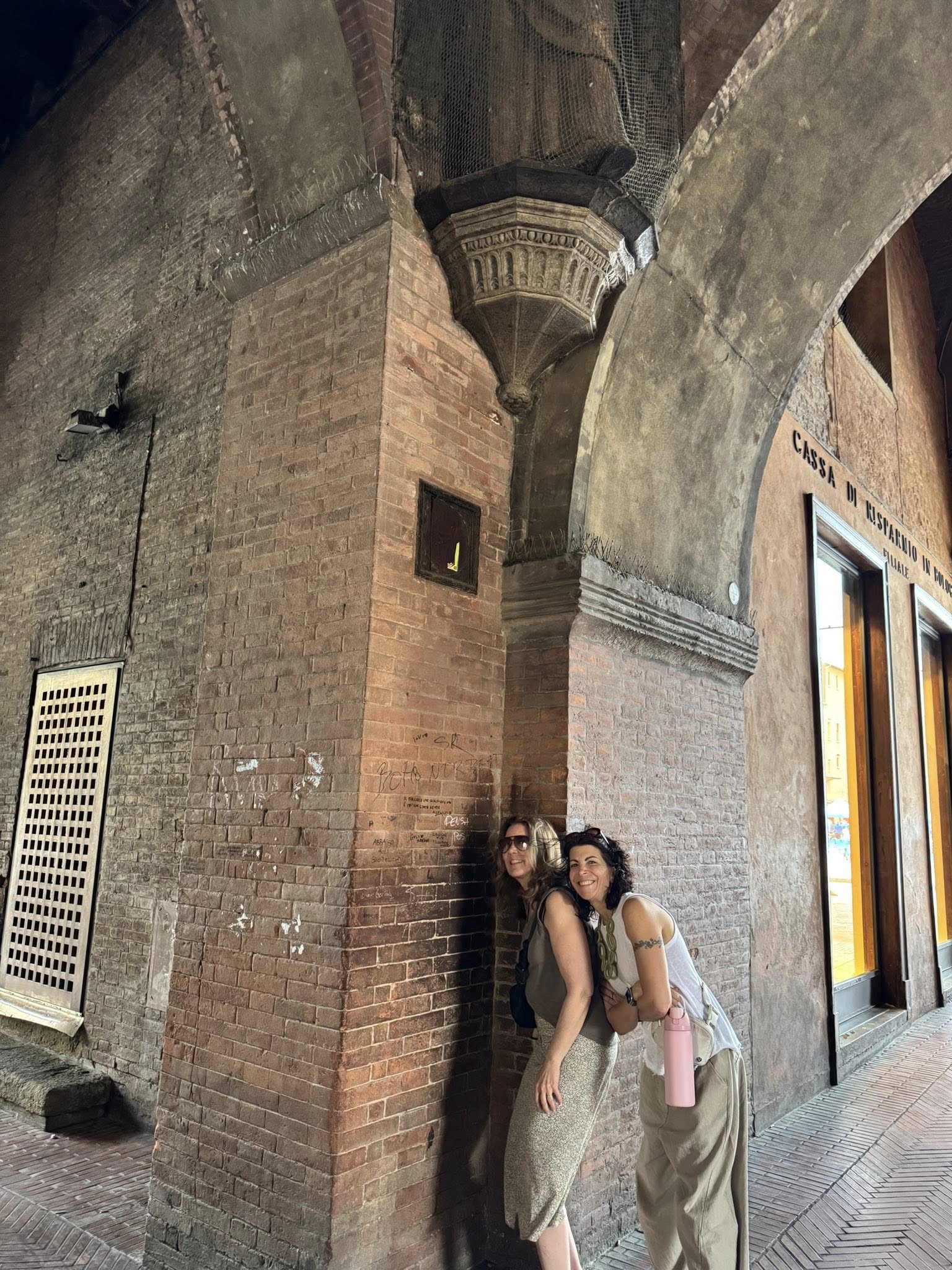
One of the seven secrets of Bologna, The Whispering Gallery has a cool physics trick. If you stand in one corner and whisper, someone in the diagonal opposite corner can hear you clearly. When this vaulted portico was built in the 13th century it was a surprise to discover this unintended acoustic effect. It served the lepers of the time well as they could do confession and not put the priests at risk.
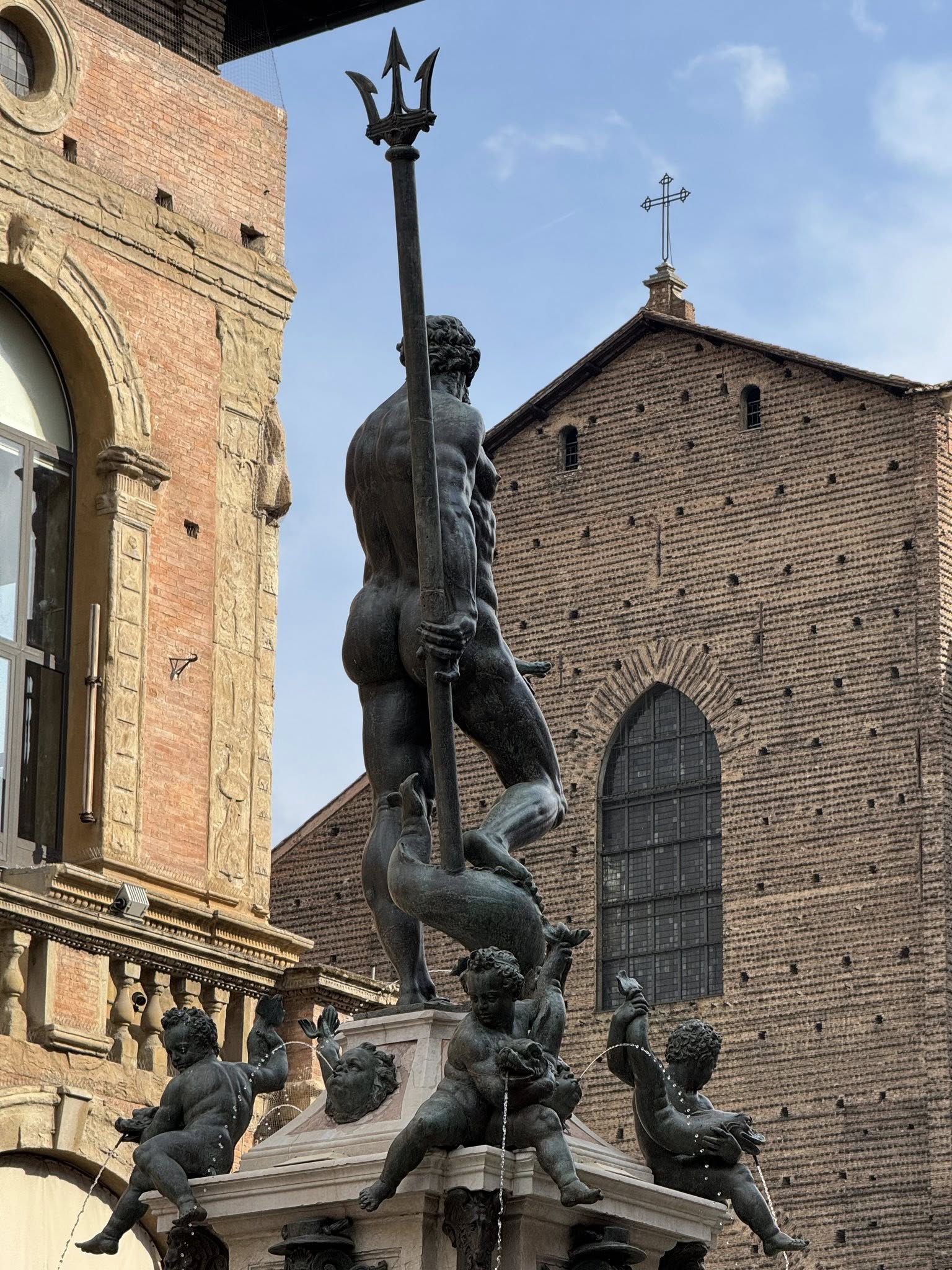
Neptune’s Secret Finger is another of Bologna’s not-so-well-kept secrets. At the right angle behind Neptune’s fountain in the Piazza Maggiore, Neptune’s outstretched thumb looks like…
Was this a cheeky bit of Renaissance humour or a surprising find by a tourist who happened to look that way when walking past at just the right angle?
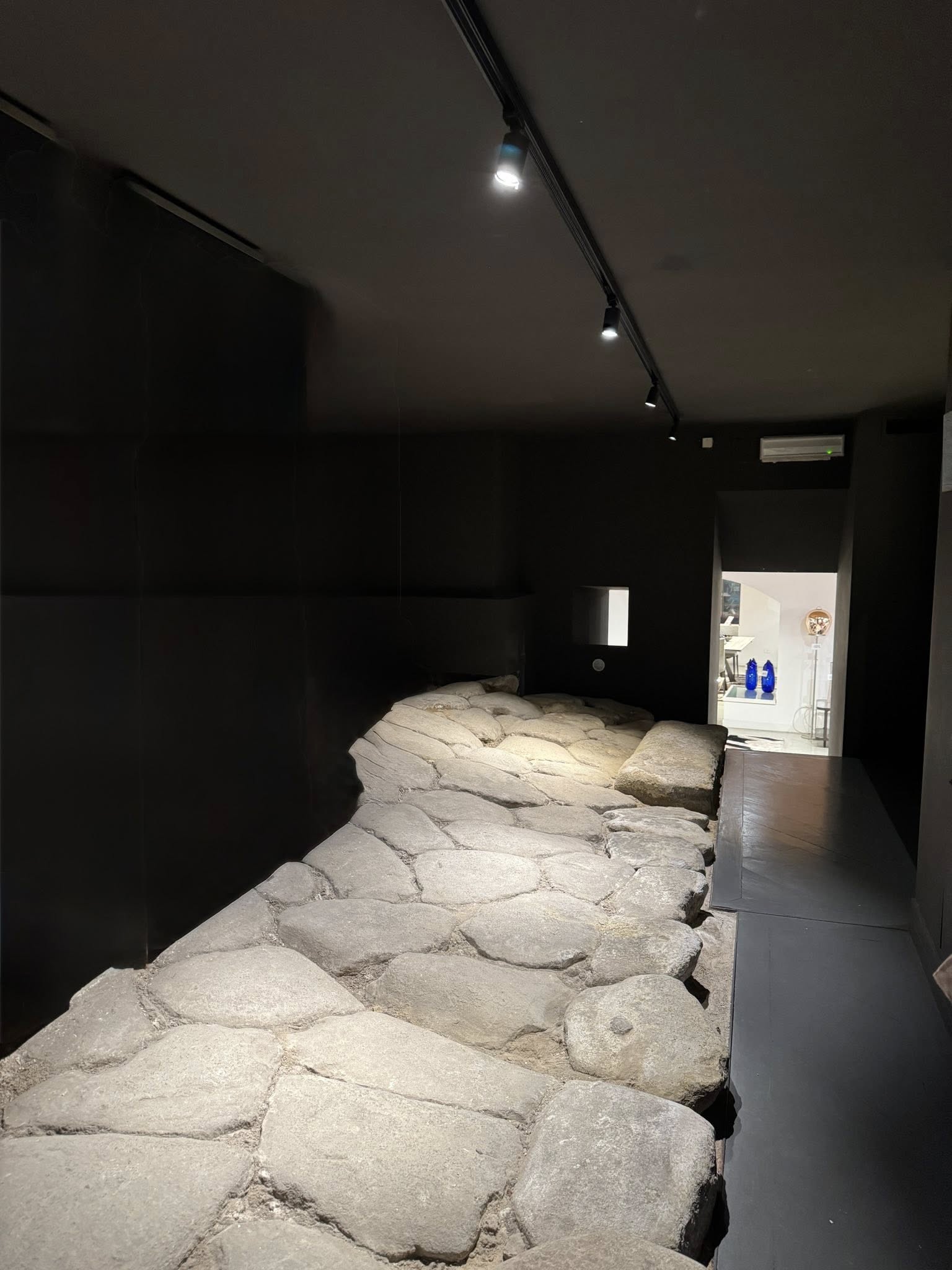
Back during the second century BC Roman Empire, Bologna was called Bononia and was conveniently located along the route between Rimini (on the coast) and Piacenza. As with much of that era, old roads and buildings were covered with new ones as society and cities modernized. When doing some renovations along a retail stretch in the early 2000s, the road between Rimini and Piacenza was discovered under the site of what is now a Roche Bobois store. The city decided that if the store wanted to keep this location, it had to provide access to anyone who wanted to see it, regardless of their shopping intent or lack thereof. So here it is, the part of the ancient Roman road network that connected the empire, in the basement of Roche Bobois!
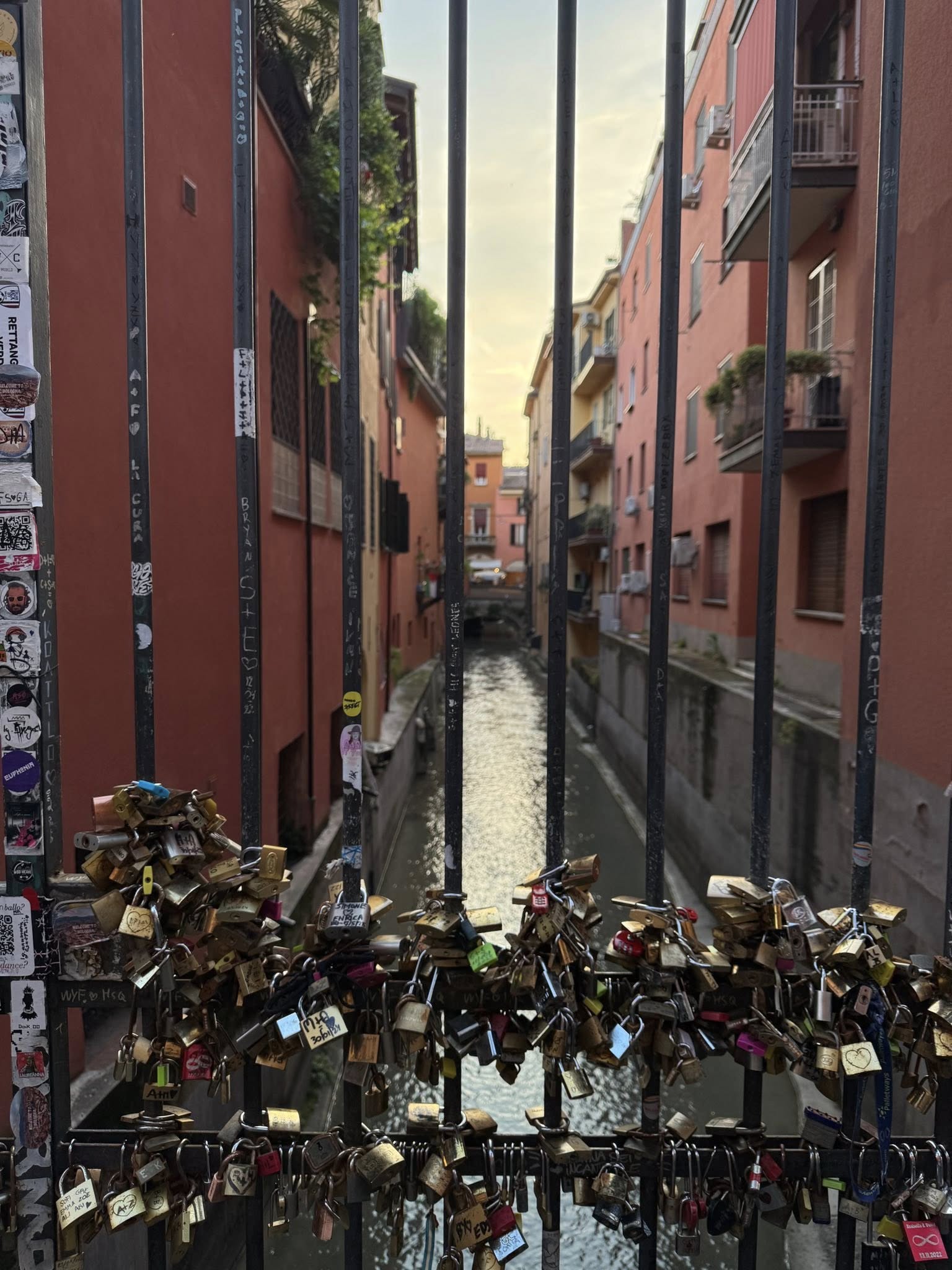
The canale delle Moline is part of the old network of canals in Bologna and is at the end of our street (it's already sounding like Bologna is our home away from home!). These canals were built during the 12th-16th centuries for agriculture, sanitation and to move goods, especially from the silk mills (moline means mills). In medieval times, Bologna was a major silk production hub with over 100 mills powered by these canals. There is just a bit of the original 60 km network of canals still visible. One day I walked past this one and it was completely drained! Turns out they do this occasionally for repairs, maintenance and cleaning (I’m sure they can get pretty stinky).
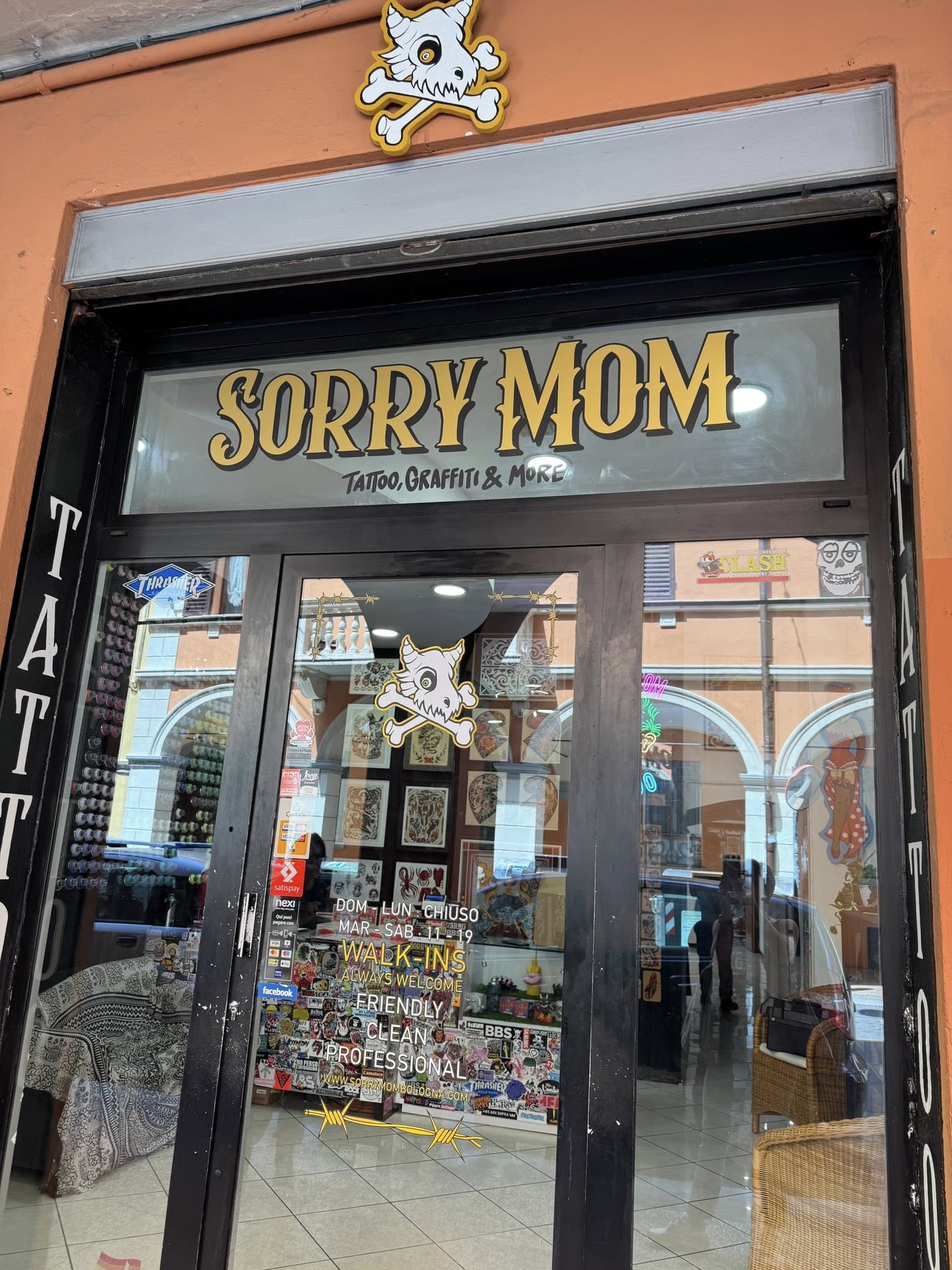
A very apt name for a tattoo parlour.
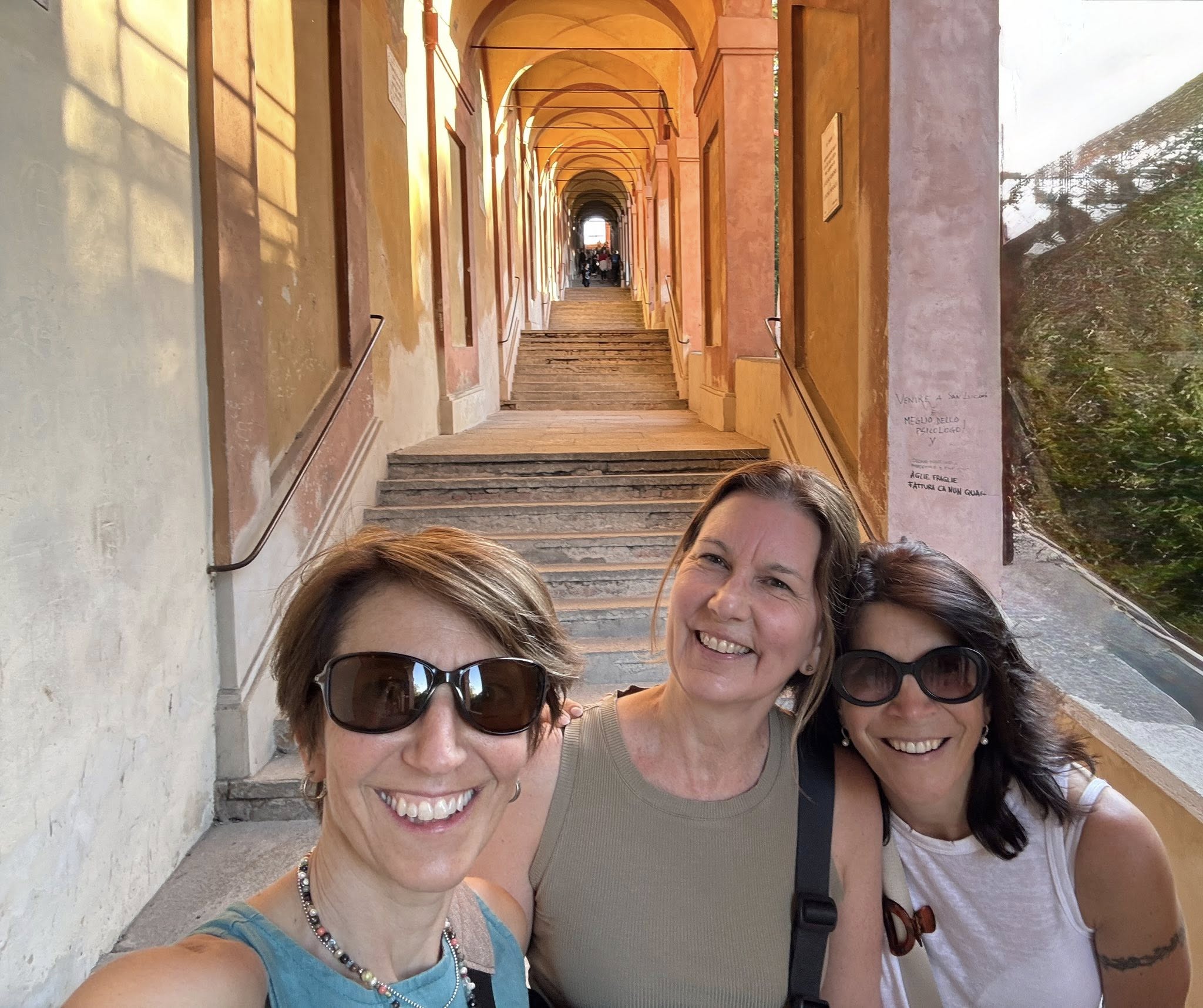
The longest portico in Bologna, and the world, is the Portico di San Luca. Built between 1674-1793 to protect religious pilgrimages to the San Luca Sanctuary, this special place is 3.8 km long with 666 arches (a dodgy number if you ask me for a path leading to a Catholic basilica) and 489 steps up. No wonder it’s now used for a workout, in addition to the odd pilgrimage!
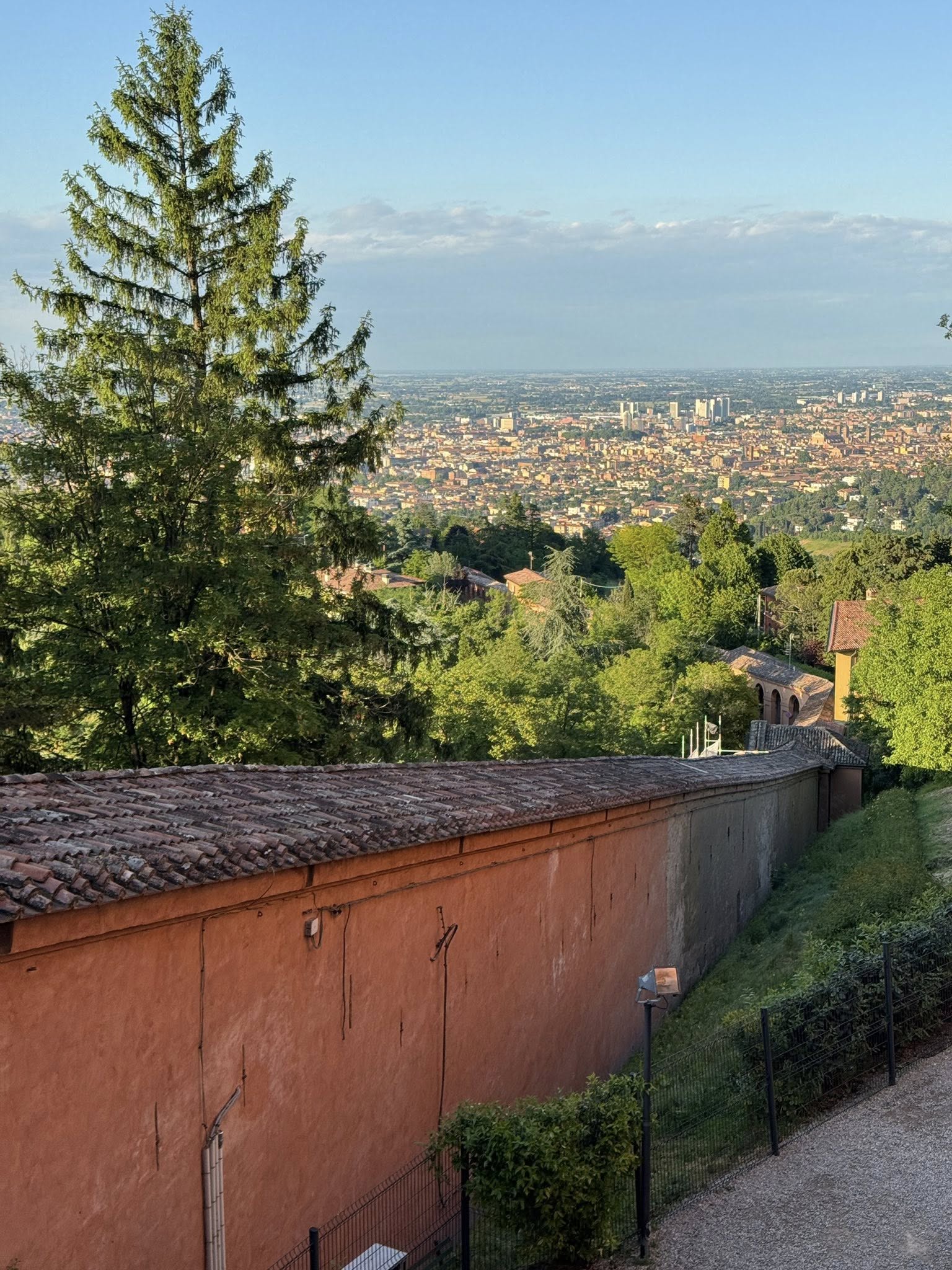
The top of the Portico di San Luca overlooking Bologna.
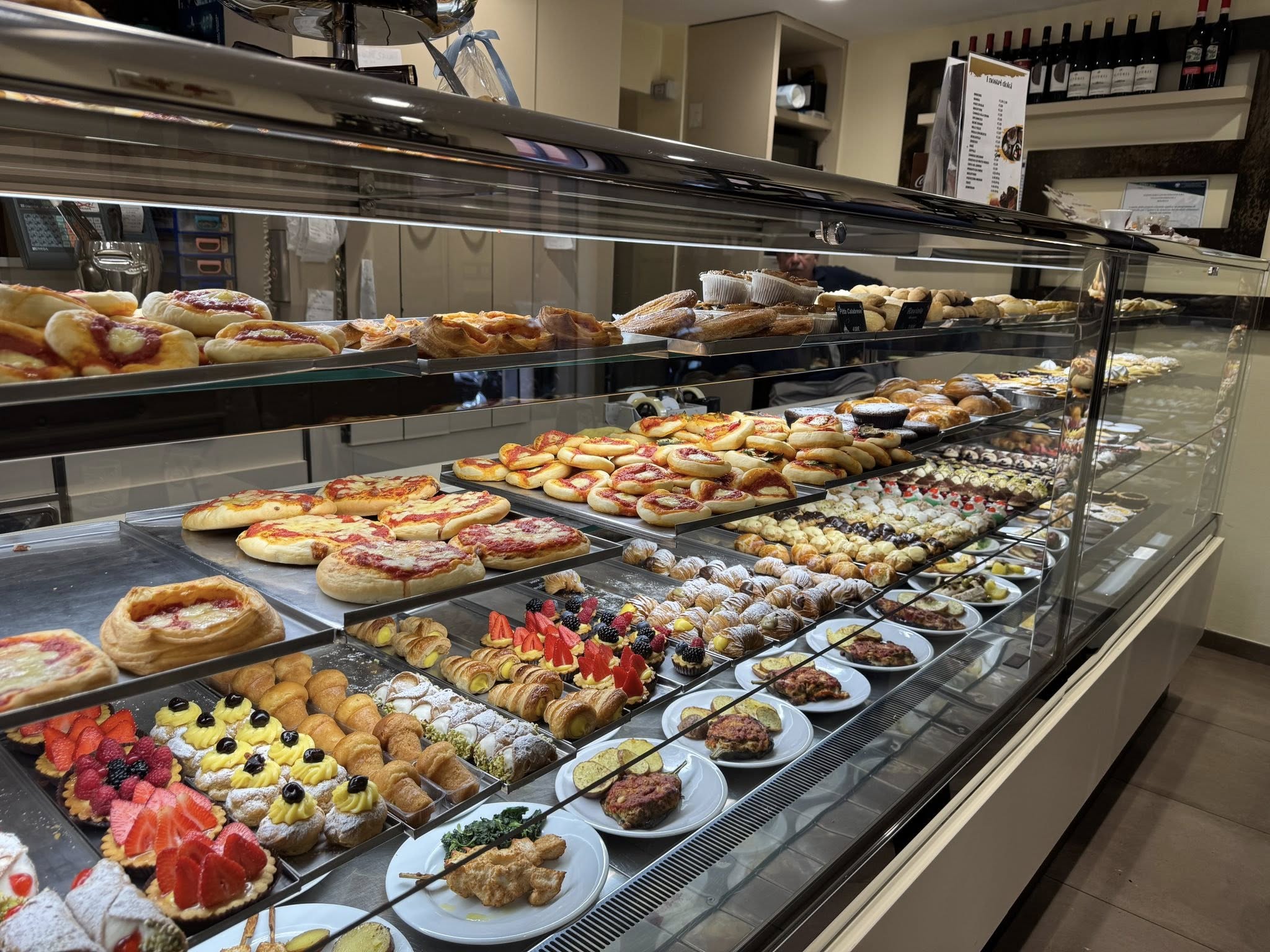
Every day, during our school's morning coffee break, we were faced with this!
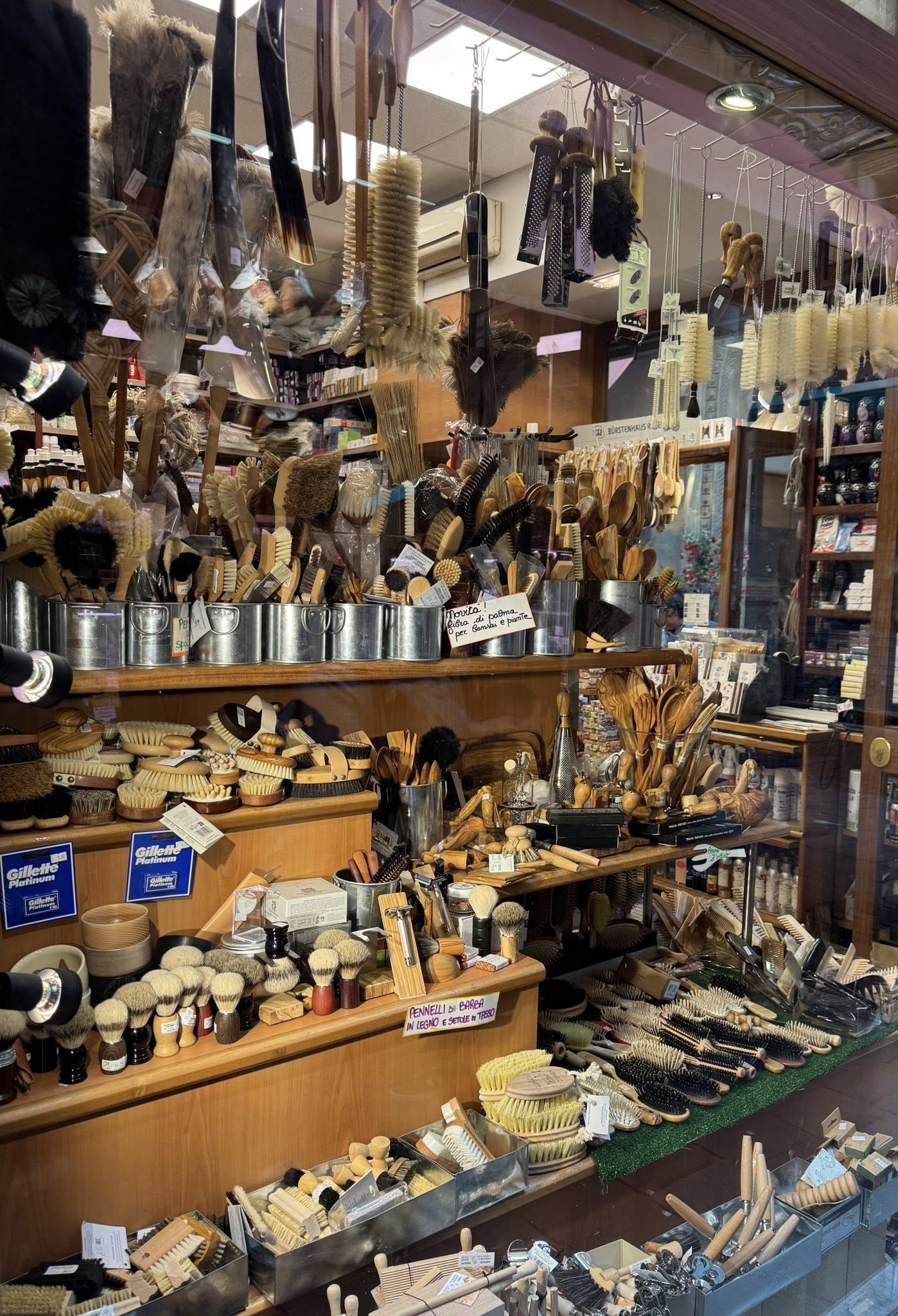
Not sure what the name of this shop is but it could be Brushes R Us. Every imaginable kind of brush can be found in here!
It seemed like a good idea at the time to do a cartwheel under a portico…glad I can still do it now that I’m pushing 60!
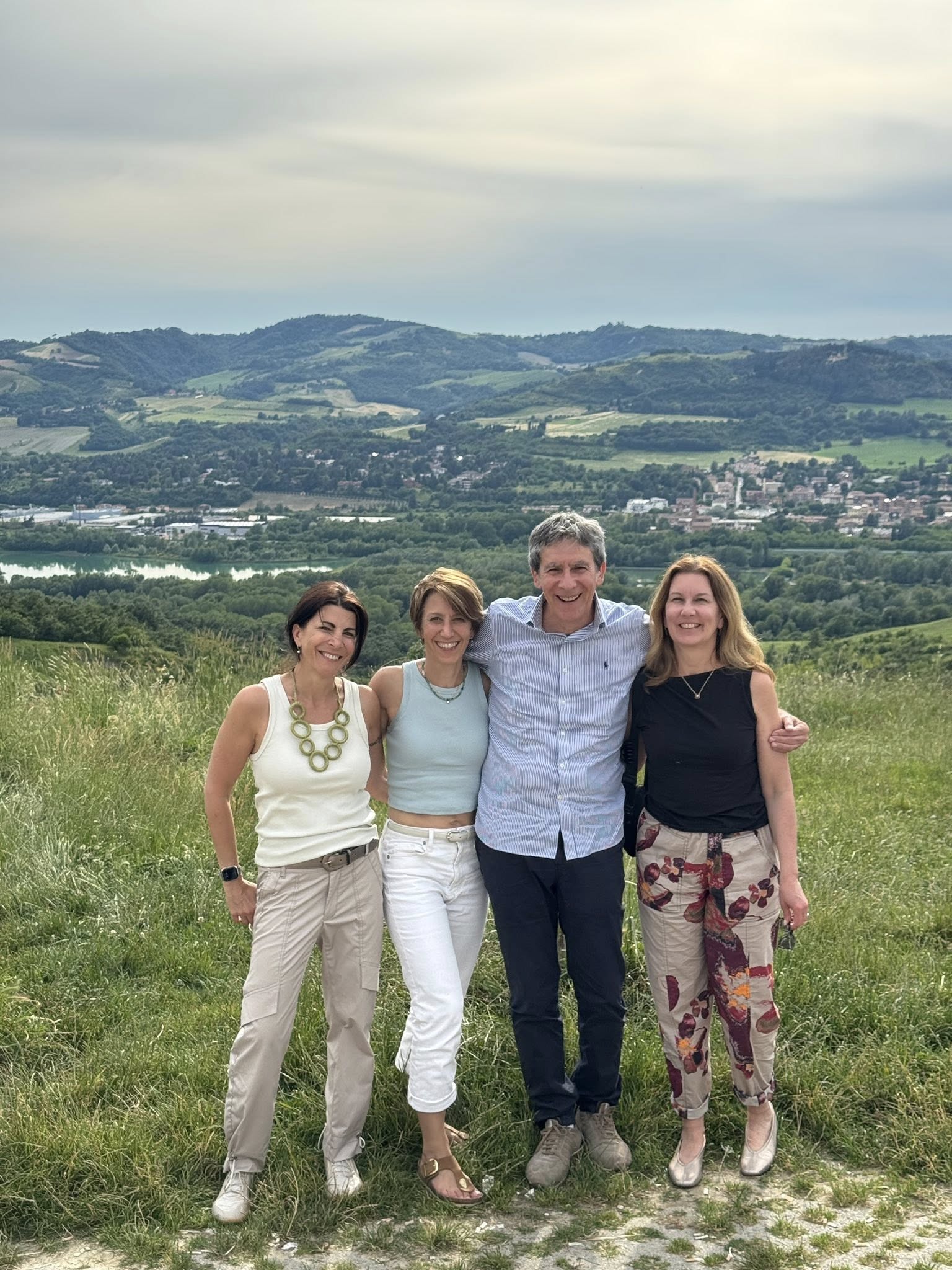
Fabio! We had such a lovely time with Fabio during our stay in Bologna. I met Fabio last November in Piemonte. He and his family were staying at the same wine estate near Alba as Adam and I. We got to chatting and it turned out he lives in Bologna and was up in Piemonte visiting his childhood best friend who owns the winery we were staying at. We stayed in touch and got together several times; we went out for aperitivo and a few dinners, we cooked together at his house…this photo was from a drive around the hills surrounding Bologna.
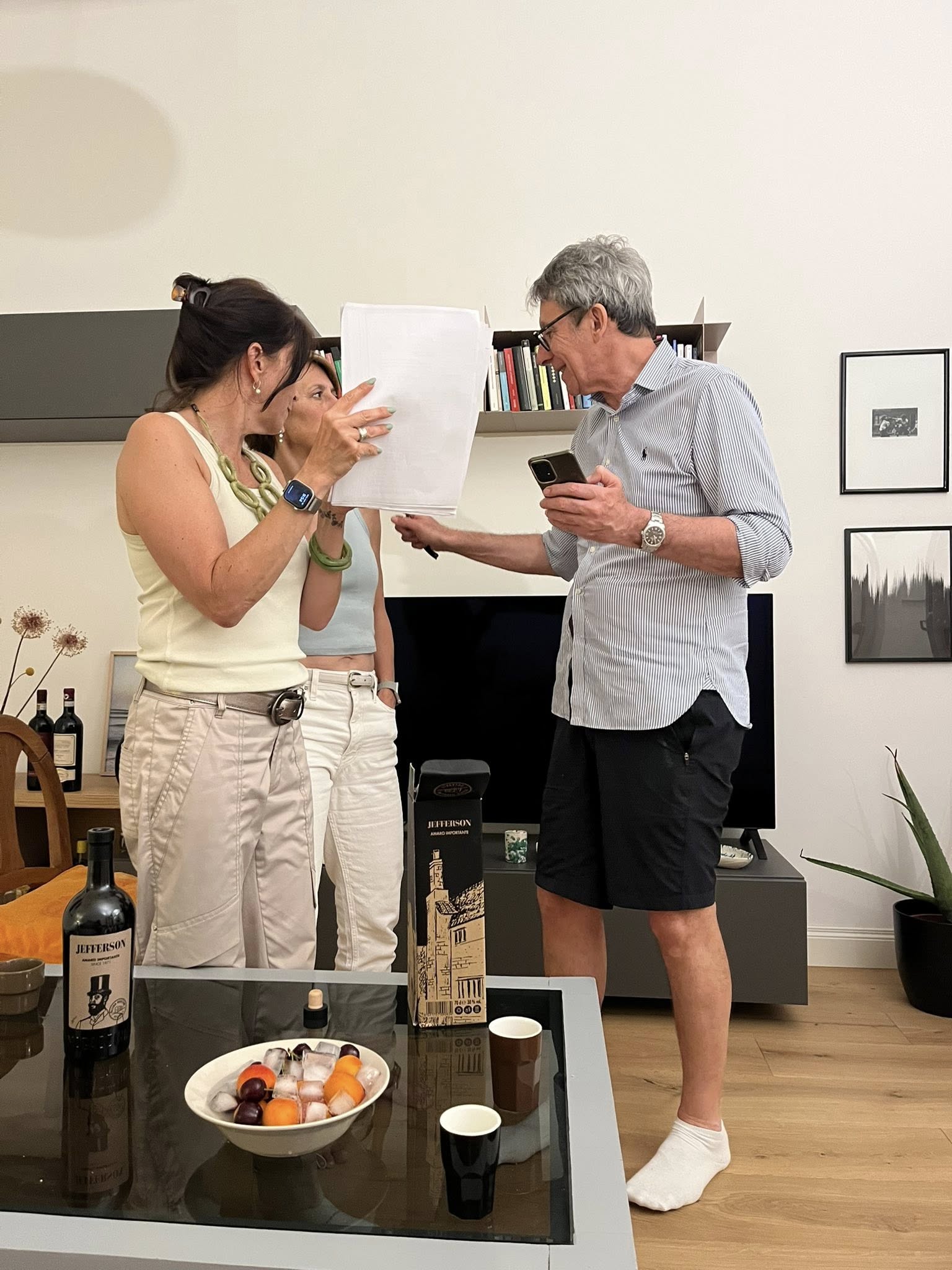
Fabio was even called in for some homework help! He doesn’t speak English but his French is excellent so sometimes that became our language bridge.
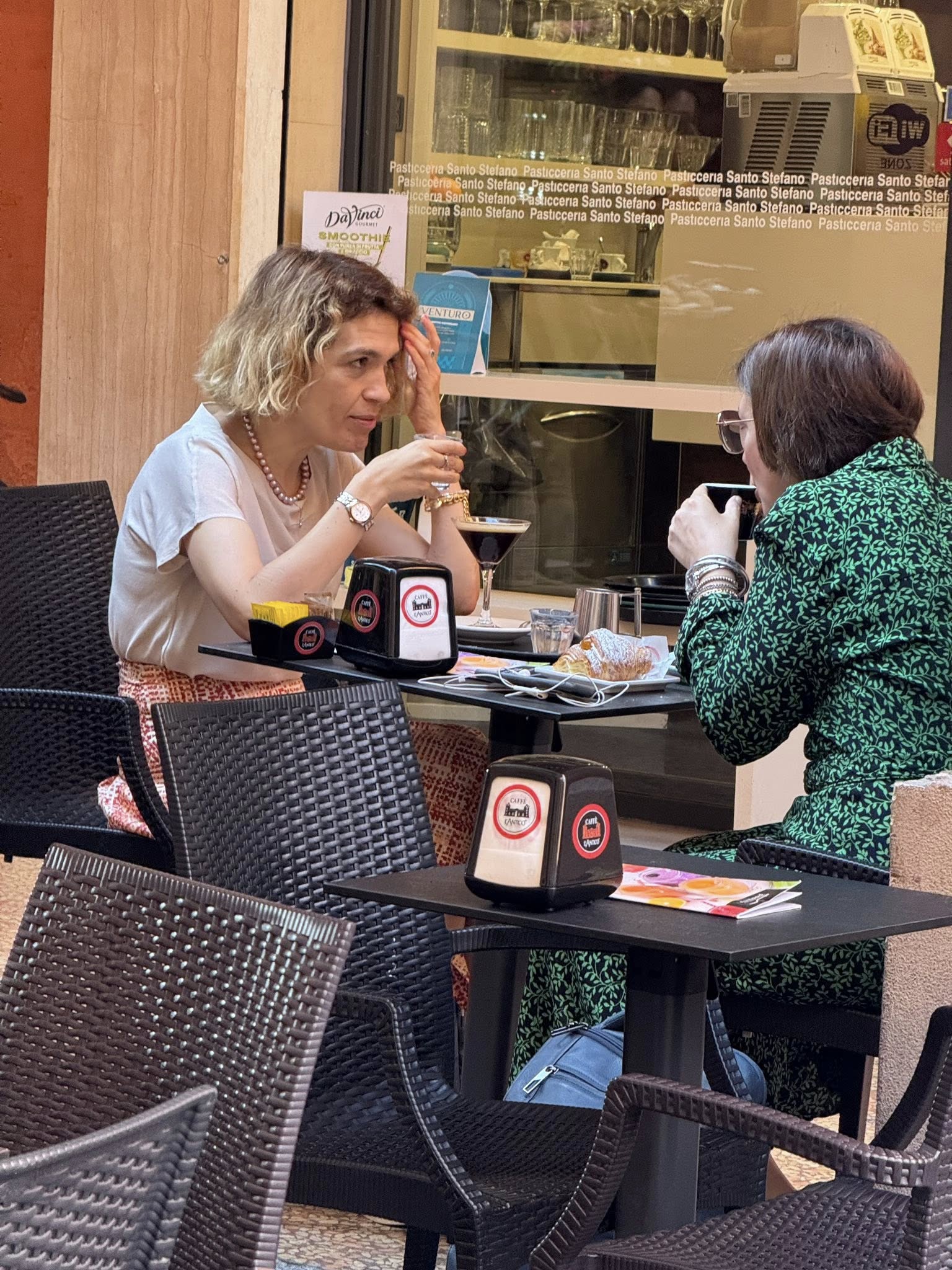
8:22 am…time for an espresso martini!
We took a three-day pasta-making class before we left Bologna at Vecchia Scuola Bologna (VSB). This was serious stuff! The owner of the school, Alessandra Spisni, learned the art of Sfoglia (traditional hand-rolled pasta) as a child at her grandmother’s knee. She wanted to be an astronaut but the kitchen calling was louder. She started the school in 1993 in an effort to preserve this traditional art of pasta-making and is now a famous television personality! Her methods are magical and we have to hurry home and order the necessary equipment (a large beech wood board and a beech matarello, the special rolling pin) so we don’t forget how! Like ballet, there’s a first position, second position and third position in the rolling.
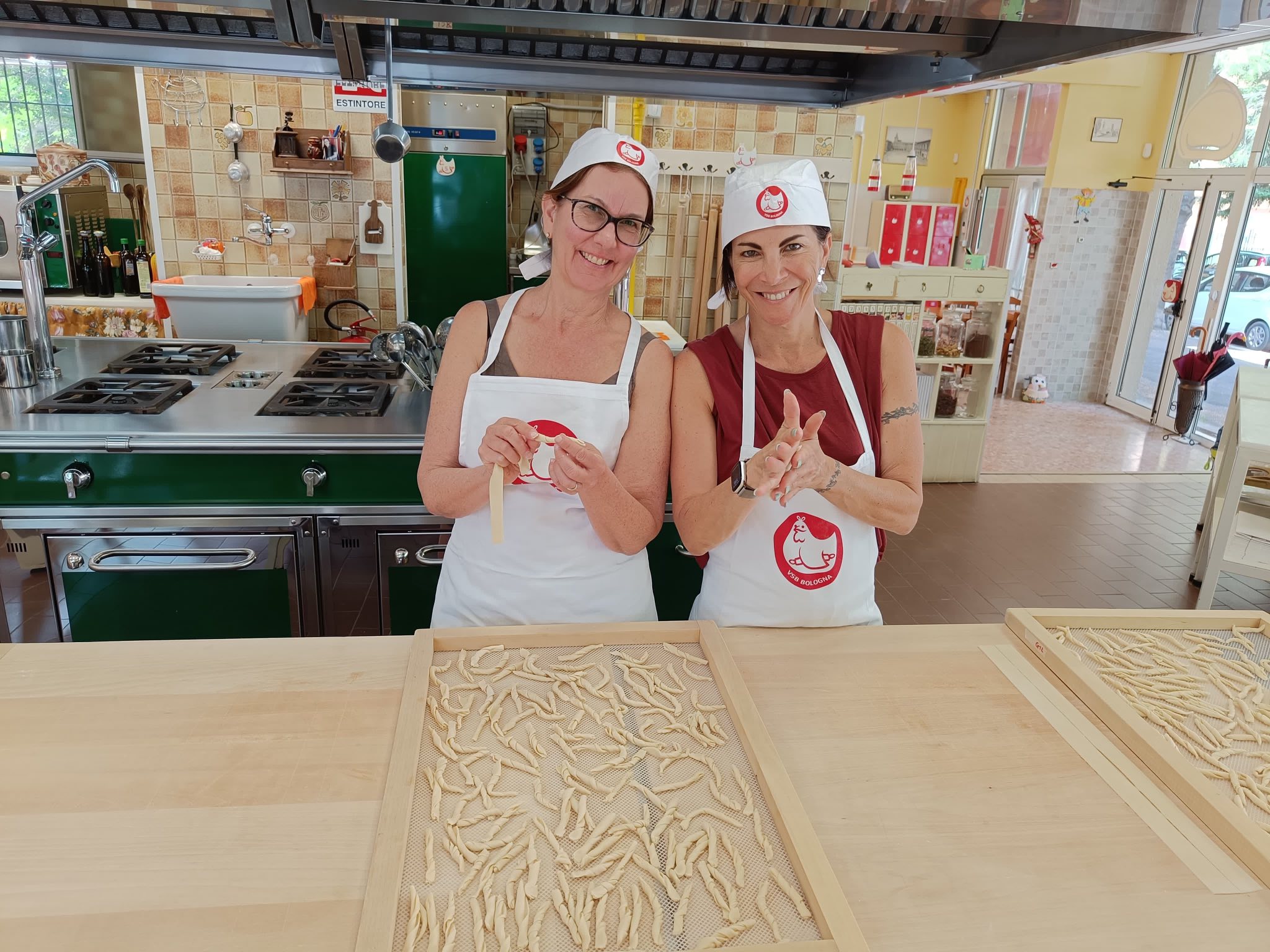
Here we are making Strozzapreti (literally “strangle the priests”). The story goes that in the old days, the priests would make their rounds in the community and end up at the best cooks homes right around lunchtime. Of course they had to be invited in for lunch. This regular occurrence got a bit old after a while so the women had a great idea. They created this pasta shape and when the priest came by at lunchtime, they were offered strozzapreti, which they politely declined!
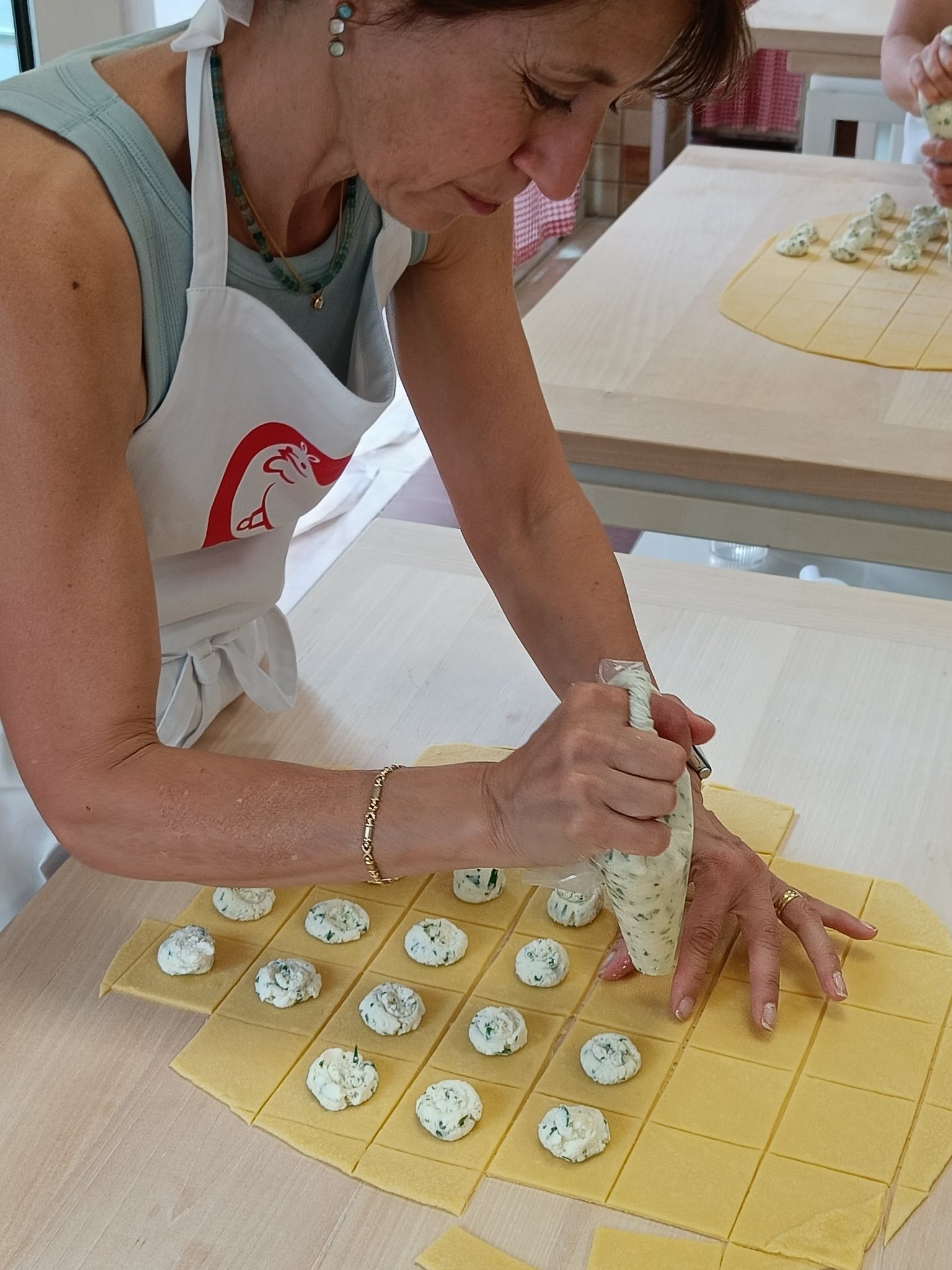
Filling the tortelloni (big tortellini) with ricotta and parsley.
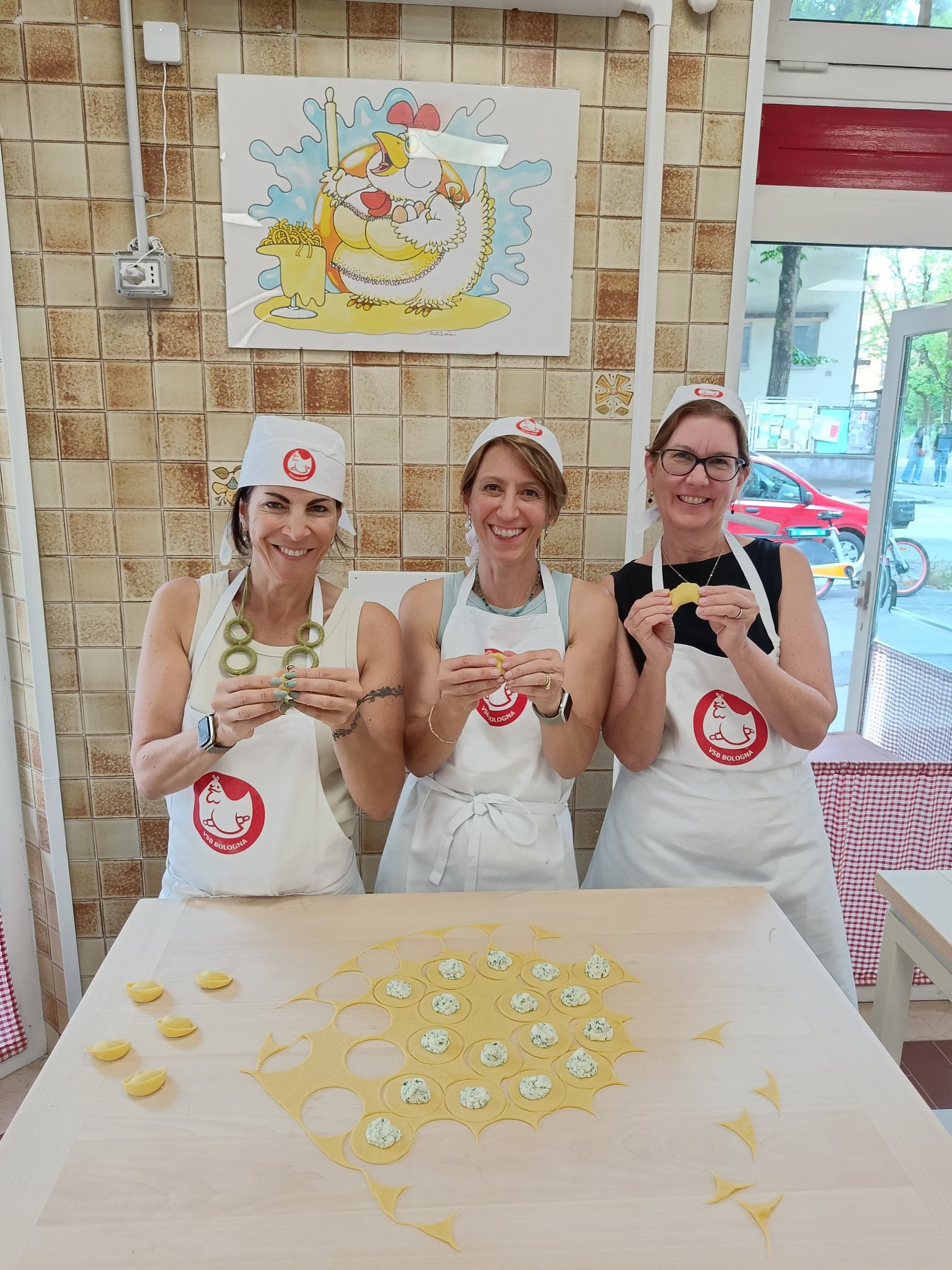
Making our tortelli tondi stuffed with ricotta and spinach.
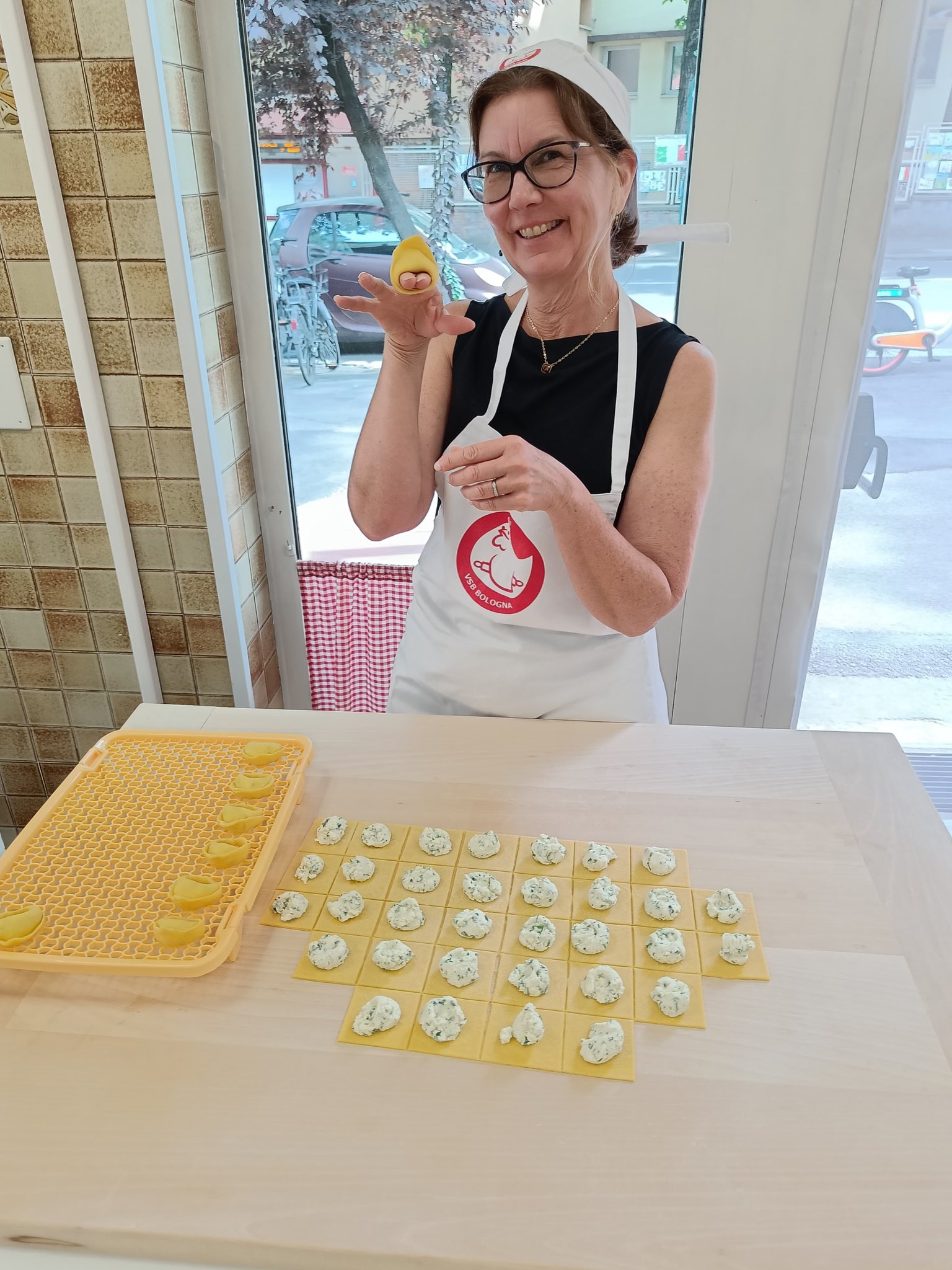
Perfect tortelloni!
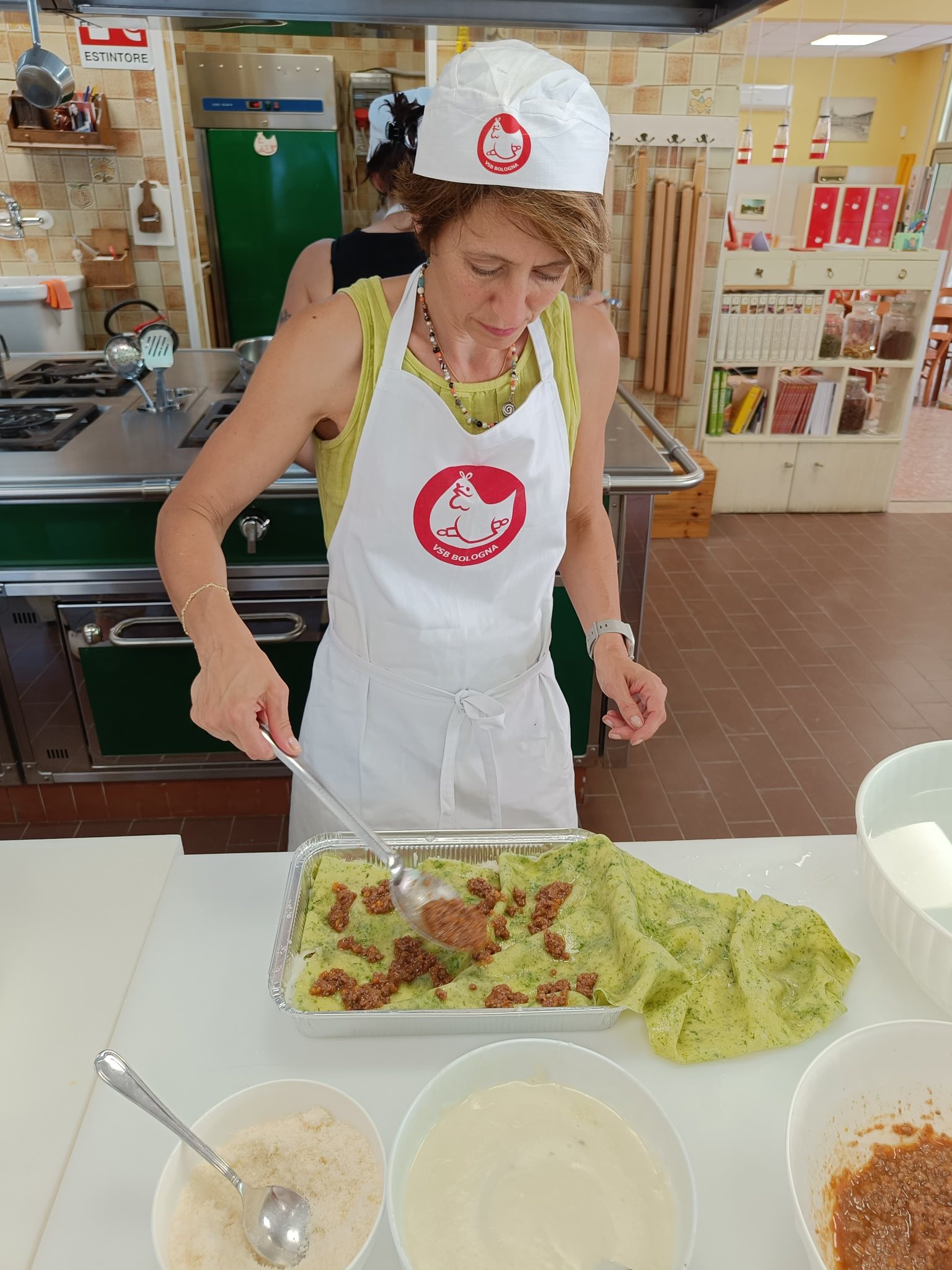
Our last day, we made lasagna. The spinach sfoglia, the ragù, the béchamel. Amazing!
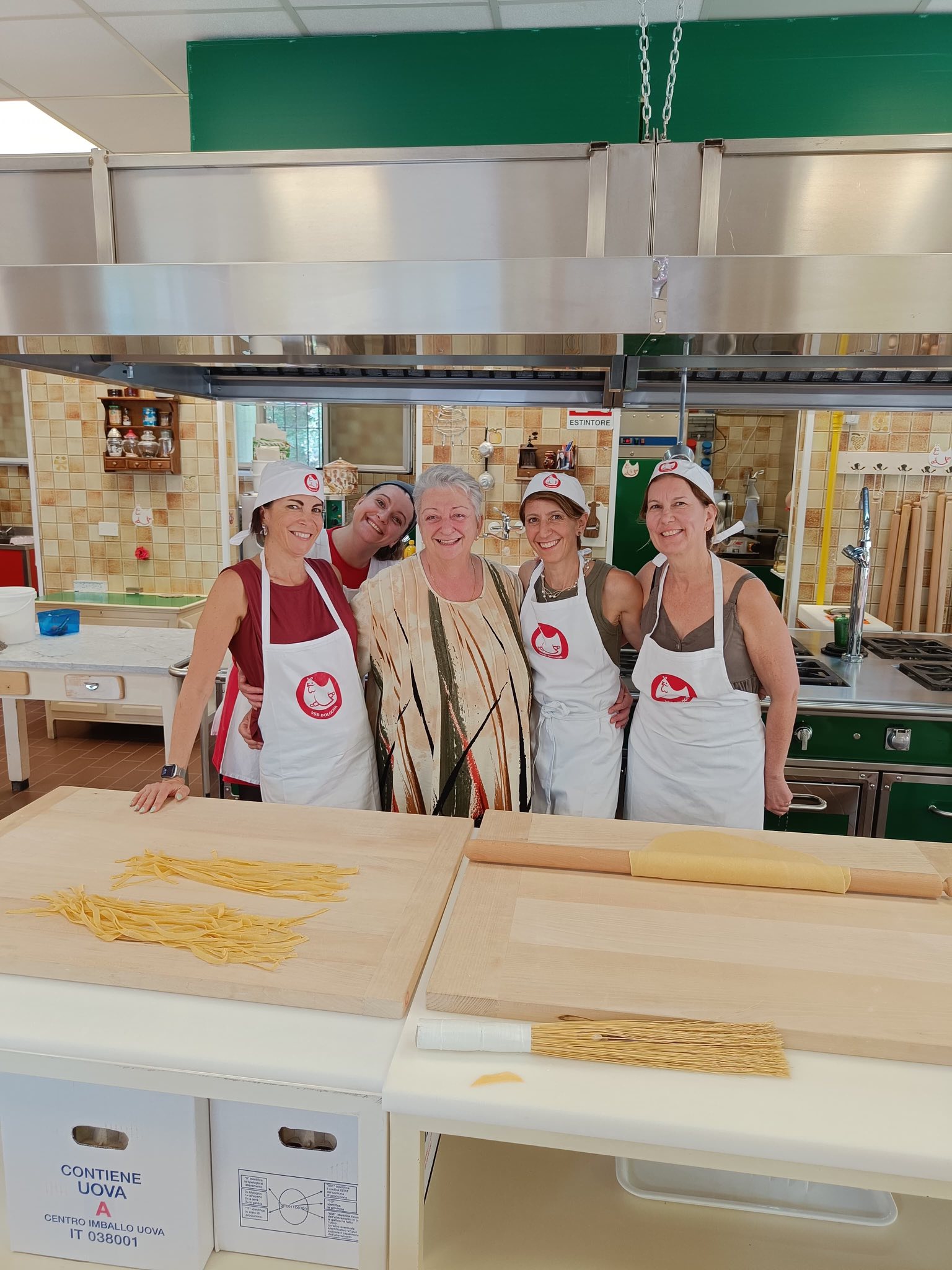
With our teachers!
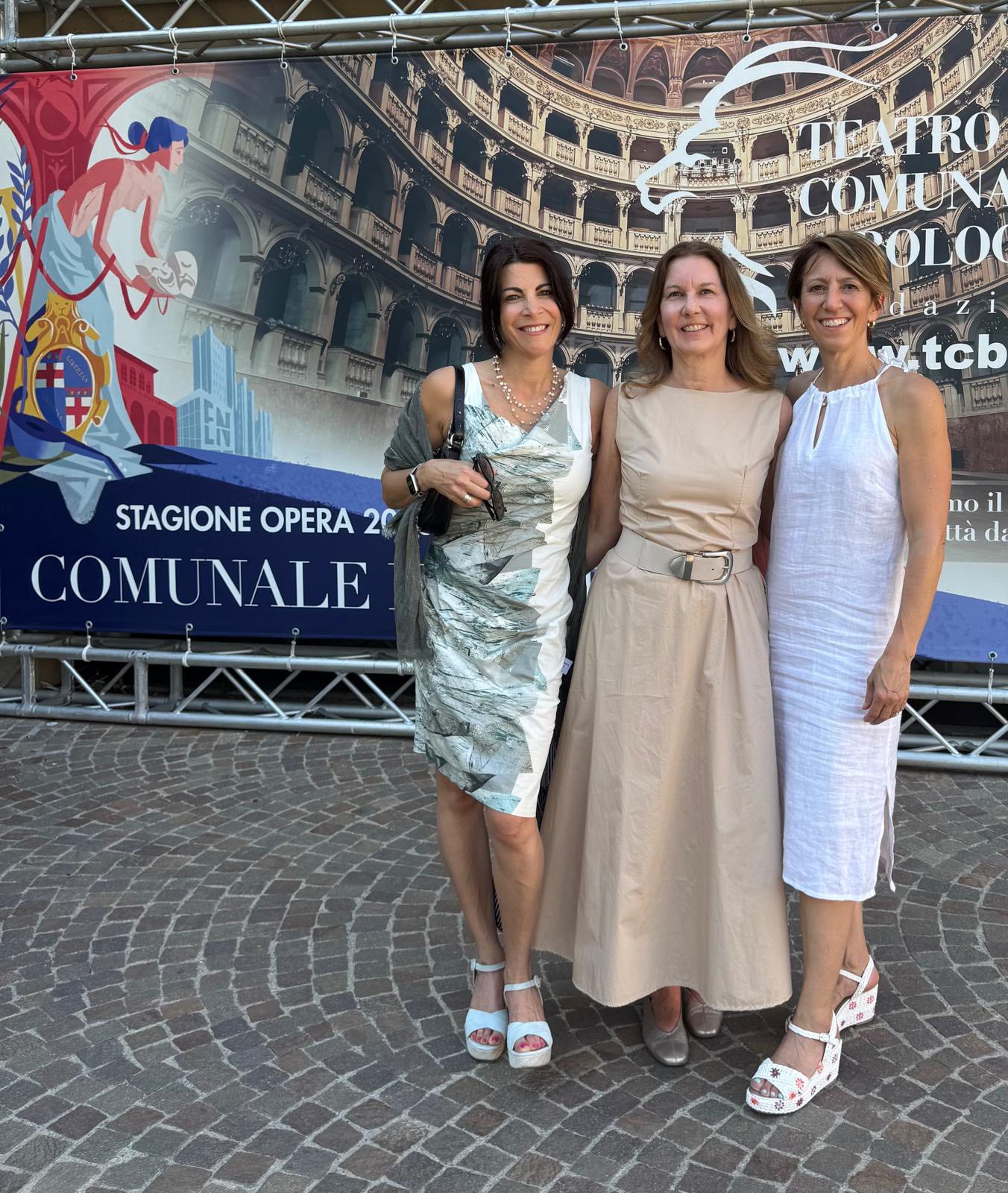
Our last night in Bologna we dressed up and went to the opera! Così Fan Tutte. This is my second opera experience (first was Madama Butterfly in Sydney) and I have to say both of these were about men controlling and taking advantage of women…time for an opera story reboot!
After the opera, we decided to leave our unobtrusive mark on our home away from home…
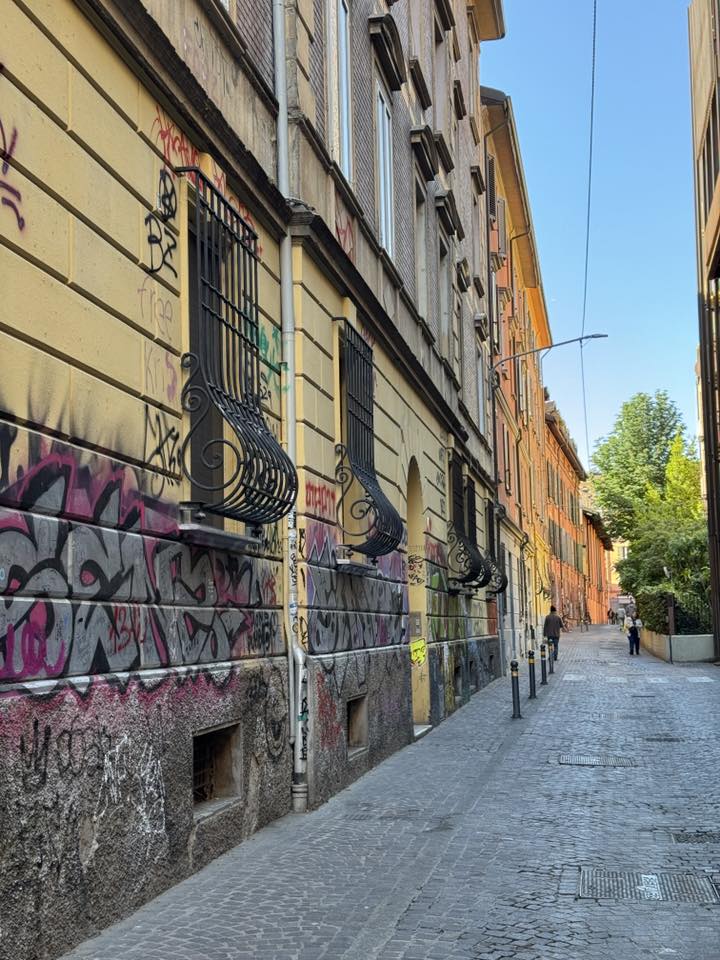
This is the front of our apartment building. Our addition on the wall definitely got lost in the abundance of the existing graffiti
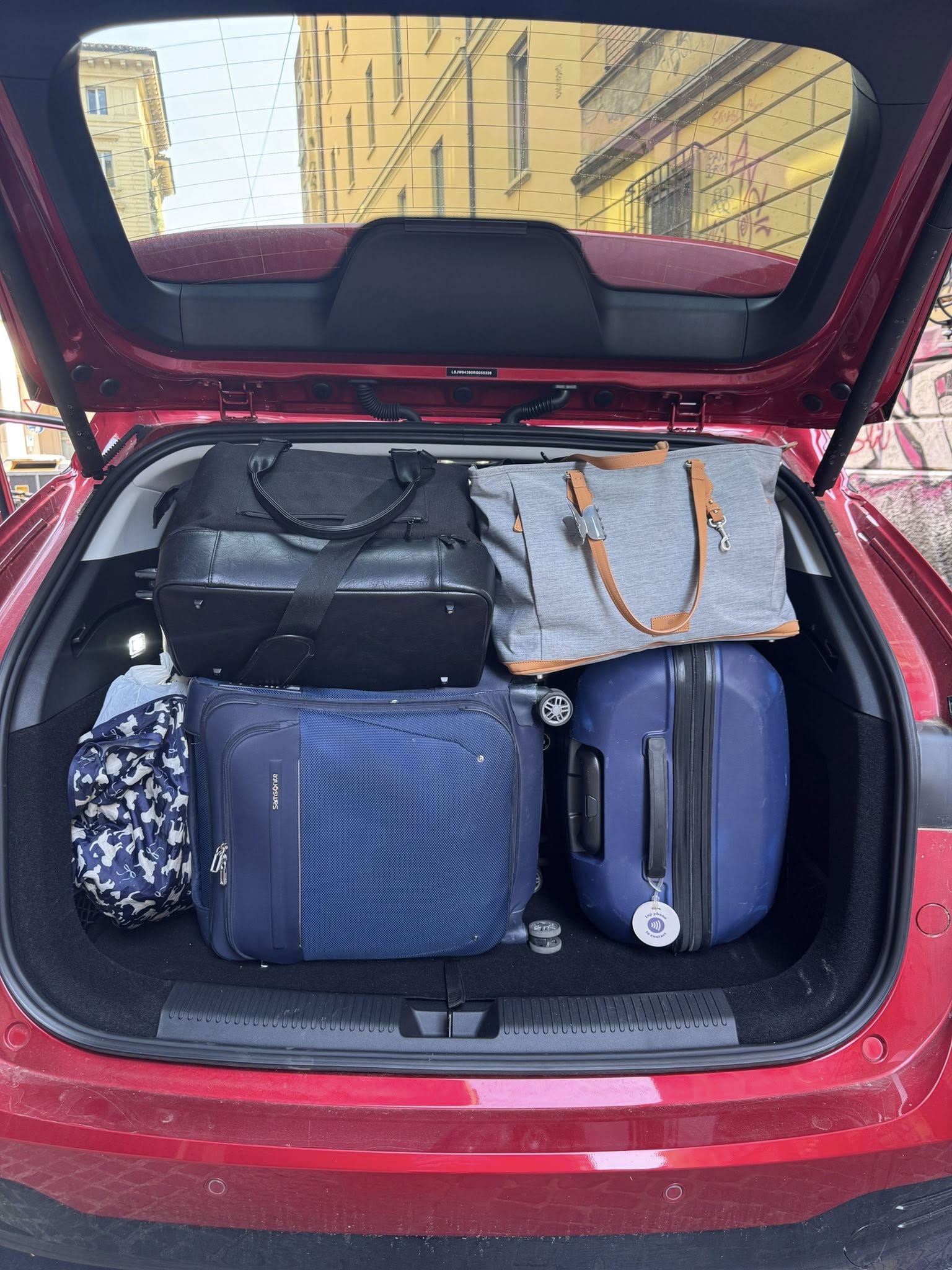
After our final night's artistic escapades, we quickly packed up and got out of town before we got caught!
But…it wasn’t as simple as it should have been…It’s a long and sordid tale…
We booked a train for the three of us to Foligno, our next stop. Then we decided to rent a car as we have: a) a fair bit of luggage to manoeuvre through a change of train with only 7 minutes and b) we acquired a lot of wine for the villa week at the tastings we did last weekend in Piemonte. That’s a lot of added weight and volume to carry. So we cancelled our train tickets and rented a car from Europcar (same company (but different location) we rented from the first weekend when we did our first road trip). We went to the location to see if we could see the car to make sure it would be big enough (we couldn’t). But what blindsided us was we were going to be refused the car. Turns out there is a little known rule in Italy that if you’re not an EU resident, you must have an international driving license. None of us did. Needless to say, not only have we already rented twice in Italy this trip but many times in the past without ever having been asked for an IDP ($25 by the way at CAA, good for a year). So, we crossed our fingers and found another car rental company, hoping they wouldn’t be such rule sticklers… As you can see, we dodged the bullet and got a car!
May, 2026
Before closing off this season's Italian sojourn, I need to loop back to my two weeks in Bologna to share a few special moments and something new!
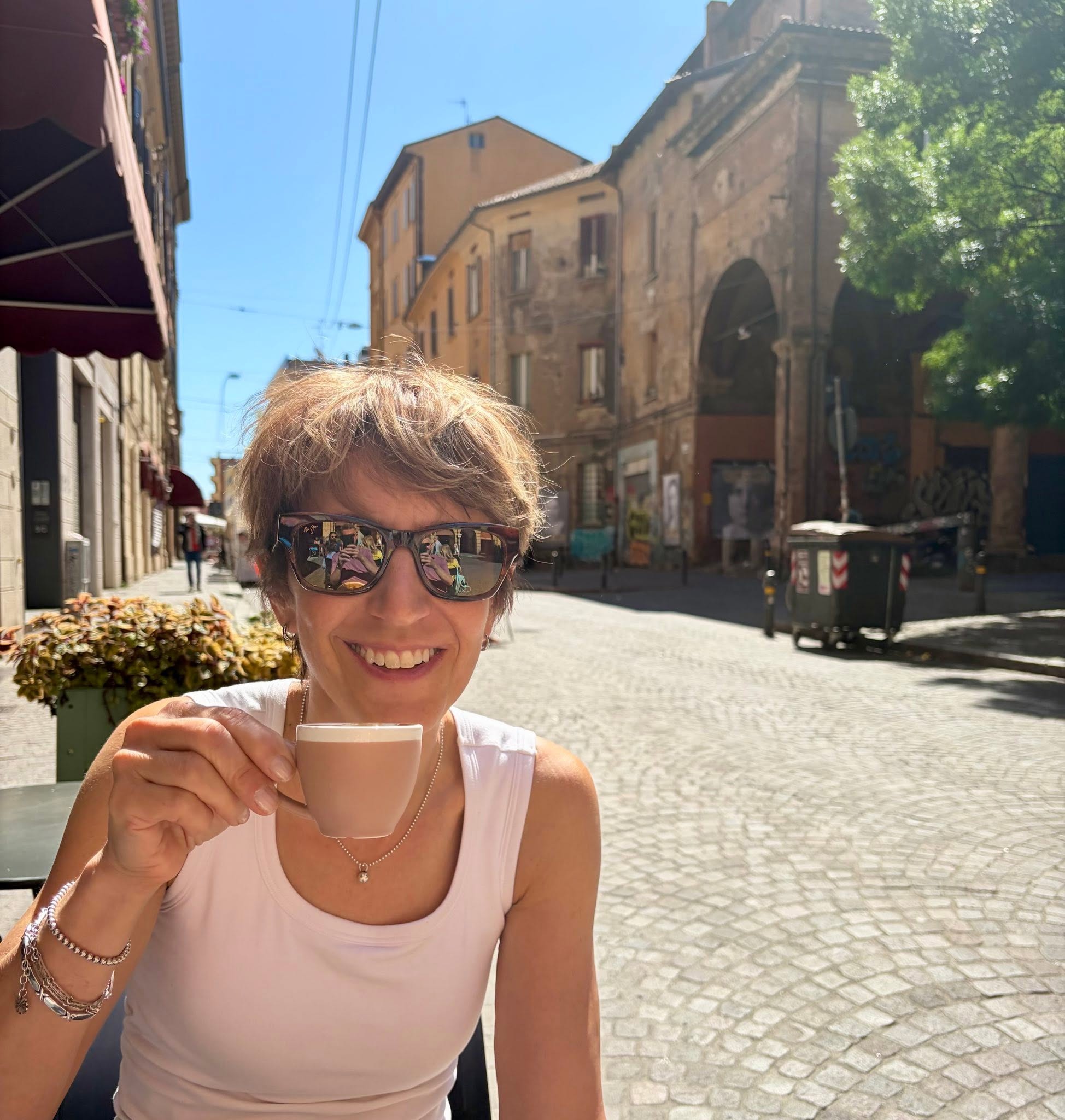
Aah, it's good to be back!
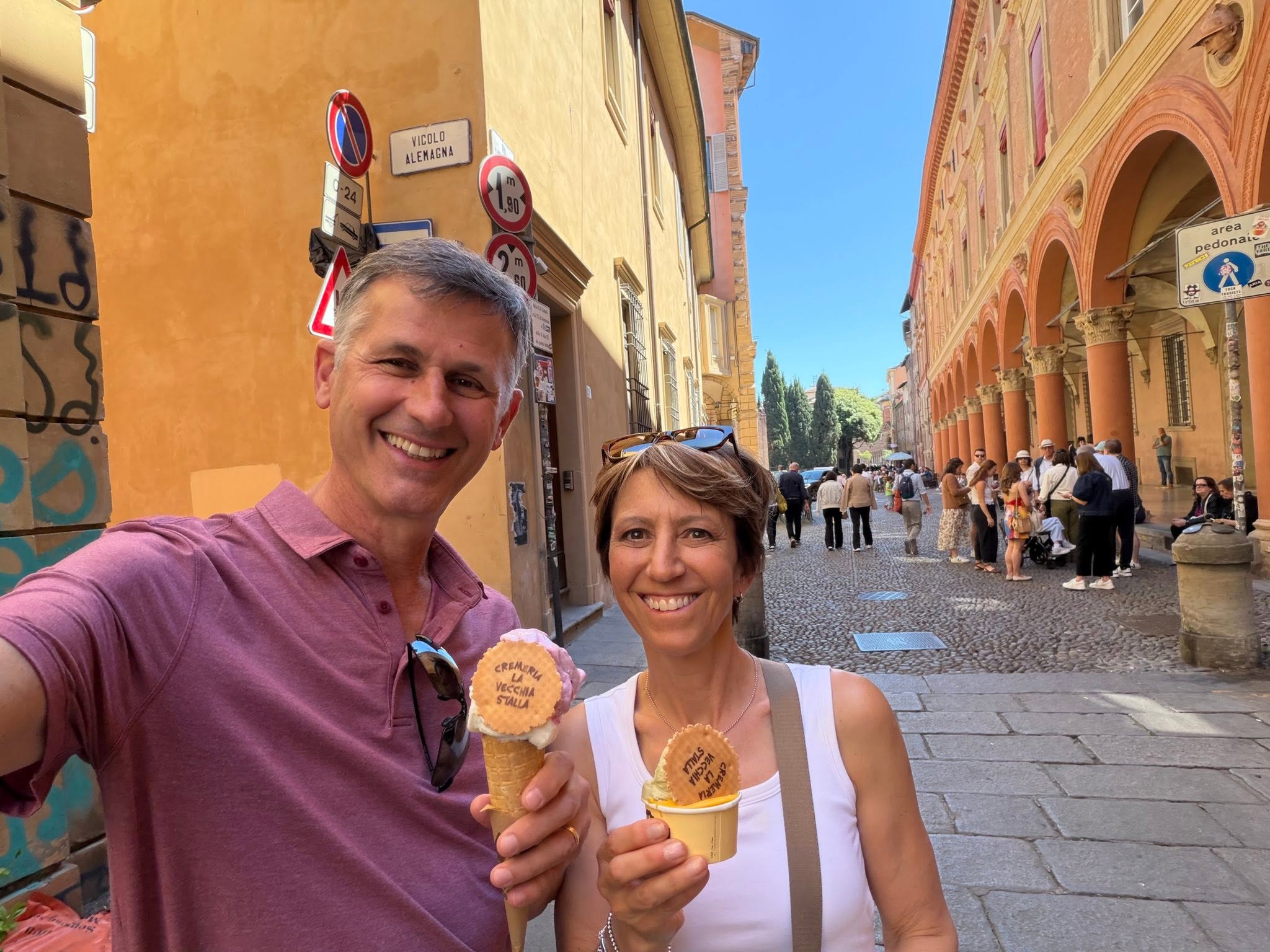
Day 1, first gelato and a commitment on Adam's part to have at least one gelato per day. Yes, it's just that good!
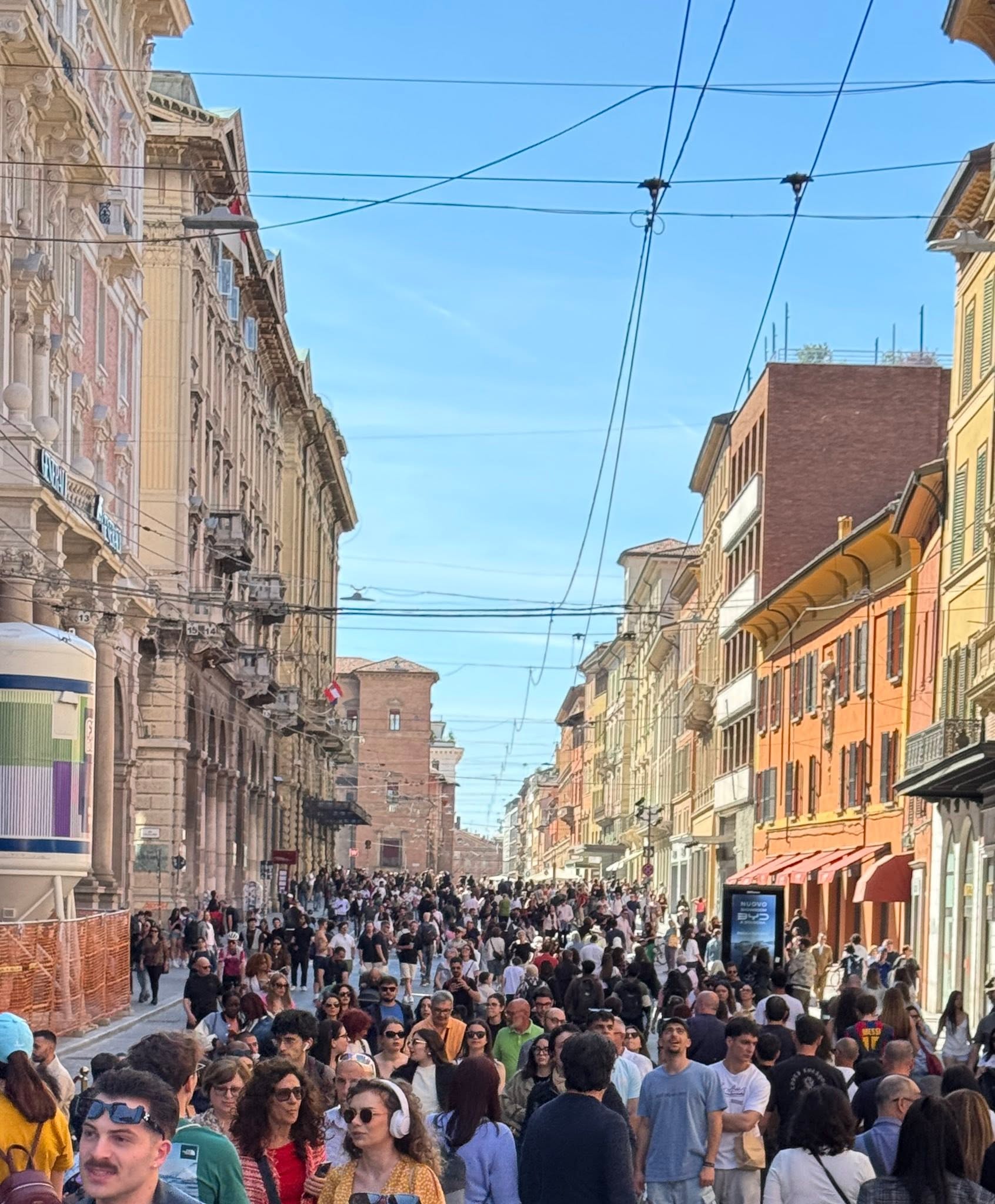
We were shocked at the crowds in Bologna when we arrived. It was nothing like this last year. Did every influencer out there tell everyone that Bologna was the place to be? Actually no...we found out it was a long weekend!
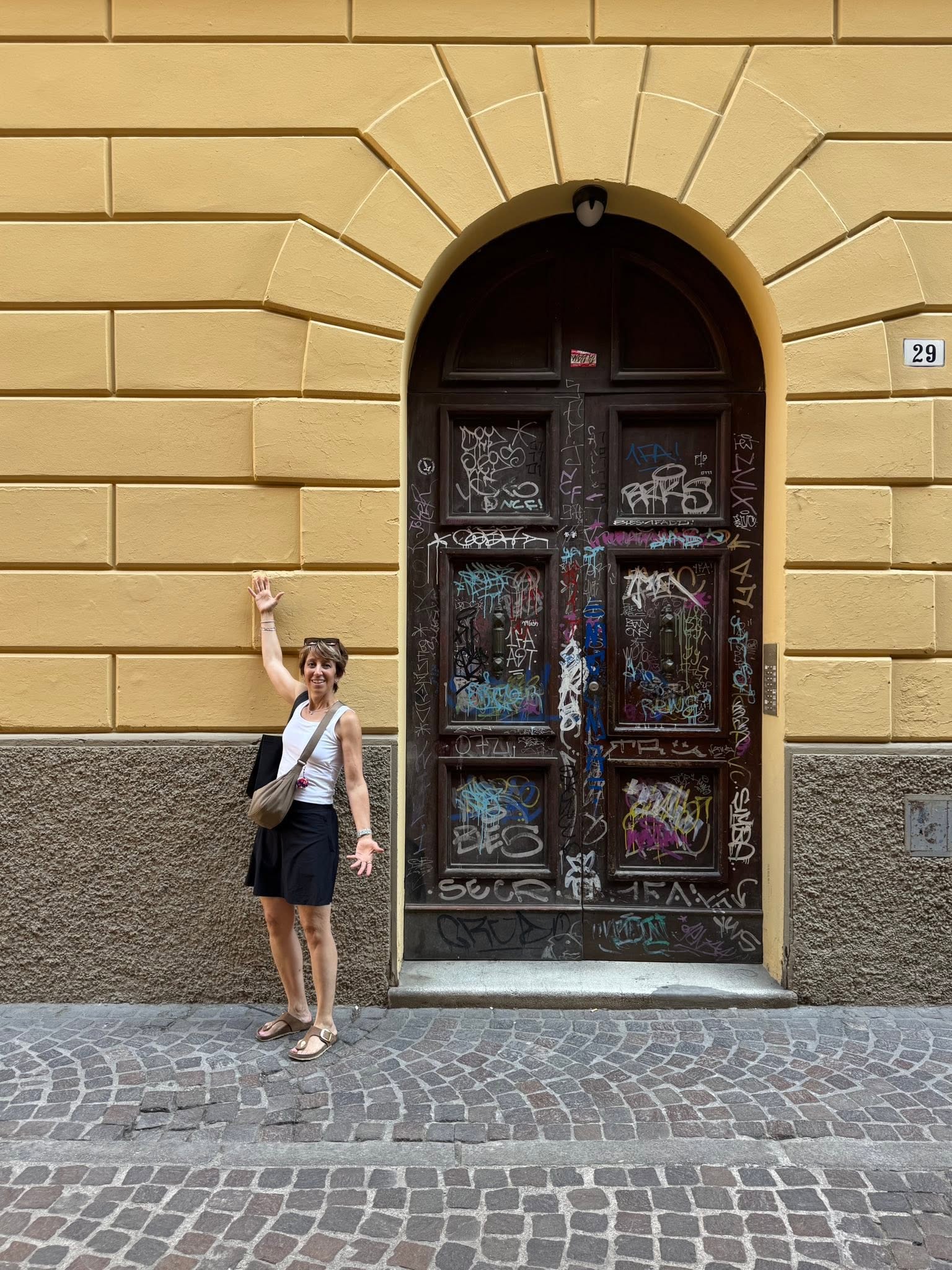
I went back to the apartment we stayed at last year to show Adam our addition to the graffiti that covered the walls as high as a tall person can reach. I was surprised to see the building's been freshly painted...except for the door. Our legacy will just have to live in our memories.
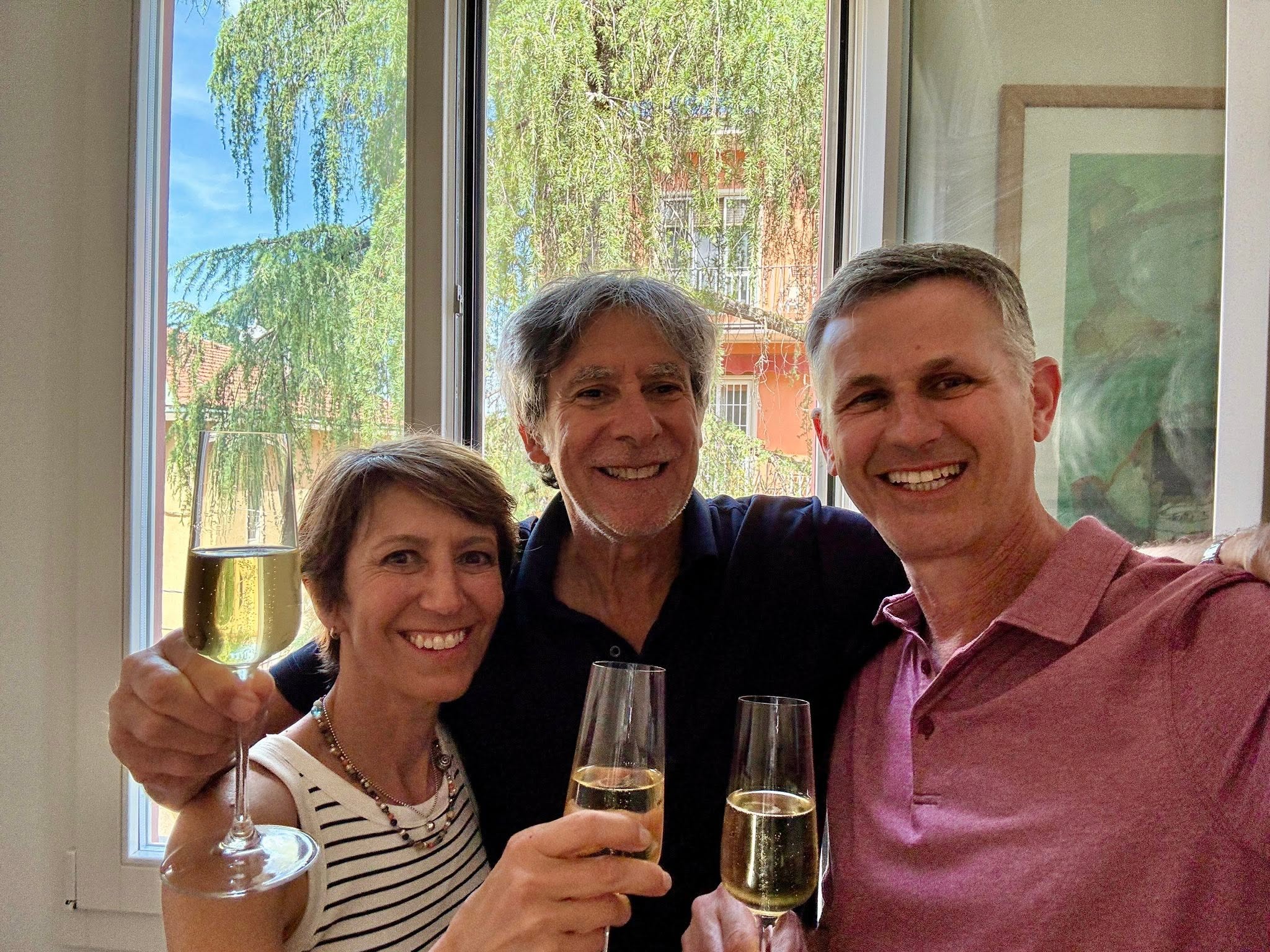
So happy to see our friend Fabio again!
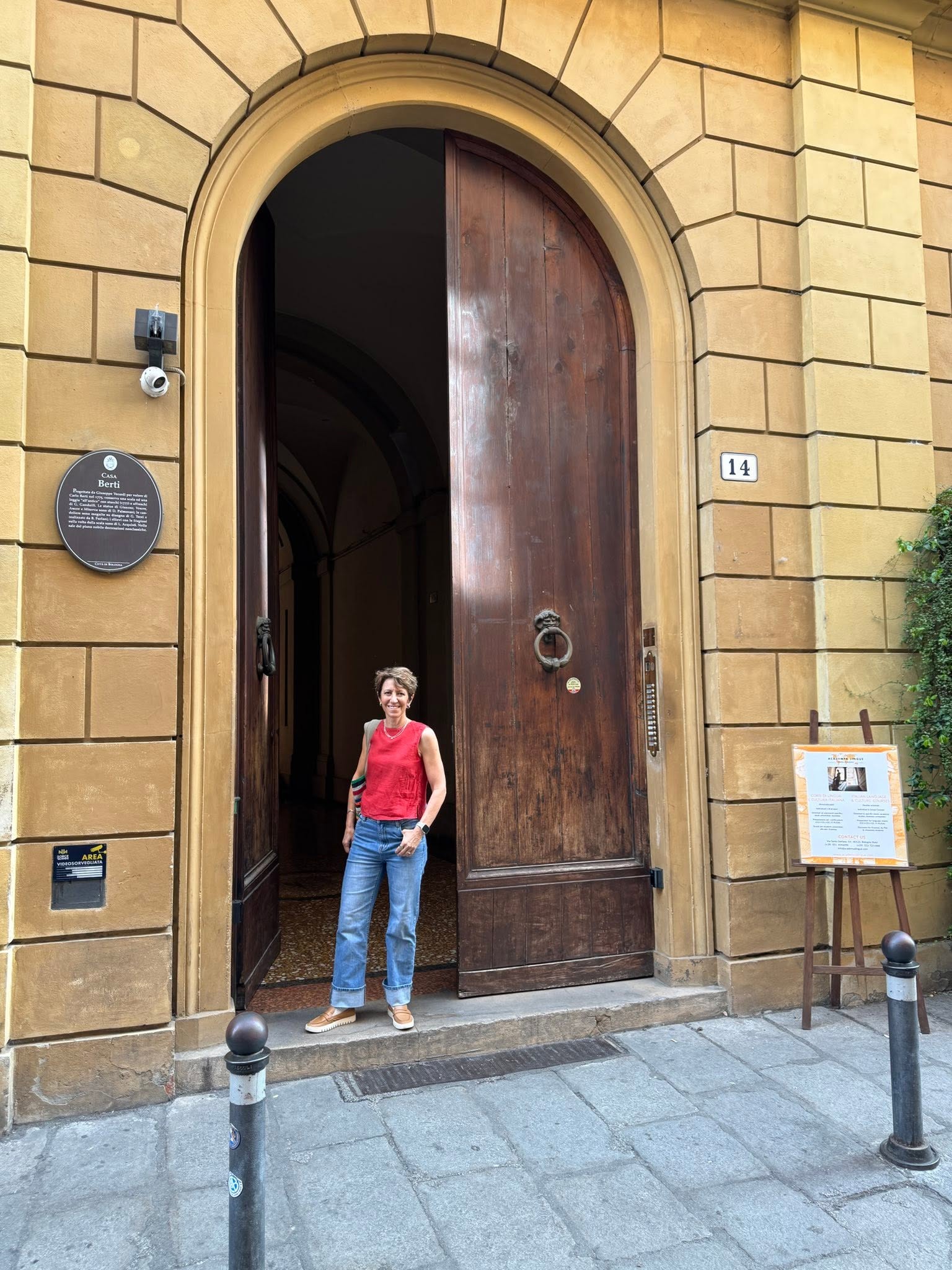
First day of school! When I was 13 I lived in Brussels for a year and went to the local school around the corner. I distinctly remember feeling tiny standing next to the massive entry doors to the school. I've grown since then but the doors are still enormous.
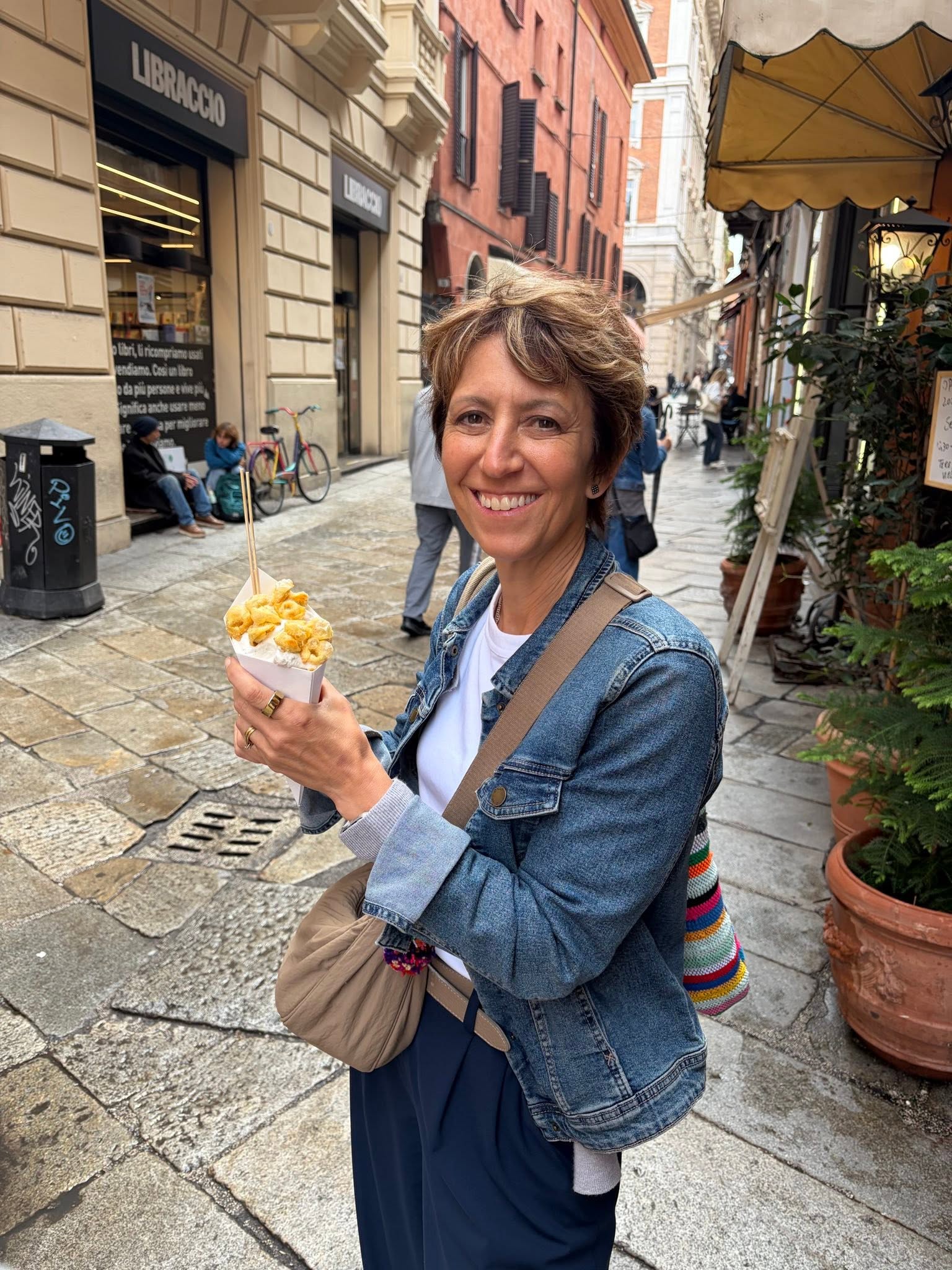
I don't recall seeing Bolognese street food last time so I had to partake! Deep fried tortellini with Parmesan cream. Glad I tried it but for me it's a one and done.
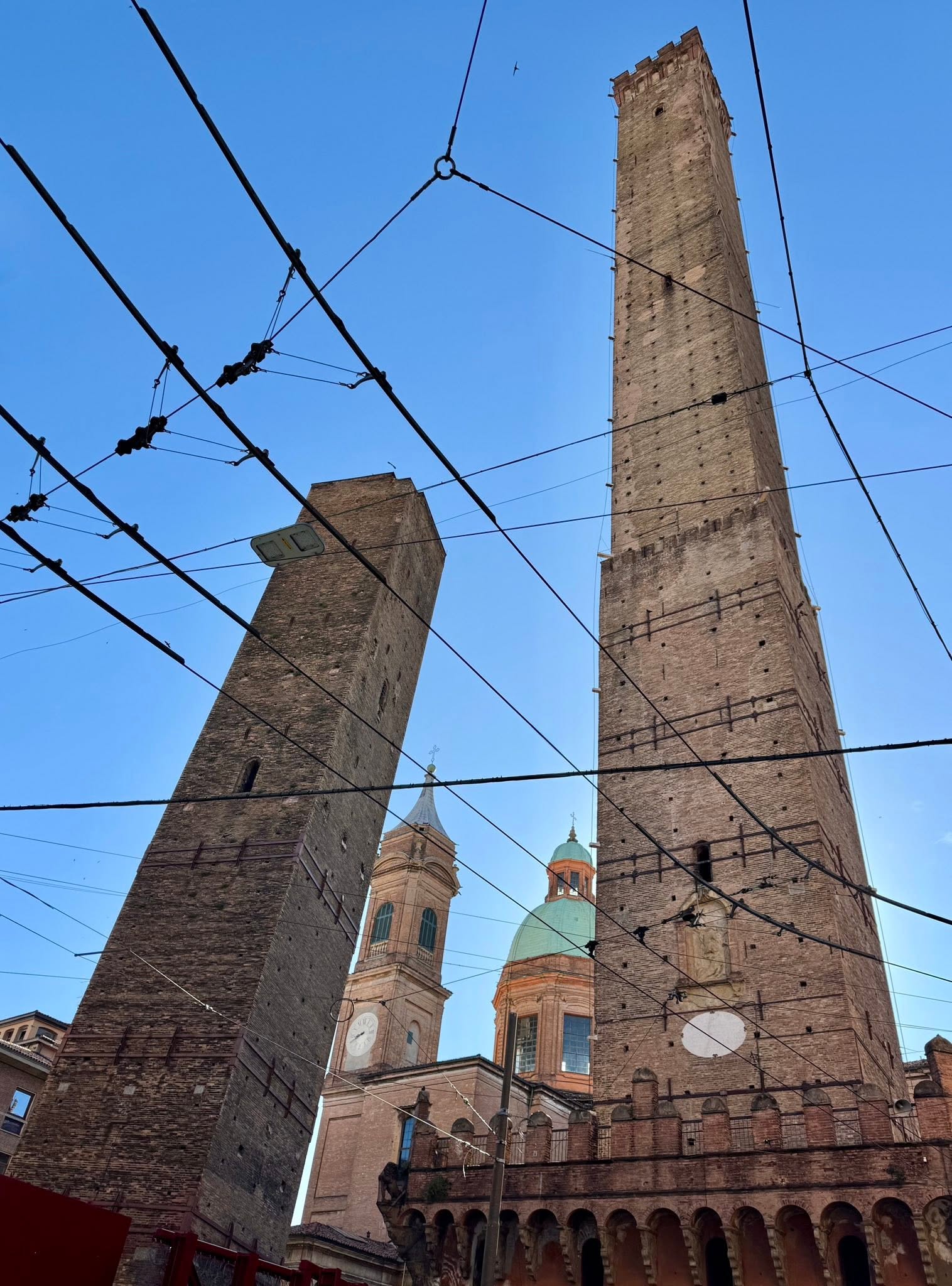
Bologna's famous towers, right in the middle of the action! If the leaning tower tips over, will these wires hold it up?
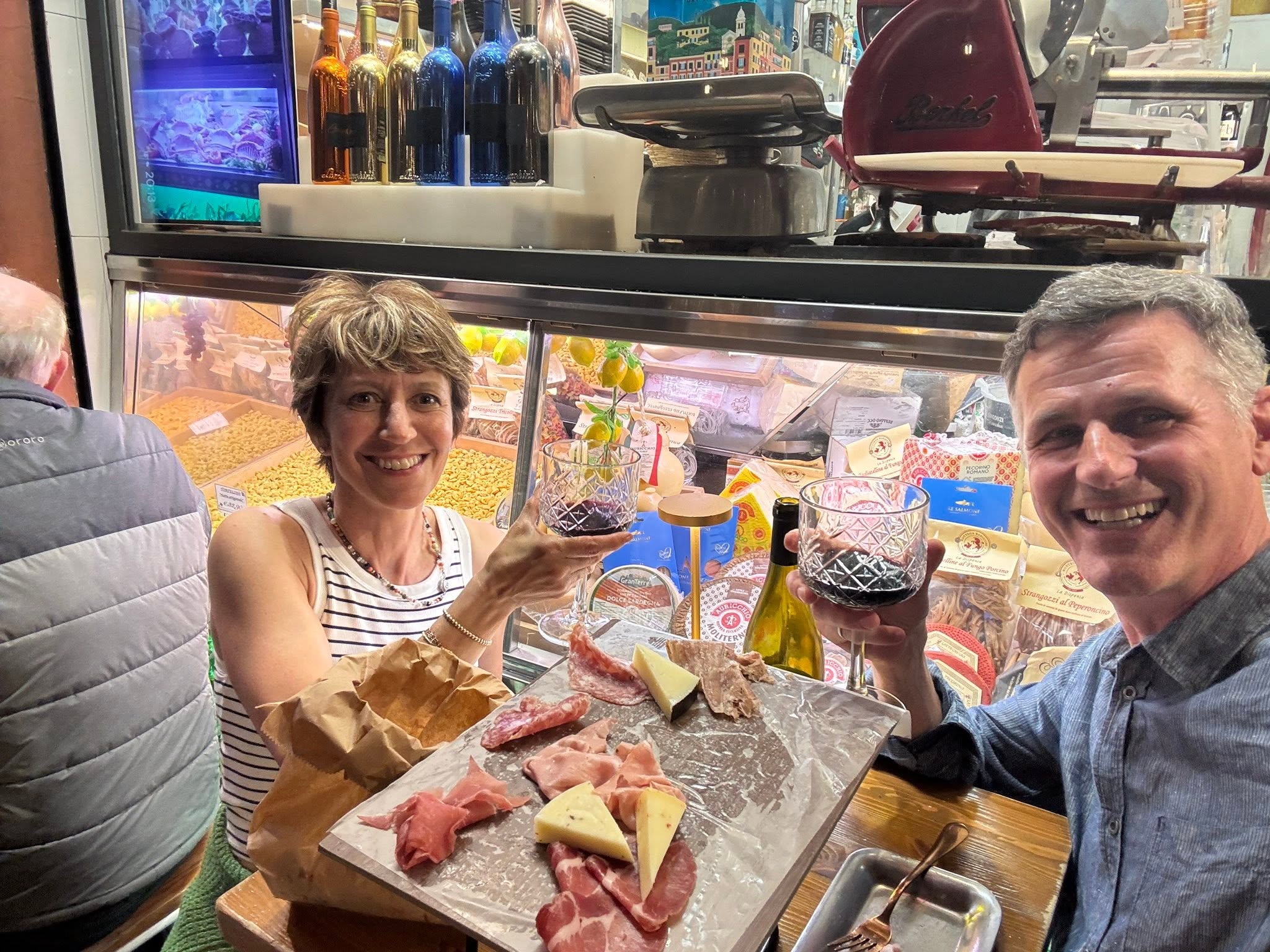
Four years ago, at this very restaurant, at this very table, with this very husband I decided I wanted to come back to Bologna to learn Italian. And here I am, for the second time! Such kismet to arrive and be seated at the same table .
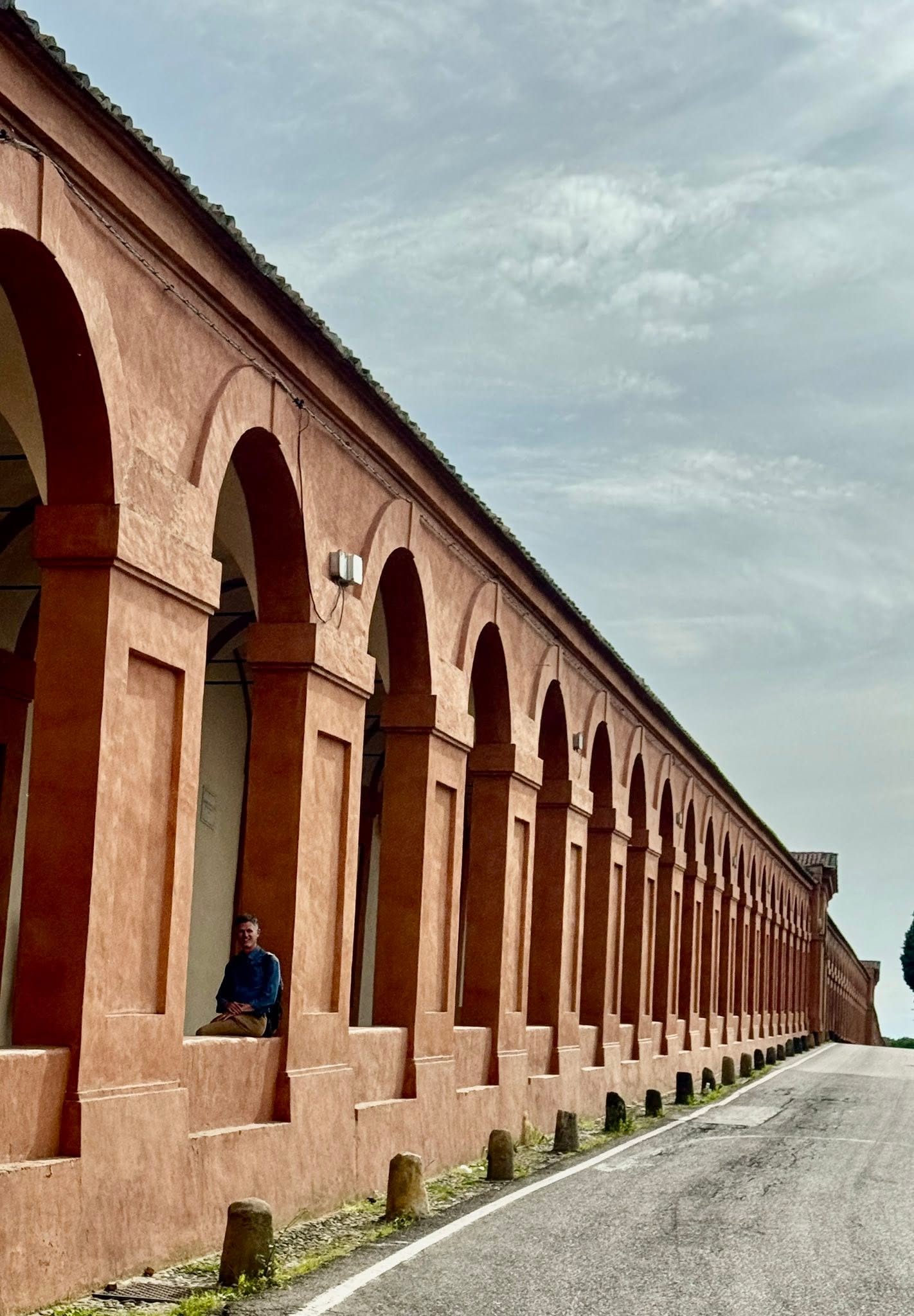
Back to the longest portico in the world that climbs 300m to the Sanctuary of San Luca that sits on top of the Colle della Guardia, the hill overlooking Bologna. Last time we were here, we didn't go into the Sanctuary and, as a result, I didn't discover the story of this place. Now I know and you will too!
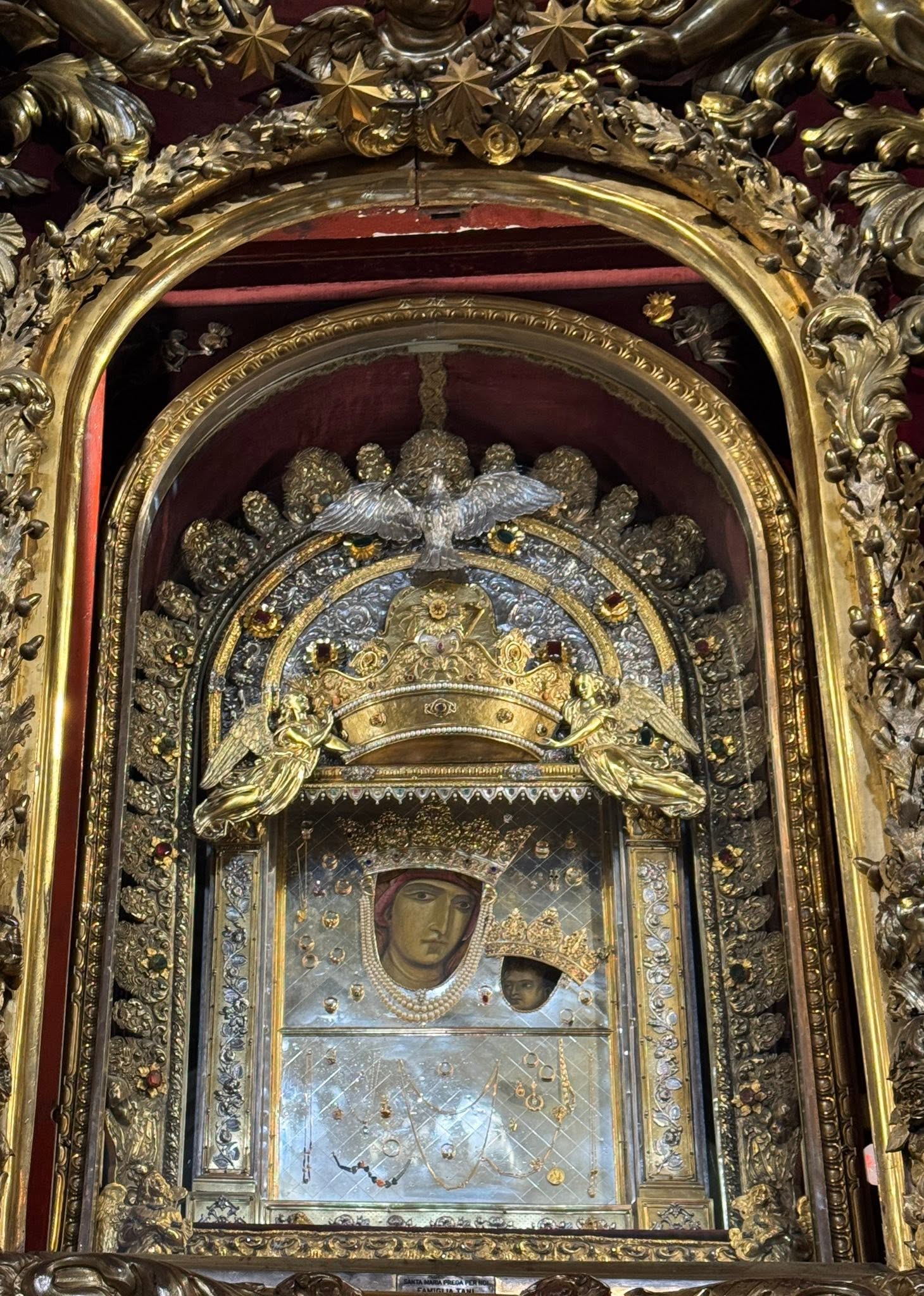
The Sanctuary was built to house and safeguard a very special Byzantine icon of the Virgin Mary. Legend has it that in 1160, a Greek pilgrim named Teocle Kmynia was given a painting of the Madonna and Child (believed to have been painted by Saint Luke the Evangelist himself!) in the church of Santa Sofia in Constantinople. An inscription on the canvas instructed him to bring it to a church on the Colle della Guardia in Bologna. You can only see her and her child's faces because deeply venerated icons, especially in the Byzantine times, were covered with a gold or silver riza (or revetment) to protect it but also made her look crowned and robes like a queen, making sure everyone knew she was special.
You'll also notice jewellery hanging from the silver riza. These are offerings left in gratitude for answered prayers or miracles. A huge blow to the city just happened a few months ago. Someone broke into the church in February of this year, broke the glass protecting the icon and stole some of the jewellery. Luckily, the precious icon and the riza were not touched. The monetary value of the theft was pretty insignificant; it was all about the spiritual value and loss of personal hopes, wishes and dreams.
Not only did the Madonna answer the prayers of generations of Bolognese individuals, she also performed a huge miracle for the city. In July 1433, the rains wouldn't stop and the entire harvest was at risk. A scholar named Graziolo Accarisi was aware that the Florentines turned to their Madonna of Impruneta in times of crisis and remembered that Bologna has its own Madonna who may be able to provide divine assistance. So the procession from her hilltop home began and, miracle of miracles, when she got to the city gates, the clouds thinned and a ray of sun burst through and the year's harvest was saved! So thrilled was the city's government that they decreed an annual procession of the Madonna in perpetuity. Perpetuity lasted intact and for 43 years the Madonna came down from hills in July. Then, the Lord of Bologna changed the date to May to not interfere with the July harvest and let the farmers come. After all, it was their harvest saved back in 1433!
Ironically, locals tell me, every time the Madonna comes for her week of city time, it rains! She who came to stop the rain brings it back with her whenever she comes to town!
So May it remains and the annual descent happened while we were there. The Madonna comes down from her country home in the hills to her city pied-à-terre at the Cathedral of San Pietro. She stays for a week and there are lots of extra masses and prayers and swag for sale at the door.
Every Wednesday of her city stay, the Madonna takes a stroll from the Cathedral of San Pietro to the Basilica of San Petronio here in the background, and then brought out onto the steps of Piazza Maggiore at precisely 18:00 when Cardinal Archbishop Zuppi formally asks her to bless Bologna from its central public square. The fact that it happens outside on the steps of San Petronio rather than inside the church is significant too. Madonna gets to be part of the city itself, not just presiding over a religious space.
It just so happened that I had my Italian language chit chat session with a local volunteer in the Sala Borsa library in Piazza Maggiore at that time so I caught the parade.
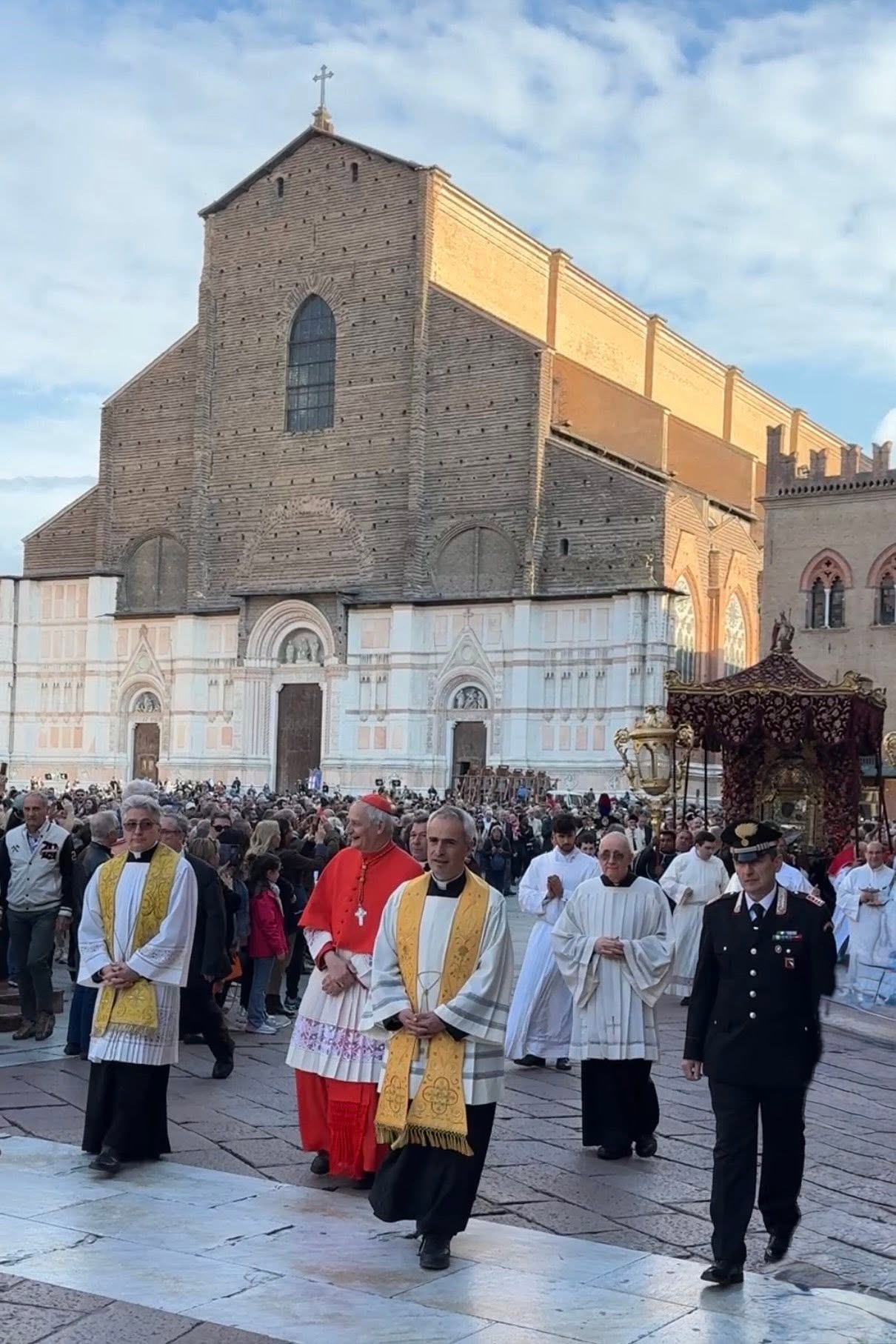
Cardinal Archbishop Zuppi is the smiling fellow in red.
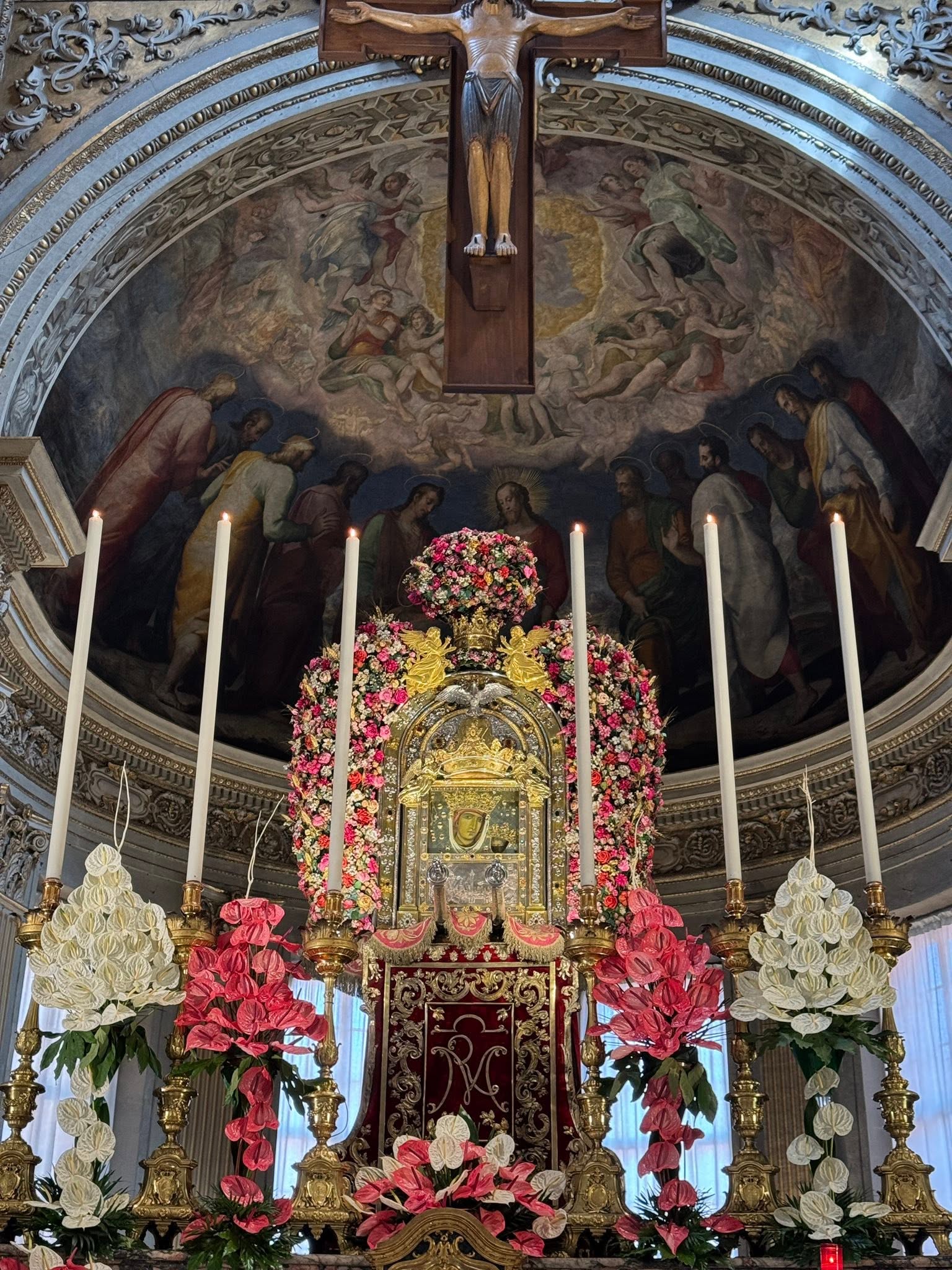
And here she is, nicely set up with fresh flowers for her in-person work week in the city. No rest for the weary